During this National Day holiday, the “famous scene” of new energy vehicles queuing up for charging in the expressway service area was staged again. According to CCTV News, on the first day of the National Day holiday, the number of new energy vehicles is expected to reach 17.8 million. The Ministry of Transport reminds that there is heavy traffic flow on key highways and service areas leading to popular scenic spots, and charging demand is relatively concentrated, especially after 10 o’clock every day.
In fact, many new energy vehicles encountered queues for charging in high-speed service areas on September 30. “There were 26 numbers in front of me, and 30 minutes later there were more than 20 cars behind me.” On the afternoon of September 30, a car owner who was queuing up to charge at the Buga service area in Qujing City, Yunnan, recorded the “long queue” in front of him with his mobile phone. On that day, the car owner went to four service areas looking for charging piles starting at 2 p.m. Until 5 p.m., the car ran out of power and had no choice but to queue up at the fourth service area. This wait is 3 hours.
Another netizen told the Red Star News reporter that his friend who drove a petrol car and a tram set out at the same time. He encountered a slight traffic jam on the road and the journey took 14 hours. My friend went to the service area to queue up for charging and encountered a traffic jam. The whole journey took a total of 26 hours.
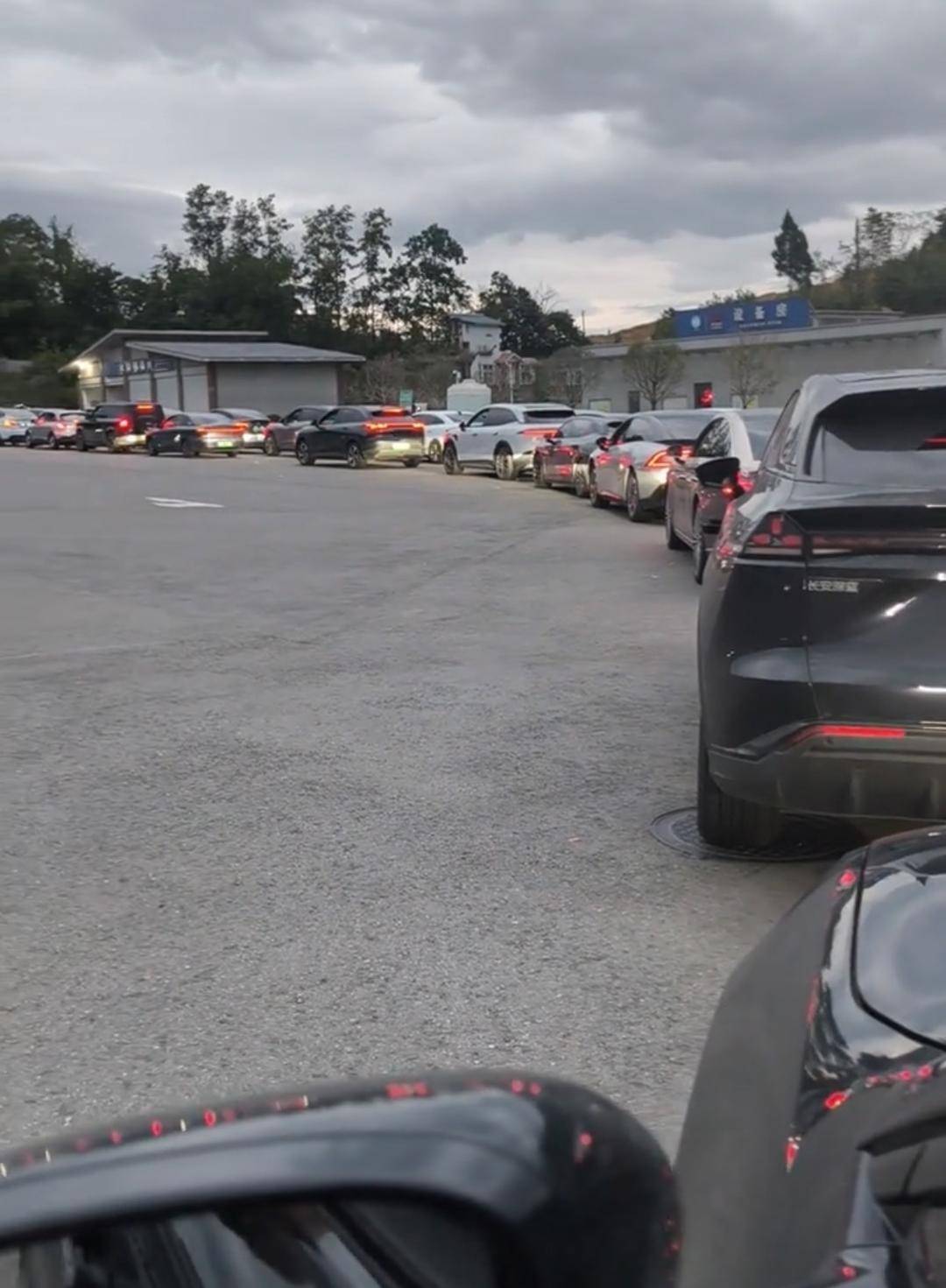
▲Mr. Ge queues up to charge in the service area
9月On the afternoon of the 30th, Mr. Ge set off from Wanyuan, Dazhou, Sichuan, and drove to Gansu. At 5 p.m., he arrived at the Guangyuan Baolun service area. By around 9 p.m., vehicles queuing up had blocked the entrance to the expressway service area, and traffic police rushed to the scene to maintain order.
“I travel every holiday, but I never encounter that kind of situation.” Mr. Ge recalled that he had traveled more than 300 kilometers at that time, and the car’s battery was only 20%. There was still 100 kilometers to the next service area, so he could only wait. Mr. Ge didn’t charge it until around 9:30 p.m., and he queued for about 4.5 hours in total. “The power of the charging piles in the Baolun service area is relatively small. Although it was already limited at the time and you had to leave after charging to 75%, it still took more than half an hour to charge.” Mr. Ge said that after charging, he continued driving to the next service area at about 11 o’clock in the evening. The road two or three kilometers away from the entrance of the service area was full of traffic, and he could not even enter the service area.
Mr. Ge analyzed that the free highway policy had not been implemented on September 30, and many cars stayed in the service area waiting. In addition, the charging piles had limited power and insufficient number. The superposition of multiple factors led to this “charging queue.”
Related Reading
- UAE refuses permission for Israel to send flights to pick up people in Dubai2026-10-03
- The context continues and the chapters are updated with each passing day—2026-10-02
- The National Day box office exceeded 300 million! “Movie+” new gameplay, cultural consumption heats up2026-10-02
- From north to south, from all corners of the country, the most beautiful thing is China Red2026-10-02
- Trump says Iran is ‘ready to fold up’ as he raises possibility of post2026-10-02