New forces reshuffle in September: Xiaopeng and Xiaomi sell for 40,000, Hongmeng Ideal retreats
582
Text | Dingjiao One (dingjiaoone), author | Jin Yufan, editor | Wei Jia
On October 1, new power car companies successively handed over their September report cards.
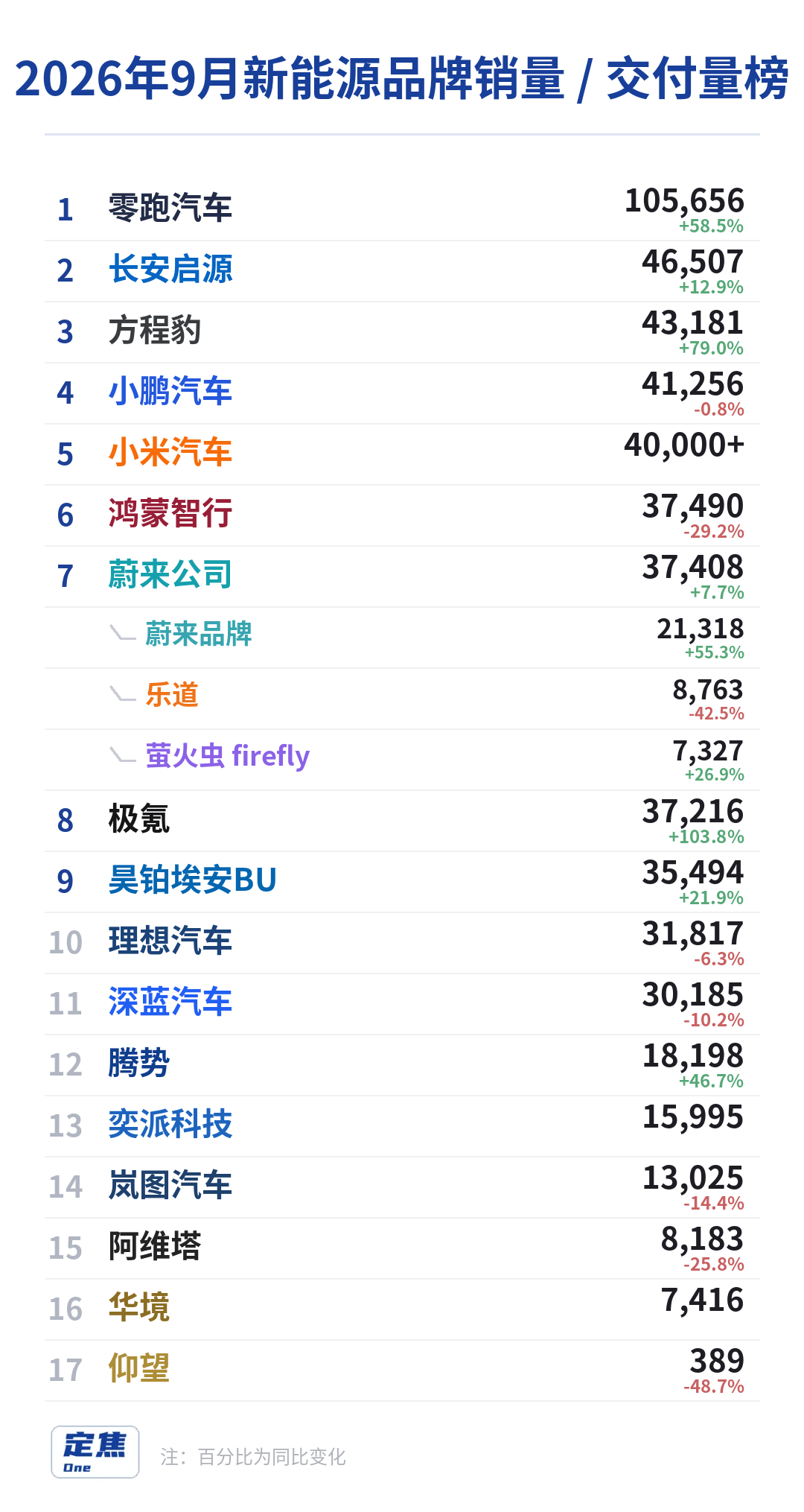
Leapmotor continues to lead the market with 105,656 vehicles, followed by a major reshuffle, with delivery volume concentrated at 30,000 to 40,000 vehicles. Xiaopeng (41,256 units) and Xiaomi (+40,000 units) ranked second and third. There is only 82 vehicles difference between fourth place Hongmeng Zhixing (37,490 vehicles) and fifth place Weilai (37,408 vehicles). Ideal (31,817 vehicles) ranks last among the six companies.
The “Golden Nine” in the traditional sense did not bring about general growth, and the trends of the six companies further diverged. Leipao held the 100,000 mark, Xpeng hit a new high for the year, Xiaomi relied on Pengcheng to get out of the previous plateau period, and NIO rebounded slightly thanks to its brand Firefly; Hongmeng Zhixing and Ideal are also intensively launching new products, but the total delivery volume continues to decline. Hongmeng Zhixing has declined for three consecutive months, and Ideal’s rebound in August only lasted for one month.
On the day the delivery volume was announced, Huawei and Cyrus announced that they would once again adjust their cooperation methods. On September 30, the two parties signed a new five-year agreement and decided to form an exclusive team for Wenjie business. Half a month ago, Wenjie just changed its product, marketing, retail and service operations to be led by Thalys.
Thalys is not alone in adjusting. Xpeng has recently consolidated four product lines into two, ideally promoting range extension and pure electric expansion at the same time, while Hongmeng Zhixing will coordinate the product layout, marketing, and channel resources of the five brands. An investor who pays attention to the new energy market told “Focus One” that the market is no longer about who can run faster, but who has a thicker health bar. When domestic growth is limited, the more models and brands there are, the more difficult it is to reduce internal duplication of investment and avoid competition for users, which will test the company’s organizational capabilities.
Expanding the scope to the entire automobile market, the total group size of traditional automobile companies is still very large. According to the overall sales volume disclosed by each company, BYD sold 456,700 passenger cars in September, Geely Automobile Group sold 292,200 vehicles, and Great Wall Motor sold 114,900 vehicles.
Specific to the brand level, Changan Qiyuan (46,507 vehicles) and Fangfang Bao (43,181 vehicles) stand at more than 40,000 vehicles; Ji Krypton (37,216 vehicles), Haopu Aian BU (35,494 vehicles) and Deep Blue Automobile (30,185 vehicles) are at the 30,000 vehicle level. Further down are Denza (18,198 vehicles), Yipai Technology (15,995 vehicles) and Lantu Automobile (13,025 vehicles); Avita and Huajing sold 8,183 and 7,416 vehicles respectively, and the higher-positioned Zangwang sold 389 vehicles.
New energy sub-brands of traditional car companies are entering the core battlefield with the help of the group’s systematic capabilities. The new forces not only have to face competition with each other, but also have to fight a war of attrition launched by a group of “second-generation rich” brands that rely on group resources.
01. Lingpao defended 100,000, and Xiaopeng reached 40,000 again
Leapao continued to rank first in September, delivering 105,656 vehicles. Its deliveries have exceeded 100,000 vehicles for three consecutive months since crossing the 100,000-unit mark for the first time in July. No new models were launched in September, and monthly delivery of existing products was maintained at this level.

The increase in September mainly came from overseas, B10 is currently the main export force.
Based on the cumulative data previously disclosed by Leapao, approximately 18,300 vehicles were exported in August and more than 27,000 vehicles were exported in September, an increase of at least 8,700 vehicles. During the same period, the company’s total delivery volume only increased by 2,527 vehicles. Although the export volume and the company’s delivery volume are not necessarily of the same caliber, it can be confirmed that the growth rate of exports is significantly faster than that of the whole, and the weight of overseas sales in zero-run sales has increased significantly.
Europe is the key market for Lingpao to go overseas. Practitioners who are concerned about the overseas expansion of new energy vehicles say,The local supply of affordable new cars has decreased, European car companies are moving up, and small fuel vehicles have to bear higher emissions and safety compliance costs, which gives them an opportunity to run zero.. Stellantis Chairman John Elkann said that the number of new cars priced below 15,000 euros in Europe has dropped from 49 models in 2019 to just one.
Zero running is still a problem in EuropeRelatively low price, high configurationstyle of play. The starting price of the T03 in Germany is 18,900 euros, catering to entry-level demand; the starting price of the B10 is 29,900 euros, focusing on the compact SUV market. The prices of both cars in Europe are higher than in China, but they still have certain price advantages in the local market.
In addition to price, whether Leapao can continue to grow in volume in Europe also depends on channels. As of the end of September, Leapao has more than 1,000 retail outlets in Europe, mainly connected to Stellantis’s original distribution and after-sales system, and shares showrooms and after-sales infrastructure with brands such as Jeep, Alfa Romeo, Peugeot, and Citroën. This not only shortens the time to build a network from scratch, but also improves maintenance, accessories and after-sales capabilities. The above-mentioned practitioners said that when consumers buy new brands, they tend to trust familiar local dealers more. For Lingpao, which still has limited local awareness,Dealers also provide a layer of trust and endorsement。
In the first nine months of this year, Leapmotor delivered a total of 667,000 vehicles, 330,000 vehicles short of its target of 1 million vehicles. Deliveries averaged about 111,000 vehicles per month in the fourth quarter, about 5,500 vehicles higher than in September. In the last three months, existing products cannot fall back and exports must continue to grow.
Ranked after Zero Pao is Xiaopeng. In September, Xpeng delivered 41,256 vehicles, an increase of 2,149 vehicles from August. This is the second time this year that Xpeng has exceeded 40,000 vehicles, and it is also a new high for the year.
Starting from June, Xpeng has been between 38,000 and 41,000 vehicles for four consecutive months. In September, it once again exceeded 40,000 units, which is related to the expansion of the product lineup.
Looking at different models,MONA L03 delivered more than 10,000 units, continued to lead the sales volume; GX delivered 7,224 units, 114 units less than in August, and gradually entered a relatively stable delivery stage. The two cars delivered a total of at least 17,000 units, accounting for more than 40% of Xpeng’s total that month.
The next variable is the G9L, which will be launched on September 17. Since it was on the market for less than half a month that month, its contribution to September deliveries is still limited. This car offers both pure electric and extended-range versions, with a limited-time price of 231,800 to 309,800 yuan. It focuses on the large five-seater family SUV market, and the entry threshold is lower than that of the GX.
After the product launch was accelerated, Xiaopeng began to shrink its internal management lines. The original four product lines of F, D, I and G were integrated into two main lines of G and D. The F line responsible for P series cars and the I line responsible for overseas models were merged into the G line, while the D line continued to operate the MONA series independently. That is to say,Product definition and R&D functions for sedans, large SUVs and overseas models are unified and managed, while the MONA series continues to operate independently.
Both Ideal and NIO have made similar adjustments, and the logic behind them is to solve the synergy costs and positioning overlap after the increase in vehicle models.
Whether it can reach a higher level in the fourth quarter depends on the climbing speed of the new car. He Xiaopeng, the founder of Xiaopeng Group, previously proposed that the monthly delivery challenge would be 60,000 vehicles; Goldman Sachs also gave a similar forecast, one of which is that the monthly production capacity of MONA L03 will be stable at 15,000 vehicles, and that G9L and subsequent L05 will continue to increase in volume.
02. Xiaomi returned to 40,000, while Hongmeng Zhixing dropped continuously.
Xiaomi’s September delivery volume exceeded 40,000 units for the first time this year. From April to August, its monthly delivery volume stayed at more than 30,000 vehicles for five consecutive months, and its growth momentum slowed down. After Pengcheng was listed, it finally moved up a notch.
Pengcheng’s delivery has learned the lessons of YU7. Pengcheng N70 and N90 were launched on September 7, and the first batch of deliveries started five days later, with more than 10,000 units delivered that month. You must know that in the early days of YU7’s launch, the delivery cycle once exceeded 53 weeks; this time, Xiaomi has prepared some existing cars in advance.
N70, N90 and YU7 are all SUVs, targeting family users and having similar price ranges. From the perspective of product positioning, Xiaomi hopes that Pengcheng will bring new home users. Xiaomi Group President Lu Weibing said at the second quarter financial report that Pengcheng’s pre-order users value family and multi-person travel more, and the overlap with YU7 is estimated to be only a dozen percent.
Xiaomi delivered at least about 286,000 vehicles in the first three quarters, about 264,000 vehicles short of the target of 550,000 vehicles, and the average monthly demand in the fourth quarter was close to 88,000 vehicles. According to the plan, after the Wuhan factory reaches full production in October, the monthly delivery capacity of Beijing and Wuhan will be close to 80,000 vehicles, which is still lower than the speed required to complete the full-year target.
The demand side is even more of a test. SU7和YU7合计大致仍在3万辆左右,纯电基本盘暂时没有明显抬高。
Zayn, a channel person who pays attention to new energy, said,Pengcheng’s sales of over 10,000 units in the first month include the concentrated release of pre-sale orders and the initial popularity of the launch. Whether it can be stabilized at 20,000 to 30,000 units in the future will better reflect its true position in the family SUV market.
The competition for the extended-range track has become much more intense than when Pengcheng launched the project. Zayn described it as “The market is shrinking and the hit rate is extremely low“. In the first half of 2026, Zengcheng was the only category among the three new energy technology routes to see both wholesale and retail declines. Wholesale volume fell by 13.1% year-on-year, domestic retail volume fell by 19.4%, and its share shrank to 7.4%.
Even if Pengcheng’s monthly sales are estimated to be 20,000 to 30,000 units, and SU7 and YU7 combined are estimated to maintain 30,000 units, Xiaomi’s monthly delivery is only 50,000 to 60,000 units, which is still significantly behind the pace required to complete the full-year target. Pengcheng needs to continue to increase production, and SU7 and YU7 must also maintain their original pure electric base.
Hongmeng Zhixing ranks behind Xiaomi. It delivered 37,490 vehicles in September, ranking fourth among the six. After reaching 50,000 vehicles delivered in June, it has fallen for three consecutive months.
A number of new cars began to be delivered that month, but the total sales of Hongmeng Smart fell by more than 10% month-on-month., which shows that the delivery of new products has not yet offset the decline of other models.
During the continuous decline in sales, Huawei and Cyrus made clear their division of labor twice within half a month.On September 15, the two parties announced that Cyrus will lead the industry’s product definition, design, brand marketing, channel retail and services; Huawei terminals will relegate to the role of “participation and empowerment”. Starting from September 16, the contracting party of the dealer’s comprehensive service agreement has also switched from Huawei terminals to Thalys affiliated companies. On September 30, the two parties signed a new five-year cooperation agreement. The core terms this time are: jointly forming an exclusive team for Wenjie business and continuing to adopt an exclusive franchise model.
Thalys switched to “taking charge of itself” overnight. On the day the news was announced, the capital market voted with its feet, and the company’s stock price fell by 5%. Even though a lot of preparations have been made before, such as 2.5 billion to buy out the Wenjie trademark, 11.5 billion to attract shares, and build a self-owned user center, the difficulty and risk of taking over the full-chain operation of a high-end brand with annual sales of hundreds of thousands of vehicles can be imagined.
Zayn commented that half a month ago it was “letting go” and now it is “pullback”. Under the new agreement, Thalys will have the final say on Wenjie’s model planning, pricing, and marketing pace, but Huawei will send a dedicated team to continue to be deeply involved in technology and cooperation.
“The Wenjie brand is still inseparable from Huawei. Both parties have realized that instead of a rigid separation, it is better to continue to bind based on a clear division of labor.” Zayn added,The priority goal of Thalys taking such a big risk to gain dominance is to bring products, channels and user operations back into the same system and reduce commissions and costs in the cooperation process.
This adjustment is also in Huawei’s interests. Hongmeng Zhixing already has five brands, and resources cannot always be tilted towards Wenjie. By handing over the most mature industries to Thalys to take on more daily operations, Huawei can devote more energy to the intellectual, enjoyment, and respect monk industries that are in the climbing stage.
However, Wenjie still supports Hongmeng Zhixing’s largest sales volume, and it is difficult for Huawei to completely retreat to the position of a technology supplier, so it has the current “callback”.
Among the remaining four sectors, Xiangjie and Zunjie focus on the executive luxury market with a price tag of over RMB 400,000 or even one million, with limited ceilings; Zhijie, except for the V9 high-end MPV, performs mediocrely in sedans and SUVs; Shangjie, which has the most potential for sales, has a niche in the mainstream track of between 150,000 and 250,000, with the most intense competition. If Hongmeng Zhixing wants to get back to around 50,000 units, Wenjie needs to end its decline first, and brands such as Zhijie and Shangjie must also steadily increase their sales.
03. NIO’s growth depends on Fireflies, and Ideal is waiting for pure electricity to grow.
NIO delivered 37,408 vehicles in September, an increase of 1,572 vehicles from the previous month. Almost all of the increase came from Firefly. In terms of brands, the main brand Weilai delivered 21,318 vehicles (an increase of 144 vehicles), Firefly delivered 7,327 vehicles (an increase of 1,475 vehicles), and Ledo delivered 8,763 vehicles (a decrease of 47 vehicles). Nearly 94% of the company’s month-on-month increase that month came from Firefly.
Firefly’s increased volume can cover a wider entry-level market, but Letao still needs to contribute a larger scale in the range of 200,000 to 300,000 yuan. Therefore, whether Weilai can stabilize monthly delivery at more than 40,000 vehicles still depends on whether Letao can resume growth.
In the third quarter, Weilai successively experienced the start of volume increase of Ledo L60, acceleration of Firefly, and main brand facelift switching. A total of 109,000 vehicles were delivered, which was only about 1.4% higher than the second quarter.
Regarding the sales problem of Letao, Li Bin bluntly stated at the Q2 performance meeting that the brand awareness was insufficient. Apart from that, Lodo, like other new cars, is always “Listing is the peak, climbing is the fall“When demand was at its peak, production capacity did not fully keep up. After production capacity climbed, market attention was diverted to other new cars.
This is also a common phenomenon in the industry.Electric vehicle technology is iterating extremely fast, and the sales cycle of models has been greatly compressed.. Letao is also in the family car market in the price range of 200,000 to 300,000 yuan. Competitors are intensively releasing new cars. The window period for the popularity of a model may only be two or three months.
JPMorgan Chase estimates that NIO’s management has guided that it will launch 5-7 new or revised models every year, hoping to maintain market attention with a higher iteration frequency. But this also puts forward higher requirements for the cooperation between new car launches, production capacity ramp-up and channel acceptance.
Lideal delivered 31,817 vehicles in September, nearly 6,000 less than in August, and a month-on-month decrease of 15.6%. The relative high in August lasted only one month. A total of nearly 100,000 vehicles were delivered in the third quarter, which was only 36 vehicles short of the company’s guidance upper limit. However, the third quarter only increased by 1.7% month-on-month.Quarterly guidance has been basically completed, but monthly sales have not yet formed a stable upward trend.
The above-mentioned investors who are concerned about the new energy market said that it took Lili a quarter to complete the replacement of extended-range models and solve some supply problems. However, judging from the current results, monthly delivery has not yet stabilized at 35,000 to 40,000 vehicles.
September is a month with intensive action for Ideal Products. The new MEGA was launched on the 2nd and delivered that week; the i9 was launched on the 16th and deliveries also started soon. However, the official did not release complete data by model, only disclosedNew L6 delivered more than 10,000 units, accounting for nearly one-third of the month’s total.
Did MEGA Home and i9 Home contribute? There is an increase, but I’m afraid it’s not enough. The MEGA facelift increased configurations and lowered the guide price. The waiting period for the car once reached 11 to 13 weeks in the early stage of launch. This means that new orders in September will mainly be delivered from November to December or even later, which will have a limited impact on the total volume in September.
But think about it from another perspective. In the past nine months of this year, Ideal has completed the replacement of the entire L series with extended range, launched i8 and i9, MEGA has been revised three times, and self-developed chips have also begun to be put into cars. Models, supply chains and production lines are switched at the same time. With this rhythm, it is understandable for any car company to have ups and downs in monthly delivery.
In October, the new i6 is scheduled to be launched, and the i9 will also have its first full delivery month. The pricing strategy of the i9 is quite aggressive. The starting price of 369,800 yuan is much lower than the pure electric version of the Wenjie M9 (509,800 yuan) and the NIO ES8 (starting at 406,800 yuan). The forecast given by the agency is that about 22,000 vehicles will be delivered this year, which is equivalent to an average monthly average of about 7,000 vehicles. For a 400,000 yuan pure electric flagship, this number is not low. But considering the ideal annual sales of 480,000 vehicles,The contribution of i9 is destined not to increase the total volume, but to increase the average price and gross profit.
Whether the ideal can return to around 40,000 vehicles still depends on two lines. The new L6 needs to maintain the scale of 10,000 units, and i6, i9, etc. also need to bring incremental orders.
04.Conclusion
September was supposed to be the peak season for the traditional car market, but the market did not see a general rise.
According to data from the China Passenger Car Association, in the first 27 days of September, domestic sales of passenger cars were 1.258 million units, a year-on-year decrease of 29%; and new energy vehicle sales were 827,000 units, a year-on-year decrease of 20%. During the same period, the retail penetration rate of new energy vehicles reached 65.7%.
Penetration rates continue to increase, but new energy sales are still declining, indicating that fuel vehicles are shrinking faster and the entire auto market has not expanded simultaneously with electrification. The above-mentioned investors who are concerned about the new energy market told “Dingjiao One” that in the past few years, users of fuel vehicles have continued to turn to new energy sources, and many brands have been able to share in the increase. Now that this part of the dividend has shrunk, new energy brands increasingly need to win orders from their peers.
This is also the reason why the range of 30,000 to 40,000 vehicles is becoming increasingly crowded. Brands of traditional car companies share the group’s platform, procurement, production capacity and channels; new forces expand their coverage by adding brands and models. However, as the product line becomes wider, R&D, marketing and service costs will also increase. Car companies not only need to launch new cars, but also ensure stable sales of each product line.
The country is becoming more and more crowded, and going overseas is becoming more and more urgent. In September, BYD’s overseas sales were close to 40% of the total, Geely’s exports accounted for more than one-third, Great Wall’s exports accounted for more than half, and Leap’s exports accounted for more than one-quarter. For new forces that have just gone overseas, shipping cars is only the first step. Channels, after-sales and local production systems will take time to establish, and profitability will also need to be verified over a longer period.
The new energy vehicle industry is entering a more difficult stage. The domestic market must improve product and channel efficiency, multiple product lines must reduce mutual consumption, and overseas growth must gradually cover new investments. The fourth quarter is bound to be a tough battle.
*The title picture comes from pexels.
Return to the homepage to see more car information
Related Reading
- US road rage killer’s sentence quashed because AI video of victim was shown in court2026-10-03
- What we’re learning about the FlyDubai co-pilot who allegedly stabbed the captain and tried to crash the plane2026-10-03
- Robin Li bet on big models, what did he think clearly?2026-10-03
- Profits shrunk by 90%, Yingshi expanded while cutting costs2026-10-03
- OpenAI fires workers for mishandling ‘sensitive information’2026-10-02