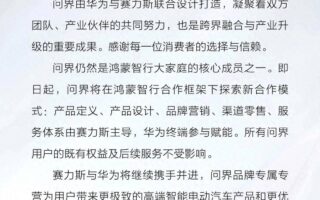
Welcoming the Coming of Age Ceremony/AI Picture
Manual labor/dig brother
Manual editing/Uncle Jiao
Produced by/Unicorn Watch
At noon on September 15, a piece of blockbuster news from China Finance News broke out in the automotive industry and the capital market: the smart car selection cooperation model between Huawei and Thalys will undergo major adjustments this week.In the future, Huawei will adopt an asset-light approach to cooperate with Cyrus. Product definition, marketing communications, store sales, and user services—these core business links that used to be fully controlled by Huawei will be transferred to Cyrus. Huawei will retreat to the technology enabler and continue to provide a full set of smart car technology solutions such as Hongmeng Cockpit and Qiankun Smart Driving., but no longer carry out heavy asset investment and full-link operations.
What is worth pondering is that the news fermented during the midday break of A-shares. Cyrus’s stock price briefly rose by 1% in the afternoon, and then turned downward, falling 5.09% to close at 45.4 yuan. This price is already halved from the historical high of 173.55 yuan set at the end of September last year, setting a new low in the past three years.
The logic of the market voting with its feet is very straightforward: in the past few years, Wenjie has been able to counterattack from a backward student to a new leader with a cumulative delivery of more than 900,000 vehicles, relying on Huawei’s brand endorsement, product definition capabilities and Huawei store channels across the country.
Now that Huawei has “let go”, how high can the industry fly?
If you extend the timeline, you will find that this adjustment is not sudden, but a strategic turn that has been brewing for at least a year. As early as the summer of 2025, Caixin Weekly revealed that the sales dominance of Hongmeng Intelligent’s three major brands, Zhijie, Shangjie and Xiangjie, has been officially returned to its partner car companies. Wenjie is the last brand among Hongmeng Zhixing’s “Five Realms” to return its operating dominance.
In other words, Huawei’s smart car selection model has been shifting from “full-link control” to “light asset empowerment”, which has been a game that has been played for a year. The adjustment of the question boundary is just the last step in this game of chess.
01
The double-sided narrative behind win-win
To understand this adjustment, we must go back to the moment when Thalys was on the verge of despair four years ago.
In 2020, Thalys was still called Xiaokang Co., Ltd., and its strategic model SF5 only sold 732 units throughout the year, with a net loss of 1.73 billion yuan. This Chongqing car company, which started from motorcycles and transformed into new energy, has been almost forgotten by the market amid the wave of new car-making forces. It was Huawei that pulled it back from the cliff.
After Yu Chengdong took charge of Huawei’s car BU, he chose Cyrus as the first “intelligent car selection” partner. Zhang Xinghai, chairman of Thalys Group, defied public opinion and took the initiative to reconstruct the product system in accordance with Huawei’s standards. This was a huge gamble – Cyrus almost handed over all the say in product definition, pricing, marketing, and channels in exchange for Huawei’s technology, brand, and traffic.
The result is that the bet won, and it was a big win.
Wenjie M5, M7, and M9 have been launched one after another. Especially the first-generation M9 broke into the 500,000-class luxury SUV market with a starting price of 469,800 yuan, and became an instant hit after its launch; the new-generation M9 (2026 model) exceeded 10,000 yuan within 3 weeks of delivery.
In 2025, Thalys’ revenue reached a record high of 165.054 billion yuan, with net profit attributable to the parent company of 5.957 billion yuan, finally turning losses into profits. Wenjie has also become the first brand among Hongmeng Zhixing’s “Five Realms” to successfully complete the business model and deliver a total of more than 900,000 vehicles. The share price of Thalys has also been hovering at a few yuan for a long time since Xiaokang Shares (before the name was changed), and has soared to a maximum of 173.55 yuan, becoming the darling of the capital market.
But the other side of the coin is that Cyrus’s deep dependence on Huawei is becoming a heavy shackles.
Market analysts separately calculated that the purchase cost of core hardware such as the Hongmeng cockpit and Qiankun Zhijia alone is about 50,000 yuan per bicycle. According to the Celis Hong Kong stock prospectus, from 2022 to the first half of 2025, the cumulative purchase amount of Cyrus from the Huawei system exceeded 75 billion yuan; the media simply converted the purchase amount of 20 billion yuan in the first half of 2025 and the delivery volume of 147,000 vehicles in the same period, and estimated that the funds corresponding to the bicycles flowed to the Huawei system of about 136,000 yuan.
It should be emphasized that this value is a simple static calculation, and there is a mismatch between procurement and vehicle delivery time. It is not the officially disclosed bicycle settlement amount. However, it can also be seen from this set of data that Cyrus has paid a lot to obtain Huawei’s deep binding.
In 2025, Thalys’s net profit margin is only 3.61%. With a revenue of 165 billion, the profit is as thin as a piece of paper. New revenue cannot be effectively converted into its own profits. As the industry’s price war escalates and the sales structure sinks, when the scale effect cannot dilute the package of cooperation costs from Huawei’s system, losses will become a matter of time.
In the first half of 2026, this boot finally landed.
Thalys’ operating income was 57.493 billion yuan, a year-on-year decrease of 7.87%; the net loss attributable to the parent company was 1.717 billion yuan, while it was still a profit of 2.941 billion yuan in the same period last year. Among them, the single-quarter net loss in the second quarter exceeded 2.2 billion yuan. What is even more dazzling is the “increased sales without increasing revenue”: in the first half of the year, the sales volume of new energy vehicles was 179,000 units, a year-on-year increase of 3.9%, and the delivery volume even increased by 10.2%, but both revenue and profits declined.
During the same period, the amount of goods purchased and services received by Cyrus from Yinwang (the main body of Huawei Auto BU) reached 9.84 billion yuan, an increase of 4.24 billion yuan from 5.6 billion yuan in the same period last year. The more cars it sells, the more it pays Huawei, while its own profits shrink. This model has obviously reached an unsustainable critical point.
02
Why is Huawei “letting go” now?
If Cyrus is motivated to take back its operational autonomy, why is Huawei willing to let it go? The answer may be hidden in Hongmeng Zhixing’s “Five Realms” chess game.
At present, Hongmeng Zhixing has formed a matrix of five major brands: Wenjie (Sales) targets Ideal, making mid-to-high-end SUVs; Zhijie (Chery) targets Tesla, focusing on young technology; Xiangjie (BAIC) targets Mercedes-Benz; Zunjie (JAC) targets Maybach, Bentley, and Rolls-Royce super luxury brands; Shangjie (SAIC) targets economic models under 200,000, aiming to benchmark Volkswagen Toyota. Five brands and ten models cover the price range from 150,000 yuan to one million yuan. The cumulative delivery of the entire series has exceeded 1.52 million units, and the average transaction price of the brand has stabilized at around 390,000 yuan.
As the first brand to get through, Wenjie has completed its historical mission of “helping Huawei build its brand”. However, Zhijie, Xiangjie, Zunjie, and Shangjie are still in the climbing stage. Huawei needs to focus its most elite product definition capabilities, marketing resources, and channel energy on these four brands. If we continue to invest heavy assets in full-link operations, Huawei’s resources will be severely diluted – after all, the team size and management radius of Huawei Terminal BG are limited.
More important is the evolution of business models. In the Smart Car Selection Model 1.0 era, Huawei is deeply involved in every aspect from product definition to sales and services. It is essentially using the method of “operating a car brand” to verify its smart car technology solutions.
The advantages of this model are strong control and unified experience, but the disadvantages are also obvious: heavy assets, high investment, limited management radius, and it is easy to create conflicts with cooperative car companies in profit distribution and voice.
In the Smart Car Selection Model 2.0 era, Huawei wants to be a “technology supplier” – exporting Hongmeng Cockpit, Qiankun Smart Driving, and Huawei brand endorsement, but not touching the front-end brand operation and channel management. In this way, Huawei can use the same team resources to serve more car companies, expand Hongmeng Zhixing’s portfolio from the “Five Sectors” to a broader market, and achieve an asset-light, high gross profit, and replicable technology empowerment model.
This is consistent with the logic of Huawei’s mobile phone business: Huawei does not manufacture its own mobile phone chips, but it controls the core experience and ecological voice of the product through Kirin chips and Hongmeng systems. In the automotive field, Huawei’s ultimate goal is not to be a car company, but to become “Android + Qualcomm” in the era of smart cars – providing the underlying operating system and core chips so that car companies can run on Huawei’s technology ecosystem.
“Let go” of the industry is a landmark event in Huawei’s strategic transformation from “making cars personally” to “retreating behind the scenes to sell water”.
03
Opportunities and Concerns of Thalys
For Thalys, taking back the business leadership of Wenjie is a belated “coming of age” ceremony.
The benefits are real. First, the profit distribution model will shift from a fixed commission to a dynamic profit sharing, and Thalys is expected to retain more operating profits. Secondly, the product pricing power, supply chain procurement power, and vehicle specification selection power return to Cyrus, which can more flexibly adjust product strategies according to market demand without having to completely obey Huawei’s product definition rhythm. Third, Cyrus can finally establish its own brand assets and channel system, and is no longer just “Huawei’s foundry”.
But the challenges are equally severe. It can even be said that Cyrus is facing a “weaning period” test of survival.
First, there is a gap in marketing capabilities. Every press conference and every round of marketing communication in Wenjie in the past was managed by the marketing team of Huawei Terminal BG, including the walking traffic Yu Chengdong who personally stood up every time. Now that Huawei has withdrawn from front-end operations, can Cyrus maintain its brand reputation in the industry? There is an order of magnitude gap between Thalys’ own marketing team and brand operation capabilities and Huawei Terminal BG.
Secondly, the reconstruction of the channel system. Wenjie used to rely heavily on Huawei’s offline store channels – Huawei has more than 6,000 experience stores across the country. This is the core infrastructure that allows Wenjie to quickly reach high-end users. After the adjustment, Thalys needs to build or rebuild its own sales and service channels in the industry, which means huge capital expenditures and a long construction cycle. As the price war for new energy vehicles intensifies, the costs and risks of channel reconstruction cannot be underestimated.
Third, the test of product definition capabilities. The success of Wenjie M9 is largely due to Huawei’s precise insight into the needs of high-end users and its product definition capabilities – the interactive experience of Hongmeng cockpit, the technological leadership of Qiankun Zhijia, and the high-end tonality of the Huawei brand. These are the core sources of Wenjie’s product strength. Although Huawei will still provide technical solutions, after the dominance of product definition is handed over to Cyrus, there is uncertainty about whether the industry can continue to launch popular products like M9.
Finally, there is the blurring of brand recognition. In the minds of consumers, Wenjie is almost equivalent to “Huawei Cars”. When many users buy Wenjie, they are essentially paying for Huawei’s brand and technology. When Huawei withdraws from front-end operations and the “luxury” of Wenjie decreases, will consumers still be willing to pay a brand premium for Wenjie? This is a question that needs time to be verified.
It is worth noting that people familiar with the matter particularly emphasized that “Wenjie will not be separated from Hongmeng Zhixing” – this means that Wenjie will still use Huawei’s technical solutions and brand endorsement, and will still be within the ecosystem of Hongmeng Zhixing. This has alleviated the market’s concerns about the “de-Huaweiization” of the industry to a certain extent, but it also shows that the relationship between the two parties has shifted from “deep binding” to “loose alliance”, and Cyrus has gained more freedom and taken more risks.
After the news of the adjustment of the smart car selection cooperation model between Huawei and Cyrus came out, the market quickly divided into two voices. The negative side believes that without Huawei’s deep binding, Cyrus may return to the predicament of the well-off stocks of the past; the optimistic side believes that after Cyrus regains its brand management autonomy, the profit retention space is expected to be further opened, and it can get rid of the passive situation of “working for Huawei” in the past.
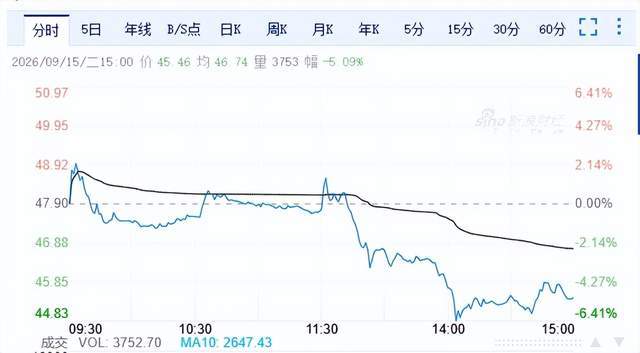
Thalys’ stock price first rose and then fell in the afternoon, and the trading volume increased significantly (see the figure above). It is the intuitive projection of this huge market divergence on the capital market.
結語
Many people simply attribute the problem of enterprise AI implementation to the fact that the model is not strong enough, but the real stuck points on the front line of the industry mostly come from the organizational level. The delivery of business results by AI is not just a technical issue, but also the reconstruction of human and machine rights and responsibilities, job processes, and performance appraisals.
In four years, Cyrus went from being on the verge of bankruptcy to annual sales of nearly 500,000 vehicles, and Huawei went from a cross-border novice to building a “five-sector” ecosystem covering the price range of 150,000 to one million. This symbiotic relationship has made each other successful, but also accumulated conflicts.
Today, the “weaning” of the world is not breakup, but growth.Huawei needs to shift from “raising children personally” to “running schools” and empowering more car companies with standardized technical solutions; Cyrus needs to shift from “being carried around” to “walking on its own” and prove its value in independent operations.
This is an adjustment needed by both sides, but it is also an experiment full of uncertainty. Can Wenjie continue to remain competitive after losing Huawei’s full-link support? Can Thalys be profitable operating independently? Can Huawei’s asset-light model be successful? These questions will take time to answer.