Huawei and Cyrus suddenly separated…
0
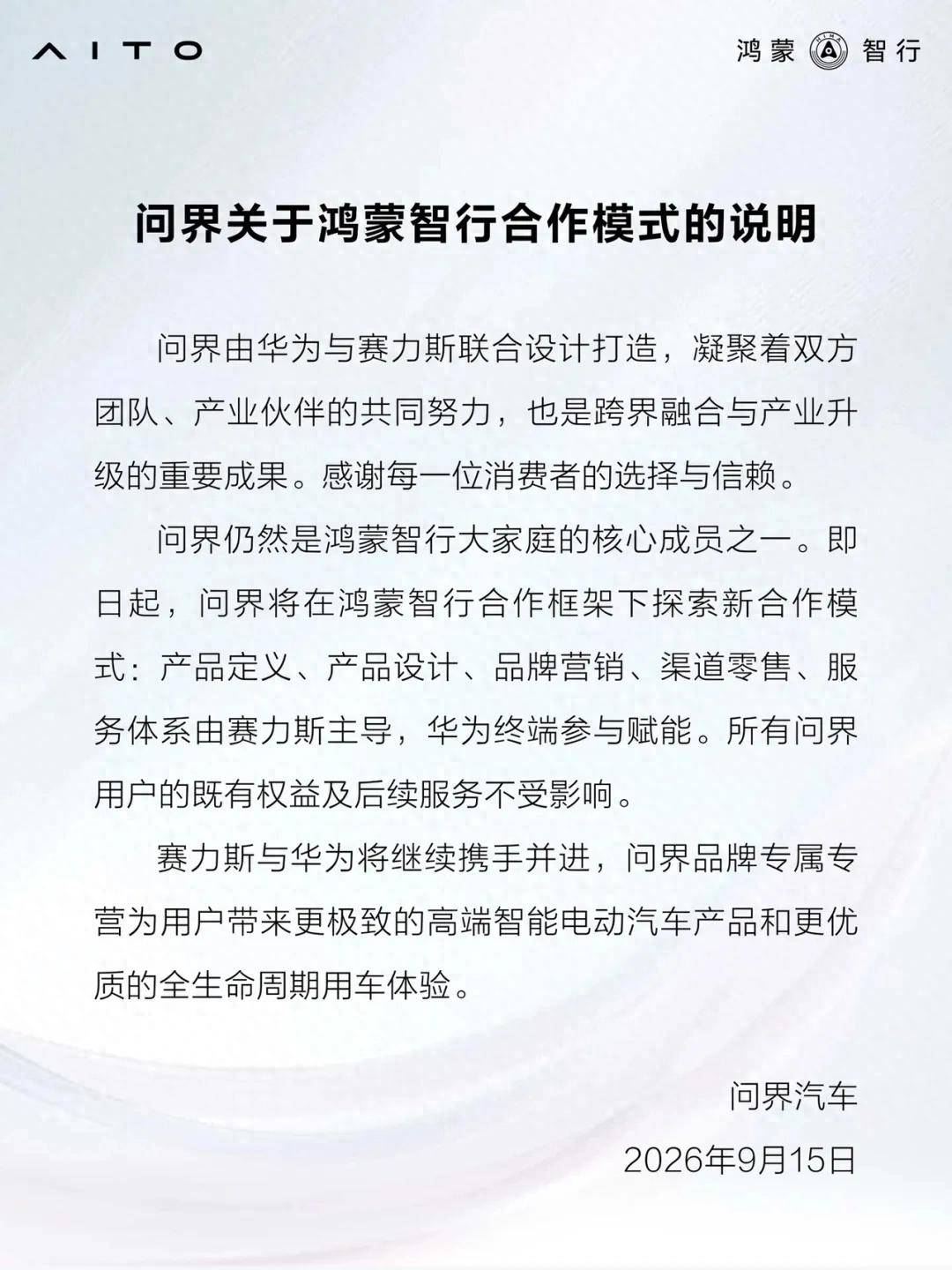
On September 15, Huawei officially announced that its cooperation model with Cyrus will undergo major adjustments.
In the future, Huawei will adopt a light-asset model to cooperate with Cyrus.
What’s the meaning? That is, products, marketing, sales, and services, these core links that used to be fully controlled by Huawei, will be led by Cyrus. Huawei will be a technology supplier, called a technology enabler.
In the official announcement, there is this sentence: Hongmeng Smart will focus on resources to accelerate the success of the Intelligent World, Enjoy the World, Honor the World, and Shangjie brands.
There are five realms, but now there are no realms to ask about.
Cyrus, this biological son who was once raised by Huawei, now wants to leave Huawei and walk on his own.

Why did they suddenly separate?
In 2020, Thalys was still called Xiaokang Co., Ltd., and its strategic model SF5 only sold 732 units throughout the year, with a net loss of 1.73 billion yuan.
This Chongqing car company, which started from motorcycles and transformed into new energy, has no influence in the wave of new car-making forces.
But Huawei doesn’t think it’s too small.
Because large companies were afraid of cooperating with Huawei at the time, all marketing technology research and development was owned by Huawei. Whose car is this?
Of course, Cyrus doesn’t care. He wants to be on Huawei’s lap.
Therefore, Huawei pulled it back from the cliff.
After Yu Chengdong took charge of Huawei’s car BU, he chose Cyrus as its first smart car partner. Cyrus almost handed over all the say in product definition, pricing, marketing, and channels, in exchange for Huawei’s technology, brand, and traffic.
As everyone knows, Cyrus won the bet.
Wenjie M5, M7, and M9 have been launched one after another. Especially the first-generation M9 broke into the 500,000-class luxury SUV market with a starting price of 469,800 yuan, and became an instant hit after its launch.
In 2025, Thalys’ revenue reached a record high of 165.054 billion yuan, with net profit attributable to the parent company of 5.957 billion yuan.
Huawei halo and Huawei technology bring a brand new Cyrus.
Of course, under this cooperation model, Huawei will naturally take the lion’s share.
According to Cyrus’ Hong Kong stock prospectus, from 2022 to the first half of 2025, Cyrus’ cumulative purchase amount from Huawei systems exceeded 75 billion yuan. The purchase cost of core hardware such as Hongmeng cockpit and Qiankun Zhijia alone is about 50,000 yuan for a bicycle.
But no matter how much money he paid, Cyrus always made money.
In its opinion, this business model is excellent! One company builds the car, another company builds the soul. Those who build cars earn hard-earned money, and those who provide souls earn technology premiums.
However, when the market is good, both parties can share the cake, but when the market is bad, the pressure falls entirely on the side that builds the car.
The final straw appears for the model
So why the adjustment now?
The answer is written in Thalys’ financial report.
In the first half of 2026, Thalys’ operating income was 57.493 billion yuan, a year-on-year decrease of 7.87%, and the net profit attributable to the parent company was a loss of 1.717 billion yuan, a year-on-year decrease of 158.38% from profit to loss. After deducting the net profit not attributed to the parent company, the loss was 2.379 billion yuan, a year-on-year decrease of 196.12%.
This is not a small number, it is a loss of billions.
It only took Cyrus one year to go from an annual profit of 2.9 billion to a huge loss of 1.7 billion.
Why the loss?
There are many reasons, for example, the main models are in the transition period of product iteration, and the scale effect has not been fully released; there are also price increases of important components, such as the price increase of battery-grade lithium carbonate, with the average price increasing by 132% year-on-year; the structural shortage of car-grade chips has increased prices, pushing up the cost of core components; and financial operations, it has made an impairment provision of 1.82 billion yuan for existing intangible assets with limited adaptability.
The clearer data is sales.
In August 2026, Cyrus sold 20,652 vehicles, a year-on-year decrease of 49.68%.
In July, the sales volume of the Wenjie series was only 20,480 units, a year-on-year decrease of 50.86%, which is equivalent to a sales volume cut in half.
Of course, this is not a problem for any one company.
In recent years, China’s new energy vehicle industry has experienced explosive growth and is entering a brutal elimination stage. Price war combined with high investment in R&D means that even if you have a hot model, you will still lose money, as long as your scale is not enough.
However, Huawei is still making rapid progress in the car company business. Through its successful cooperation with Cyrus, it has successfully signed contracts with many car companies. However, for Cyrus, one party continues to make money and the other party continues to lose money. This model itself has lost its sustainability.
Cyrus also has a spare tire
Although Cyrus relies heavily on Huawei, the company does not want to continue doing so for a long time.
He keeps making spare tires.
In 2025, Cyrus and ByteDance launched an in-depth cooperation. In May 2026, the original Landian Technology officially changed its name to Saidou Technology and completed a round of capital increase and share expansion of 6.671 billion yuan.
Saidou’s technical route adopts a brand-new model. The cockpit uses a large beanbag model of the Byte Volcano engine, and the smart driving uses Yuanrong Qixing’s solution, based on the NVIDIA platform with lidar.
The first crossover model will be launched at the Thalys Phoenix Factory in 2026. Two power versions, extended range and pure electric, will be simultaneously launched. An independent distribution network will also be established.
In other words, Cyrus has already started from scratch, starting from technology to channels, and has begun to build a complete system that is independent of Huawei.
In the adult world, no one is inseparable from anyone. There is only calculation of benefits and choice of timing.
From Huawei’s perspective, there are good reasons to retreat behind the scenes.
The first reason is the issue of resource allocation. Hongmeng Zhixing already has five brands, and Huawei’s channel resources, marketing team, and R&D energy are limited. When Wenjie is already the first brand among the five industries to have a successful business model and has delivered more than 900,000 vehicles, Huawei has shifted resources from the mature Wenjie to the Zhijie, Xiangjie, Zunjie, and Shangjie that need more support. This makes sense from a business logic perspective.
The second reason is related to the public opinion environment. In the summer of 2026, a bamboo cicada worth a few yuan put the Huawei system into the limelight of public opinion. The significance of this controversy is not who is right or wrong, but it sends a signal. When the volume of marketing is too loud, the value of the product itself will be obscured. When the personal IP of executives becomes synonymous with the brand, the backlash of public opinion will directly hit the brand itself.
Selis probably doesn’t want to take such a risk.
結語
Wenjie’s success is largely due to Huawei’s brand endorsement, Huawei’s product definition capabilities, and Huawei store channels across the country.
This is a powerful marketing enabler. But when this empowerment begins to have negative effects, when partners begin to calculate the cost of Huawei tax, and when consumers begin to replace admiration with ridicule, we should stop and think about where does the vitality of a company come from?
From marketing? Of course marketing is important. It allows a good product to be seen by more people and allows a brand to gain huge attention in a short period of time. But marketing is a double-edged sword. When you have raised all your expectations, and when the slogan “The best SUV under 10 million” is shouted out, the product must withstand the scrutiny that matches it. Once a product fails to deliver on its promise, the marketing buzz can turn into a backlash.
From a partner? Partners can bring technology, channel and brand premiums, but partners’ resources and energy are limited, and partners’ strategies will also be adjusted. When you put your destiny in the hands of others, you must accept their choices.
What is truly reliable is the product you create yourself, and the trust you accumulate through word of mouth.
Cyrus faces a huge challenge. It needs to prove its ability to independently operate a high-end brand without Huawei’s full-link empowerment. From product definition to channel management, from user service to brand building, these tasks that were done by Huawei in the past must now be completed by ourselves.
Huawei also needs to face a problem. When Huawei’s halo is no longer as invincible as it was in the past, and when partners begin to seek independence, how should Huawei’s automotive strategy be adjusted? From car building to empowerment, from dominance to asset light, can this road be passed?
Return to the homepage to see more car information