Recently, desks and chairs for primary and secondary school students that can change the lunch break from “lying down” to “lying down” have become popular among parents. A reporter from Beijing Daily found that many primary and secondary schools in Beijing have begun to explore new lunch break models and optimize existing classroom conditions according to local conditions. Some parents also called for the “lying-down sleeping mode” to be promoted as soon as possible. However, many students want to make their own decisions during lunch break. In this regard, some principals and doctors said that taking a nap is not a “necessary option” and should be tailored to each individual and guided scientifically.
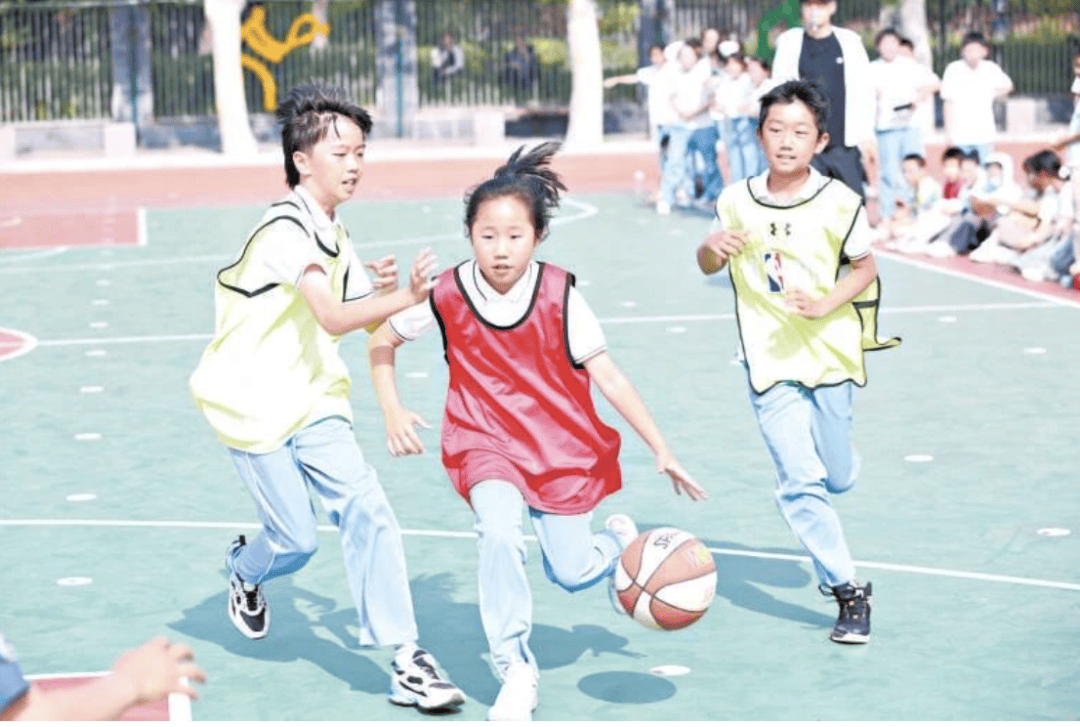
Students at the Emerald City Branch of Beijing Primary School carry out sports activities during lunch break. Photo provided by the school
Seat turns into recliner
Many primary and secondary schools explore new lunch breaks
At 12:40, the lunch break bell rang. In the classroom of the junior high school of Yangfang School in Changping District, students returned to their seats one after another. They gently pulled the backs of their chairs and pulled out the pedals. The seats instantly turned into recliners, allowing them to “lye and sleep freely.” The students by the window helped everyone close the curtains, and the classroom that was lively a few minutes ago gradually became quiet.
“This set of reclining tables and chairs is uniformly equipped by Yangfang Town for the school, covering more than 900 students in grades one to nine.” Wang Ning, director of the Yangfang School Office, said that the height of this set of tables and chairs can be adjusted and is divided into two versions for primary school and junior high school, which can adapt to the height of students in different grades. “Every day at noon, students in the primary school almost use reclining chairs to rest. In the junior high school, studies are relatively tight. Some students choose to use their lunch break to study on their own, while the rest of the students rest.”
The junior high school of Yangfang School in Changping District is equipped with reclining desks and chairs. Photo provided by the school
In order to create a more comfortable lunch break environment for students, Yangfang School also replaced all classroom curtains with thick sunshade curtains. “During lunch break, the classroom becomes dark and quiet, and the children fall asleep faster.” Wang Ning said that the students’ acceptance and willingness to use this new set of desks and chairs are very high. “I used to sleep on my stomach during lunch breaks and I always felt restless. When I woke up, my arms were numb and my neck was sore, which made me easily sleepy during afternoon classes. Now I can sleep for 20 minutes while lying down, and my mind is clearer during afternoon classes,” said a boy in the second grade of junior high school.
Not only this school, but many schools have begun to explore new lunch break models. Longquanwu Primary School in Mentougou District is also equipped with reclining desks and chairs. According to the relevant person in charge of the school, teachers are also trying to optimize the lunch break environment so that students can lie down comfortably and ensure high-quality sleep.
The Primary School Affiliated to Capital Normal University has equipped first-grade students on both campuses with sleeping desks and chairs. “Children who have just entered school still have the habit of taking naps. This set of desks and chairs can help them successfully transition from kindergarten to primary school.” Huang Yanwu, the school’s teaching director, said that the school also plans to gradually replace the facilities for students in other grades to adapt to different growth stages based on the “General Technical Requirements for Desks and Chairs for Lunch Breaks for Primary and Secondary School Students” and student height standards, so that desks and chairs can be like “growth partners” and dynamically match the height changes of students.
學生態度
“I prefer to make my own decisions during my lunch break.”
Taking the lunch break from “reluctantly enough” to “enjoying it with peace of mind”, the “campus nap artifact” has triggered widespread discussions on social platforms. Many netizens suggested promoting reclining desks and chairs. Some parents said that compared with primary school students, middle school and high school students have more heavy academic work and need to “lie down and sleep” more.
“Children get up early every day and really need a good rest at noon.” Ms. Zhang, a parent of a first-year junior high school student, said frankly, “We adults also need to take a rest at noon, not to mention that children are still growing and need a place to lie down.”
At the same time, some parents believe that there should not be a “one size fits all” approach to what children do during lunch breaks. Mr. Huang, a parent of a high school sophomore, said: “My child belongs to the ‘high energy group’ and participates in various club activities at noon every day. The school also holds class leagues and music festivals. The child said that changing his mind can help him concentrate better in class in the afternoon.”
Children’s attitude toward lunch breaks is more independent and relaxed. Xiao Han, a first-year high school student, put it bluntly: “I am not sleepy at all at noon. I like to go to the playground to play basketball with my classmates. Those who can sleep can sleep, and those who can’t sleep play, it is best for everyone to make their own arrangements.” Xiao Liu, a first-year junior high school student, said: “During lunch break, I prefer to read extracurricular books by myself, or discuss a few wrong questions with my classmates. Sleeping makes me more confused in the afternoon.”
The reporter randomly interviewed more than 10 students in different grades of primary school, junior high school and high school. 80% of the students said that “they would rather make their own decisions during lunch break” and more than half of the students hoped to use lunch break to expand their interests and hobbies.
校長建議
“Voluntary choice, zoning management”
Beijing Primary School Emerald City Branch has a one-hour “happy lunch break” every noon. Students can sleep, exercise on the playground, and read in the library. Zhang Wenfeng, secretary of the party branch of the school and principal of Emerald City Primary School Education Group, believes that lunch break must be different for each individual: “Some children have the habit of taking a lunch break and can choose to rest in the classroom; some children like to be released and can play games and do crafts.”
Zhang Wenfeng teaches the children two days a week, arranged in the last period of the morning and afternoon. “I feel that the children are in good condition.” She explained that the school will also fully consider the students’ daily schedule when arranging the class schedule. Subjects that require high concentration such as Chinese, mathematics, and English are arranged in the morning, and more active subjects such as music, sports, and art are arranged in the afternoon. “Children are not prone to sleepiness, and it also helps relieve fatigue and regulate emotions.”
According to Li Yuzhen, vice principal of Beijing No. 20 Middle School, the workload of middle and high schools is gradually increasing. After continuous classroom study in the morning, students are easily tired. Lunch break is crucial to ensure the efficiency of the afternoon class. For this reason, the school does not arrange any group activities during the lunch break, and does not occupy it at will, giving full time to students.
“The school implements a voluntary choice and zoned management model for lunch break.” He introduced that the classroom is used as a rest area. During the lunch break, blackout curtains are drawn and the lights are dimmed. Students who need to take a nap can bring their own neck pillows, eye masks, etc. to rest peacefully. The class teacher is responsible for maintaining order. The school has also opened self-study rooms and laboratories, where students can read extracurricular readings, organize notes, and practice hands-on practice. “Students can also go to the playground to play basketball and football to relieve physical and mental stress, or voluntarily participate in small clubs, popular science lectures and other activities.”
“The core goal of the lunch break is to allow students to rest their brains and body and mind, rather than to complete the task of ‘sleeping’.” Li Yuzhen said that from daily observation, some students are willing to take a rest, and many others choose to exercise and read. “For sleepy students, taking a nap can indeed relieve fatigue. But for students who are energetic and can’t fall asleep even if they lie down, forcing them to sleep will not only fail to achieve the rest effect, but will also easily lead to resistance. Of course, voluntary does not mean laissez-faire – no matter which lunch break method is chosen, it cannot interfere with other students.”
醫生提醒
Naps vary from person to person
Do primary and secondary school students have to take a nap? Zhou Shuangyao, deputy chief physician at the Sleep Medicine Center of Beijing Huilongguan Hospital affiliated to Capital Medical University, believes that not all children are suitable for naps. On the one hand, children’s studies in the morning consume a lot of brain power. A short nap can relieve brain fatigue, reduce drowsiness and lack of concentration in the afternoon, and is also helpful for memory consolidation. It can also make up for the sleep gap at night. On the other hand, it is not recommended for children who have difficulty falling asleep at night and have insomnia problems themselves; for children who have high energy, cannot fall asleep when lying down, and become more irritable the longer they lie down, there is no need to force it.
“Forcing a nap will cause psychological burden and even affect sleep at night. It can be replaced by other ways to relieve mental fatigue and regulate stress.” Zhou Shuangyao suggested that primary and secondary school students can take a nap in two ways. One is quiet and static relaxation: close your eyes for 10 to 15 minutes without falling asleep, just close your eyes and slow down your breathing, which can also reduce brain excitement and reduce visual fatigue; or take 3 minutes of slow and deep breathing to gradually relax your muscles from head to toe and calm down learning anxiety; you can also relax and look at the distant scenery outside the window to get your brain out of a state of continuous thinking. The other type is mild dynamic adjustment: walking gently in the corridor or playground, looking into the distance, to relieve cervical fatigue caused by sitting for a long time; doing gentle stretching of the shoulders, neck, and lower back; or engaging in low-intensity activities such as painting and puzzles.
Related reading

2026 National Cyber Security Awareness Week Opens
The opening ceremony of the 2026 National Cyber Security Publicity Week was held in Jinan, Shandong Province on September 14. A series of important results in the field of network security, including the "Artificial Intelligence Security Governance Framework" 3.0, "2026 Artificial Intelligence Technology-Enabled Network Security Application…

Xi Jinping’s reply to all members of “Zhangzhou 110” in Fujian Province
Xinhua News Agency, Beijing, September 15th Xi Jinping’s reply to all members of “Zhangzhou 110” in Fujian Province All members of “Zhangzhou 110” in Fujian Province: Your letter has been received. "Zhangzhou 110" is a bright business card of the public security system, which left a…
Xi Jinping replied to all the members of Fujian Province’s “Zhangzhou 110”
Xi Jinping wrote back to all the members of the "Zhangzhou 110" in Fujian Province, emphasizing their commitment to serving the people and being a loyal guardian of the Party and the people. Recently, Xi Jinping, General Secretary of the CPC Central Committee, State President, and…