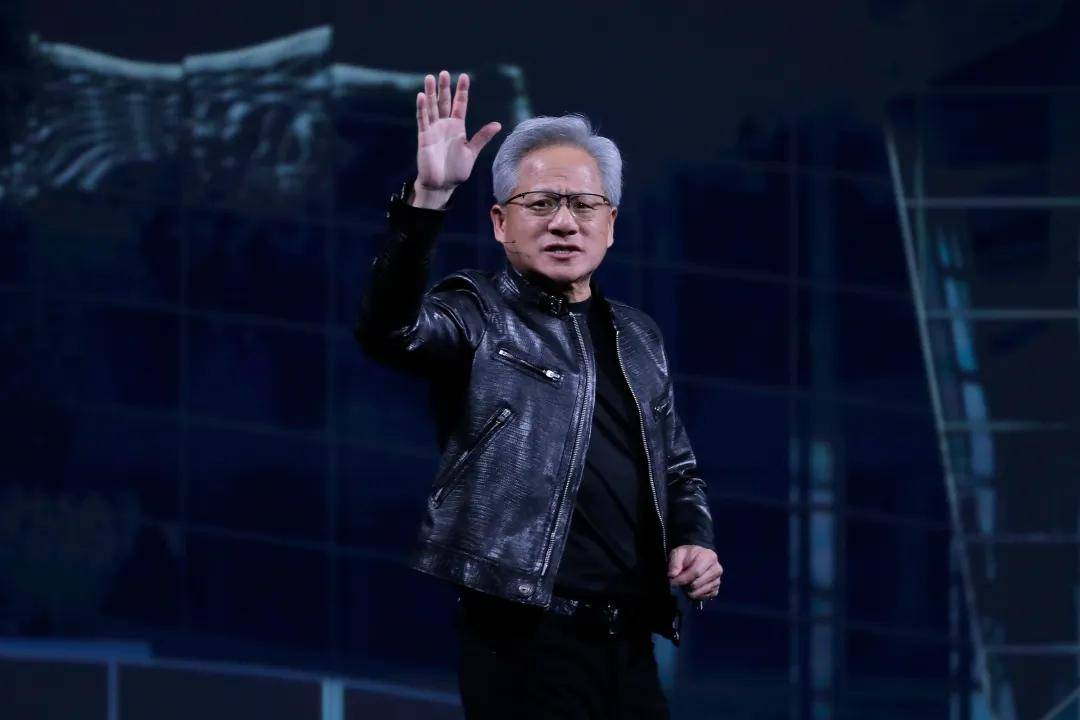
On November 12, 2026, Nvidia’s board of directors ended Huang Renxun’s 33 years in charge with a restrained and “effective immediately” announcement. There was no farewell party, no transition period, not even a board seat reserved for him. A company with a market value of more than 4 trillion US dollars completed the separation from its founder in four days.
As the light of the Chinese people, it has supplied core chips to many regions around the world and driven the overall development of global large-scale models. To end in this way, is it a black swan incident or a conspiracy by the Democratic Party? Do you have to take the blame for yourself and have to return it, or do you take advantage of the rapid current and retreat bravely? Tell us your views in the comment area. But no matter what, it is touching and sad.
What happened in these four days is worth reviewing; but more importantly, this “peaceful coup” exposed Nvidia’s governance debt and what problems it left for the global technology industry.
Will Jen-Hsun Huang “return the king” like Steve Jobs did? I’m afraid it’s difficult.
01
Four Days: From a Letter of Apology to a Resignation Announcement
The starting point is November 8th. On the same day, NVIDIA’s official website published Huang Renxun’s “Message to All Employees of the Company.” “I was unfaithful to my wife,” the 63-year-old founder wrote in the letter. “My actions hurt her and our children. There is no excuse for what I did. I am deeply sorry.” (Chinese translation, according to the full text of the letter seen by Caixin.com) On the same day, the board of directors announced the launch of an independent investigation.
Then things accelerated by the day. The New York Times reported that Huang Jen-Hsun’s cheating partner was “someone else”, an executive within the company who had reported directly to him; the Wall Street Journal followed up by reporting that the board of directors was preparing to meet to decide on his departure. On the prediction market Polymarket, the betting probability of “Huang Renxun being dismissed by the board of directors” jumped from 13% to 77%.
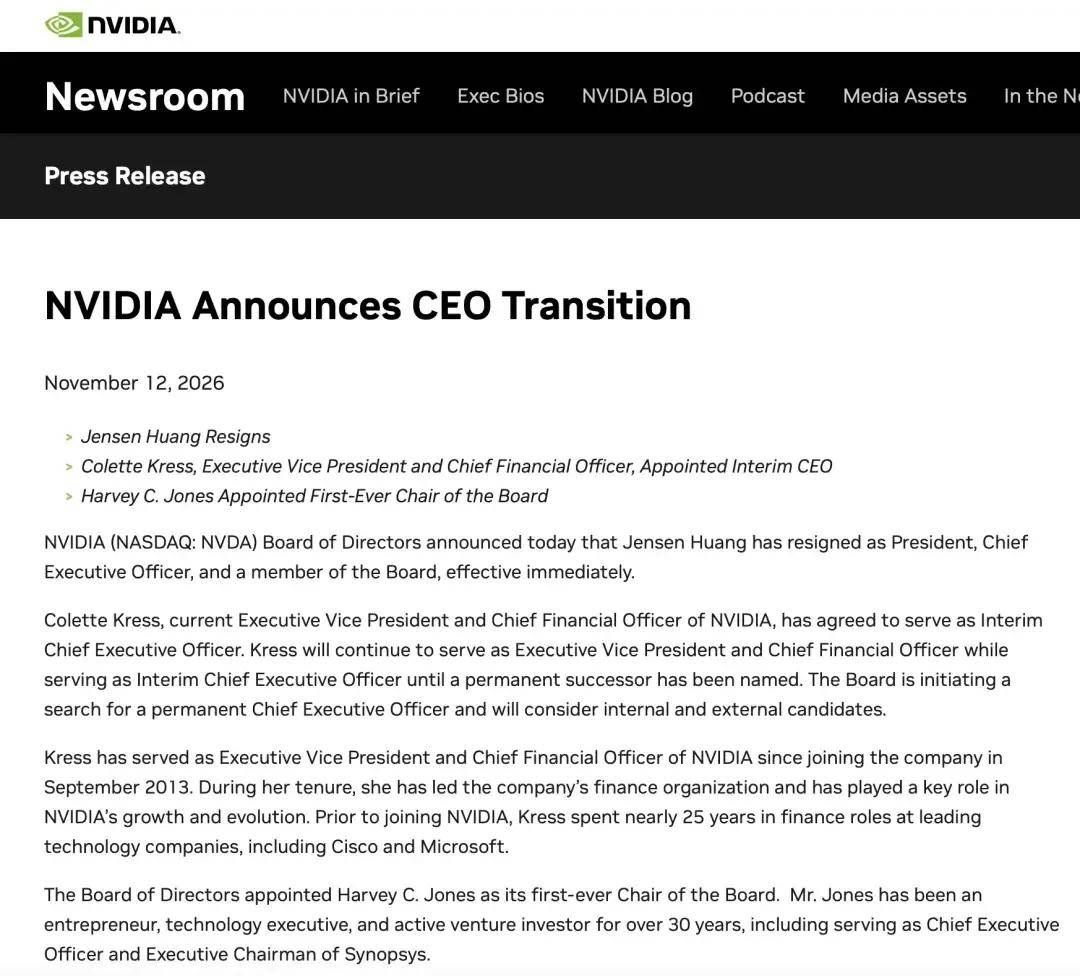
On the morning of November 12 (local time in the United States), the boots fell: Huang Renxun resigned from his positions as president, CEO and director, effective immediately. Chief Financial Officer Colette Kress serves as interim CEO and continues to serve as CFO; senior director Harvey C. Jones serves as the first chairman of the board of directors in NVIDIA’s history. The board of directors announced the launch of a formal CEO search, considering both internal and external candidates. Kress stated that he would work with the management team to consolidate the foundation laid by Huang Renxun in 33 years and continue to promote accelerated computing and artificial intelligence business; Jones promised that the company’s operations and product roadmap will continue to advance, and “commitments to customers will continue to be fulfilled.”
The market’s reaction can be viewed at three levels. On Monday and Tuesday before the news broke, Nvidia had fallen 4.27% and 5.47% respectively, with its market value evaporating by about US$430 billion in the two trading days. On the day of the announcement on the 12th, the stock price fell 14.3% at the opening, and then bottom-hunting funds poured in. It finally closed down by about 4.3% to US$166.19, and the market value fell back to about US$4 trillion – a price that has retreated by about 30% from the historical peak of US$5.7 trillion in early October. Statistics from data analysis company ORTEX show that investors shorting Nvidia made book profits of approximately US$3.8 billion during the same period.
02
Why It Can’t Be Stopped: A $4 Trillion Company’s Governance Debt
Simply reading this resignation as a “personal ethics overturn” will miss the truly valuable part. The scandal was the trigger, but what made the fire get out of control were three outstanding debts that had been accumulated in Nvidia’s governance structure for many years.
The first debt: In the 27 years since it was listed, Nvidia has never had a chairman of the board of directors.The founder has held the three positions of president, CEO and director for a long time. The title “first chairman of the board of directors” did not appear for the first time until the day he left. Under the standards of modern corporate governance, this means that the checks and balances of the board of directors have long been in name only.
The second debt: extremely flat reporting structure.According to public reports, there are as many as 60 to 70 executives reporting directly to Huang Renxun (according to different sources), and the company does not have a clear “number two person”. This structure is efficient when attacking – the decision-making chain is extremely short, and products can be iterated once a year; when used defensively, it is a single point of failure – once something goes wrong in the center, the entire decision-making system has no redundancy.
The third debt is hidden in the equity structure.Huang Renxun himself only holds about 3.58% of the shares, while BlackRock and Vanguard hold 7.43% and 7.31% respectively. Institutions hold about 70% of the shares in total. Caixin Data’s analysis is straight to the point: the low shareholding ratio makes the “no-removal” structure more stable – if he is removed, his personal losses will be limited, but all shareholders will have to share the losses of the valuation reconstruction. Therefore, in the past 33 years, shareholders have never initiated the recall mechanism, because the result of every calculation is “not worth it”.
Why was it worth it this time? Because the nature of risk has changed. The scandal involves direct subordinates, escalating the matter from a personal ethics issue to an issue of employment relations and corporate governance; shareholder class actions have followed; more importantly, the uncertainty of congressional hearings and US government investigations hangs overhead. For passive institutional investors such as BlackRock and Vanguard, by continuing to place their chips on an individual facing multiple investigations, the risk exceeds the cost of “cutting” for the first time.
Wall Street’s actions confirm that this is a repricing for “people”: Baird downgraded the rating from buy to neutral, and the target price was cut in half from US$500 to US$200; Citigroup, Wells Fargo, and Mizuho successively lowered their target prices; Morgan Stanley and Bank of America removed Nvidia from their respective “preferred lists” – but please note that no mainstream institution has given a sell rating so far, and 77 of the 82 analysts covering the stock still maintain buy. Wells Fargo was clear when it cut its price target: Pressure comes from “investigation and key person risks”.
Of course, there are many voices in the industry complaining about Huang Renxun. Epic Games CEO Tim Sweeney publicly called for “Save Huang”, saying that if the board of directors really removes him, “it would be as stupid as when Apple fired Steve Jobs, and would seriously damage the interests of the United States.” Some netizens called Musk to hire Huang, and Musk himself replied: “That would be my honor.”
03
Two accounts must be calculated separately: human risks and business resilience
To judge Nvidia’s next direction, we need to separate the two accounts.
Let’s look at the business accounts first.The company’s fundamentals have not changed in these four days: in the second fiscal quarter of fiscal year 2027 (as of July 2026), Nvidia’s revenue was US$96.2 billion, a year-on-year increase of 106%, including US$89 billion in data center business, an increase of 117%; management gave guidance for the third fiscal quarter of approximately US$108 billion, and even predicted for the first time a year in advance that revenue in fiscal 2028 will increase by 70% (the company specifically emphasized that this was based on “supply constraints”). Kress disclosed at the August financial report that the backlog of orders in the cloud industry has exceeded US$2 trillion. The capital expenditures of the top five cloud vendors will be close to US$800 billion in 2026 and are expected to reach US$1.3 trillion in 2027. The realization of these figures does not depend on any individual.
Let’s look at people’s accounts.There are indeed some things that are personal to Jen-Hsun Huang: the annual product iteration rhythm set by him personally; the relationship he has accumulated over decades with global technology giants – the story of him personally delivering the world’s first DGX supercomputer to the OpenAI office in 2016 is still a Silicon Valley legend; and the decision-making center formed by more than 60 executives reporting directly to him. Munster of Deepwater Asset Management put it bluntly: “For a company that is dominated by a founder and does not have a clear No. 2 figure, this situation is a precursor to a 20% correction in the stock price.” Seaport analyst Goldberg also expected an impact of 20%, but he added a key word: “But this is only a short-term impact, that is, the shock caused by the announcement of the news.”
Historical accounts may be more valuable for reference. Since its listing in 1999, Nvidia’s share price has retraced more than 25% 13 times, of which 9 times it recovered its lost ground within a year; the exceptions were 2001, 2002 and 2007 – those times were industry crises, not corporate governance crises. Nvidia’s current TTM price-to-earnings ratio is about 21 times, and its expected price-to-earnings ratio for the next fiscal year based on FactSet is about 11 times, which is even lower than the overall S&P 500 index of about 18 times. Let’s break down the approximately 30% retracement since October: In early October, the market began to question the sustainability of AI capital expenditures. This is an old wound; the key man risk in November is a new wound. Mixing the two accounts together will overestimate and underestimate the company at the same time.
The next observation points are actually very clear: whether the third fiscal quarter financial report can meet the guidance of about 108 billion US dollars, who is the official CEO candidate, and how to reorganize the more than 60 direct reporting relationships. The answers to these three things are more important than any comments.
Interim CEO Colette Kress joined Nvidia in 2013 and had previously worked in finance for nearly 25 years at technology companies such as Microsoft and Cisco. Image source: Nvidia official website data map, quoted from Yingzhengtianxia report on November 13, 2026.
04
After the Founder’s Myth, NVIDIA must make up a lesson
The analogy of Steve Jobs being kicked out of Apple in 1985 has been cited countless times these days. But the two things are essentially the opposite: Apple back then was looking for a scapegoat for business failure, while today’s NVIDIA is doing risk isolation at its peak. This difference determines that the outcome is likely to be different.
What is really worth recording is the institutional signal: for the first time, a US$4 trillion company has an independent chairman of the board of directors, for the first time it has launched a formal CEO selection process, and for the first time it has to operate without a founder. From this perspective, this is a belated “coming of age” ceremony for Nvidia.
If NVIDIA can still deliver on its product rhythm and customer orders after Kress takes over and the new CEO takes over, it will not prove that Huang Renxun is not important, but that the machine he built for 33 years is mature enough. For the founder, the best legacy is precisely that “the company can do without him.” On the other hand, if the guidance fails and orders are transferred, it means that a considerable part of the past market pricing is indeed the “Huang Jensen Premium” that cannot be institutionalized, and no governance arrangement can save the evaporation of this premium.
I can’t say enough. It would be irresponsible to assert at this moment that “Nvidia’s era is over” or “all the bad news is gone”. There are only a few certain facts: the title of the world’s largest market capitalization has changed hands this week to Apple (market capitalization is about 5.2 trillion US dollars); the uncertainty of the AI sector has been significantly amplified, and the US stock technology sector and the A-share optical communication chain are re-pricing; and, a founder bid farewell to the company he built in the most dishonorable way.
The way the Jen-Hsun Huang era ended is sad. But the answer sheet NVIDIA hands over next will truly determine how these 33 years will be written.
Attached: Description of main data calibers
1. Jen-Hsun Huang’s resignation and appointment of interim CEO and first chairman of the board of directors: NVIDIA board of directors announcement, November 12, 2026 (local time in the United States), as reproduced and verified by Sino-Singapore Jingwei, Titanium Media, 21st Century Business Herald, etc.
2. Quotation from the apology letter: “Message to All Employees of the Company” on NVIDIA’s official website, November 8, 2026. The Chinese translation is quoted from relevant reports on Caixin.com (November 2026).
3. Stock price and market value: It fell 4.27% on November 10, fell 5.47% to close at US$168.89 on November 11, and evaporated approximately US$430 billion in two days (Quick Technology/Ifeng.com, November 12, 2026); closed down by approximately 4.3% on November 12 %, reported at US$166.19, with a market value of approximately US$4.01 trillion, and a TTM price-to-earnings ratio of approximately 21 times (Futu Quotes, Caixin); the peak market value in early October was approximately US$5.7 trillion, with an intraday record high of US$236.26 (October 2, 2026).
4. Profit from short selling: Reuters cited statistics from the data analysis company ORTEX, and the book profits of short sellers were approximately US$3.8 billion (as of the close of the previous trading day, quoted by China News Service, November 12, 2026).
5. Rating adjustment: Baird target price 500→$200, rating downgraded to neutral; Citigroup 315→$285 (maintain buy); Wells Fargo 315→$300 (maintain overweight); Mizuho 315→$250; Morgan Stanley moves out of top pick The stock list (triggering the stop-loss rule) and Bank of America’s removal from the preferred investment list both maintain buy/overweight; Bloomberg data shows that 77 of the 82 covered analysts have buy ratings (Financial Associated Press, Global Market Report, November 11-12, 2026).
6. Financial data: Revenue in the second fiscal quarter of fiscal year 2027 (as of July 26, 2026) is US$96.221 billion (+106% year-on-year), data center revenue is US$89 billion (+117%), third fiscal quarter guidance is approximately US$108 billion (±2%), and guidance for fiscal year 2028 revenue growth of 70% is given one year in advance for the first time (NVIDIA financial report and Caixin report, 2 August 26, 2026); the backlog of orders in the cloud industry exceeds US$2 trillion, and the capital expenditures of the top five cloud vendors are nearly US$800 billion in 2026, and are expected to be US$1.3 trillion in 2027 (Kress, August 2026 financial report conference call); the full-year revenue in fiscal year 2026 is US$215.94 billion (+65%) (NVIDIA official website, Xinhua News Agency, February 2026).
7. Ownership structure: Huang Renxun beneficially holds about 871 million shares, accounting for 3.58% of the total share capital; BlackRock 7.43%, Vanguard 7.31%, and the total number of institutions is about 70% (Caixin data, November 2026).
8. Historical retracement statistics: Since its listing in 1999, it has retraced more than 25% 13 times, 9 of which recovered within one year (Yahoo Finance statistics, quoted by Global Market Report, November 12, 2026); the expected price-earnings ratio for the next fiscal year is about 11 times, and the S&P 500 is about 18 times (FactSet, same as above).
9. Analyst and industry quotes: Munster (Deepwater Asset Management), Goldberg (Seaport Research Partners), etc., quoted from the Chinese translation of CNBC related reports (reprinted by Jinshi Data, Sina Finance, November 12, 2026); Sweeney and Musk’s remarks are quoted from social media posts (Fast Technology, Financial Industry, November 12, 2026); Polymarket betting probability changes are quoted from Ai Faner’s report (November 11 to 12, 2026).
10. Others: Apple’s market value is approximately US$5.2 trillion (Sina Finance, intraday data on November 12, 2026); shareholder class action lawsuits (Caixin data “Shareholder class action lawsuits follow one after another. Who can guarantee that Huang Renxun will be exempted from fines?”, November 11, 2026).
Note: Nvidia’s fiscal year is misaligned with the natural year (the second fiscal quarter of fiscal year 2027 corresponds to the natural year May to July 2026); the market value and target price in the article are in US dollars; some Chinese translations and quotations are subject to the original English reports.
點擊「推薦❤”, the koi is possessed!
Related Reading
- Depth丨The outcast Huang Renxun, and the trillion-dollar Nvidia that has lost its helmsman2026-11-15
- Original: Wang Jianlin, 72, re-appointed as chairman of Wanda2026-11-15
- The former chairman voluntarily surrendered! With three changes of leadership in four years, how many question marks does Xiamen Bank hide?2026-11-15
- Behind the U.S. grounding: the air traffic control system has been in service for 50 years, and spare parts rely on overseas purchases2026-11-15
- Hesai, Shenghong, and Nvidia reveal the “pricing system” of technology tycoons’ extramarital affairs2026-11-14