
Author|Chu Xia
Statement | The title picture comes from the Internet. Original article from Jingzhe Research Institute. If you need to reprint, please leave a message to apply for permission.
Departing at 7:30 in the morning on September 25th, the high-speed train started at 9:30, arriving in Shangrao at 12:30, and then went straight to the hotel to put my luggage and have lunch. In the afternoon, I plan to visit the museums and art galleries in the city, and then set off to Gexian Village the next day…
As early as one week before the holiday, Xiao Ge, who lives in Shanghai, had already planned his holiday itinerary in advance. She repeatedly studied the high-speed rail timetable, opening hours of attractions and map routes, and filled in the form at what time to depart, where to eat, who was traveling with her, mode of transportation, and even precautions, creating an interlocking “project execution table.”
On social platforms, more and more young people like Xiao Ge are posting about their “scheduled” vacations. They calculate time like accounting, trying every possible means to maximize their limited vacation, and this “whether the table itself is full” has become their new standard for measuring whether a trip is worth it.
The ultimate special forces soldier, traveling through 6 provinces and 8 places in 13 days
The most valuable three-day annual leave this year may be from September 28th to 30th. As long as you can take it, you can connect the Mid-Autumn Festival and National Day holidays end to end to create a “super long holiday” that lasts for 13 days. Therefore, “please take 3 days off and 13 days off” has become the “big result” that many migrant workers want to win this year.
And many people arrange their vacations according to this idea. Qunar travel data shows that the number of holiday travelers from September 28 to 30 increased by 52% year-on-year; hotel bookings during these three days accounted for 15% of the entire 13-day holiday window, which is equivalent to at least 1 out of every 7 hotel orders falling on these three working days. At the same time, advance bookings for hotels in popular cities during the Mid-Autumn Festival and National Day increased by nearly 40% year-on-year, and the popularity of booking air tickets one month in advance was 21% higher than the same period last year.
Xiao Ge happened to catch up with this wave of “please take 3 days off and 13 days off”. She originally planned to play all the way from September 25 to October 7, starting from Shanghai, passing through Shangrao, Gexian Village, Nanchang, and then to Shenzhen, Hong Kong, Chaoshan and Quanzhou. Ten days sounds like a lot of money, but when there are more cities, the trouble becomes how to string them together.
“This kind of cross-city travel is most afraid of detours, so I usually first list which city I will stay on on that day, see what is the easiest way to travel between the several destinations, then book tickets and hotels, and finally fill in the attractions in the daily itinerary.” Xiao Ge said that when planning a specific itinerary, she will first let AI give a preliminary version of the plan, and then fill in the details, “I will “I am starting from Shanghai” , a total of ten days, I want to go to Jiangxi, Shenzhen, Hong Kong, Chaoshan, and Quanzhou. This kind of demand is directly given to GPT, and it is arranged for me first, but it is just a reference for the route. I will not follow the AI completely, because sometimes the plan it gives seems reasonable, but after actual inspection, I will find that the transportation time is wrong, or there is no need to stay in a place for so long. “
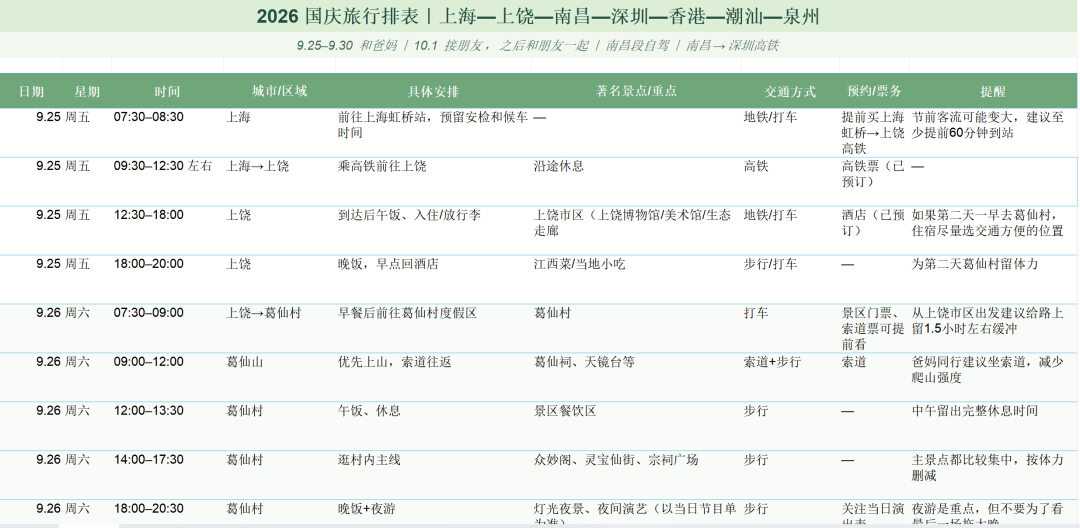
*Xiao Ge’s itinerary generated using GPT
Therefore, to a certain extent, what young people now face when making strategies is not “cannot find information”, but too much information, and they need to re-assemble a plan that suits them.
Xiao Han, who works in Shanghai, feels this even more clearly. Xiaohan told Jingzhe Research Institute that she made a special trip to Hong Kong Disneyland on the weekend last month. What time to get up, what time to go to the airport, when the flight will arrive in Guangzhou, which high-speed rail to take to Shenzhen, what time to cross the border the next day, what time to take the cross-border bus to Disneyland, which bus to take back at the latest in the evening, and even how much it costs to take a taxi, check in luggage, high-speed rail and bus, all were recorded in the form.
“In order to find out how long I need to reserve for customs clearance, which port is more convenient, and what time the cross-border bus is the latest, I will look back and forth between the ticket purchase software and Xiaohongshu.” In her opinion, the official information will only indicate “corresponding flights”, but will not tell how much buffer time should be left. These details can only be slowly dug out from a large number of user notes.
Plans can’t keep up with changes
Arrange the itinerary closely, and the actual experience will be far more than just “efficiency”. For the “scheduler”, this form may be perfect enough, but there will always be some “changes” that break the original plan.
“Before the Mid-Autumn Festival and National Day trip even started, I had already spent several nights of free time from route planning to price comparison of flights and wine. Moreover, something unexpected happened in my hometown before departure this time. All the first three stops in Shangrao, Gexian Village, and Nanchang were canceled. I finally decided to fly directly to Shenzhen. The route I had spent a long time researching and comparing hotels was instantly wiped out. The originally watertight travel plan was completely leaked.” Xiao Ge complained to Jingzhe Research Institute.
The more detailed the strategy is, the more obvious the “sunk costs” caused by temporary changes will be. Even with a smooth start, forms may not only make travel easier. Xiao Ge told Jingzhe Research Institute: “If you are too obsessed with completing every item on the list, traveling can easily become a ‘check-in task.’” Therefore, before setting off this time, she consciously left a blank period of time in her daily schedule instead of filling all the time in advance.
The “change” that Xiaohan felt most deeply was that his body could not keep up with the rhythm of the form. “On the first day, I flew from Shanghai to Guangzhou, then transferred to the high-speed train to Shenzhen, and I had to switch modes of transportation throughout the whole journey. The plan in the form seemed very friendly to J people, but only when I dragged my suitcase through the whole journey did I know how energy-consuming it was.” Xiao Han also emphasized to Jingzhe Research Institute, “Once the previous link is a few minutes later than expected, I will start to check the time frequently, and I will keep calculating in my mind whether I can catch the next train.”
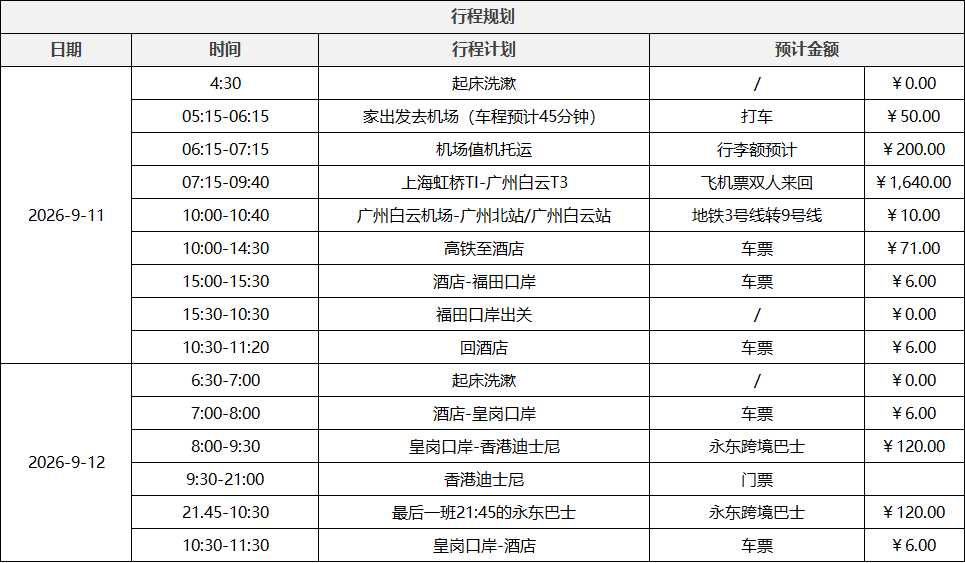
*Xiaohan’s itinerary
And when the vacation itself only lasts a few days, this careful calculation of time also begins to affect how she spends her money.
“If you arrive an hour early, you may enjoy two or three more activities; if you arrive an hour late, you will get less experience for the same ticket price,” Xiao Han said. Especially in a scene like a theme park, she will clearly feel that “time and money are tied together.” Therefore, instead of wasting time in transportation, queuing, and checking guides at the last minute, she is more willing to plan in advance and spend a little more money when necessary in exchange for a smoother trip.
Xiao Ge will calculate this cost into accommodation, transportation and queuing. “If the hotel is close to a high-speed rail station or the place I want to go the next day, I may choose it even if it is more expensive. For some popular attractions, if the normal queue takes two or three hours, paying extra can really save waiting time, and I will also consider paying the bill.”
This experience-focused travel preference is also confirmed in industry data. The “New Era Cultural Tourism Brand Development Research Report” released by the National Advertising Research Institute in May this year shows that Generation Z shows the characteristics of both pragmatism and pursuit of cultural tourism consumption prices. 44.23% of them are willing to pay a moderate premium for unique experiences, and 41.35% pursue high cost performance.
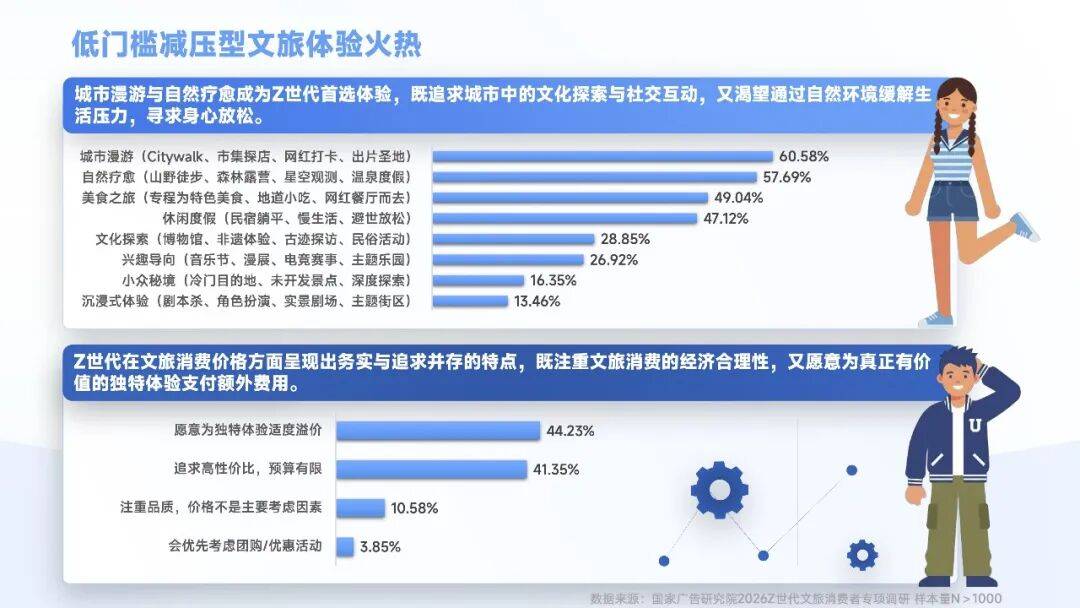
*Source: “Research Report on Cultural Tourism Brand Development in the New Era”
For the cultural tourism industry, when tourists pay more and more attention to the time cost behind the experience, it means that new paid spaces are emerging.
A new business about “time”
In theme parks where it is easiest to perceive that “time is money”, paying to buy time is nothing new.
According to statistics from the third-party queuing platform Queue-Times, the average waiting time for many popular projects at Shanghai Disney in 2025 is close to or exceeds 1 hour. Among them, the average waiting time for the Seven Dwarfs Mine Car is 85 minutes, and the Light Wheel and Flying Over the Horizon are 72 minutes and 70 minutes respectively. In order to save time and experience more projects, many people will choose to purchase exclusive cards, early access cards and other products launched by Shanghai Disney, thereby enjoying the “privilege” of priority access to projects and entering the park one hour in advance.
Similar products also appear at Universal Studios Beijing. The official description of Global U-Speed Express clearly mentions that by entering some projects and performances through separate channels, you can get priority entry opportunities. The core selling point is “shorter waiting time.”
*Hong Kong Disneyland photographed by Xiaohan
Services related to “saving time” are also provided throughout the entire journey. “Hotel + attractions” packages and amusement park transfer services have become popular categories on the platform. Tuniu’s “2026 Summer Travel Report” shows that the number of domestic customized tour bookings increased by more than three times year-on-year, and the number of “hotel + attractions” independent travel package bookings increased by nearly 30% year-on-year.
On the travel side, the popularity of chartered cars and self-driving cars at destinations continues to rise. They focus on door-to-door pick-up and drop-off and flexible itineraries, helping users save time on transfers and waiting for buses. On the luggage side, the advance storage and cross-city delivery services of hotel chains, as well as the popularity of third-party luggage storage platforms, are “removing” luggage from travel routes, further liberating tourists’ time and energy.
While the entire travel service chain is upgrading its services around “saving time,” the popularity of AI has brought new variables. In the past, the value of travel agencies was more reflected in itinerary planning, flight and hotel reservations, but now the destination, number of days, budget and even work and rest preferences are handed over to AI, and a basic itinerary can be generated in a few minutes. The work of looking through guides, looking up maps, and calculating routes in the past is becoming zero cost.
The “AI Tourism Application Trend Insight Report for the First Half of 2026” jointly released by China Tourism Group and others shows that the penetration rate of consumer use of travel AI tools is close to 80%; Fliggy data shows that the number of AI orders on the platform during the 2026 Spring Festival increased by more than 800% compared with before the holiday. This means that basic route planning is becoming increasingly difficult to justify charging, and the traditional model of selling itineraries based on poor information is facing a direct impact.
But behind the impact there are also opportunities. The “AI Tourism Application Trend Insight Report for the First Half of 2026” shows that 66.2% of consumers will still return to traditional platforms for secondary verification after receiving AI recommendations. Only 15.2% truly trust AI highly and purchase directly.
*Source: “AI Tourism Application Trend Insight Report in the First Half of 2026”
When browsing relevant discussions on social platforms, Jingzhe Research Institute also found that many users would proactively remind them “not to follow the AI strategy completely.” Problems with the AI guide that netizens have repeatedly complained about include: the opening hours of scenic spots, bus schedules and other information are not updated in a timely manner, the recommended restaurants or stores are closed, and the route looks reasonable on the map, but when you actually walk it, it ignores queues, physical strength and transfer costs.
Some netizens believe that AI sometimes overly follows the needs of the questioner and arranges the itinerary to “look perfect” without proactively pointing out the real risks. A report from Quzhou Daily also mentioned that some tour guides and travel consultants said that AI is currently more suitable for building itinerary frameworks. For dynamic information such as temporary maintenance of scenic spots, traffic adjustments, weather changes, etc., users still need to reconfirm through the official platform or manual services.
What AI cannot replace is the real value of cultural tourism services. The repeatedly amplified needs of “schedulers” have also made another opportunity clearer: what tourists really need is not just more information, but a more time-saving, less fuss-free, and smoother travel experience.
This also means that competition in cultural tourism services is shifting from “providing information” to “optimizing experience.” When time begins to be calculated as carefully as price, the answer for the cultural tourism industry is no longer just “what else can be sold”, but “what else can be saved for tourists”.
*Xiao Ge and Xiao Han are pseudonyms
Related Reading
- Original Yang Zhilin broke his wrist: Kimi’s darkest moment and expedition2026-10-06
- SpaceX stock price surges, Musk’s net worth surges by more than $30 billion in one day2026-10-06
- Trump plans another oil stockpile sell-off with global reserves already ‘scarily thin’2026-10-06
- Original: 157,000 businesses closed down in one year! With an average of 430 stores withdrawing every day, why do milk tea shops collectively “evaporate”?2026-10-06
- Stock market headwinds could set up a major rally in coming months, strategist says2026-10-05