摘要:The quota history is rare (welcome to follow Girlfriend Finance)
Written by | Sister Mi
This is the 1832nd original article by @best friend finance
The day before the holiday, Hangzhou Bank became the focus than Hangzhou West Lake.
On September 30, the Zhejiang Supervision Bureau of the State Administration of Financial Supervision and Administration issued a fine. Hangzhou Bank received a large fine of 9.75 million yuan. At the same time, many bank responsible persons were warned and imposed personal fines.
Fines worth nearly RMB 10 million seem to be rare among city commercial bank fines. Let’s talk today.
01
From the fine, Sister Mi saw that Hangzhou Bank’s violations were concentrated in its loan business. This time, three areas were highlighted in one breath: working capital loans, personal loans, and project loans. These three areas are exactly the areas where Hangzhou Bank’s business has expanded the fastest in recent years.
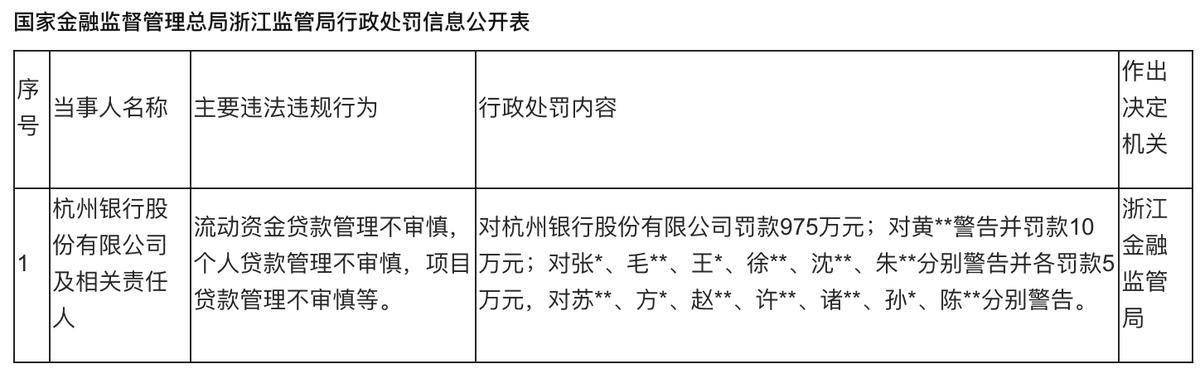
The management of working capital loans is not prudent. The most common situation in the industry is that the loan funds are not used for the declared purposes. For example, the money that should be used for the daily turnover of the company is diverted to purchase financial services, pay land fees, or even fill holes in other projects.
Careless management of personal loans is often seen in consumer loans and business loans where the funds cannot be tracked. The bank has no idea where the money went after being loaned out.
Project loan management is not prudent, and most of them are just a formality in pre-loan investigation and loopholes in post-loan monitoring.
For city commercial banks, credit asset quality is the foundation of their business. As the leading listed city commercial bank in China, Bank of Hangzhou has a large asset scale and comprehensive retail and corporate business layout. It has always been a benchmark for regional banks. Benchmark banks have shown imprudent management of multiple categories of loans, which deserves reflection.
Sister Mi’s observation is that this may be related to the business model of Bank of Hangzhou. Being rooted in Zhejiang and serving small, medium and micro enterprises is the differentiated advantage of Bank of Hangzhou.
However, the credit risk of small, medium and micro loans is higher than that of large corporate loans, and the requirements for risk control capabilities are also higher. When scale expands rapidly, problems may easily arise if the risk control system cannot keep up.
In addition, Sister Mi noticed that this is not the first time that Hangzhou Bank has been fined due to loan issues. Previously, in March, its Shenzhen branch received a large fine of 1.0185 million yuan for failing to complete the “three checks” on loans; in July 2025, its Shanghai branch received a large fine of 3.8 million yuan.
From a vertical perspective, the 9.75 million yuan fine this time is also rare in the history of Hangzhou Bank fines, which is enough to illustrate its weight.
02
From the perspective of financial data, as Sister Mi mentioned earlier, Bank of Hangzhou is considered a benchmark among listed city commercial banks.
In the first half of 2026, Hangzhou Bank’s revenue was 21.048 billion, a year-on-year increase of 4.75%; net profit attributable to the parent company was 12.813 billion, a year-on-year increase of 9.87%.
Although this growth rate has dropped a lot compared to previous years, from a horizontal comparison, it is still good. Especially the net interest margin, which was 1.39% for Bank of Hangzhou in the first half of the year, rose by 4 basis points year-on-year in a year when the industry-wide interest margin generally narrowed.
In terms of asset quality, in the first half of the year, Hangzhou Bank’s non-performing loan ratio was 0.76% and its provision coverage ratio was 471.96%, ranking among the best in the industry.
Chart source|Oriental Fortune (Thank you!)
However, changes in some data on the retail side are also worth noting.
As of the end of June 2026, the non-performing rate of personal loans of Hangzhou Bank was 1.48%, an increase of 0.27 percentage points from the beginning of the year. Among them, the non-performing rate of personal business loans was 2.08%, an increase of 0.56 percentage points from the beginning of the year.
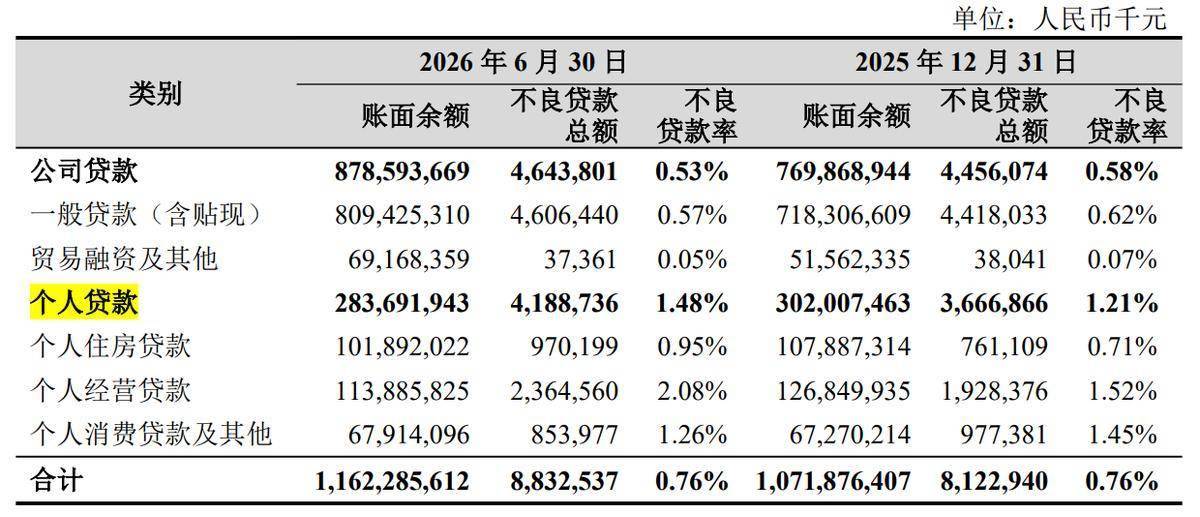
Taking a longer look at the timeline, this data of Bank of Hangzhou has been on an upward trend. Its personal loan non-performing ratio was 0.77% at the end of 2024, 1.21% at the end of 2025, and 1.48% at the end of June 2026.
In one and a half years, Hangzhou Bank’s personal loan non-performing rate has almost doubled.
However, Sister Mi noticed that Hangzhou Bank has taken the initiative to reduce the scale of personal business loans: in the first half of 2026, the balance of personal business loans decreased by 12.964 billion yuan.
However, it will take time to digest the existing risks. In 2026, Hangzhou Bank also listed 740 million yuan in bad debts for consumer loans. Vice President Pan Huafu also admitted that new personal credit NPLs may still increase in the second half of the year.
03
Also on September 30, Bank of Hangzhou just announced that Song Jianbin was re-elected as chairman, Zhang Jingke was re-elected as president, and 6 vice presidents were appointed. So far, Bank of Hangzhou has formed a stable core partner of “Song Jianbin + Zhang Jingke”.
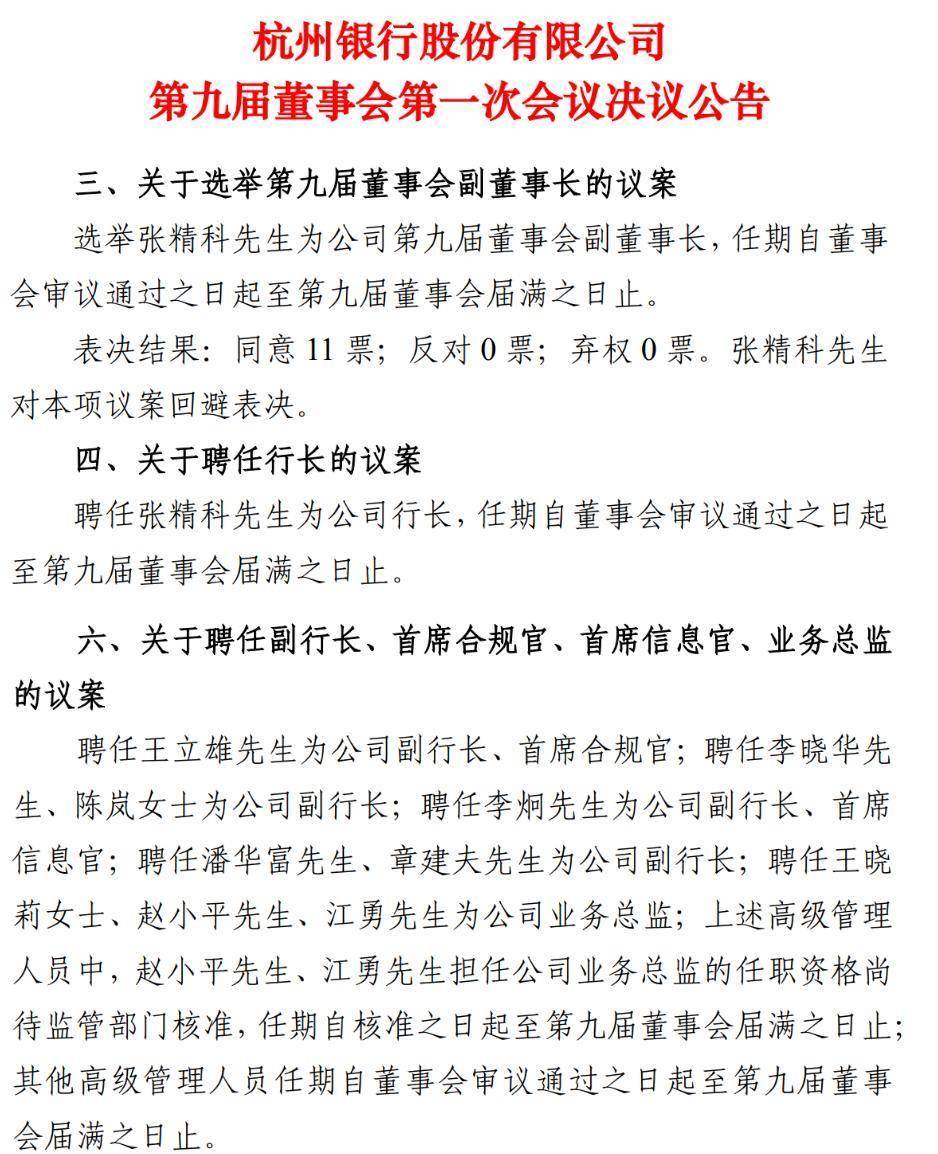
Looking back to the past, in April 2025, Yu Liming, the former president of Bank of Hangzhou, resigned from his positions as vice chairman and president due to “personal reasons.” There were rumors in the market that he had lost contact, which caused widespread concern. Yu Liming came from outside and served as deputy secretary of the Party Committee of Hangzhou Financial Investment Group.
After Yu Liming resigned, Chairman Song Jianbin performed the duties of president on his behalf. This “generation” lasted for nearly one year.
It was not until January 2026 that the Board of Directors of Hangzhou Bank approved the appointment of Vice President Zhang Jingke as President; in March 2026, Zhang Jingke’s qualifications were officially approved by the Zhejiang Supervision Bureau of the State Administration of Financial Supervision.
Who is Zhang Jingke? Born in 1978, he is a cadre trained throughout the Bank of Hangzhou and was previously the vice president. Unlike the appointment of his predecessor Yu Liming, Zhang Jingke’s appointment was interpreted by the market as “strengthening strategic coherence and professional background.”
Screenshot source|Baidu Encyclopedia (Thank you!)
What is the biggest change brought about by the new team? In Sister Mi’s view, it is a clear strategic direction.
Public information shows that Bank of Hangzhou has proposed a new round of five-year strategy “3366”. The core idea is to “take a capital-light, sustainable development path.” Mijie feels that this direction is right.
But the question is: Can the execution ability keep up? In the “Three, Three, Six, Six” strategy, the construction of six capabilities is key. If the basic risk control capabilities are not solid, no matter how good the strategy is, it will be just a castle in the air.
Judging from the fines, Hangzhou Bank’s compliance issues are not individual cases, but systemic issues across branches, businesses, and years. To solve this problem, I am afraid it requires the courage and determination to scrape the bones and cure the poison. Bless Hangzhou Bank!
The article is for discussion and analysis only and does not constitute investment advice. Charts not noted in this article are all from corporate disclosures. Please note and thank you!
Related Reading
- Hiking becomes popular during the National Day, with young people escaping from their workplaces spending tens of thousands of yuan to hike into the mountains2026-10-04
- After falling by more than 80% in 5 years, Nike has completely fallen from the altar.2026-10-04
- After not filming for more than 600 days, how did Zhao Lusi make more money?2026-10-04
- After taking the lead in scale, the most difficult problem for Chinese automobiles is profitability2026-10-04
- Original 600 billion wiped out in ashes! Arowana disguised as a domestic product, how could the former “king” decline?2026-10-03