Following “So close, so beautiful, go to Hebei on weekends”, Hebei has brought another “specialty” to the entire network.
In late August, the owner of a furniture factory in Renqiu, Hebei Province, bought 100 sets of disposable tableware in a neighboring village for 40 yuan, 4 cents a set, half cheaper than on e-commerce platforms.
He made a video: Hebei’s factories can make things so cheaply, why don’t we Hebei people create our own platform?
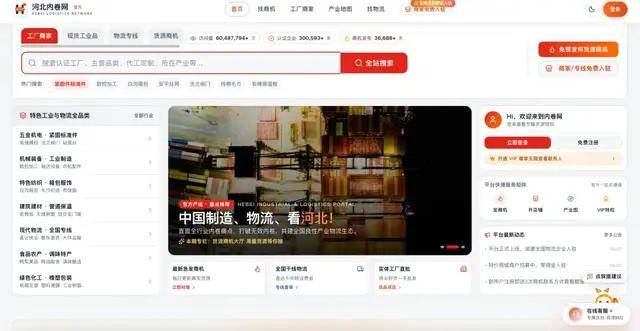
He also named this non-existent website by the way:Hebei Neijuan Network。

The video quickly reached nearly 10 million views, and the joke quickly turned into reality. In more than 20 days, seven or eight websites with the same name appeared, and domain names related to the “Hebei Involution” were sold to 56,000.
One of the websites has more than 60 million visits and more than 300,000 certified companies.
The birth of Hebei Involution Network was not originally intended for involution. On the contrary, they were afraid of being involved.
The owner of the furniture factory said that an antique tea table worth a thousand yuan could earn 30% of the profit in the early days, but now each set only earns a few dozen yuan.
Military coats priced at 50 yuan, T-shirts priced at 7 cents each with free shipping, iced black tea priced at 8 cents and 5 cents, plush bear pendants at half the price in Yiwu… These products, which are so cheap that Pinduoduo trembles, are all shipped to Hebei.

Netizens ridiculed: “No wonder there are so many generous and tragic people in Yanzhao. The fellow villagers are so generous!” “They are not trying to make money, they are just trying to work.” “It is so close and so beautiful. Purchase goods in Hebei!”
In response to these ridicules, Hebei people could only sigh.

The Hebei boss who “does not make profits but sells too much”:
No profit but price reduction
The boss in Hebei does not follow common sense when selling things.
For e-commerce companies in other provinces, the cost is 5 yuan and the product is sold for 50 yuan; in Hebei, the cost is 5 yuan, but it is sold for 4 yuan and 9.
Someone shared their shopping experience: “Buy a mobile phone holder for 1 cent, get 1 yuan in cash back, and make a net profit of 99 cents.” Another merchant said, “I did it once with a guy from Hebei. I sold it for 98 (cost) 40, and he sold it directly for 38. I followed up and got it to 38, and he sold it directly for 28, and he sold it to me immediately.”
This is no longer small profits but quick turnover, but “no profit but quick turnover”, which focuses on making no profit and selling orders in the tens of thousands.
Many merchants had difficulty understanding the psychology of their counterparts in Hebei in the past, “Do they like the feeling of packaging and shipping?”
In fact, selling even if you don’t make money involves two aspects.
One is where does the cost come from?
First is the venue. Many factories in Hebei are opened in their own homes, using their homesteads as factory buildings. In some places, even wells are dug by oneself, and electricity bills are calculated based on household electricity, so it is even cheaper to start work in the middle of the night. A businessman from Zhejiang who went to Pingxiang for inspection calculated that the rent for the factory with the best conditions in the local county development zone was only one-third and a quarter of that in the coastal areas of Jiangsu and Zhejiang.
Second is the labor cost. Some media reported that people working in workshops in Hebei are often villagers from surrounding villages, or even members of their own family. When people need to be hired, they are basically women from nearby villages. Their salary requirements are not high, and they only want flexible time so that they cannot delay picking up their children or taking care of their families. When there were not many orders, the whole family came together – the employees were all born by the boss himself, how can they compare with their counterparts in other places?
In addition, there are various industrial clusters that reduce procurement costs; and the increasing shipment volume dilutes logistics costs. In 2025, Hebei’s express delivery business volume will be 11.96 billion pieces, a year-on-year increase of 25.4%, ranking first in the country.
They use their own land, labor during off-farm periods, accessories made in the neighboring village, raw materials bought in groups, preferential express fees for huge orders…the costs are all “deducted”.
The other half of the reason why you have to sell even if you don’t make money lies in the rules of the platform.
The lower the price, the higher the ranking of the product display page; in order to get free traffic, merchants can only push the price down again and again. Someone specially designed a “drainage product” – the user sees a pen selling for only 1 cent, and when he clicks on it, he discovers that the 1 cent is a pen cap, and the pen costs 1 yuan.
The same goes for cashback for good reviews. It looks like charity, but it is actually to deal with the platform’s service evaluation scores. The scores are directly linked to the rankings, which is safer than fraudulent orders.
But the most direct cost of doing this is that their profits are extremely thin.
An owner of a Cangzhou fishing rod factory said that he used to earn a few yuan for a set of fishing rods, but now he only earns a few cents, which is enough to pay the workers’ wages. In some highly competitive industries, the boss’s profit is not even as much as that of the skilled craftsman he hired.
Some merchants who had been copied and surpassed by their peers in Hebei were completely convinced after going to Hebei for an on-the-spot inspection and completely gave up the idea of competing with them on price.
After all, not only does it have ultra-low cost, but its Hebei counterpart also has an almost invincible underlying code.
The sentence “It’s better than farming”,
Forced Yiwu into a middleman
There are some historical reasons why Hebei e-commerce is so unbelievable.
Compared with some coastal areas, Hebei e-commerce entered the market relatively late. A practitioner said, “Those around us who entered the e-commerce industry earlier would not have entered the e-commerce industry until around 2015.” “Some of our counterparts in the south entered the industry very early. They even had two crown stores in their stores before we started.”
The pioneers have rich operating experience and platform support. As a latecomer, Hebei, which has no advantages, wants to break the old pattern and get a piece of the pie, so it has to cut the price.
The price of rolls is very cruel, but Hebei people are very open-minded.
For the difficulties and obstacles in trying various businesses, they have a common underlying code and standards:It’s better than farming.
A furniture merchant in Hengshui said: “Like selling a table, the bosses in some places have to earn at least a thousand. We think it is enough to earn a few hundred, as long as we can continue doing it for a long time.” Some netizens have done some calculations: growing one acre of corn can earn about 800 yuan a year, and making small commodities can earn one or two hundred yuan a day. Information from Qichacha shows that there is an individual industrial and commercial household called “Bizhangdiqiang Clothing Store” in Suning County, Cangzhou, Hebei.
Extremely low profit expectations allowed them to quickly catch up.
But the reason why we can support the idea that “it’s better than farming” is thanks to the wealth of the entire Hebei Province – there are clusters in almost every county.
There are 333 county-level characteristic industrial clusters in Hebei with annual revenue exceeding 500 million yuan, covering 66 subdivisions in 9 categories, including 6 clusters exceeding 100 billion yuan and 113 clusters exceeding 10 billion yuan. By 2024, 107 provincial-level key county-level characteristic industrial clusters will achieve operating income of 3.6 trillion yuan, a year-on-year increase of 9.3%.
For example, Pingxiang County produces 145 million bicycles, strollers and toys a year, accounting for 50% of the domestic market and 40% of the international market; Nanhe District’s pet food supplies more than 60% of pet dogs’ jobs in the country; Anping’s wire mesh accounts for 80% of the national market, with annual revenue exceeding 100 billion; Baigou produces about 1 billion bags annually, and one of every four bags sold on the market comes from here.
The general manager of a textile company in Gaoyang once revealed in an interview: “Our greatest advantage is the industrial cluster.” From spinning, weaving, printing and dyeing to packaging and logistics, all supporting links can be found within a radius of 5 kilometers.
In Huangzhuang Village, Gaocheng District, Shijiazhuang, there are 113 mooncake production companies in this village alone.
In Hebei, a street may be a production line that has been dismantled among the people.
In the end, even Yiwu’s small commodities often have to avoid the edge when encountering “Made in Hebei”.
When merchants in Yiwu discovered that the ex-factory price in Hebei was even lower than their purchase price, they directly chose to purchase the goods from Hebei and then wholesale them at a higher price in Yiwu. They were forced by Hebei e-commerce companies to become “traitors”. In Hebei, there is even a group of specialized “online suppliers” who combine family workshops and scattered online stores to help online stores put together fragmented orders one by one. The industry jokingly calls them “putting together a good package.”
But this scene also somewhat revealed the embarrassing situation of Hebei e-commerce companies: they are busy working, but they are mostly making wedding dresses for others.
The tragedy of Hebei e-commerce:
Price depression = brand depression
Low prices put “Made in Hebei” on the table, and also kept it at the thinnest link in the value chain for a long time.
Cui Lili, deputy director of the Institute of Digital Economy at Shanghai University of Finance and Economics, said: These county clusters in Hebei generally have “strong manufacturing and processing but weak channel capabilities.” There are almost no brands, and all are OEM or white brands. It is impossible to increase premiums through brands, and competition relies entirely on price cuts.
A price depression will almost certainly turn into a brand depression. If you can’t develop a brand, you can only continue to raise prices.
Hebei’s industrial scale ranks sixth in the country, second only to Zhejiang, Jiangsu, Shandong, Guangdong, and Hunan. However, data shows that among the 1,000 consumer brands in the country, 678 are made in mainland China, but more than half are concentrated in the five cities of Shanghai, Hangzhou, Shenzhen, Guangzhou, and Beijing. Hebei is almost completely wiped out among the top 500 brands, and only 6 of the top 1,000 brands are included.
Baigou in Baoding, Hebei Province is a typical example.
This is the largest luggage production and sales base in the country, with an annual output of about 1 billion bags. The production capacity is amazing, but there is still no independent brand that is well-known by the public. Gao Yongli, vice president of the Baigou Luggage Industry Association, said in a CCTV interview: Everyone has been struggling in the past two years. As the scale has increased, profits have become thinner.
In addition to being difficult to make money, blindly low prices will also bring many adverse effects, which is destined to not be a long-term solution.
One is obvious internal friction, which hurts both sides.
“These manufacturers who engage in price wars sometimes fail to calculate clearly,” said a 1688 insider. Many small factories are not so sensitive to expenditures. Sometimes they roughly sum up various costs and think they can make money by engaging in price wars. But in fact, the outcome may be a lose-lose situation for both parties.
Another is that product quality is difficult to guarantee, which drags down regional reputation.
A rubber factory owner who moved his factory from the south to Hebei observed that many small factories did not know how to correctly reduce costs and increase efficiency, so they relied on mixing low-priced raw materials and cutting time in the process. The quality was greatly affected, so much so that a large number of “lightning protection posts” appeared on the Internet.
Therefore, many Cangzhou fishing rod factories would rather spend a few more yuan on logistics fees and detour shipments through Weihai and Beijing, because there is a saying in the circle that “Weihai, Shandong, is good, but Cangzhou, Hebei, be careful.”; Xingtai Nanhe’s pet food was once labeled “Hebei food is equal to poisonous food.” Later, some merchants simply changed their registration places to Shandong and Shanxi next door.
These are of course not the fundamental solutions to the problem. What they need is breakthroughs in innovation, branding, channels, etc. to end the involution.
Being able to offer low prices is part of strength, but it is not enough to gain a firm foothold.
Compared with low prices, having bargaining power is a reflection of strength.
Related Reading
- Original Hilton offers more than 200 yuan, the more you open, the more you buy2026-09-26
- China’s female drug king has turned the tables on global drug kings2026-09-26
- Double the average! Diamonds can’t be sold, but they are rising more and more2026-09-26
- Meta’s new AI agent wants to make managing money easier2026-09-25
- Mortgage rates top 7%, dealing a further blow to the frozen housing market2026-09-25