
The Mid-Autumn Festival and the National Day are approaching, and many young people plan to take a relaxing trip. When booking a hotel, they were filled with joy when they saw the word “Hilton”. The price is not expensive. It only costs more than 200 yuan a night. It feels like a better deal than Dodo and All Seasons. But everyone who knows the business knows that this Hilton is not a Hilton. You get what you pay for. It is almost impossible to spend more than 200 yuan to get a five-star hotel experience.
01. This Hilton is not that Hilton
The word “Hilton” was once synonymous with luxury.
In 1988, Hilton entered China and opened its first store on Huashan Road in Shanghai. It is said that the opening ceremony alone cost US$800,000 and lasted three days; the guest rooms were filled with overseas VIPs, and dozens of imported fruits were displayed at the banquet. Now, 38 years later, Hilton is no longer the Hilton it used to be.
Before the Mid-Autumn Festival holiday, Wang Qi, a post-90s white-collar worker, planned to go to Qingzhou, Shandong Province. When I open the booking software, in addition to familiar faces such as All Seasons, Atour, and Orange, a “Hampton by Hilton” pops up. The location is good, close to the ancient city of Qingzhou. On the Mid-Autumn Festival, a superior double room costs only 296 yuan a night, including two breakfasts. In comparison, the same room type throughout the season costs 298 yuan without breakfast, and the price with two breakfasts is 376 yuan.
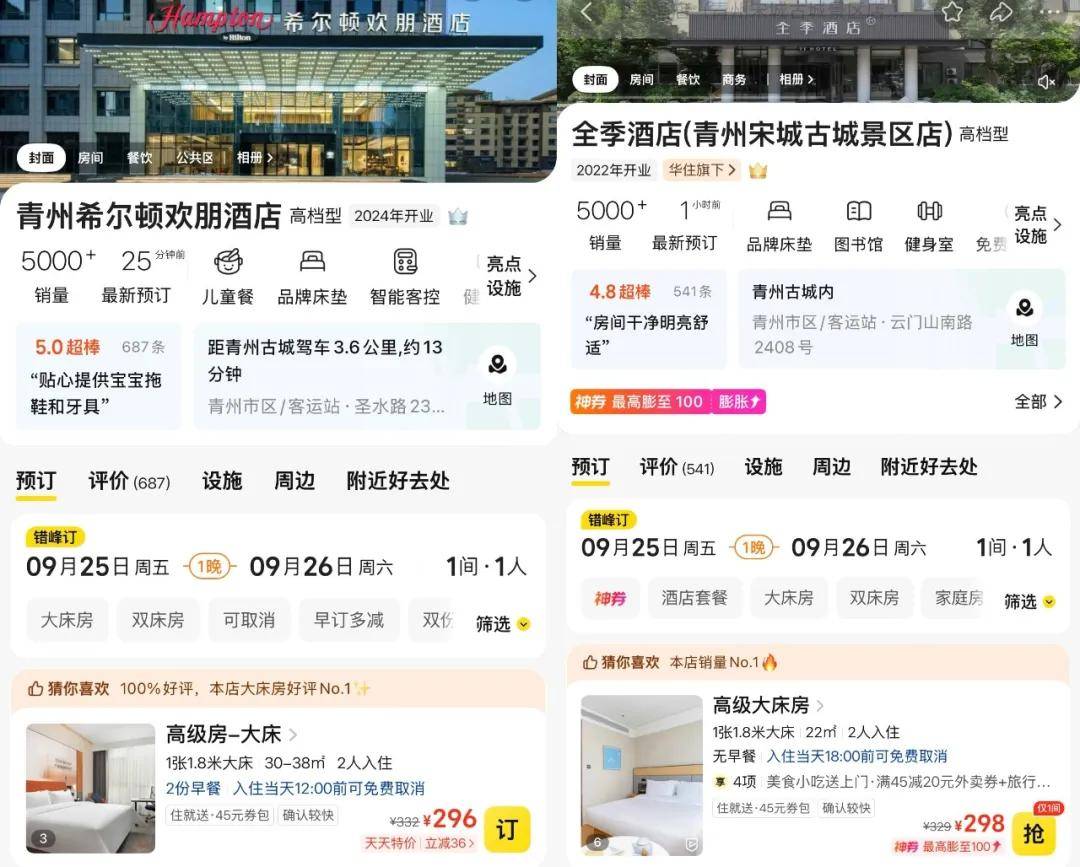
▲Picture source/screenshot of a certain booking platform
“Is there a Hilton in a small county?” “Do you have to rely on cheap prices to compete with Jiji for customers?” Two questions popped up in Wang Qi’s mind. Immediately afterwards, the third question came – couldn’t this be a fake Hilton?
Gao Min had the same doubts. During this May Day holiday, she traveled to Xingtai, Hebei Province, and booked a Hilton Garden Inn hotel on Fliggy. The room rate for one night was only 241.58 yuan, which was much cheaper than Biadot and All Seasons. She thought she had found a treasure, but she was disappointed after checking in. “Not only is the breakfast variety limited, but the elevator is also very small. You have to wait for a long time to get up and down.”
“Although it is labeled as a Hilton, this Hilton is not a Hilton, that is, it is just an ordinary hotel.” Gao Min bluntly told Caijingtianxia that the core factor why Hilton is a Hilton is that the hotel facilities are good, the lobby is magnificent, the elevator is spacious, the bathtub is standard, not to mention the service. The Hilton she lives in is obviously not up to the standard.
In July this year, Qian Yu stayed at Hilton Homewood Suites in Hohhot. The experience was not very good. The room was small and noisy. You had to wait for more than 2 minutes for the elevator during peak hours, and you had to queue up for breakfast. What’s more important is that the hygiene is not up to standard and there are hairs on the bed. Qian Yu said helplessly: “I feel like I have lived in a fake Hilton, and I never want to live there again.”
The Hilton hotel where Wang Qi, Gao Min, and Qian Yu stayed is actually not the same thing as the five-star Hilton hotel in public perception. Knowledgeable guests generally automatically classify it into the category of All Seasons and Atour, and do not have high expectations.
Take Hampton by Hilton as an example. Hilton only provides brands and is responsible for exporting standards and membership systems. From development preparation, supply chain to daily operations, it is all managed by Jinjiang Group. The industry often calls it a “hybrid model.”
Hilton Garden Inn and Home2 Suites by Hilton are in a similar situation. The former was originally Hilton’s “son”, but after the launch of the franchise model in 2021, the daily operations of newly opened hotels were directly handed over to the owners; the latter is the product of a “hybrid” between Hilton and Country Garden’s Fengyue Hotels and Resorts.
Relying on Hampton by Hilton, Hilton Garden Inn, and Homewood Suites by Hilton, Hilton has achieved remarkable results in its expansion in China. In August, Hilton announced that the number of hotels operating in Greater China had exceeded 1,100. Among them, Hampton by Hilton has 550, accounting for nearly half.
At the same time as the expansion of the number of stores, consumers are also disenchanted with the word “Hilton”.
Some people originally placed an order based on the word “Hilton”, thinking that there would be high-standard service, but when they arrived, they found that it was just like an ordinary hotel. “The water in the room of Atour and All Seasons was at least Nongfu Spring, but Hilton was Pure Joy. It felt like I was staying in a fake five-star hotel.”
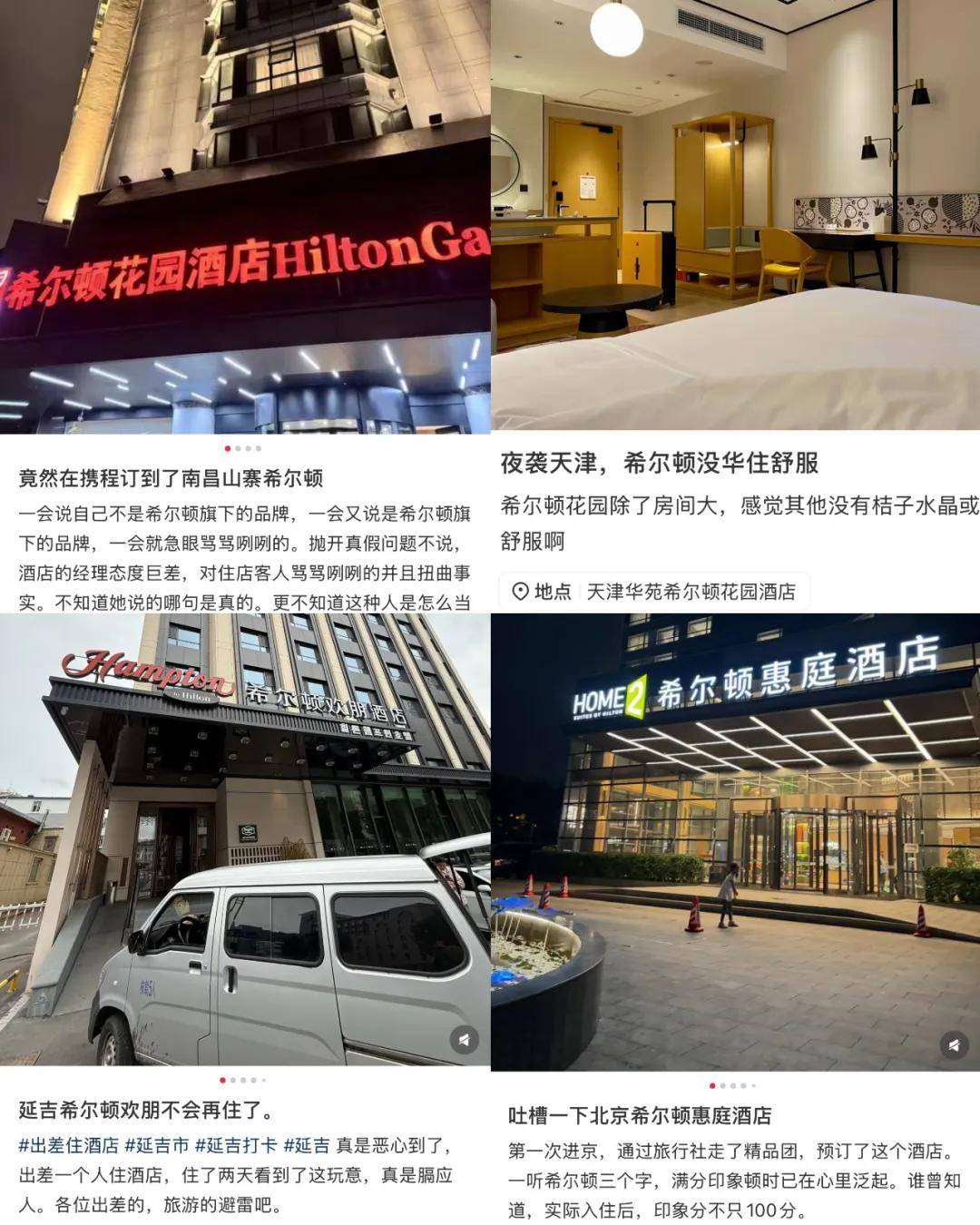
▲Picture source/Xiaohongshu
Someone else stayed at the Hilton Garden Inn in Shanghai and found that the TV did not have a screen projection function and the bedside socket was too loose to charge. What is more concerning are the inconspicuous places: the disposable slippers are so thin that they are visible to the naked eye, and there are no welcome fruits.
After the gap was too big, some people shared their experiences on social media, frankly admitting that “you get what you pay for”, and reminded netizens to pay attention. Gao Min later stayed at a Hilton in Zhuhai, and it was a completely different experience. Before arriving at the hotel, the housekeeper communicated the details in advance. Although the price of 800 yuan a night was a bit high, the view was very good. The Macau Tower was opposite, and someone helped with luggage as soon as he got off the bus.
02. The product of the mid-range battle
The proliferation of Hilton brands in China is actually a product of Hilton’s decline in the Chinese market.
Looking back at the development history of China’s hotel industry, 2014 was a landmark year. This year, local groups and foreign giants have all set their sights on the same mid-range “cake.”
On the one hand, after more than 10 years of competition, budget hotels have become saturated, and the price war has driven profits to the bottom. In order to find growth, many franchisees opened stores in fourth- and fifth-tier cities, only to find that they could not sell at high prices. On the other hand, affected by policies, government consumption demand plummeted, and five-star hotels also faced excess inventory.
Coupled with McKinsey’s data support – the potential consumer groups in China’s mid-range hotel market are expected to continue to expand at an annual growth rate of about 10%. The entire industry has reached a tacit consensus: Those who win the mid-range hotel market will win the world.
It was in this year that Hampton by Hilton was introduced to China under this background.
In the past, most foreign-funded high-star hotels in China controlled their operations personally. But when it comes to the mid-range market, this style of play fails. Mid-range hotels compete to see who can run faster, lower costs, and understand the thoughts of local franchisees better. These are precisely the strengths of local hotel groups. As a result, the foreign giants invariably changed their strategy: “rent” the brand and retreat behind the scenes to collect management fees.
At that time, a senior executive of Hilton Group said that the cooperation with Plateno (later acquired by Jinjiang) was finalized within one month, and the Hampton by Hilton brand was launched three months later.
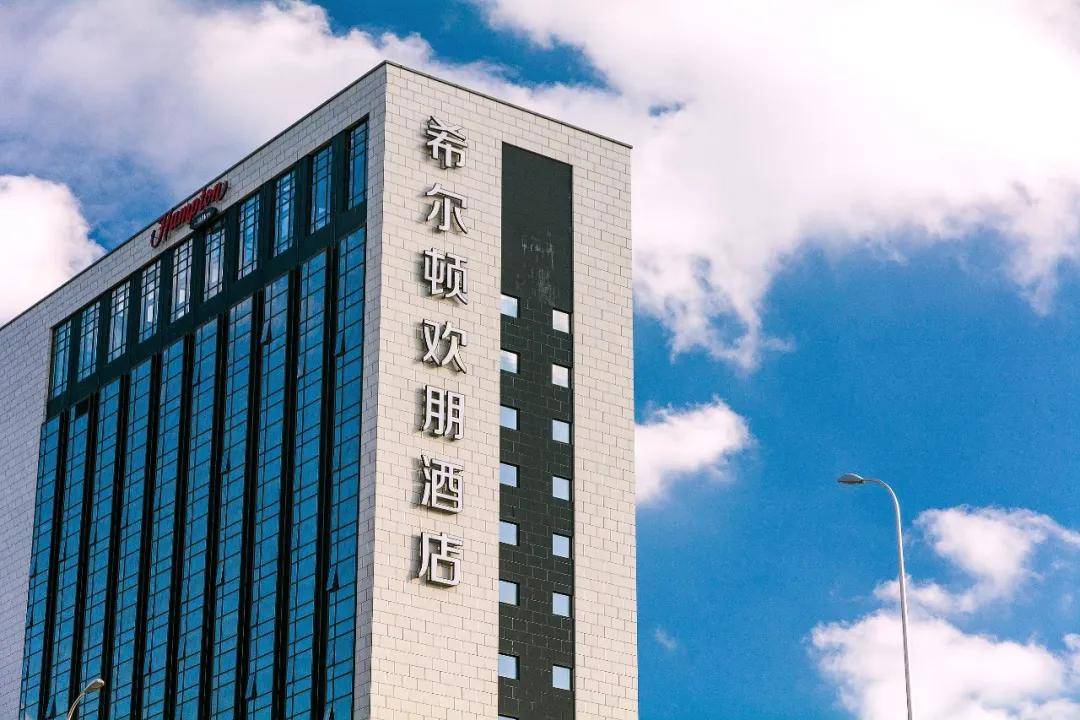
The first advantage of this “hybrid” model is its rapid expansion. Originally, the review of franchisees by international hotel brands required approval at all levels within the group. However, through cooperation with Plateno, Hilton Group has fully transferred the decision-making power, and the cycle from site selection to signing of franchisee stores has been greatly shortened.
In December 2015, the first Hampton by Hilton opened in Sanya. In less than 3 years, the total number of stores exceeded 50. After that, it took Hampton by Hilton 6 years to increase the number of stores eightfold to more than 400.
In order to compete with local brands for franchisees, Hampton by Hilton has adopted a lighter model. Important facilities such as banquet halls, executive lounges, and all-day dining restaurants have been greatly streamlined, leaving only the core accommodation functions. The saved area and cost reduce the pressure on franchisees and free up room for price reductions.
In 2019, Wang Wei, then president of Hampton by Hilton, revealed that the cost of a single room in Hampton by Hilton was 150,000 to 200,000 yuan. In 2025, after multiple product iterations, the new generation product will cost approximately 170,000 yuan. Although it is still higher than Ador and All Seasons, the word “Hilton” and the membership introduction of Hilton Group can always attract some franchisees to pay.
Even saving time for franchisees has become a bargaining chip. Hilton Garden Inn has said that through comprehensive modularization and standardized design, the hotel’s preparation time can be shortened to the greatest extent, ensuring that owners can complete all design and preparation work within 6 to 8 months.
In this whole set of logic to compete for the mid-range market, cost control, franchisee interests, and scale growth are the key. Whether it can provide consumers with a high-end experience is not in this logical priority sequence.
03. A new round of horse racing and staking
Of course, this wasn’t the Hilton family’s choice either.
In the past 10 years or so, almost every international luxury hotel group with a name, from AccorHotels, Marriott to Hyatt, has found local “partners” in the Chinese market and used similar methods to enter the Chinese market.
In 2014, AccorHotels and Huazhu signed a strategic alliance. According to the agreement, Huazhu will become Accor’s exclusive general franchisee in China and Mongolia, responsible for the operation and development of Accor’s brands such as Grand Mercure, Novotel and Mercure.
In 2016, Marriott signed a contract with Dongcheng Group, handing over the development and management rights of the mid-range brand “Wan Maple” in the Chinese market (excluding Hong Kong, Macao and Taiwan) to Dongcheng. Regarding the specific cooperation model, Marriott will export the brand and control the standards, while Dongcheng will be responsible for development and management. The reservation systems and membership systems of both parties will be connected and shared.
Hyatt has more strategies. In 2018, it first authorized Minyoun Hotels and Resorts as a cooperative company to focus on the management of two brands, Hyatt Place and Hyatt House. In 2019, Hyatt established a joint venture with BTG to launch a new brand “Yifei”.
Although the specific cooperation models of each company are different, the underlying logic is highly consistent: the international group is responsible for exporting brand IP and standards, and the local partners provide franchisee networks, property resources, and localized operating capabilities; one side seeks scale expansion, and the other side earns brand premiums, each getting what it needs.
However, due to the tightness of authorization and obvious differences in the capabilities of the partners, the results of this collective bet were uneven.
Brands such as Wanfeng and Yifei did not spread as quickly as expected. In just three years, the cooperation between Marriott and Dongcheng was terminated early. An interesting detail is that in 2025, Marriott directly followed Hilton’s lead and added “Marriott” directly in front of Wanfeng, trying to use the aura of Marriott’s parent brand to give this mid-range brand a halo.
Hilton has outgrown its scale, but the other side of the coin is that the gold content of the parent brand continues to be diluted.
For international brands, China’s mid-range market is still a hot spot. Not long ago, the vice president of Intercontinental Group publicly stated that China’s hotel consumer market has emerged as a stratification phenomenon. The silver economy, the intergenerational wealth inheritance of Generation Z, and the county market opportunities brought by urbanization have jointly constituted the driving force for the growth of mid-range hotels.
Various companies have also started a new round of competition to compete for this mid-range cake.
According to media statistics, since 2026, four new international hotel brands have been intensively launched in China, from Marriott Hotels to Hyatt Place, from InterContinental to Hilton Garden Inn. Slightly stretching the time axis, in one and a half years, 13 brands have entered China, almost all targeting the “mid-to-high-end selected services” level.
At the same time, in sinking markets, it is becoming more and more common for Hampton by Hilton and Marriott to compete for land at the same intersection. The focus of opening stores of Hampton by Hilton and Hilton Garden Inn is also shifting from the core areas of first- and second-tier cities to the transportation hubs and new districts of third- and fourth-tier cities.
Behind the lively horse racing arena, there is still the same knot that cannot be circumvented.
The international group wants to use the fame of the parent brand in exchange for the scale of the sinking market. However, the more stores there are and the closer the prices are to local chains, the easier it is for the original high-end brand filter to wear out. Franchisees wanted international brands to bring premium prices, but ended up getting involved in a price war with All Seasons and Atour. Consumers place orders based on familiar names, and often find a gap between expectations and reality after checking in.
At the end of the day, you get what you pay for. Brand premium is called a brand when it can be sustained. When it cannot be sustained, it is just a premium.
(Wang Qi, Gao Min and Qian Yu are pseudonyms in the article)
Related Reading
- Original: A T-shirt sells for 2 yuan, and Hebei people are stunned by Yiwu2026-09-26
- China’s female drug king has turned the tables on global drug kings2026-09-26
- Double the average! Diamonds can’t be sold, but they are rising more and more2026-09-26
- Meta’s new AI agent wants to make managing money easier2026-09-25
- Mortgage rates top 7%, dealing a further blow to the frozen housing market2026-09-25