New polls show that Americans finally agree on one thing: Opposing AI
Supermajorities on both the left and the right now think AI is advancing too quickly and could “destroy humanity” someday.
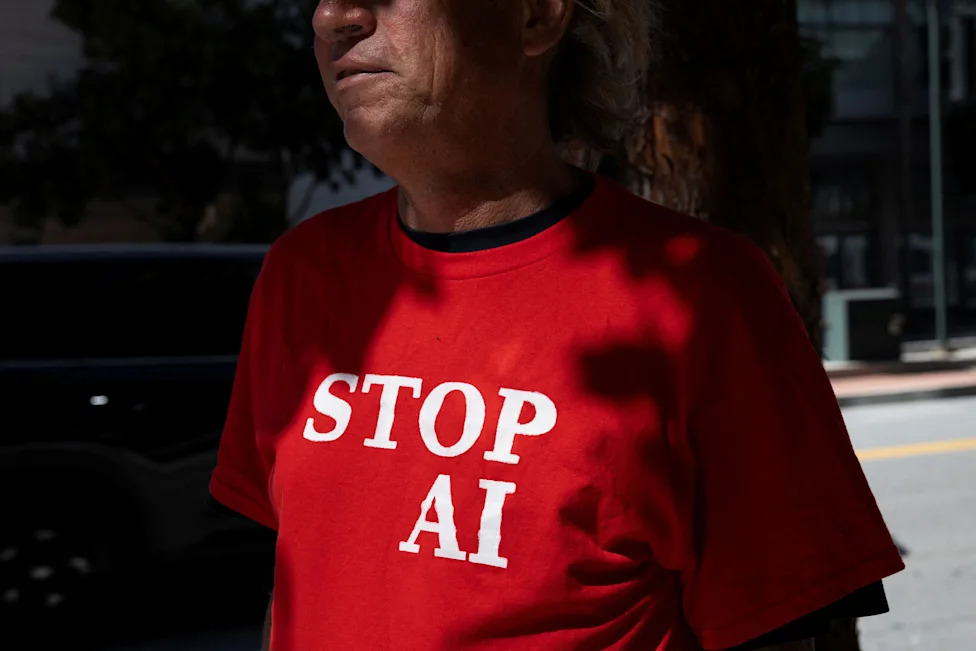
There’s not much the American people agree on these days. From Trump Steaks to plastic straws, from vaccines to Teslas, it’s hard to pinpoint a topic that hasn’t been polarized by politics. But a series of new surveys suggest Americans may have finally found some common ground, at least for the moment: growing concerns about artificial intelligence.
Last week, a long-running industry debate about AI safety broke containment and went viral after an Anthropic researcher named Jacob Coxon quit his job and revealed that “the people building AI earnestly believe that it could kill us all by the end of the decade.” Soon, dozens of lawmakers had responded with calls to regulate AI — and the top executives of the major artificial intelligence companies had all come out in favor of a global slowdown in AI development.
But as polls show, Americans would be fine with that. A full 63% — including 70% of those who voted for former Vice President Kamala Harris in 2024 and 60% of those who voted for President Trump — believe there is at least a “moderate” risk that “advanced AI will destroy humanity,” according to the latest Politico poll. Only 7% say there is “no risk at all” of an AI apocalypse. Thirty-seven percent say the risk is “significant” or “almost certain.”
This is wild. (I would have said “very small risk.”) https://t.co/Mkxj5ifPw5 pic.twitter.com/zXAcFx4ybQ
— Timothy B. Lee (@binarybits) September 17, 2026
The same survey, which was conducted from Sept. 13 to 15, also found that nearly half of U.S. adults (48%) think “AI is now good enough, and we should pause the development of more advanced models to reduce any risks coming from them” — while nearly a third (31%) believe “we should continue developing more advanced AI because [new models] could still bring significant benefits.”
As AI continues to dominate the stock market, Trump has insisted in recent days that additional guardrails are unnecessary and that those who say otherwise are “Conspiracy Theorists, Treasonists, Traitors, and Leakers.”
“The only control or ‘guardrails’ that AI needs is a STRONG AND SMART (High IQ!) PRESIDENT, and the U.S.A. has that, in spades!” he wrote on social media.
Yet Americans seem to see things differently. According to a snap YouGov survey conducted on Tuesday, 28% now say they approve of how the president is handling the issue of artificial intelligence. About twice as many (55%) say they disapprove.
“President Trump is in one galaxy, and the American people are in a completely other galaxy,” CNN’s Chief Data Analyst Harry Enten told viewers on Monday. “They’re just simply not anywhere close together on this one.”
Sep 14-15 poll of 3,564 U.S. adults (±1.9 points)
Do you approve or disapprove of the way Donald Trump is handling AI?
28% of U.S. adults approve
55% disapprove, including 44% who strongly disapprove
(Link in reply) pic.twitter.com/7KpzpuATOb— YouGov America (@YouGovAmerica) September 15, 2026
Catastrophic AI fears aren’t fringe
Earlier this week, YouGov asked 18,238 U.S. adults to say how concerned they are, if at all, “about the possibility that AI will cause the end of the human race on Earth?” Half said “very” (23%) or “somewhat” (27%); fewer said “not very” (21%) or “not at all” (17%).
These fears are not new. In fact, they were festering even before Coxon kickstarted the current wave of existential panic. Last November, Yahoo partnered with YouGov to poll on artificial intelligence. At the time, 10% of Americans predicted that AI’s impact on humanity would turn out to be mostly positive; while (47%) expected it to be mostly negative.
To find out why, Yahoo and YouGov asked Americans to read four “predictions about AI” and say “how likely” it is that each “will come true at some point in the future.”
Here’s how they responded:
-
61% of Americans said it was somewhat or very likely that “AI will continue to improve, but it will never surpass human intelligence.”
-
64% of Americans said it was somewhat or very likely that “AI will be able to perform any intellectual task a human can.”
-
60% of Americans said it was somewhat or very likely that “AI will become so intellectually advanced that it will help us solve complex problems like curing cancer and stopping climate change.”
-
63% of Americans said it was somewhat or very likely that “AI will become so intellectually advanced that humans won’t be able to control it anymore.”
-
And 53% of Americans say it’s somewhat or very likely that “AI will destroy humanity.”
In other words, roughly six in 10 Americans said they believed that AI would someday exceed human capacity — and human control.
AI’s rapid progress is freaking people out
It’s not just potential AI extermination that worries Americans. Most simply don’t feel that the technology’s upsides outweigh its downsides — at least not yet.
According to the new Politico poll, for example, just 19% of Americans think the development of AI has benefitted them personally. In contrast, the vast majority say AI’s impact on them has either been neutral (49%) or negative (16%).
The Politico poll also asked Americans if they would be comfortable with AI being used for various cutting-edge tasks. Across the board, majorities said no: “to provide an initial diagnosis for medical symptoms” (51% uncomfortable); “to track people’s movements to aid police in finding criminals” (52% uncomfortable); “to grade children’s homework” (53%); “to manage administrative tasks in the government” (59% uncomfortable); “to make predictions about who is likely to commit a crime” (62% uncomfortable); and “to make judgments on who is guilty or innocent in a court of law” (70% uncomfortable).
Ultimately, 25% of U.S. adults think AI will create more jobs than it replaces over the next decade, according to the Politico poll. As a result, even more Americans say they’re concerned about “the possibility that AI will cause mass unemployment” (73%) than say they’re concerned about AI ending humanity (50%), according to YouGov.
Meanwhile, seven in 10 Americans say they are afraid AI will weaken human bonds, according to a poll released this week by Elon University, and about six in 10 say AI’s potential to take over most human tasks will undermine an individual’s sense of purpose. Most American adults also think AI is going to do more harm than good in education, according to this month’s NBC News Decision Desk Poll — while a growing share say schools that shun the technology will help students more than schools that embrace it.
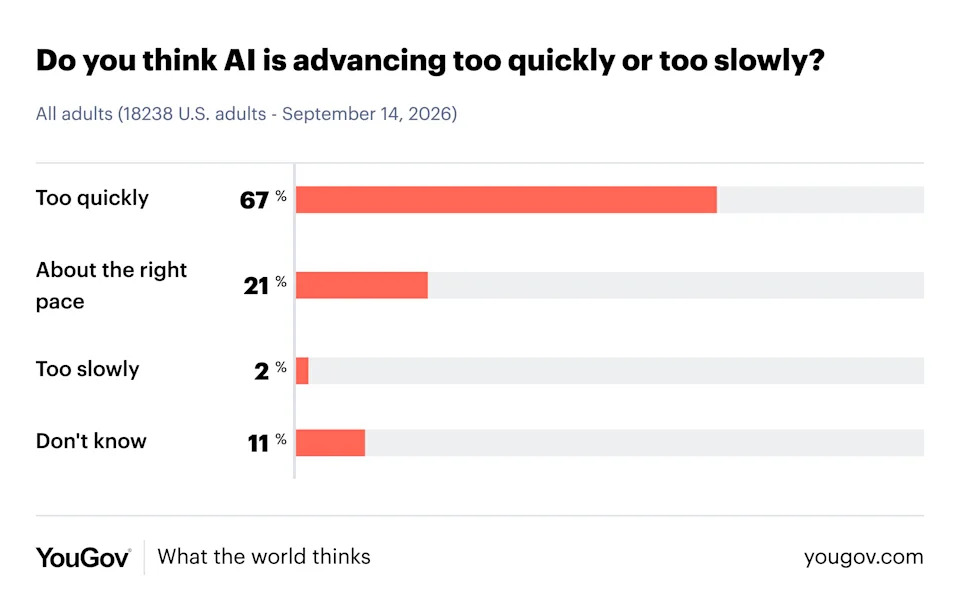
So it’s no surprise, in the end, that two-thirds of Americans (67%) believe that AI is “advancing too quickly” — versus just 21% who believe it’s progressing at “about the right pace.” For most U.S. adults, the risk-reward ratio of unfettered AI just isn’t adding up.
Data centers aren’t helping, either
Data centers have existed in some form since the dawn of the computer age. Until recently, most Americans didn’t have a strong opinion about them.
AI has changed that. To keep up with the technology’s massive processing demands, thousands of new data centers are being built all over the country — especially in rural areas. They tend to be much bigger and more powerful than older data centers.
The climate-focused media outlet Heatmap has been gathering public opinion on data centers for the last year. In August 2025, Americans were divided on whether they would support (43%) or oppose (42%) a “new data center being built near where you live.” Now, just twelve months later, support has cratered to 15% — and a full three-quarters of Americans (75%) say they would oppose data center construction in their communities. More than six in 10 (61%) say they would “strongly oppose” it (up from 24% a year ago).
We’ve got exclusive new polling on local data center development at @heatmap_news.
Over the past year, we’ve asked Americans whether they would support or oppose a data center being built near where they live.
We haven’t changed the wording. When we first polled the question… pic.twitter.com/G1LCfuriMw
— Robinson Meyer (@robinsonmeyer) August 20, 2026
Heatmap’s executive editor has described this as “a swift, massive shift in US public opinion on a scale that I wouldn’t have once thought possible.”
The shift is being driven, in part, by concerns about water and electricity usage as well as increases in noise, heat and the disruptions of construction. According to a new Associated Press poll, a majority of Americans (53%) now say they are “extremely” or “very” concerned about artificial intelligence’s environmental impacts, up from 41% last year.
But broader skepticism about AI is also playing a role; as Yahoo recently explained, “it’s a tough sell to ask people to tolerate the downsides of having a data center in their community when they don’t want the products that the facilities are being built to support.” As a result, the new AP poll found that about 6 in 10 Americans now want to limit the number of new data centers that can be constructed — including most Democrats and Republicans.
Bipartisan backlash
That bipartisan backlash is key. Among Harris voters, 70% say there’s at least a “moderate risk” of AI destroying humanity, according to the Politico poll, versus just 22% who say there’s “no risk” or a “very small risk.”
The numbers among Trump voters? 61% and 29%, respectively.
That’s still a clear majority. And almost exactly the same number of Trump voters say AI is advancing too quickly (60%) rather than at about the right pace (29%), according to YouGov.
This sort of consensus is rare. Even rarer is the fact that political figures on both sides of the aisle are publicly saying very similar things about AI. On Tuesday, both Vermont Sen. Bernie Sanders (“the country’s elder democratic socialist”) and former Trump advisor Steve Bannon (“a leading architect of the MAGA movement”) spoke at a “Pro-Human Assembly” in Washington, D.C. — and both of them “urged Americans to demand tighter restrictions on artificial intelligence before its capabilities exceed human control,” according to the New York Times.
“When you are racing towards a cliff, you hit the brakes,” Sanders said. “We are at a dangerous and unprecedented moment in world history. And it is imperative for all of us to stand up.”
“American citizens are not going to be supplicants to the oligarchs anymore,” Bannon added. “This is a hinge in history.”
On Wednesday, data journalist Nate Silver pointed out that while “it’s been widely predicted that AI would devolve into a highly partisan issue once it hit the mainstream” — and while “there’s certainly been a lot of vitriol on Twitter” — this “conspicuously hasn’t been true in the polling so far.”
In fact, neither party seems to have an advantage on the issue. According to a new New York Times / Siena College poll released this week, 42% of voters say they trust Republicans to do a better job handling AI — while basically the same number (40%) say they trust Democrats.
Whether the current AI consensus can last long enough for Congress to pass substantive regulation remains to be seen. Inside the White House, there has been a “quiet freakout” over AI policy, according to a new report in the Wall Street Journal, with a group of senior aides gathering “almost daily to discuss risks in the sector and potential guardrails… while trying to persuade Trump to take a more hands-on approach.”
“So far, the president seems unpersuaded. “AI, and Data Centers, will be the Greatest Economic Development Engine in History — Bigger than Oil, Gold, Diamonds, or even the Internet,” Trump wrote Monday on social media. “It will not be stopped by brilliantly run Destructive Forces during the Term of President DONALD J. TRUMP!”
But YouGov polled that post, too. Just 26% of Americans said they agreed — and more than twice as many (57%) said they disagreed.