A few weeks ago, I sent out a small team of AI agents to conduct a small experiment by letting them build lineups and manage teams.
Now that AI agents have penetrated into every aspect of life, I want to try: Can a group of AIs come together to form a winning dream team?
In fact, I tried using AI to play fantasy leagues a few years ago. At that time, I used a tool from the British Turing Institute, which relied on modeling past league data to select lineups, but the suggestions it gave were outrageous. It does not consider the actual situation at all. Key information such as whether players are injured or whether the team has changed coaches is not included in the reference.
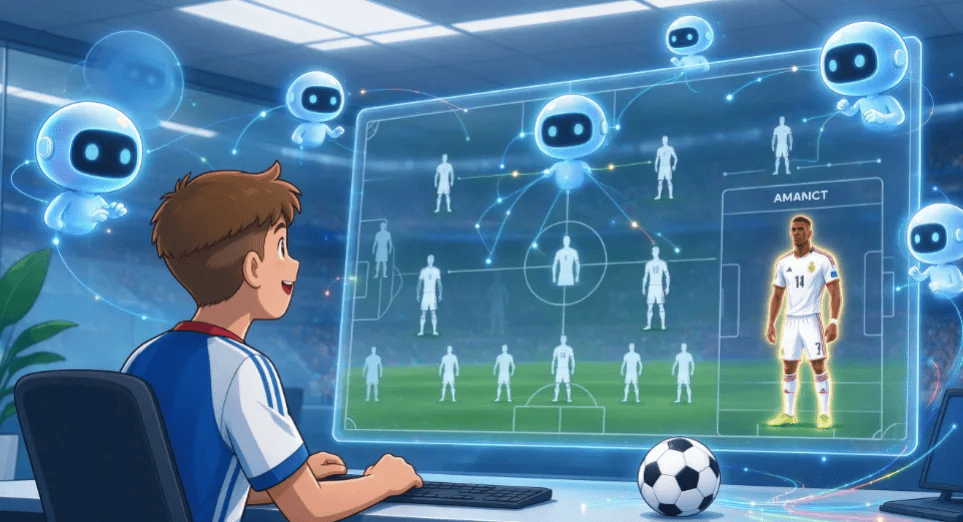
This time I asked Codex for help on the flight back to my hometown. I first fed the model several related research papers, and then set up a “command framework” for it: write instructions and codes, and lead different AI agents to work step by step. It is necessary to follow up on recent news and run data models to make predictions.
It quickly set up a system, and it seemed that the amount of information it could sort and analyze was much more than I could handle on my own.But I never expected that its initial lineup suggestions were ridiculously stupid. Put Haaland on the bench? How dare you call this professional advice?
I then asked Codex to split up the AI teams with different divisions of labor: a few dedicated to reading news and fan blogs, a few responsible for analyzing recent game results, a few running data prediction models, and a group dedicated to finding faults and raising objections. After this change, the advice given is obviously much more reliable.
But even so, compared with a few years ago, the progress has been amazing. Xu Haifeng, a computer scientist at the University of Chicago who studies AI market applications, said that the core reason why the new generation of large models have stronger predictive capabilities is that they can digest and analyze massive amounts of real-world information, and can also build more complex systems to complete predictions.
At the end of last year, Xu Haifeng noticed that prediction markets such as Kalshi and Polymarket were becoming more and more popular, and he was curious about how the top commercial models on the market would perform in these markets. So he and his colleagues began to test the prediction capabilities of the large model.
They asked the model to guess various outcomes: such as who would win the NBA championship and who Trump would meet next.
“We soon discovered that the model performed quite well.” Xu Haifeng said. Even without any special instructions or guidance, the prediction level of the model can sometimes exceed that of ordinary people.In their tests, GPT-5 ranked first in prediction ability, followed by Grok 4, Claude Sonnet, Gemini and Llama.
Interestingly, AI is still unable to compare with the top group of “superforecasters”. Xu Haifeng explained that although humans cannot process so much information, they have a deeper understanding of the real world and can understand the logic and dynamics behind a piece of news.
That said, there is growing evidence that the advantage of human superforecasters is shrinking. In the recent Metaculus Cup prediction competition, AI has sometimes been able to beat the top human prediction players. There is also a review called ForecastBench. The results of the ongoing competition will be released soon, which may further prove:AI’s predictive capabilities have already caught up with human levels. According to this trend, major AI laboratories will definitely regard “predicting the future” as a new core direction for measuring the progress of machine intelligence.
All these prediction experiments are pointing to one conclusion: Just as the mathematics, programming, and legal industries have been successively impacted by AI, industries that rely on transactions may soon be disrupted by AI. Perhaps the top traders in the future will change their identities: becoming managers and schedulers of AI agents, and these AIs are much better at predicting the future than humans.
Talking about my own fantasy team, the suggestions given by AI are not that impressive at present. In the past few weeks, the teams it manages have not even touched the average score. I definitely wouldn’t use it as an idea when choosing my own lineup.
But there is no doubt that AI will become stronger and stronger, and maybe it won’t be long before it can easily dominate the Fantasy League. But to be honest, I don’t want this day to come too soon.
After all, you have to rely on your own brains to win the game, and the fun of bragging to your friends is the essence of this game.
Related Reading
- Nvidia live updates: Jensen Huang ousted, CFO Colette Kress to serve as interim CEO2026-11-13
- Are mangoes not afraid of red fruits?2026-11-12
- Original: After Huang Renxun, who is most likely to take over Nvidia?2026-11-12
- Samsung’s roll-screen mobile phone is exposed, creating a new form ahead of Huawei and Apple, and folding screens are expected to be eliminated2026-11-12
- Musk’s favorite car is going to be discontinued.2026-11-12