DeepSeek’s second round of financing was 105.5 billion yuan, with Tencent and CATL each investing 10 billion. The proportion of state-owned capital increased significantly, and industrial capitals such as Xiaohongshu, SMIC, and Changxin Memory entered the market.
According to the investment community, DeepSeek’s new round of financing is close to completion, with an amount of approximately 100 billion yuan setting a single-round financing record in China’s AI field. CATL and Tencent have once again increased their capital in large amounts and are the main investors in this round.
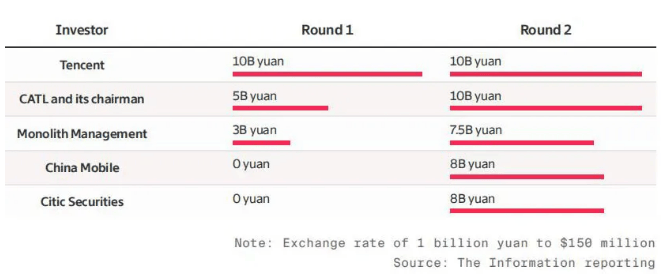
DeepSeek’s cumulative financing amount in the past six months has exceeded 150 billion yuan. Among them, CATL’s two rounds of heavy investment are impressive. People close to the transaction have previously shared DeepSeek’s first-round financing lineup, including founder Liang Wenfeng, Tencent, NetEase, JD.com, CATL Systems, Zhengxin Valley Capital, Shixiang Technology, Monolith Capital and IDG Capital.
Among the overall financing scale of approximately 51 billion yuan, founder Liang Wenfeng and Tencent ranked first and second largest investors respectively, followed closely by CATL System (including CATL and Puquan Capital).
This has been known for a long time. In April this year, the relevant person in charge of CATL stated at the first quarter performance interpretation meeting that the popularity of artificial intelligence is very fast, and the important bottleneck of computing power is energy. In the future, the energy storage demand of data centers will have great development. “CATL is exploring data center solutions from the perspective of energy supply.”
“Every Token is energy.” Zeng Yuqun also said in an interview that he hopes to make some contributions to the energy solutions of AIDC (AI-driven data center).
At that time, JP Morgan analyzed in a research report that CATL was establishing a vertically integrated AIDC energy storage ecosystem, transforming from a pure battery supplier to an “energy infrastructure partner for AI computing power construction.”
In addition, the instantaneous power consumption of large-scale intelligent computing centers fluctuates greatly, which requires not only a stable high-voltage DC power supply system, but also supporting energy storage to cope with fluctuations in wind and solar power generation and peak and valley differences in the power grid, while also assuming the role of backup power supply for the computer room. Ningde Times happens to have been accumulated in this field for a long time.
The annual power consumption of a very large-scale data center can reach hundreds of millions of kilowatt-hours, and the corresponding energy storage needs are difficult to estimate. In other words, investing in DeepSeek is locking in potential large customers.
In addition to CATL, Xiaohongshu is also among the investors in DeepSeek’s second round of financing disclosed by The Information.
Although Xiaohongshu has been developing self-developed models for AI before, while adjusting its strategy, the platform is also strictly preventing AI-generated content from eroding the community’s “real grass planting” ecology.
Until April this year, Xiaohongshu established Dots, a first-level department with AI as the core. It was upgraded from Hi Lab, a humanistic intelligence laboratory established in early 2025. It consists of four major sections: model research and development, infrastructure, engineering, and products. It reports to the new president Conan. From the outside, this marks the beginning of Xiaohongshu’s full embrace of AI.
Then in October, Xiaohongshu issued a letter to all employees, announcing that it would connect Dots, the first-level AI department, with the company’s core infrastructure (Infra) team, further clarifying the internal division of labor: Dots will be responsible for model implementation and service products, while Hi Lab will continue to do cutting-edge long-term exploration.
This is the second time Xiaohongshu has made major adjustments to its AI organizational structure in half a year. In the letter, Xiaohongshu repeatedly mentioned that “rather than pursuing model capabilities or computing power scale itself, what is more important is the deep integration of models and applications.” This may also be one of the driving forces behind Xiaohongshu’s investment in DeepSeek.
Internally, Xiaohongshu has acted more decisively. Looking at the shareholder lists of Kimi and MiniMax, Xiaohongshu can be seen.
In 2024, it participated in Kimi’s financing of over US$1 billion; before MiniMax went public, Xiaohongshu also appeared in the team of strategic investors. Coupled with DeepSeek this time, Xiaohongshu seems to have won all the “tickets” for the first echelon of China’s large models.
According to 21st Century Business Herald, Xiaohongshu’s investment in DeepSeek is between 1 billion and 3 billion yuan. People close to Xiaohongshu said that this investment in DeepSeek is only a simple investment, and there is no in-depth binding cooperation arrangement between the two parties.
DeepSeek’s second round of financing was 105.5 billion yuan, with a post-money valuation of 615.5 billion yuan. Nearly 30 institutions participated in the investment, including Tencent, CATL and Zeng Yuqun, who invested 10 billion yuan each. Memory chip manufacturer Changxin Memory and its chairman Zhu Yiming, as well as state-owned wafer foundry SMIC also participated in this round of financing, but the specific investment amount has not been disclosed.
In addition to Xiaohongshu, companies that have invested between 1 billion and 3 billion yuan include Internet giants Meituan and Ctrip, as well as manufacturing leaders Midea, Vivo, Geely, and Luxshare Precision. Based on this calculation, Xiaohongshu’s investment is not small.
It is worth noting that the participation of state-owned capital in this round of financing has increased significantly.
According to reports, state-owned investors accounted for 27% of the total financing in this round, much higher than the 2% in the first round of financing. The two rounds of financing accounted for about 19%. The National Artificial Intelligence Industry Investment Fund invested 1 billion yuan in this round, which is the same as the first round. China Mobile, China Telecom, CICC, CITIC Securities, China Life and other institutions also participated in this round of investment, with a single investment amount ranging from 2 billion yuan to 8 billion yuan.
In terms of VC institutions, Beijing Lisi Capital invested 3 billion yuan and 7.5 billion yuan respectively in the two rounds of financing; IDG Capital invested a total of 6.5 billion yuan in the two rounds; Boyu Capital invested 3.5 billion yuan in the second round.
The external investors that squeezed into DeepSeek’s first round of financing include Tencent, CATL, NetEase, and JD.com.
It is worth noting that DeepSeek’s first round of financing adopted a special structure: with the exception of the National Artificial Intelligence Development Fund, funds from other investors were injected into Hangzhou Chengli, an entity controlled by Liang Wenfeng. These investors gave up voting rights and promised to lock their shares for five years unless the company went public in advance.
It has not yet been disclosed whether this structure will be used in the second round of financing. If it is adopted, Xiaohongshu will play the role of a financial investor and will be able to distribute dividends in the future without voting rights.
According to China News Weekly, Liu Chunsheng, associate professor at the Central University of Finance and Economics, believes that DeepSeek’s technical strength and open source route are important foundations for attracting capital. For industrial capital, the value of investing in DeepSeek goes beyond financial returns.
For example, Tencent can use this to further improve its AI and cloud computing ecosystem; CATL may explore computing and power synergy opportunities in areas such as computing power supply and energy storage, while using large model technology to promote the digital upgrade of its own industry chain.
Financial commentator Guo Shiliang also believes that in addition to financial returns, industrial capital’s participation in investment may also be based on considerations such as resource allocation and complementary advantages. “Industrial capital is optimistic about ecological positioning and synergy.” Guo Shiliang said.
Related Reading
- Nvidia live updates: Jensen Huang ousted, CFO Colette Kress to serve as interim CEO2026-11-13
- Are mangoes not afraid of red fruits?2026-11-12
- Original: After Huang Renxun, who is most likely to take over Nvidia?2026-11-12
- Samsung’s roll-screen mobile phone is exposed, creating a new form ahead of Huawei and Apple, and folding screens are expected to be eliminated2026-11-12
- Musk’s favorite car is going to be discontinued.2026-11-12