Text | Farsight
This year’s Double Eleven, AI is no longer a supporting role for the platform to reduce costs and increase efficiency, but has become the protagonist that consumers can add to their shopping carts.
On the evening of November 2, 2026, Chen Yusen, vice president of Alibaba Group and CEO of Qianwen Office, was a guest in Li Jiaqi’s Taobao live broadcast room. The original price of the personal basic version of Qianwen Office monthly card was only 1 cent for 28 yuan, and nearly 100,000 copies were sold in half an hour, corresponding to about 2 trillion Token quota.
Not only Taobao, but also on JD.com, Douyin and other platforms, major anchors are also selling token packages of DeepSeek, GLM, MiniMax and other models, and the popularity is unprecedented. JD.com data shows that the 3C digital procurement and sales live broadcast room sent out more than 1 billion tokens in the first hour of broadcasting, and the sales of large model token package products increased 20 times month-on-month in the first two hours of broadcasting.
As AI technology matures, large model manufacturers are learning from consumer brands and are committed to competing for users’ minds by relying on live streaming, extremely low prices, limited sales, and other methods. When AI shifts from parameter competition to mass consumption, can it be continuously purchased by consumers like lipstick, clothing, and video website memberships?
Tokens are put on shelves, and AI services become consumer SKUs
Previously, model calling packages were mainly sold through the manufacturer’s official website or open platform, and AI application members mostly subscribed within their respective products. This year’s Double Eleven, AI manufacturers not only sell AI services on e-commerce platforms, but also hope to reduce the understanding cost and purchase threshold of AI services through intuitive product specifications, pricing strategies and demonstration methods.
Overall, the AI services put on the shelves during Double Eleven can be divided into three categories, namely model calling packages, AI application memberships, and hardware-included AI rights.
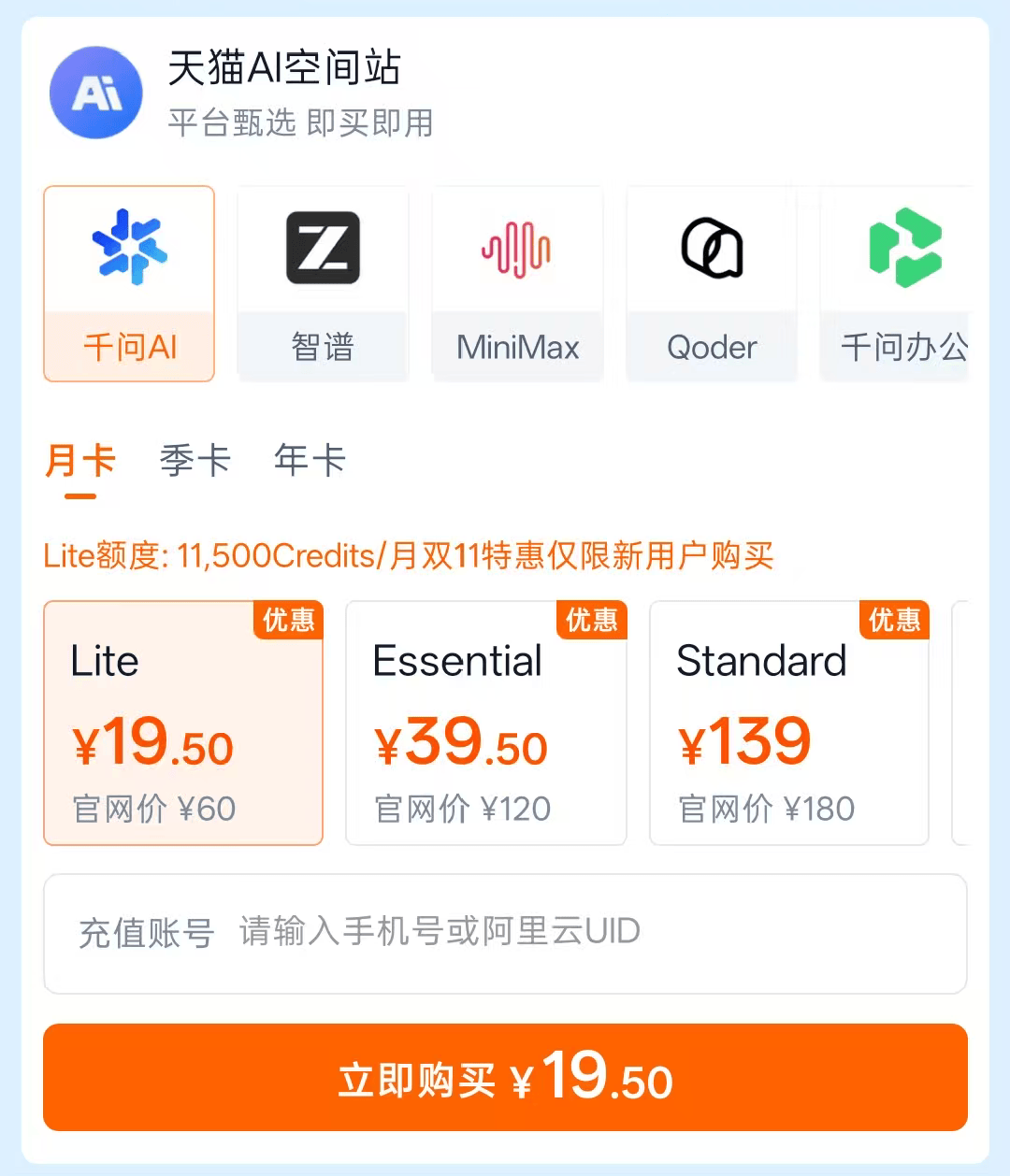
E-commerce platforms such as Tmall and JD.com have launched Token recharge centers based on the logic of traffic recharge, and launched subscription packages for large-model services such as Qianwen AI, Zhipu, and MiniMax. Consumers can choose monthly, quarterly or annual cards based on their needs.

In addition, AI applications such as Qianwen and Doubao also sell subscription memberships in live broadcast rooms, including low, medium and high levels. After users subscribe, they can use programming, photo-taking, video and other rights within the validity period.
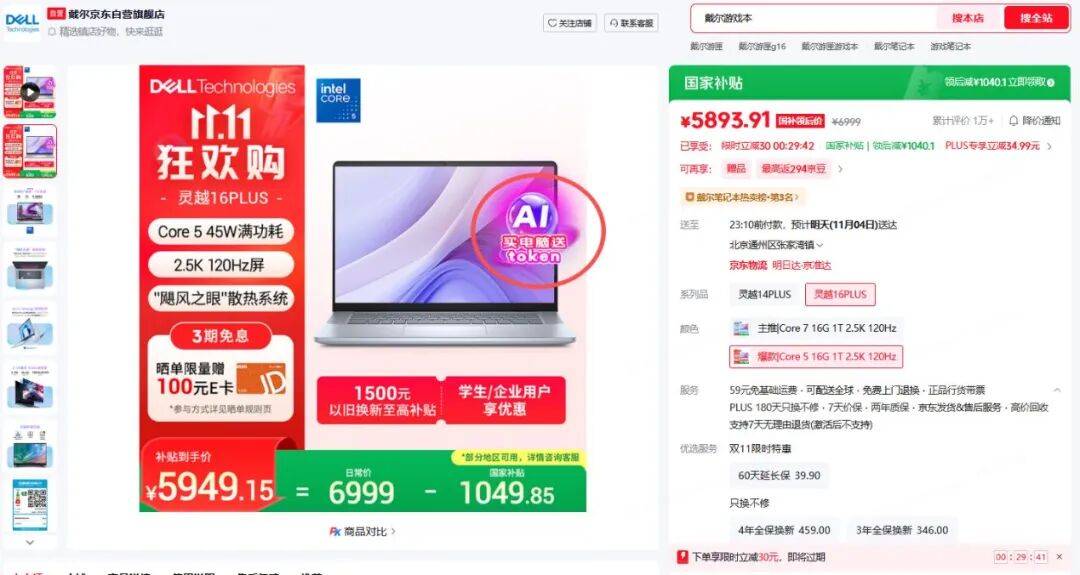
In addition to directly selling tokens and members, some hardware companies will also give away corresponding AI rights when selling hardware products. For example, on the JD.com platform, when consumers place an order for Dell Inspiron 16 Plus, Dell XPS 13 Air, Alienware Starship 16X and other models, they will be given a JD Cloud Token starter pack, including 13,000 points. When purchasing recording pens, AI glasses and other equipment, manufacturers will also provide corresponding AI service memberships.
These products correspond to different needs: the model calling package is suitable for development and tool calling scenarios, the application membership is oriented to specific tasks, and the hardware attached benefits lower the threshold for first experience. In terms of sales channels, the recharge area handles active search and purchase needs, the live broadcast room helps users understand the use through demonstrations, and hardware bundling allows AI services to enter usage scenarios with devices.
It can be said that this year’s Double Eleven, the “match point” of the AI industry has undergone significant changes. Previously, AI manufacturers focused more on developing models with powerful performance. Today, AI manufacturers are beginning to learn from consumer brands, actively entering e-commerce platforms, packaging AI services into products, and are committed to increasing consumers’ willingness to pay through scenario-based demonstrations.
The payment rate is limited, and manufacturers want to rely on Double Eleven to leverage the market
In fact, as early as the first half of 2026, as Agents gradually matured, many AI manufacturers launched paid services. However, to this day, the payment penetration rate of individual users is still at a low level.
In May 2026, a netizen AI consumption survey launched by Tencent Research Institute showed that although as many as 95.6% of respondents had used large AI models in the past three months, the proportion of paying AI users was only 9.8%.
The reason is that AI manufacturers have not yet effectively completed market education. Only by allowing users to feel the incremental value of paid services in specific tasks can conversions be further promoted.
Tencent Research Institute pointed out in a research report that the more obvious the user’s perception of efficiency is, the higher their willingness to pay. The payment rate of users who “improve efficiency but increase workload” is the highest, reaching 18.9%. The payment rates of users who “partially improve efficiency” and “no impact/not used” are 5.6% and 1.8% respectively.
However, most users currently mainly use free AI chat tools, with a usage rate as high as 92.9%. The usage rates of AI efficiency tools and AI development platforms aimed at productivity scenarios are only 22.9% and 14.2% respectively.
Obviously, the biggest challenge currently facing the commercialization of AI technology is the “mismatch between supply and demand.” The threshold that AI manufacturers need to cross is to enable users to move from existing usage habits such as question answering and writing to complex task execution, and to recognize that paid services have irreplaceable value compared to free functions.
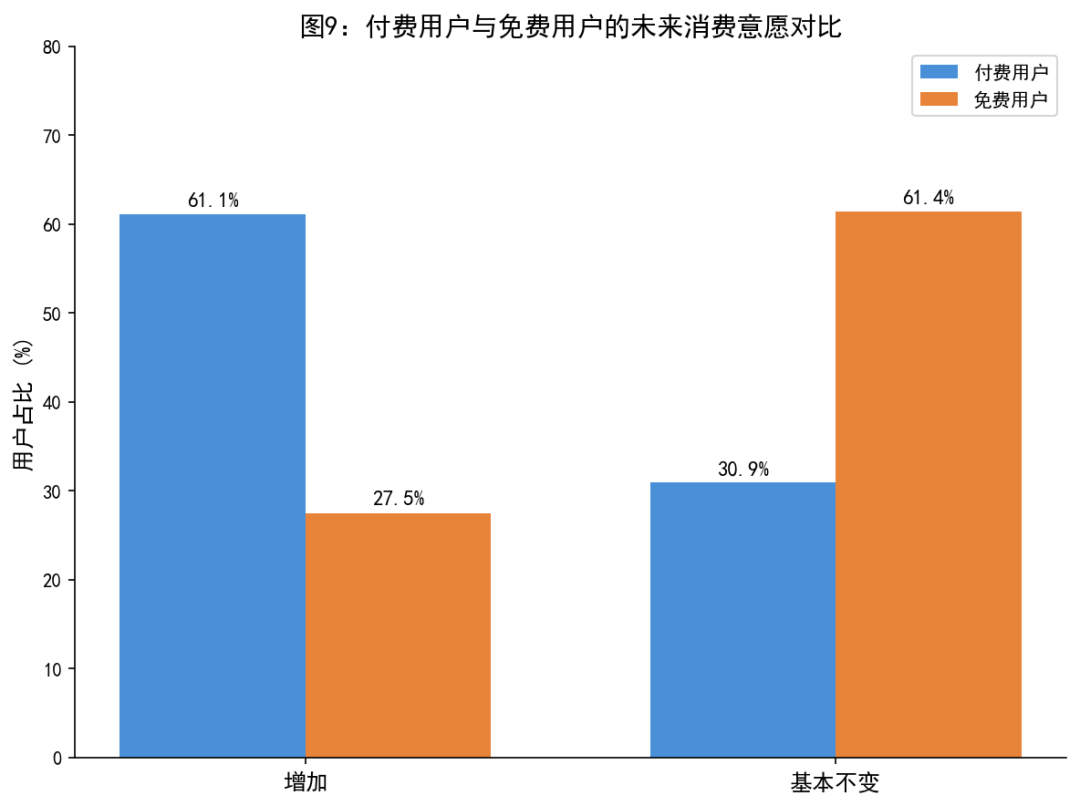
Tencent Research Institute survey data shows that in the next three months, 61.1% and 30.9% of paid users said the payment amount will increase and remain basically unchanged respectively; among free users, these two figures are 27.5% and 61.4% respectively. It can be found that there is a significant K-shaped differentiation in the AI industry. Paying users are more willing to pay, and free users tend to use it for free.
If AI manufacturers combine this market trend, launch friendly trial policies, and guide free users to try paid functions, it will be possible to gradually build an upward spiral of “AI services create value – form usage habits – continue to pay”.
From this point of view, the 2026 Double Eleven Shopping Festival is not only a promotion battle for the AI industry, but also an experiment in the centralized transformation of AI services. Through subsidies to reduce early adopter costs and anchors’ scenario-based demonstrations to enhance the sense of presence, AI services have established a closer connection with users’ actual production scenarios, and are expected to convert more paying users.
1 cent can attract traffic, what will you rely on for the next payment?
During the Double Eleven Shopping Festival, although the sales of many AI services were very impressive, they did not contribute much revenue to manufacturers. Take the Qianwen Office personal basic version monthly card sold in Li Jiaqi’s live broadcast room as an example. If 100,000 copies are sold for 1 cent each, the total amount paid by all consumers is only about 1,000 yuan, and they cannot even buy a REDMI entry-level mobile phone.
You know, the original price of Qianwen Office Personal Basic Edition monthly card is as high as 28 yuan/month. Although the early adopter price of 0.01 yuan significantly lowers the purchase threshold, there is a huge gap between it and the original price. After the monthly card for the early adopter version expires, how to convince 100,000 users to subscribe to basic membership at the original price will become a major challenge facing Qianwen Office.
Based on industry research data, the first renewal of the AI service monthly card can be described as an important watershed.
RevenueCat’s research on 3,519 AI application configurations and over 50 million paid subscriptions found that in monthly paid packages, the first-time renewal rate of users of high-retention applications was 57.9%, while the first-time renewal rate of users of low-retention applications was only 30.2%. By the third month corresponding to the renewal node, the renewal rates of the two groups were 79.5% and 68.5% respectively, and the gap narrowed.
Therefore, for AI manufacturers competing for the Double Eleven Shopping Festival in 2026, the real problem is not how to attract more people to buy early adopter monthly passes, but how many people rely on AI to complete specific tasks after Double Eleven, and how many people are willing to continue to subscribe after the discount ends.
From the perspective of ordinary users, although the performance of large models from major AI manufacturers varies, daily work mainly involves relatively simple needs such as question and answer, writing, and summary. It is difficult for different AI services to open up a significant gap and persuade more users to continue paying.
Typical examples include WorkBuddy and Doubao Work. Although they have launched paid memberships, they continue to attract and retain users through free memberships, free credits for sign-in, and free for a limited time.
Next, AI vendors will compete for a fixed position in user workflows. For ordinary users, free tools can often meet the needs of Q&A, writing and summarizing. Paid products need to prove whether they can connect files and applications, retain project context, and stably complete more complex production tasks.
On this basis, what really supports the premium is how much less time users spend on modification and verification, and whether the accumulated information, preferences and processes can make the next use more worry-free. This also poses a cost test question for manufacturers. The more complex the task, the higher the investment in computing power and services. Double Eleven can buy you an early adopter, and renewal after the discount must be supported by repeatable delivery value and sustainable service costs.
When tokens and lipstick appear in the same live broadcast room, AI manufacturers begin to face a familiar set of consumer market rules: consumers will compare prices, wait for discounts, and switch between multiple free products. Double Eleven provides a larger showcase for AI technology, and at the same time brings the issue of pricing power to the forefront. If the user only remembers the “1-cent monthly card”, the manufacturer may gain a group of customers waiting for the next subsidy.
Looking at a deeper level, this is also the competition between e-commerce platforms for the distribution entrance of AI services. In the past, users completed purchases on the manufacturer’s official website. Nowadays, platforms and anchors are involved in demand discovery, product demonstrations and transactions. Who controls the renewal entrance and who assumes after-sales responsibilities will affect the profit distribution of this business. AI manufacturers are leveraging consumer brand strategies to reach the masses, and may also gradually bear the channel costs and promotion dependence that consumer brands are familiar with.
Therefore, the significance of this year’s Double Eleven to the AI industry will still have to wait for the post-promotion ledger to be tested: whether the new revenue can cover subsidies, channels and computing power expenditures, and whether users have formed a continuous payment habit.
Related Reading
- Nvidia live updates: Jensen Huang ousted, CFO Colette Kress to serve as interim CEO2026-11-13
- Are mangoes not afraid of red fruits?2026-11-12
- Original: After Huang Renxun, who is most likely to take over Nvidia?2026-11-12
- Samsung’s roll-screen mobile phone is exposed, creating a new form ahead of Huawei and Apple, and folding screens are expected to be eliminated2026-11-12
- Musk’s favorite car is going to be discontinued.2026-11-12