Text | Handset Tech
This Double 11 is more exciting than cosmetics and there is Token?
“321, use Token.” On the evening of November 2, Li Jiaqi’s live broadcast room launched a 20 trillion Token benefit. The monthly membership card of Qianwen Office Personal Basic Edition was reduced from 28 yuan to 1 cent. Nearly 100,000 copies were sold in half an hour, corresponding to about 2 trillion Token quota.
Chen Yusen, vice president of Alibaba and CEO of Qianwen Office, came to the live broadcast room, and the theme of the live broadcast room was “AI office companions for all girls”.
This is also the first time that AI computing power services have been put in front of ordinary consumers in the form of live broadcast.
The girls in the live broadcast room are still a little unfamiliar with Token. Chen Yusen uses one click to generate live broadcast review and other scenes, trying to make the people in front of the screen understand, “What is a Token” and “What can a Token do”.
The data after the live broadcast is impressive. The figure of 2 trillion Token quota seems to be a pretty good start to the retailization of computing power. However, although Token is on the live broadcast shelves and the excitement is real, it is still early for retail sales.
After all, the price of 1 cent has the answer written on its face. If Token is really a product ready for mass retail, it does not need to be sold for a cent.
In other words, the real function of 100,000 orders is not to allow consumers to “have computing power”, but to allow “AI office to have a price” to complete the consumer psychology of ordinary people at a very low cost.
Perhaps, this account is far more honest and useful when recorded on Alibaba’s chessboard for AI entry than when recorded on Qianwen Office’s monthly profit and loss statement.
Token’s e-commerce shelves are set up
“This is the first time I heard that tokens can be sold in the live broadcast room.” Sister Lin, born in the 1990s, lamented.
Sister Lin from Dachang’s “Niu Ma” is a frequent visitor to Li Jiaqi’s live broadcast room. This year, she was squatting. She originally wanted to replenish two sunscreens, but she waited and said, “321, enter Token.”
In the live broadcast room, Sister Lin was stunned for two seconds before clicking the link. 1 cent, 500 points, limited to one purchase, redemption ends on December 30. When she placed the order, she only remembered one sentence, “With 500 points, you can make about 50 PPTs or write 160 weekly reports.”
The number “50 PPTs” is very useful. Sister Lin was calculating another calculation in her mind. If this thing could really get her out of the layout, 1 cent would be the most cost-effective order during this year’s Double 11.
Of course, many girls do not know Token as well as Sister Lin.
For example, Chen Yusen appeared in Li Jiaqi’s live broadcast room and tried to translate Token into words that ordinary people can understand. He said that AI is not a metaphysics, but a “digital tool” that helps you organize to-dos, generate PPT, and review live broadcasts. He also demonstrated how to generate a report with one click and explained how to turn computing power from a back-end bill into a visible thing.
But “all the girls” don’t seem to be very interested in Chen Yusen’s interpretation. The core focus is not on AI, nor on Token and Qianwen.
In Li Jiaqi’s live broadcast room, many consumers asked, “Why is there such a special event on Double Eleven?”; some netizens were off-center, pointing out, “Can I check in with the Qianwen Office membership monthly card?”, “What clothes does the president wear, please match it”…
More often, they ask when other skin care products or daily necessities will be distributed, and when there will be a rain of red envelopes.
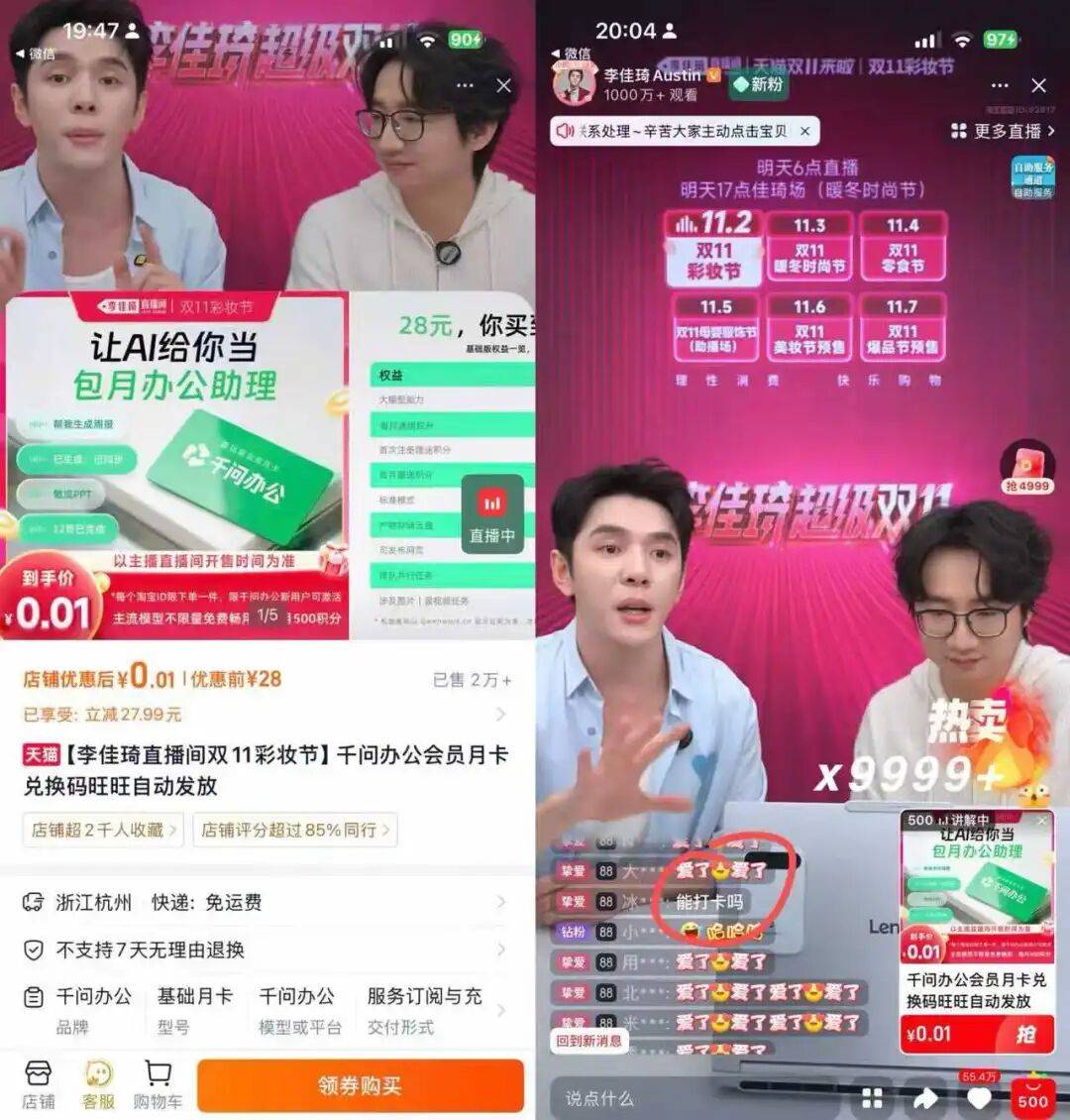
Picture: Li Jiaqi’s live broadcast room launches “Qianwen Office Membership Monthly Card” Source: Li Jiaqi’s live broadcast room, screenshot of “Handset Tech”
Even though Sister Lin strongly embraces AI office, her doubts are obvious. In her view, placing an order for 1 cent is only the first step. The real decision to repurchase is the experience after opening and whether the price measurement unit is transparent.
Sister Lin explained this way, if the redemption requires going through three pages, the installation requires a bunch of permissions, and if the task becomes complicated, it will prompt that there are insufficient points, then this monthly card will be like those “get it and forget it” members on the phone, lying in the corner and gathering dust.
“What big companies lack most is not tools, but don’t let me learn a new set of processes.” In Sister Lin’s view, if AI office really wants to retain people, it must be able to work after opening it, and know how much it cost after doing it, instead of letting users guess by themselves.
The same goes for price.
When it comes to spending money on computing power, Sister Lin’s standards are very simple, that is, to know exactly how much it costs to complete a task.
“If what is written on the shelf is ‘30 cents for a work report PPT’ and ‘50 cents for a live review’, I might really buy it; if it is still ‘how much is one million Tokens’, then I have to calculate for a long time, and there is a high probability that I will not buy it after the calculation.”
In fact, this is also the biggest difference between “AI as a new consumer product” and traditional consumer products.
“On the lipstick shelf, if you put two lipsticks together, you can clearly compare the color number, grams, and texture. But on the token shelf, the cheaper price may correspond to a more verbose model, and doing the same job will burn more computing power. This is hard to say.”
In Sister Lin’s view, this wave of tokens being put on the shelves and the shelves are set up is progress; however, the AI products on the shelves still lack transparent and fair units of measurement.
As Sister Lin said, “One penny buys curiosity, not productivity. Putting up shelves is progress, but when the comparison is no longer ‘how many tokens cost’, but ‘how much does it cost to complete this task’, then the token can really be put into the shopping cart.”
A centralized approach to the e-commerce industry
If you only watch the live broadcast room, it is easy to interpret this cooperation as Qianwen Office’s battle to attract new customers, but the launch of Token on e-commerce shelves did not start with Li Jiaqi.
Long before Qianwen Office membership monthly cards were launched in Li Jiaqi’s live broadcast room, Tmall’s “AI Space Station” had been connected to Qianwen, Zhipu, MiniMax and other manufacturers, and JD.com’s “AI Software Recharge Hall” also opened simultaneously. On the first day of Double 11, Taobao’s Token category sales increased by 450% month-on-month.
The enthusiasm on the supply side is real, but whether retailization is established or not depends on the sales volume, which is also the bottleneck for Token to reach mass consumption.
Previously, some media reported that Token was on the Double 11 shelves, but there was no discount as on Double 11. The sales volume of most products was still around 100 pieces, and the symbolic significance was greater than the actual sales volume.
According to statistics from Handset Tech, as of November 4, “300+” Zhipu Coding Plan Lite monthly cards have been sold on JD.com, the cumulative sales of all Token products in Tmall Zhipu flagship store are less than 900 pieces, and the MiniMax Tmall flagship store has a package that has sold more than 100 pieces since its launch. These figures are incomparable to the 100,000 copies sold in Li Jiaqi’s live broadcast room.
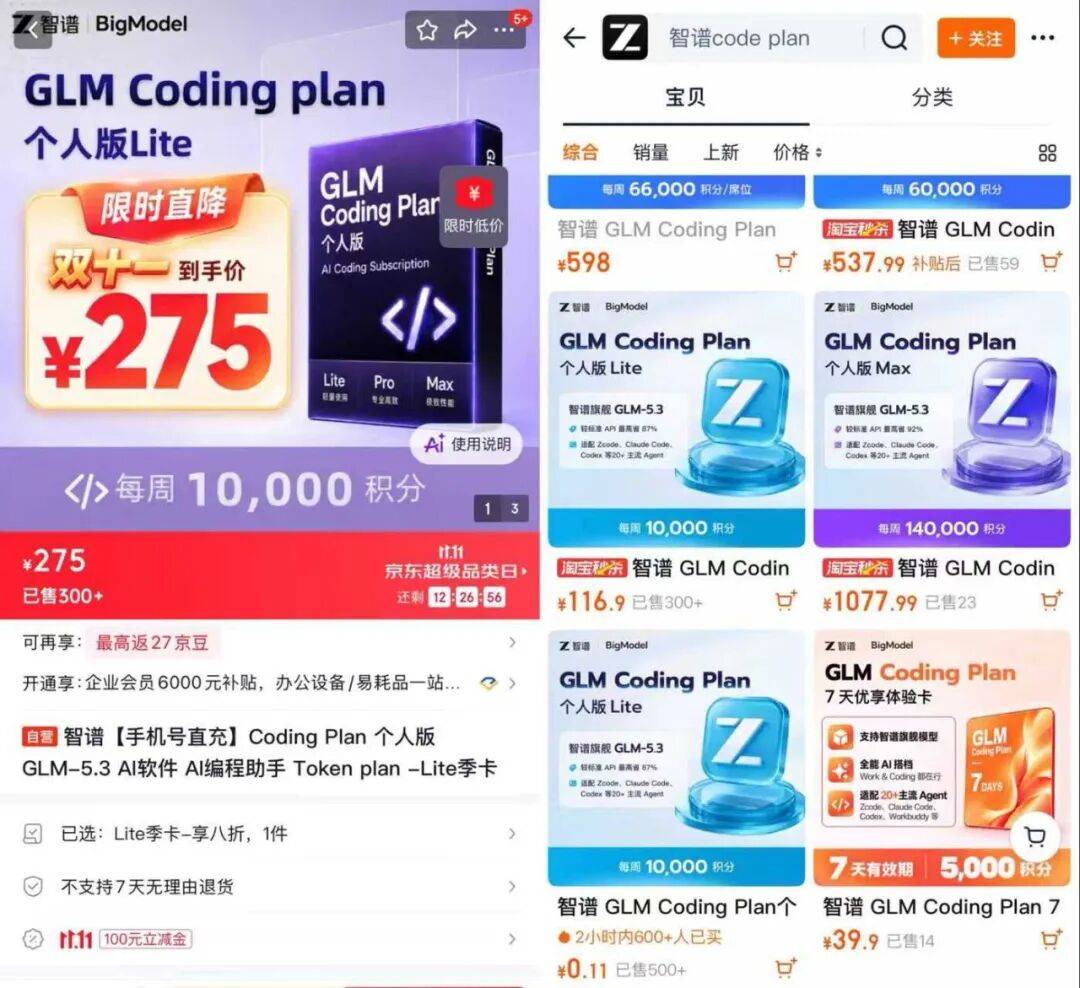
Figure: Sales of Zhipu AI products on e-commerce platforms Source: JD.com (left), Tmall (right) Screenshot of “Handpiece Tech”
Therefore, some analysts believe that when looking at the continuous actions of model manufacturers before and after Double 11, it is not Li Jiaqi who made Token popular, but Token needs Li Jiaqi.
The logic behind this is that AI manufacturers need a low-friction entrance to pull “computing power” out of developers’ API bills and stuff it into ordinary people’s shopping carts.
E-commerce platforms also need a new category to tell an incremental story in addition to beauty, clothing, and home appliances. The two sides hit it off immediately, and the head anchor’s live broadcast room was the loudest speaker.
Of course, looking at the user structure of Qianwen Office, it is a new background.
At the press conference of the e-commerce version of Qianwen Office in October this year, Chen Yusen disclosed a key data. About 20% of Qianwen Office’s current paying users are from the e-commerce industry. E-commerce users complete an average of 38 tasks per week. They are the largest group of users with significantly higher usage depth and payment rate than the average.
The e-commerce version of Qianwen Office is connected with tools such as Business Consultant, Qianniu, Wanxiangtai, and Youzan. It aims to open up the software silos in the e-commerce industry for more than 20 years.
Therefore, the payment scenarios where Qianwen Office really works are not the working women and stay-at-home mothers in the live broadcast room, but the e-commerce sellers who have to inspect multiple stores every day, generate materials, and monitor delivery data.
The real function of Li Jiaqi’s live broadcast room is not to attract 100,000 new paying users for Qianwen Office, but to create public awareness that AI office has a price, and the price can be very low.
For e-commerce sellers who have already paid, this understanding is very important. For example, when e-commerce sellers hesitate to renew their subscriptions, “Is it worth spending the money every month?”, the scene in Li Jiaqi’s live broadcast room of “100,000 people robbed for one cent” completed an external psychological confirmation for him.
In the view of Internet observer Dali, “From this perspective, Chen Yusen chose Li Jiaqi not to find a traffic pool, but to complete a concentrated reach in the place where the attention of e-commerce practitioners is most intensive.”
In fact, among the core audience of Li Jiaqi’s live broadcast room, there are a large number of female sellers, operators and content creators. They are the group of people who account for a high proportion of Qianwen Office paying users.
However, the greater significance of this live broadcast is that “AI is seen”. As for “how AI is used”, this matter is left to the product itself.
The token is sold for 1 cent, what next?
However, if you interpret this live broadcast sales as AI’s new move, you may miss what Alibaba is really doing.
In March this year, Alibaba established a business group with a very straightforward name, Alibaba Token Hub (ATH). Wu Yongming personally took charge of it. The mission is only one sentence, which is to “create Token, transport Token, and apply Token.”
In fact, as early as the end of 2025, Qianwen has replaced Quark and been pushed to the front of Alibaba’s C-side AI entrance. When these actions are stacked together, the conclusion is very clear. Token on the shelves is not a retail business on Ali’s chessboard, but a cognitive laying in the entrance war.
As time goes by in November this year, Alibaba needs to use a big enough event to make “AI office has a price, a brand, and a specific entrance” to enter the context of ordinary people’s shopping carts for the first time.
iiMedia Consulting CEO Zhang Yi defines the inclusion of Token on the live broadcast shelf as “the C-end market enlightenment movement under the Token economy” and believes that this is Alibaba’s move to bring AI commercialization and B-end technology narratives into the context of mass consumption.
However, enlightenment is enlightenment, and the industry still needs to answer a question: Will Token gradually become more popular after it is put on the shelves?
In Dali’s view, “It won’t happen in the short term. It’s not that the demand is not enough, but that the pricing language on the shelves has not yet matured. Especially on the Token shelf, the number of words consumed in different models for the same piece of text may differ by 20 to 50%. Each company’s billing rules are its own system, and it is difficult to convert horizontally between packages.”
What’s even more troublesome is that Agent will completely disrupt the Token consumption structure.
Gartner’s data is very straightforward. Inference agents consume 5 to 30 times more tokens per task than basic chatbots. After reviewing nearly a thousand cases, Gartner also pointed out that currently less than 10% of agent deployments can deliver robust ROI.
In other words, when one task may burn the volume of dozens of past conversations, pricing based on “how much does one million tokens cost” is opaque and unpredictable to users.
In fact, for a category that cannot clearly see “what can be done with the money”, it is difficult to rely on subsidies to develop the habit of repurchasing. According to the “2026 Subscription Application Status Report”, the annual subscription retention rate of AI applications is only 21.1%, which is nearly 10 percentage points lower than non-AI applications. This number itself is a warning.
But this does not mean that Token will not become popular.
In Dali’s view, it is more likely to follow a path of layered popularization rather than becoming a daily necessities at once.
The first level of popularization is scenario-based packaging, which is what Qianwen Office e-commerce version is already doing. It is not selling “millions of Tokens”, but selling “the cost of opening a store has been reduced from tens of thousands of yuan to a few hundred yuan.” E-commerce sellers are willing to renew because the money corresponds to calculable manual replacement, not the unit price of Token.
Also, it points to hybrid pricing of “pay-by-results”.
Gartner predicts that seat subscriptions will not disappear, but the hybrid model of “basic subscription + usage + tasks + results” will gradually become the pricing language of the Agent era.
Gartner also predicts that by 2030, approximately US$234 billion in enterprise application software spending will face the risk of being diverted and repriced by agents.
“However, the current implementation rate of ‘pay-by-result’ is still very low. Buyers’ adoption is more of a direction than a ready-made answer.” Dali said.
The third item is the true popularization of mass retail. But the premise is that the supervision and industry must first lay out the “water, electricity and coal” level infrastructure such as measurement standards, billing disclosures, and after-sales rules.
At present, the National Information Center has proposed unifying the measurement caliber of word units and introducing third-party verification. The Department of Big Data Development clearly stated that it is necessary to unify the measurement caliber of word units as soon as possible, establish conversion standards, standardize billing disclosure, and introduce third-party verification.
This shows that the industry itself knows that shelves are just running ahead of the rules.
In Dali’s view, after selling tokens for 1 cent, will it become normal for words to be put on the shelves? It is still a slow process. The final form is likely not to be “everyone hoarding a bunch of tokens”, but “Tokens are hidden behind the scenes, and users pay for a completed task.”
What Alibaba does in the live broadcast room is to make Token visible to a wider range of consumers.
This also means that what the industry needs to do next is not only to let the Token be seen, but also to allow users to see a work report PPT, a store inspection, and a live review when placing an order, rather than a string of numbers in trillions.
In other words, the shelves have been set up, but the things to be placed are still on the way from “units of measurement” to “solutions”.
Related Reading
- Nvidia live updates: Jensen Huang ousted, CFO Colette Kress to serve as interim CEO2026-11-13
- Are mangoes not afraid of red fruits?2026-11-12
- Original: After Huang Renxun, who is most likely to take over Nvidia?2026-11-12
- Samsung’s roll-screen mobile phone is exposed, creating a new form ahead of Huawei and Apple, and folding screens are expected to be eliminated2026-11-12
- Musk’s favorite car is going to be discontinued.2026-11-12