
At Cambrian’s third-quarter performance briefing, Chairman Chen Tianshi was repeatedly asked the same question: How much of the 11.6 billion inventory are raw materials, products in progress, and finished products?
He did not give an answer, but just repeated the sentence in the third quarter report: “Strategic stocking of raw materials was carried out in the early stage. As the age of raw material inventory increases, the provision for inventory price decline increases accordingly.”
Someone asked about the rumors circulating in the market that “more than 1 million units will be shipped next year”, and his answer was even shorter: “The company has never conducted relevant communication.”
This scene condenses the tension of the third quarter report: profits are doubling, but management is explaining inventory and rumors.
The highlight of Cambrian’s third quarter report is not the income statement, but the balance sheet.
Part.
01
14.7 billion “capacity deposit”
Cambrian is an AI chip design company that makes cloud smart chips, boards and complete machines. But Cambrian does not manufacture its own chips. It leaves the manufacturing process to SMIC, and it is only responsible for design and sales.
The “Fabless” model is currently a common model for chip manufacturers, which can pool resources, but the problem lies in upstream constraints.
The performance indicators of the third quarter report are almost impeccable. Revenue in the third quarter was 3.531 billion, a year-on-year increase of 104.5%. Net profit was 1.404 billion, a year-on-year increase of 147.7%. The net profit margin has reached 40%, and the gross profit margin has also reached 59%. Its profit model has become increasingly close to that of a mature chip company.
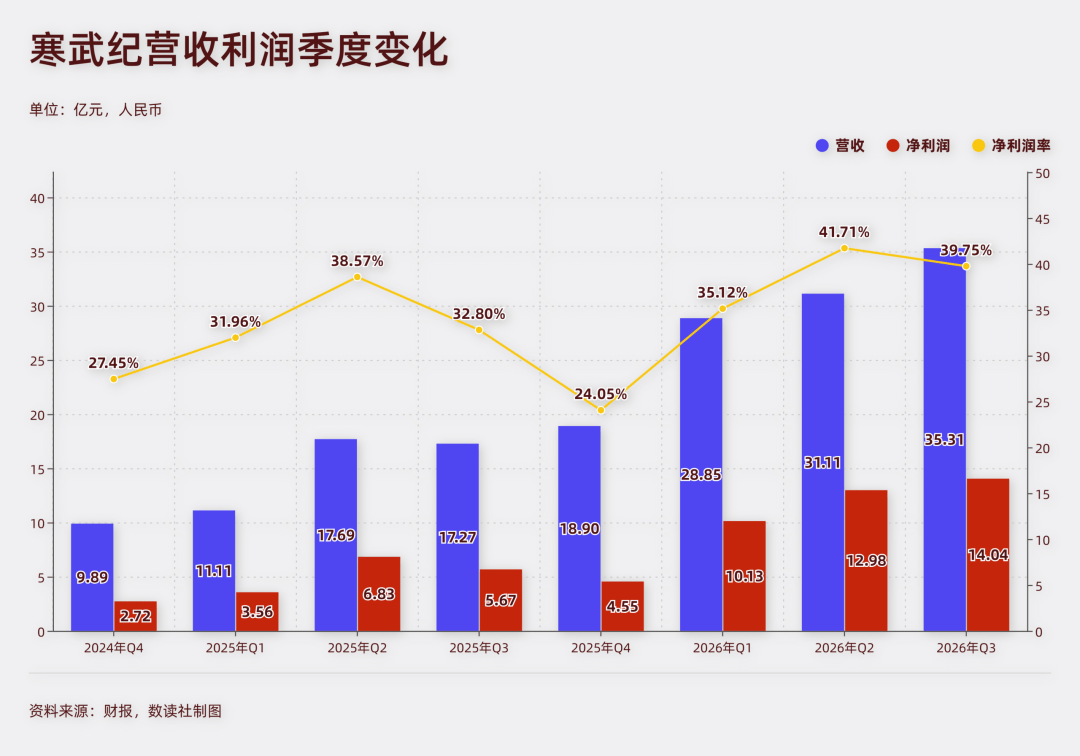
But the feedback given by the market is a different temperature: on the last trading day before the disclosure, the stock price was 932.2 yuan and the total market value was 586.2 billion, a retracement of more than 40% from the trillion-dollar high more than three months ago.
A month earlier, Reuters revealed that Cambrian’s intention to quote the next-generation chip “690” had increased by 20% to 30% compared with two months ago. The company’s public response was that “no price increase related information has been released, please refer to the announcement.”
Profits are growing, which could have led to price cuts, but the market is more worried about price increases. The doubling of growth originally led to a boost in stock prices, but in the end it retraced sharply.
The market’s concern is not performance, but the balance sheet that continues to be under pressure.
As of the end of the third quarter, Cambrian’s asset-side inventory was 11.665 billion, an increase of 6.721 billion from the beginning of the year. Prepayments were 3.044 billion, an increase of 2.299 billion.
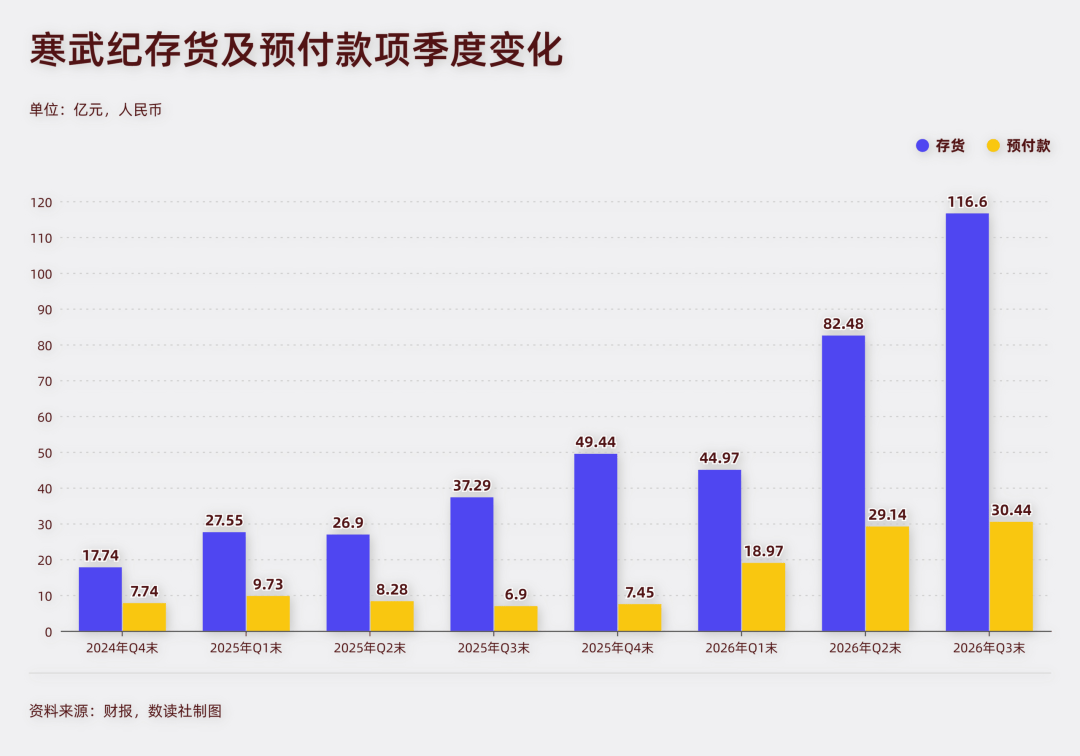
Inventory and prepayment, the total new occupation of these two items exceeds 9 billion. During the same period, there were only 555 million in monetary funds, 3.810 billion in trading financial assets, and a total of 4.365 billion in own liquidity, which was far lower than inventory and prepayments.
Dissecting the internal structure of inventory, the third quarterly report did not disclose inventory details. Combined with the structure at the end of June: of the inventory of 8.248 billion, raw materials were 5.278 billion and commissioned processing materials were 2.418 billion. The two items together accounted for 93.3%. The inventory of goods is only 85 million, a sharp drop of 76% from 353 million at the beginning of the year, while the goods shipped increased from 130 million to 465 million.
Finished products are approaching zero, shipped goods are doubling, and raw materials and work-in-progress dominate. This structure shows that the backlog of finished products is very light. The real “inventory” is wafers, bare chips that have not yet completed packaging and testing, and silicon that has been circulated on the production line but has not yet been turned into a deliverable accelerator card.
Advance payments increased from 745 million at the beginning of the year to 3.044 billion, an increase of more than 300%.
In the domestic AI chip industry chain in 2026, advanced process logic production capacity, HBM3e storage particles, and 2.5D packaging schedules are both scarce. Chip design companies must pay large advances to foundries and storage suppliers in advance to lock the production window.
Therefore, in the third quarter report, the money earned by Cambrian did not lie in the bank account, but almost all was put into inventory and advances.
Part.
02
second on the quota table
On the liability side, as of the end of the third quarter, Cambrian had notes payable of 4.966 billion and accounts payable of 1.827 billion.
Supply chain leverage is not bank borrowing plus leverage, but using the account period and commercial credit provided by suppliers to support upstream purchases that exceed its own cash capacity.
Cambrian dares to reduce its own liquidity to 4.3 billion and increase supply chain liabilities to 6.793 billion, not because banks are willing to borrow money, but because it ranks second on SMIC’s N+2 quota table in 2026.
According to industry research estimates, SMIC N+2’s annual AI chip production capacity in 2026 will be approximately 2.6 million units, with domestic demand of approximately 4.2 million units, leaving a gap of 1.6 million units. Under the same estimate, Huawei has about 43% and Cambrian has about 11%. Cambrian still has a monthly demand of 30,000 pieces of 7nm+ from SMIC North.
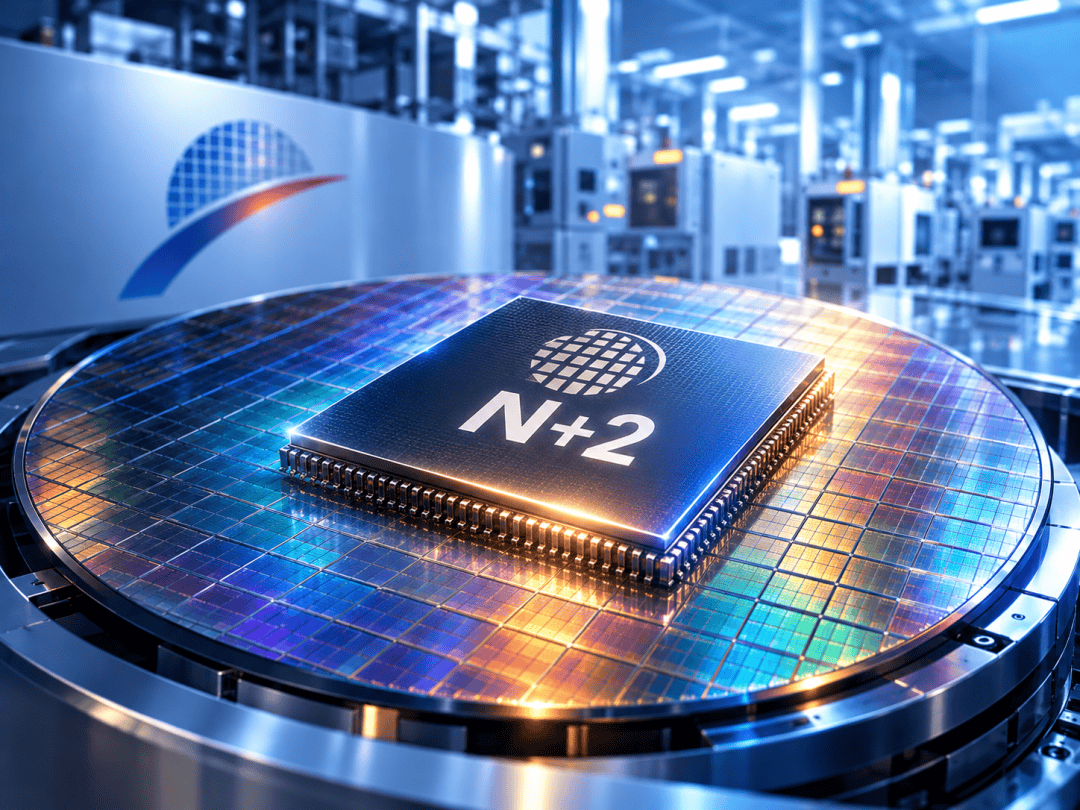
In a market where “approximately one out of every three needs is not met”, 11% is not a small number. Cambrian is the highest-ranking customer on the production line besides Huawei.
HBM3e is the other half of the ticket.
Changxin Storage has launched risk mass production of HBM3e in 2026. Manufacturers such as Cambrian are conducting evaluation and certification with their own processors. If the certification is successful, it will enter commercial products as early as 2027.
The 3 billion advance payment mainly refers to advanced process production capacity, HBM3e storage particles and 2.5D packaging schedule. The turnover rhythm is particularly important.
The structure of supply chain liabilities is more noteworthy than the scale: notes payable 4.966 billion, accounts payable 1.827 billion, accounting for about 94% of total liabilities, and interest-bearing liabilities are almost zero.
This shows that the main risk is not the debt repayment risk of interest-bearing liabilities, but the liquidity risk of supply chain bills due. If the bills cannot be redeemed when due, it will still be converted into debt repayment pressure. Once the delivery pace is slower than the bill expiration pace, the pressure will switch from “suppliers are willing to wait” to “suppliers start urging” within two quarters.
From an industry perspective, peers are all locking up production capacity, but Cambrian is one of the most aggressive. This style of play shows that it does not prepare stocks according to the conventional “sales determine production”, but has strong confidence in market expectations and dares to make heavy bets.
The stocking logic of Haiguang Information is similar to that of Cambrian, but the narrative is more certain. Haiguang’s advance payment at the end of Q1 2026 was 3.440 billion and inventory was 7.333 billion (different from the Cambrian reporting period, only for direction comparison), and it is also doing “large-scale strategic stocking + production capacity locking”.
The difference is that Haiguang is larger and its customer structure is more focused on government affairs and Xinchuang’s basic market. Stocking is more easily understood as advance arrangements for confirmed orders.
Huawei Ascend represents the “quota priority” route, which Cambrian cannot replicate. Huawei has locked in about 43% of SMIC’s advanced production capacity, and its annual delivery is expected to be more than 1.3 million units. It relies on its full-stack capabilities and the priority of production allocation brought by main battlefields such as operators.
Alibaba Pingtou Ge and Baidu Kunlun Core are more like “demand-driven within the system”, and their customer base is different from Cambrian.
Pingtou Ge shipped about 141,000 units in 2026H1, with a share of 7%, and Kunlun Core shipped about 80,000 units, with a share of 4%. The production capacity strategy is not transparent, but behind it is demand coordination within the Internet or Baidu system.
As a third-party independent chip manufacturer, Cambrian lacks this kind of coordination within the system and can only use the supply chain leverage to the extreme.
Looking at the four companies together, Cambrian uses balance sheet pressure to seize the window of opportunity in 2027 in the absence of Huawei-style quota priorities and lack of demand within the Pingtou Ge and Kunlun core systems.
Part.
03
Two faces of inventory
The problem is that this window of opportunity is fleeting and needs to be realized quickly. If it is not realized in time, it will bear the risk of impairment due to increased supply and falling prices.
Morgan Stanley predicts that China’s AI chip self-sufficiency rate will rise from 45% in 2026 to 68% in 2027, and the direction of supply release is certain. After the production capacity gradually increases from 2027 to 2028, SMIC N+2’s “ticket” scarce quota becomes production capacity that can be queued up, and Cambrian’s priority will be diluted.
During the window period, inventory is a strategic asset. After the window closes, the increase in supply leads to a decrease in prices. If the same batch of inventory does not have time to turn into income, it will be converted into high-priced inventory and a source of impairment.
Asset impairment losses of 502 million have been accrued in the first three quarters of 2026, compared with only 87 million in the same period last year. If price fluctuations become more severe, such impairments will still occur.
In July this year, Cambrian released a 13.5 billion equity incentive plan. Q4 is the first level. According to the target, operating income in 2026 will be no less than 13.5 billion yuan, which means fourth quarter revenue will be greater than 3.974 billion. Q3 revenue was 3.531 billion, a month-on-month increase of 13.50%. According to this rhythm, it is a high probability that Q4 will reach 3.974 billion. However, revenue declined sequentially in the fourth quarter of last year.
Not only that, meeting the revenue target itself does not prove that leverage is being recovered. The more critical observation item is whether the month-on-month growth rate of inventory can significantly narrow from the 41% growth in Q3.
If Q4 revenue barely crosses the line and inventory continues to expand by more than 30% month-on-month, it means that the stocking speed is still faster than the delivery speed, and leverage is still increasing.
The path stated in the equity incentive is 13.5 billion in 2026, 27 billion in 2027, and 59.5 billion in 2028. The target for Q4 is just the ticket. In 2027, it will double again on the basis of 2026. As the base becomes larger, the revenue pressure will be greater in the future, and the risk of stocking up will continue to increase.
At the same time, HBM3e certification cannot be compromised, SMIC’s quota cannot be further squeezed, and the acceptance rhythm of cloud vendors cannot be collectively delayed.
Since the pace of delivery is never solely determined by Cambrian itself, if any one of these conditions loosens, the risk increases.
Related Reading
- Nvidia live updates: Jensen Huang ousted, CFO Colette Kress to serve as interim CEO2026-11-13
- Are mangoes not afraid of red fruits?2026-11-12
- Original: After Huang Renxun, who is most likely to take over Nvidia?2026-11-12
- Samsung’s roll-screen mobile phone is exposed, creating a new form ahead of Huawei and Apple, and folding screens are expected to be eliminated2026-11-12
- Musk’s favorite car is going to be discontinued.2026-11-12