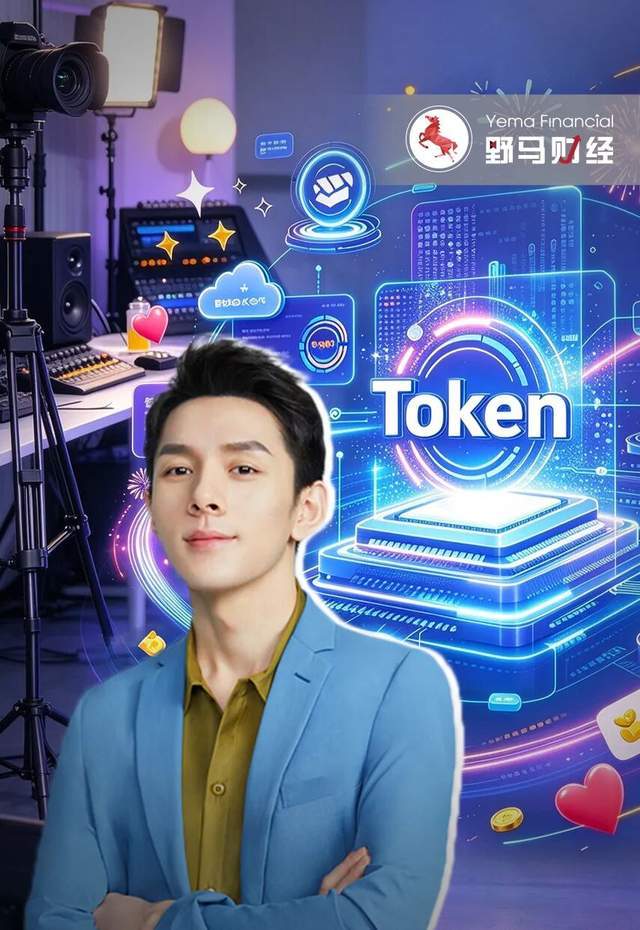
“321, get the Token!”
Author | Jia Zicong
Editor | Yu Na
Source | Yema Finance
This year’s Double Eleven, it’s not just lipstick and liquid foundation that are “linked to 321”, but also large model computing power tokens.
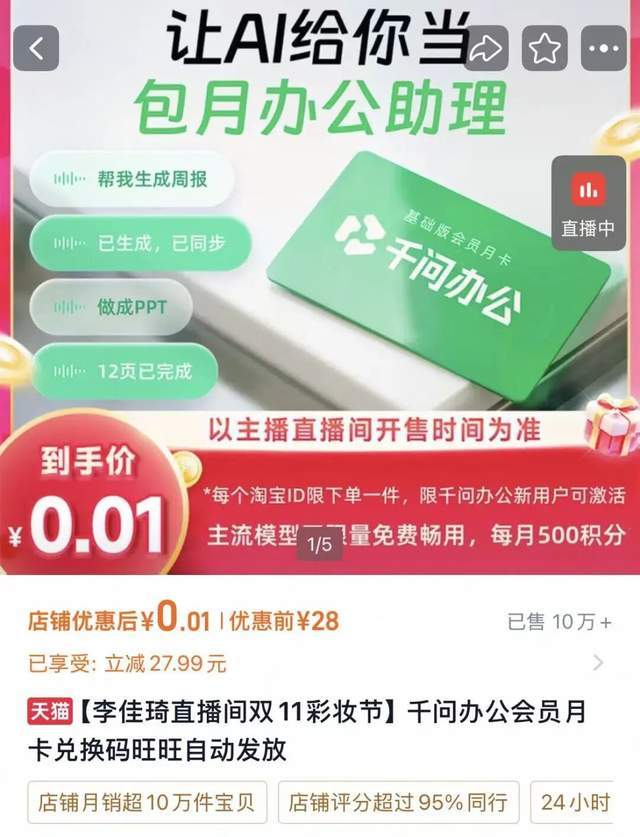
On the evening of November 2nd,Chen Yusen, vice president of Alibaba Group and CEO of Qianwen Office, appeared in Li Jiaqi’s live broadcast room. What he brought was an AI office membership monthly card with an original price of 28 yuan and a live broadcast price of 1 cent.
Half an hour later, Chen Yusen left the live broadcast room.The monthly card sales exceed 100,000 pieces, and the corresponding AI computing power quota totals more than 2 trillion Tokens.

This is the first time that a leading anchor has sold tokens in his live broadcast room. In the past, the unit of measurement that was placed in the developer backend and written in the API bill was placed in the middle of beauty and snacks this night.
The Token discount is almost free, and the revenue is only 1,000 yuan based on the sales of 100,000 copies. If these 100,000 copies were sold at the original price of 28 yuan, the price would be 2.8 million yuan.
Turn the clock back to the same live broadcast room eight years ago. At the 2018 Tmall Double 11 party, Jack Ma and Li Jiaqi competed on the same stage to sell lipstick. Li Jiaqi sold 15,000 lipsticks in 15 minutes and became famous in one battle. From lipstick to tokens, the items on the shelves have changed, but the account hidden behind the shopping cart has just been settled.

01
“321, get the Token!”
The barrage in the live broadcast room changed from “321, upload link” to “321, upload token.” This is the most familiar urging in the live broadcast room. This time it is aimed at an “invisible” product.
Chen Yusen used a metaphor to explain the term Token:“Just like we need gas to drive and our daily appliances need electricity, the fuel for AI work is Token.”
Li Jiaqi told the audience:Every time AI generates and every time long text is understood, Tokens are consumed. What you buy in this package is not a physical item, but a computing power quota that can help professionals save time.
This product is a Qianwen Office Personal Basic Edition monthly membership card, which contains 500 general points and 100 bonus points per month. Users who register for the first time will get another 300, for a total of 900 points. According to the calculation given in the live broadcast room, 500 points is approximately equivalent to 50 PPTs, or 160 Word documents such as weekly reports, summaries, and plans, or 250 Excel sheets, or 80 investigation reports, or 60 data analyses, or 20 high-definition pictures.The anchor also explained that the actual consumption depends on the complexity of the task.
The live broadcast listed many usage scenarios of Token: parents use AI to organize test papers and create targeted training games; fishing enthusiasts generate a global fishing map in one sentence. Li Jiaqi lamented at the scene: “If I had known earlier, I wouldn’t have had to stay up late to write the partner report.”
In fact, this is not the first time that Token has been put on the shelves.In early September this year, Tmall launched the “AI Space Station” Token recharge center. Manufacturers such as Zhipu, MiniMax, Alibaba Cloud, and Step Star have successively entered the center. Various brand packages are displayed in a centralized manner based on monthly cards, annual cards, and recharge packages.The relevant person in charge of Tmall said that on the first day of “Double Eleven” sales on October 20, the transaction volume of Taobao Token category increased by 450% month-on-month.
JD.com also launched the “AI Software Recharge Center” in September, which collects many large models such as GLM, DeepSeek, Seedance, etc., and not only has Token recharge packages, but also AI-related books, as well as AI tool memberships such as Jimeng and Jianying.
A research report released by Huaxin Securities also stated that e-commerce platforms have concentrated on listing token categories, creating a new entrance to standardized retail of model tokens and promoting the further integration of AI large model services into traditional e-commerce consumption scenarios.
But amid the excitement, one has to figure out what exactly is being sold.The preferential price of 0.01 yuan not only buys computing power, but also a registered account. The carnival in this live broadcast room is more like a carefully designed new recruitment.
When token is no longer a term in technical documents, but a line of products that can be checked, compared, and stocked in a shopping cart, the competition for large AI models seems to have quietly entered the second half.
02
The lively competition for AI ranking
Based on the sales of 100,000 monthly cards, the income is about 1,000 yuan; if the original price is 28 yuan, the corresponding value is about 2.8 million yuan. What manufacturers give up is not profits, but customer acquisition costs. This 1 cent is not only the price, but also the admission ticket.
A survey by Tencent Research Institute in May 2026 showed that the overall payment ratio of AI users was only 9.8%.More than 90% of them are still free and shallow.What Qianwen Office wants to do is use an almost zero threshold to bring people who have never paid for AI into its registration system.
Zhou Zhifeng, managing partner of Qiming Venture Partners, once pointed out the real problem in the industry: reasoning costs are falling, and quotations are also falling.“Whether customers stay because of price subsidies or because they are irreplaceable is the real question.”. 0.01 yuan can sell well, but it does not mean that 28 yuan can retain people.The real test will be the next month, how many of the more than 100,000 accounts are willing to renew at the original price.
Only by looking at the rankings of AI offices can we more intuitively see the current competitive pressure. QuestMobile’s “AI Application Market Development Report for the Third Quarter of 2026” shows that,In September 2026, the monthly active users of Tencent WorkBuddy, Baidu Tazi, and Alibaba Qianwen Office were 32.353 million, 9.77 million, and 7.905 million respectively. Qianwen Office’s monthly activity is about a quarter of WorkBuddy’s, ranking third.
Qianwen Office has the foundation of more than 20 million corporate organizations behind DingTalk, as well as the merchant resources of Alibaba e-commerce. In terms of the scale of C-side activity, there is a real gap between the leaders.
QuestMobile’s report also shows that,The PC web client and client of Qianwen Office were only launched in July, released to public beta in August, and launched at the end of August, while WorkBuddy was fully launched as early as March.The PC client of Beanbao Job, which ranks fifth in the ranking, will not be launched until the end of August 2026. The starting time of each company is not the same, but it is natural to catch up if it is ranked low.
The excitement in the live broadcast room cannot cure the anxiety of competing for position. Also launched in Li Jiaqi’s live broadcast room that night were three AI computers with built-in Qianwen Office, including Laiku Air, Mechanic Shuguang 16S, and Lenovo Zhaoyang Yue Plus, as well as DingTalk A1 and QwenNote A2 audio and video cards.
Token is the “hook”, and hardware and subsequent membership renewals are the profit pool.Tmall previously disclosed that 70 computer hardware models equipped with Qianwen Office will be launched during this year’s “Double Eleven”. While the industry is still competing for monthly active rankings, Alibaba has already put its shelves on the screen closest to users.
03
From selling lipstick to selling Token, it only took eight years
Eight years ago, Alibaba founder Jack Ma sold lipstick in Li Jiaqi’s live broadcast room; eight years later, Ali Vice President Chen Yusen sold tokens in Li Jiaqi’s live broadcast room.
Meizhi Network Technology Co., Ltd. (hereinafter referred to as “MeiONE”) where Li Jiaqi works is originally an MCN invested by Alibaba. This cooperation is more like the “Alibaba team” stuffing its own AI products into the most attractive shopping cart in its ecosystem.
The fate between Alibaba and US ONE was laid long before Li Jiaqi entered the game. At that time, Beauty ONE was just starting out and promoted a project called “BA Internet Celebrity”. To put it bluntly, it trained beauty shopping guides at offline counters into online anchors. At that time, they teamed up with L’Oreal to try this new model.
In early 2016, Hupan Shannan Capital invested in the angel round of ONE. Hupanshannan Capital is a fund established and managed by Xie Shihuang, one of the eighteen Arhats of Alibaba. Alibaba itself is the main investor of this fund, and its investment direction is also focused on finding early-stage projects in the Alibaba e-commerce ecosystem., used to support entrepreneurs upstream and downstream of the platform. This amount of money is equivalent to getting a boarding ticket for Taobao Live for the early US ONE. In the same year, Li Jiaqi was selected in the “BA Internet Celebrity” project and officially joined US ONE. His live broadcast story began.
Later, Mei ONE completed two more rounds of financing. In October 2016, Ssangyong Aviation Soft Ventures invested in the Pre-A round; by the end of 2017, Fashion Capital, Weibo Capital, Detong Capital, Qifeng Capital, and Hewhale Capital jointly completed the A round.
After Li Jiaqi became popular in 2018 as the “lipstick brother”,Mei ONE has taken root in the traffic pool of Taobao live broadcast rooms, and Alibaba’s role has gradually changed from an early investor to a platform partner.
Mei ONE has been rooted in Taobao for a long time. Li Jiaqi’s live broadcast room can get key resources from the platform for almost every major promotion, which continues to bring popularity and sales to Taobao. In turn, Taobao’s huge traffic also supports this leading anchor IP, and both parties achieve mutual success.
When AI is put on the shelves as a “fast-selling product”, its price tag, measurement and after-sales service still remain in the logic of the developer’s backend. Ma Shenglong, solution manager of Qinghai Mobile Computing Business Operation Center, once told the media,For the same text, the Tokens consumed in different models may differ by 20% to 50%, and the billing rules of each company are also inconsistent, making it difficult to convert between packages.It is difficult for consumers to judge which package is cost-effective based on the unit price alone, like comparing prices of laundry detergents. Wang Jiandong of the National Information Center once suggested,Unify Token measurement standards, standardize billing disclosures, and introduce third-party verification as soon as possible.
並且,You can apply the lipstick immediately after buying it, but you have to learn to use it first after buying the token, and the supply may be limited during peak periods.It is still unclear how many weekly reports and PPTs can be written with the tokens purchased by consumers. The data given in the live broadcast room are only reference values, not promised values.Moreover, the product pages of many large model manufacturers’ Ci Yuan packages indicate “7-day no-reason returns are not supported.”, there may also be problems after sales.
Cheng Yuan, general manager of Tmall 3C Digital, once told the media: The purpose of moving Token onto e-commerce shelves is to make it “as easy as paying utility bills in the future.”
But for AI to become a daily necessities, it still needs an understandable price tag. How much work can be done with 500 points, how long is the validity period, and whether complex tasks will suddenly double the deductions? Until these rules are made clear, mass consumption is just the beginning.
When Token and lipstick are placed in the same shopping cart, AI competition has entered the “second half”; but whoever can write the price tag clearly will truly embrace the “second half” of AI.
Related Reading
- Nvidia live updates: Jensen Huang ousted, CFO Colette Kress to serve as interim CEO2026-11-13
- Are mangoes not afraid of red fruits?2026-11-12
- Original: After Huang Renxun, who is most likely to take over Nvidia?2026-11-12
- Samsung’s roll-screen mobile phone is exposed, creating a new form ahead of Huawei and Apple, and folding screens are expected to be eliminated2026-11-12
- Musk’s favorite car is going to be discontinued.2026-11-12