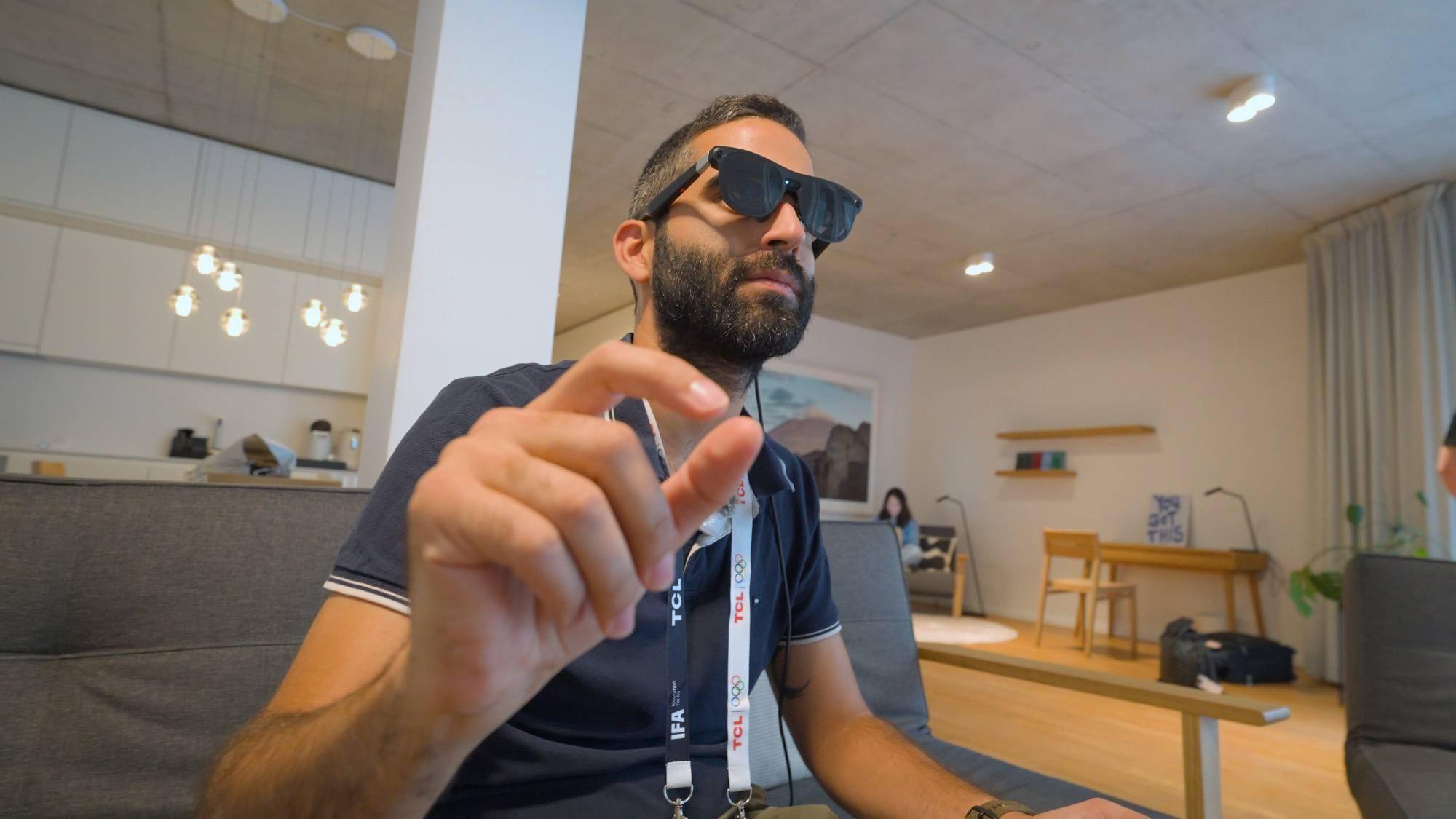
Title picture|Frontline
This year, AI glasses are finally understood by the public.
According to IDC data, global smart glasses shipped 7.11 million units in the first half of 2026, a year-on-year increase of 70%. Counterpoint data shows that 96% of AI glasses sold in the first half of 2026 do not have a screen. Taking photos, listening to music, and asking AI questions constitute the core experience of most products.
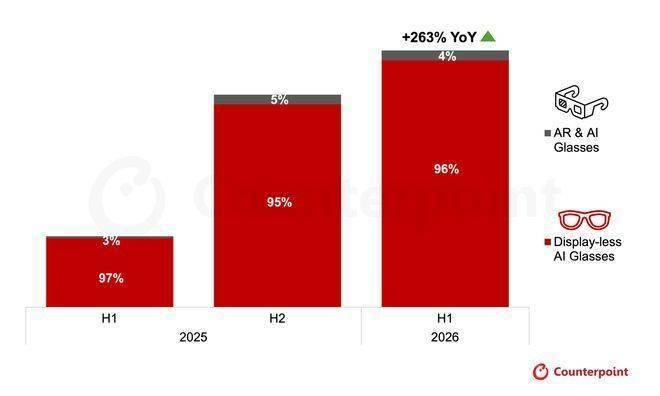
Just when everyone has just figured out what AI glasses are, the next round of competition for glasses has already begun. Because there is another type of glasses that does not aim at this. The problems they want to solve are:Can glasses allow people to do things they couldn’t do before, rather than just moving old functions to a position closer to the eyes.
On September 23, Meta released VR Glasses at the Connect conference, which consists of a pair of glasses and a pocket-sized computing unit. More than a month later, on October 28, Google and XREAL jointly released AURA, which was the first to go on sale and be the first to be delivered this year. It also consists of the glasses body and a split computing unit. It is also the world’s first wired split XR glasses equipped with Android XR.
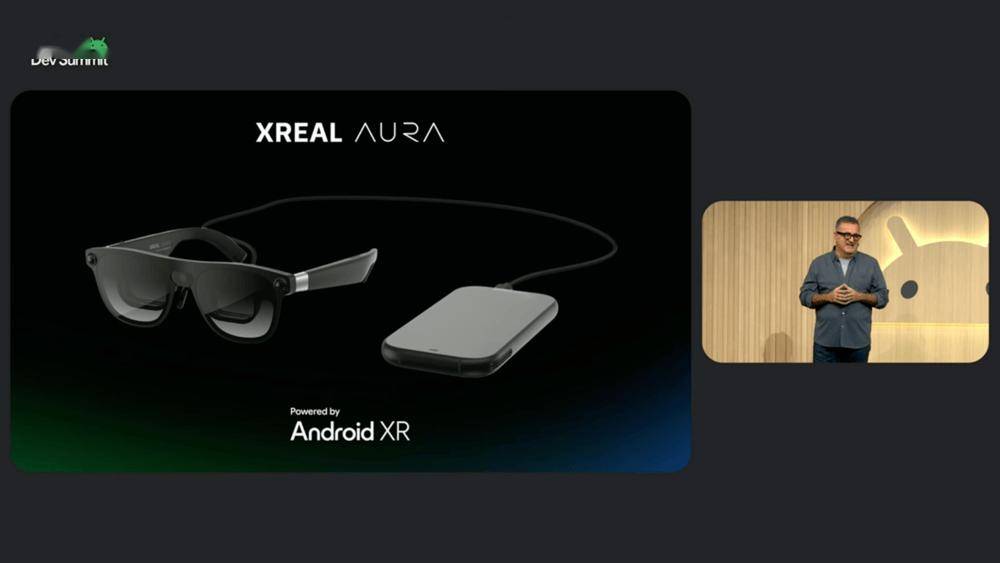
The two companies started from different starting points, one from virtual reality and the other from augmented reality, but they have reached almost the same form. This leads to a question: Why do wearable computing terminals in 2026 have reached this form?
Xu Chi, founder and CEO of XREAL, used an analogy in his answer. “Computing terminals also came first with desktops, then laptops, and finally mobile phones.” The smaller and lighter the device, the harder it is to complete everything. “AI glasses are the lightest, but making them well is the most difficult.” Therefore, XREAL does not stop making AI glasses, but chooses to first make a laptop or tablet that is worn on the head. In Xu Chi’s view, this is the current spatial computing.
Laptops and tablets anchor complete computing power and multi-tasking capabilities, but what XR really wants to cross is the boundary of flat screens.It integrates space perception, portable computing power, operating system and application ecology into the same product, allowing digital content to obtain a location in real space and accept human operations.From this, tools are no longer just held in people’s hands, but also begin to revolve around people. The question it wants to answer is no longer how big the picture can be projected by the glasses, but to set up a benchmark for “what is real XR”.
At the Google I/O conference in 2012, several skydivers wearing Google Glass jumped from the sky above San Francisco and broadcast the first-person view live to the conference site. That was the first time many people felt that computers worn on the face were coming.
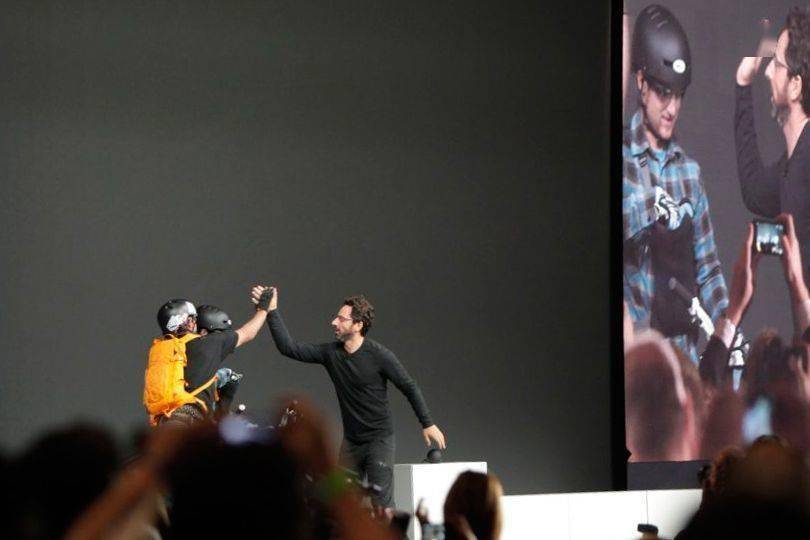
From Google Glass to Vision Pro, the XR industry has been ignited by new products in the past decade or so many times, and it has returned to the niche many times. People have been waiting for a product like the original iPhone to tell everyone that a new era has arrived. But more than ten years later, that moment never came.
“People tend to remember a moment, but ignore the maturity of several basic production factors before that moment arrives.” Xu Chi said. The reason why the original iPhone was born was that multi-touch, mobile chips and mobile Internet were all ready at the same time.
In his view, a new terminal requires three pieces of the puzzle.The first piece is the right hardware: a form that a person is willing to wear, as well as the chip and core components behind it; the second piece is ecology, any terminal requires an operating system and a group of developers; the third piece is interaction, a new way of communication between people and machines.
Products of the past ten years or so have often only received one or two of them. Some hardware is amazing, but too heavy to be worn for a long time; some ecosystems are started from scratch, and developers are unwilling to come; the interaction has always been “touching the air with gestures”. The difference with AURA is that these three pieces of the puzzle are finally starting to fall into place simultaneously in the same system.
Remove weight, leave space
What can people with AURA do? The simplest understanding is: what you did on your laptop and tablet today can now be “unfolded” in front of your eyes and in space. Exhibition is not simply to emerge, but to spread out the elements according to your wishes.
When you are out and about, you can connect your laptop with a USB-C cable without installing any software. The computer screen becomes a spatial window that can be enlarged at will. Several Android applications can be opened on the table next to it to handle multiple tasks in parallel. These images are only visible to the wearer.
On the plane, darken the lenses and AURA can turn into a private theater; when someone comes over, the lenses turn back to transparent. Back at home, the living room changes with your needs. The dining table can be a court, the sofa can be in the middle of a theater, non-existent dice are rolled from your hands, and objects in the virtual world can be touched and placed. As long as you are willing, the space in front of you is your secret cyber base. XR glasses should not only display images, but also lead people into the images.
Through a three-camera array, 6DoF space hovering and gesture operation, AURA allows the window to be stably “placed” on the desktop or on the wall, and people can approach, look around, or reach for it. Optical see-through preserves direct physical line of sight, with digital content superimposed on top. The 70-degree field of view gives enough space for multiple windows and three-dimensional content.
To achieve this space experience in lightweight glasses, computing power allocation is an unavoidable engineering problem.The common practice in the industry is to “outsource” computing power and batteries and connect them with wires, and AURA does the same. The Puck, an external computing unit in the pocket, contains the battery and the main computing chip. Large computing tasks such as the operating system, 3D rendering and AI inference are run here. The self-developed XREAL X1S spatial computing chip on the glasses is responsible for the immediate affairs. Don’t underestimate this part. It is used to complete many tasks of spatial computing: real-time fusion of multi-sensor data, and 6DoF spatial positioning and spatial anchoring. The ability to achieve ultra-low latency spatial display is all due to the XREAL X1S spatial computing chip.
This solution of “outsourcing” power and computing power may seem simple, but it is actually a watershed moment among devices. Whether the external unit is installed in a mini mobile phone for screen projection or an operating system natively designed for three-dimensional space determines whether the product will stay on an external display or step into a spatial computing terminal. The hardware form may be similar, but the underlying space operating system and ecological base cannot be implemented quickly.
To measure whether a device counts as true spatial computing, you might as well ask the three simplest questions: Does the content have a position in space? Can tasks be completed continuously? Will there be new ways to use it after I buy it home?
An ecology that doesn’t start from scratch
The division of labor between hardware and computing power determines whether a terminal can run. The next question is how the user can continue to use it after buying it back. The XR industry has been trapped in a cycle for a long time: hardware sales are limited, developers are unwilling to invest; applications are insufficient, and users lack reasons to purchase and continue to use it. The amazingness of many devices only remains in the demonstration stage. Although the hardware is already full, the ecology is very skinny.
Xu Chi had made a judgment on this matter very early.Rather than spending all your energy on polishing native AR applications, it is better to move the ecology of mobile phones and the Internet over and enhance it in the space; with users and scale, the native ecology will naturally grow.AURA began to turn this judgment into reality. The growth plan of this system is exactly these three steps.
The first step is transplantation.Android apps on Google Play can directly access AURA, and laptop screens can also be accessed through a single cable. For users, they already have things to do after receiving the device, and there is no need to change their work habits; for developers, there is no need to rewrite the application first. What this step solves is “will there be any use after buying it?”
The second step is enhancement.The same application becomes more usable in space: windows are no longer crowded on one screen, and multiple windows are placed around it in any size; ordinary videos and photos can be converted into 3D; content can be shrunk to the edge of the field of view when walking. The application can also be related to the scene where the wearer is located. The transplantation solves whether something is useful, and the enhancement makes it more enjoyable for users to use it here rather than directly.
The third step is native.After being connected to the Google Play ecosystem, in addition to the general applications that support daily basics, there are more than 150 spatial experiences specially created for XR, which can use spatial positioning, gestures and three-dimensional content to provide gameplay that is difficult to carry on a flat screen. XR games from Owlchemy Labs and Resolution Games can be played directly with hands, and new space-native games such as “The Rescue Plan” are also on the way. How many Android applications can be opened determines the out-of-box experience, and how many applications must rely on space to be established determines the upper limit of this ecosystem.
This is the logic for consumers.Only if users are willing to wear glasses repeatedly for work and entertainment can developers obtain continuous usage scenarios, feedback and distribution opportunities. The value of the consumer side is not only how many devices are sold, but also whether stable spatial interaction habits can be formed.
For the enterprise side, it depends on whether efficiency and cost have been improved.When a head and neck surgeon tried AURA, he still looked directly at the real surgical field through the lens, and the three-dimensional holographic model of the lesion and surgical specimen hung beside him. With the help of shared experiences, the surgery, imaging and pathology departments can discuss plans around the same 3D model, and other members in the operating room can also share the three-dimensional view simultaneously. When used in teaching and multidisciplinary consultations, not only the steps of searching for two-dimensional slices are reduced, but also the communication costs of each person separately restoring the three-dimensional structure in their minds and then aligning and understanding each other.
The same logic can also be applied to industrial and enterprise collaboration. Complex CAD models can be converted into interactive digital copies, and the repair process can be carried out on the same site as the real equipment. The design team can also get close to the three-dimensional prototype before the product is launched, and experience the space in front of them before it is launched. Of course, physical prototypes, real machine training and labor costs cannot be completely eliminated in the real working environment, but at least they can be converted into reusable spatial processes to improve efficiency. Google has separately released AURA’s enterprise deployment plan for this purpose. For enterprises, whether the equipment can be managed uniformly and the process can be deployed on a large scale determines whether it is a set of production tools that can be integrated into the existing work system or a one-time three-dimensional demonstration.
Ecology brings consumption and professional tasks into the digital space, and interaction determines how long people can stay in the digital space, because only comprehensive and coherent operations will not interrupt the user experience.
The XR industry has been improving gesture recognition accuracy in the past, but Xu Chi believes that “gestures are never enough.”The next generation of interaction may also require an intelligent agent that can understand the scene and accept natural language instructions.“Like anyone talks”. The third interactive puzzle piece on AURA comes from Gemini.
What impressed him most was a scene of playing games. Normal space games are part of the game. When it comes to games that pay attention to fine operations, the wireless controller specially developed for Android Gemini in the glasses can see your game screen and will be like a friend sitting next to you, helping you analyze the next step based on the progress in front of you. The same logic applies to daily work and life: return your gaze to any place that arouses curiosity, raise your hand to circle the object in front of you, and you can directly ask questions.
This is the biggest difference between glasses, mobile phones and computers. Mobile phones and computers usually wait for user input. People must first break the object they see into keywords, screenshots or a description before handing it over to the machine; glasses are between people and the world, directly understanding everything that is happening in front of people and making people curious. At the same time, new tools such as natural language development are also lowering the threshold for creating three-dimensional content, allowing segmented ideas in the hands of small teams and individuals to quickly grow into new applications in the space.
At this point, AURA has put three pieces of the puzzle into the same system:Spatial hardware allows digital content to gain location, the Android ecosystem provides applications that can be continuously called, and Gemini tries to understand the scene that users are facing.The value of the ecosystem also changes from “how many applications can be opened” to “how many real tasks can be completed here.”
A “strange” combination
In the era of smartphones, Apple happens to be good at both software design and hardware design, and one company gets things done. But this time things are different.
“Who can define the interaction? Who can define the operating system? Who can define the product? You will find that it is probably not one company that can do all of these things.” Xu Chi said that AURA therefore became a product jointly completed by XREAL, Qualcomm and Google.
Each of the three companies has its own strengths and needs.
Google needs to prove that Android XR can’t just run in a closed headset. It needs a form that is light enough and has transparent lenses that can be incorporated into daily life; Gemini also needs a pair of eyes that can see what the user sees. Shahram Izadi, head of Google’s XR business, said in a blog that AURA is “a new way to use Android XR.”
Qualcomm needs a first-release terminal to demonstrate the spatial computing capabilities of Snapdragon Reality Elite. When this platform was released in June this year, Qualcomm had listed AURA as one of the first products to be adopted.
XREAL needs to advance glasses from display devices to computing terminals. Optics, chips, and overall machine capabilities can be accumulated by oneself, but operating systems, multi-modal AI, and a global developer ecosystem are difficult to build from scratch by a hardware company. What it needs is a mature platform that can be directly connected.
For Android XR to enter real life, it is not enough for ecosystem providers to only define the software system. They must also have corresponding officially defined hardware as a demonstration.For the sake of experience, XREAL and Google sat together and worked together from the early design and development stages of the product, allowing the operating system and hardware to adapt in both directions, and then developed the new route of wired split Android XR glasses.
“Our vision today and the vision of the first product have not changed at all.” Xu Chi said. What changes is the path. XREAL’s ability to enter this decision-making scene comes from their long-term persistence in product route. When XREAL launched its first product, Nreal Light, it adopted a split design and supported 6DoF. At that time, they were even more radical than they are now. They wanted to do everything themselves: hardware, operating system, interaction, and even part of the content. After Nreal Light, XREAL made two decisions that were not optimistic at the time.
The first is to insist on split architecture.For a long time, the mainstream idea in the industry was to put computing, battery, and cooling all into the equipment on the head. XREAL’s judgment is the opposite: to make glasses light enough to be worn for a long time, you must take heavy things away from your face. Looking back today, new products such as Meta’s VR Glasses and Qualcomm’s lightweight optical see-through solution defined for the new platform have different technical paths, but the layout of computing power has moved towards a similar split form.
The second is to temporarily narrow the product range to display glasses.By turning the images of mobile phones, computers, and game consoles into a large screen in front of you, XREAL has also accumulated the ability to develop its own optics and chips. At the end of 2024, XREAL released the X1 chip customized for spatial display, and the X1S used on AURA is its upgraded version. Public data shows that XREAL has accumulated more than 800 patents and patent applications around the world, and has deployed dozens of key patents in core markets such as the United States and Europe.For international platform parties that attach great importance to global compliance and security and the feasibility of large-scale implementation, what they value is not only the mass production delivery process, but also the set of independent intellectual property rights that are tenable in the global mainstream market, as well as the long-term technical reserves of self-developed optics and chips.
Through these two decisions, XREAL has made steady progress in distributed architecture and display quality, and finally sat on the defining seat of the new Android XR category. Participating in defining the product is the next step in participating in defining the industry. For a long time in the past, Made in China has been good at efficiently manufacturing products that others have ordered, and participating in the global division of labor based on manufacturing efficiency, supply chain response and engineering execution.This time, a Chinese company, with its self-developed optics, spatial computing chips, global patent reserves, and long-term verification of split architecture and lightweight wear, worked with Google and Qualcomm to define how a new terminal should work.What it provides is a specific sample: entering the game with core technology and complete machine engineering, entering into the early definition of the operating system and application ecosystem, and writing reference answers for the next generation of terminals.
尾聲
Of course, AURA is far from answering all the questions of spatial computing. The weight of the glasses is still much higher than that of ordinary glasses; the cable connecting the glasses to the computing unit is still hindered when getting up and walking around, storing it in a bag, or taking it on and off repeatedly; the battery life is not enough to last a full day of use. Although universal Android applications are still usable out of the box, and can take full advantage of spatial interaction, they still have to rely on developers to spend time and continue to accumulate native content. The thousand-dollar pricing also determines that it is currently mainly targeted at early users, developers and professional users with clear needs.
These real-world boundaries don’t detract from the step it takes, but they serve as a reminder that the next generation of terminals won’t all evolve in one release. AURA turns an abstract concept that has been discussed for many years into a system that can be truly tested in daily life. It allows people to see a change:In the past few decades, people have been learning how to use machines; starting from this generation, we are remaking software to learn to understand ourselves.
Today’s Work Agent is good at dismantling instructions and processing tasks, but it is difficult to understand people outside the task; Xu Chi, founder of XREAL, began to envision Life Agent:Let the interaction slowly move from executing commands to understanding the situation. Glasses are close to people’s line of sight and have display, voice and environment perception capabilities. They are naturally at the entrance of this evolutionary path. Of course, AURA currently does not have complex physiological monitoring functions, and Life Agent is still a long-term idea. But what AURA has actually accomplished today is to bring spatial computing and multi-modal Gemini to the forefront of human sight, and to build a product base for this long-term idea that can actually run in daily life.
Back to the original question. The “iPhone moment” that the industry has been waiting for for more than ten years may not arrive in the form of a genius, a giant, or a conference. As Xu Chi said in an interview with the Financial Associated Press in May this year,“It’s very possible that the iPhone was not made by one company at all times, but maybe this time it was made by a combination.”When hardware, ecology, and interaction matured at the same time, several companies that did their best put it together.
In 2012, a skydiver dropped from the sky and gave the world its first glimpse of what a pair of glasses can do. More than ten years later, this pair of glasses is finally not just for seeing, it can also understand and enhance the world in front of you.
Related Reading
- Nvidia live updates: Jensen Huang ousted, CFO Colette Kress to serve as interim CEO2026-11-13
- Are mangoes not afraid of red fruits?2026-11-12
- Original: After Huang Renxun, who is most likely to take over Nvidia?2026-11-12
- Samsung’s roll-screen mobile phone is exposed, creating a new form ahead of Huawei and Apple, and folding screens are expected to be eliminated2026-11-12
- Musk’s favorite car is going to be discontinued.2026-11-12