Apple’s foldable screen has finally been released.
As early as seven years ago, we heard rumors from the supply chain that “Apple is going to make a folding screen.” During this period, rumors about hinge suppliers and screen suppliers were widely spread.
However, it wasn’t until early last month that we finally saw the full picture of Apple’s foldable screen “iPhone Duo”.
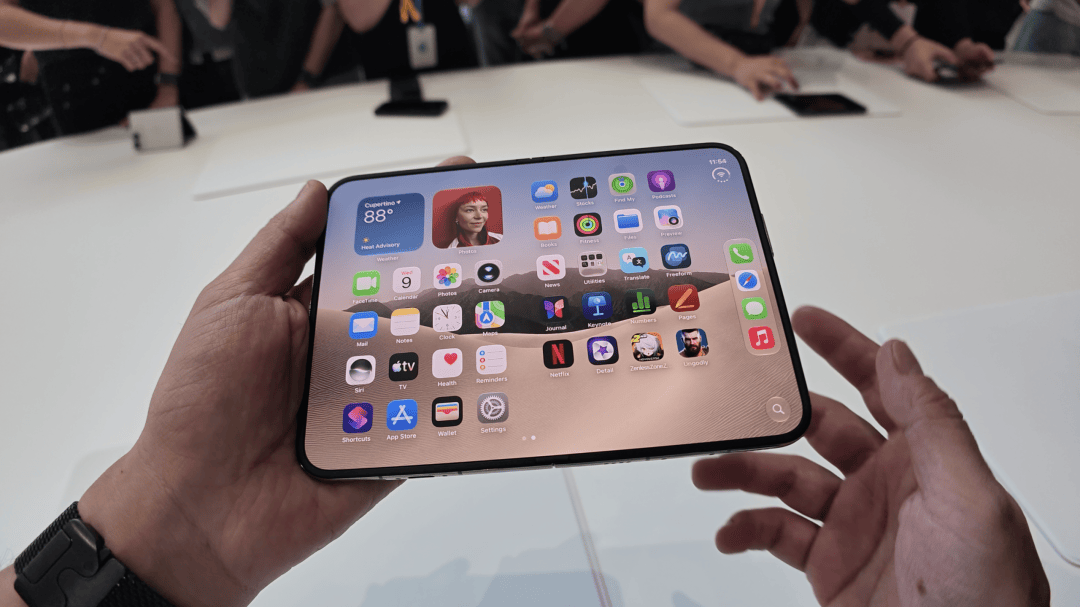
At first glance, the iPhone Duo is just “another foldable screen”, but when you look into the details, it hardly follows any industry convention – the charging port is on the left side, the press conference did not mention a word about the folding life, and the inner screen uses a nano-texture surface.
Just like the time when iPods and MP3s, Macs and PCs, iPhones and smartphones were deliberately separatedLikewise, Apple has its own explanation for Duo.
On the eve of the launch of the new generation of iPhone, Ergouwo, on behalf of the hardware department, chatted with Kaiann Drance, Apple’s vice president of global iPhone product marketing, and Zongjian Chen, vice president of hardware technology.

When the two executives talked about iPhone Duo, they did not directly talk about the “folding screen”, but repeatedly mentioned the same word – iPhone standard.
“A product must first meet the standards of iPhone before it can be called iPhone.” This is the most repeated subtext in the entire conversation. Today’s article is a bit long, so I will make an outline first so that friends who are interested in a certain topic can jump quickly:
Two “unconventional” choices: why is the charging port on the left and why is the volume button on the top?
Are hinges durable? Why doesn’t Apple announce the number of folds?
Why does the inner screen use a frosted nano-texture?
Folding is not just about “opening and closing”, the process of opening and closing is also important.
Self-developed baseband C2, is it mature enough? How much has it been upgraded?
Why are we making foldable screens now?
Easter Egg: How to use it if you are left-handed?
Note: During the dialogue, we asked questions in Chinese and English, and the two guests answered in English; this article has been organized into smooth text based on the editor’s understanding, and professional terminology has been unified.
>/ Two “unconventional” choices: why is the charging port on the left and why is the volume button on the top?
At this year’s Apple autumn new product launch, iPhone Duo was presented as One More Thing, and it is just like what everyone has seen from various previous revelations. Today, when there are no secrets on the Internet, its appearance is far from amazing.
But after watching the press conference and playing with the real machine in the experience area, we found that the details of Apple’s product definition are still different from other manufacturers. For example: Why is the charging port of iPhone Duo on the left half of the folding screen, instead of on the right half like most folding screens?
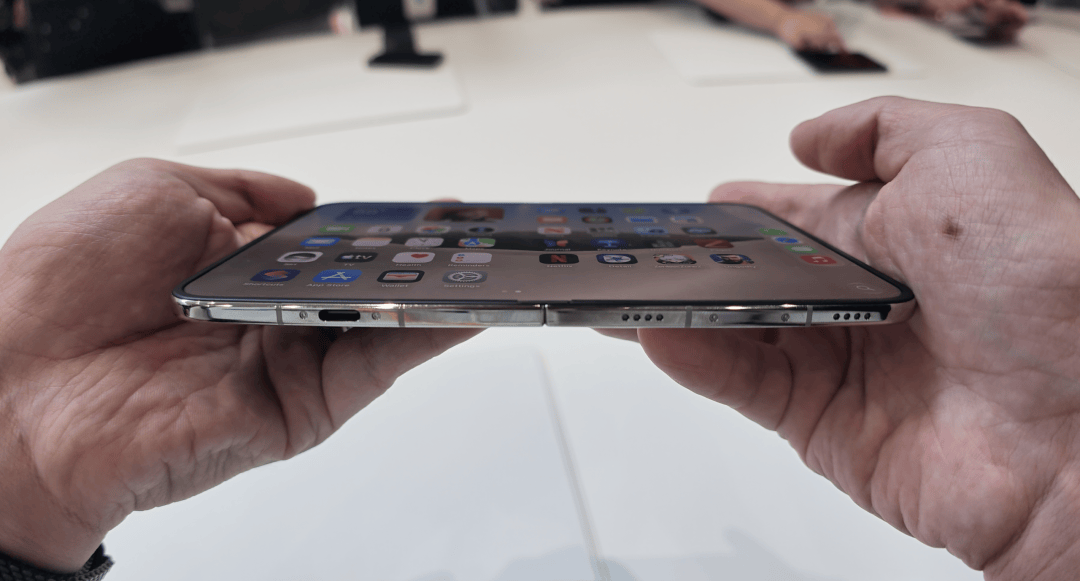
Apple’s answer is: the design of hardware (components) must serve the various “forms” of the product when used by users.Because it can be folded and has various hovering angles, the plug-in charging experience of iPhone Duo in different forms must be considered.
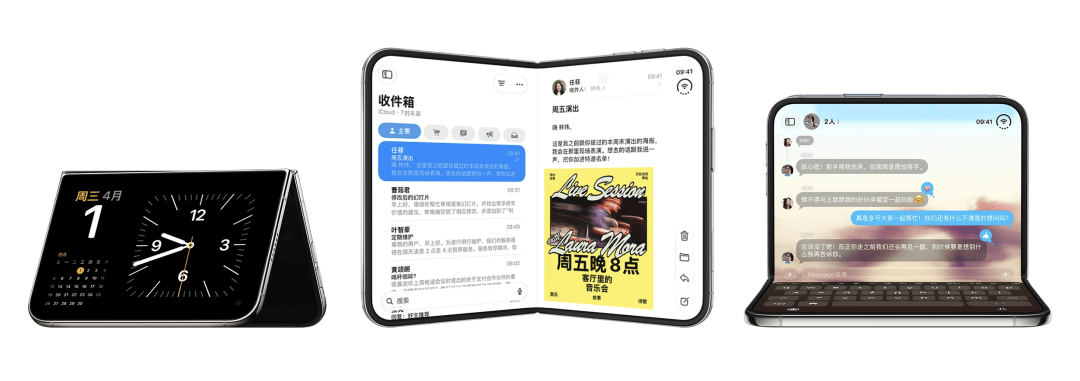
In the form of a candy bar machine, it is more reasonable for the charging port to be under the outer screen;
When unfolded, it can be used either left or right;
In desk calendar mode, both front and back are OK;
In the “mini notebook” form, the charging port is placed on the side of the “keyboard”, which is more reasonable than charging suspended on the side of the “screen”.
Which of the two halves of the screen should be the “keyboard”?
Naturally, it’s the left half, because the flat external screen on the back is more suitable as a “notebook base”. After considering all conditions, the bottom left side of the inner screen is what Apple thinks is the most reasonable position.
In terms of internal space stacking scheme, the iPhone has one more challenge than other smartphones: Magsafe.It is also a more reasonable choice to avoid the side where the Magsafe is located.
This theory can also be used to explain the button layout of the iPhone Duo: why is the Touch ID lock screen button on the side and the two volume buttons on the top?
The folding structure prevents Duo from being able to increase and decrease the volume on the left side and lock the screen on the right side like all iPhone candy bars. The relatively short and fat shape is not suitable for placing all the buttons on the right side. The further down the Touch ID is, the worse the natural holding unlocking experience will be.
From this point of view, the volume button on the top is also the most appropriate layout in all forms.
>/ Are hinges durable? Why doesn’t Apple announce the number of folds?
From the hands-on video sent by colleagues on-site, it seems that iPhone Duo has good control over creases. But at the press conference, Apple did not prove its reliability with specific durability figures like many of its peers, such as hundreds of thousands or millions of folding tests. When asked this question, Kaiann and Zongjian did not disclose the specific number of folding cycles. Instead, they gave a concept called “dwell time”.
Dwell time refers to how long a user will stay in a certain folded state.This is another indicator Apple proposes for the durability of folding screens in addition to the number of folding cycles.
iPhone Duo has a layer of viscoelastic glue between the display layers, which allows the layers to slide against each other when it is opened and closed, thus avoiding the build-up of stress, which is critical to the long-term durability of the entire structure.
No matter how long the user stays in whichever folded position, these viscoelastic layers must always remain smooth and fluid.
Apple will also conduct other reliability tests on the folding parts of iPhone Duo, such as looking at the performance of folding and falling events, as well as dust or liquid splashes. It is worth noting that the dustproof and waterproof rating of iPhone Duo reaches IP68. A dustproof rating of 6 means that dust cannot enter the body, which is relatively rare among foldable screens.
The bottom of the display layer of iPhone Duo is also covered with a layer of solid titanium alloy. Apple has etched a “kirigami” structure in the middle of the fold to relieve stress when folding.
All of this can be summed up in one sentence: Apple designs for durability first and then tests it in real scenarios. At the end of this part, I specifically asked about the durability of the folding structure of the iPhone Duo, such as its state after one or two years. Zongjian gave a very confident answer: “You can rest assured.”
>/ Why does the inner screen use a frosted nano-texture?
After the product was released, some people said that the iPhone Duo’s inner screen uses a nano-textured surface layer, which is a clever way to weaken the creases. We also raised questions about this during the conversation.
Apple did not deny its effectiveness in weakening creases, but in addition to this, Kaiann also added two other functions: one is to prevent glare under strong outdoor light, and the other is to strengthen the rigidity of the screen structure – which is why the iPhone Duo’s internal and external screens directly support the same Apple Pencil as the iPad.
>/ Folding is not just about “opening and closing”, the process of opening and closing is also very important
I believe that since the release of iPhone Duo, everyone has been very impressed by the transition animation when iPhone Duo is opened and closed. So what hardware is at work behind this?
First, there are sensors on both sides of the iPhone Duo’s body to detect the current position of the hinge. The hinge also has a customized torque curve. It not only has two states of opening and closing, it can not only stop at any angle, but the sensor can also know what state it is stopped at.
The sensor then tells A20 Pro and iOS the position of the hinge, and the software makes decisions accordingly:
For example, when folded to a certain angle, the screen is no longer suitable for touch interaction, and the software will move the interface away and present updated content.
For example, the two halves of the screen will interact with each other to achieve interesting light and shadow effects;
For another example, iPhone Duo can combine the hinge opening and closing angle, as well as gravity, motion sensor and other data to determine the state of the machine, thereby adjusting the driving mode of the two speakers in real time to achieve a consistent spatial audio listening experience.
Apple has even redesigned a set of UI design and interaction logic for various forms. But as consumers, we will definitely use a large number of third-party apps, and what work has Apple done to adapt to third-party apps?
According to Kaiann’s explanation, on iPhone Duo, third-party apps are available out of the box. In order to facilitate further adaptation by developers, Apple has launched a variety of APIs, one of which is called universal resizing (universal size adaptation). If developers have already started to adopt it, this App will take the lead in iPhone Duo compatibility.
In addition, there are already many games and apps that have achieved very good results through cooperation with Apple. Even if you switch between the internal screen and the external screen, or switch horizontally and vertically, the game progress can be continuous.
>/ Self-developed baseband C2, is it mature enough? How much has it been upgraded?
When it comes to the iPhone, signal is always one of the topics that everyone is most concerned about. This year, all national bank machines, whether it is the iPhone 18Pro series or iPhone Duo, use Apple’s self-developed C2 baseband. In this regard, we also asked questions about the maturity of C2.
According to Zongjian, the energy efficiency of C2 is 15% higher than that of C1X, which makes the total energy efficiency of iPhone 18Pro increase by up to 35% compared to iPhone 17 Pro. At least in the area of power saving that everyone is concerned about, the performance of C2 should be satisfactory.
In terms of performance, Apple has improved uplink performance by 50% through uplink MIMO, uplink switching and other technologies. This can also significantly improve network performance in multi-tasking scenarios such as playing games and replying to messages.
>/ Why are we making foldable screens now?
At least in the folding screen track, Apple is the latest to enter the game or the last to launch products. Is Apple passively attacked by its friends, or does it launch the right products at the right time at its own pace? Kaiann’s answer to this is:
Apple saw an opportunity: given how people use it and how important it is in their lives, we could give them a bigger screen.
What was important to us was that the form could still be held with one hand and fit in a pocket, and we were not very inspired by the products on the market at the time. We noticed that most of them use a nearly square ratio and do not make full use of the larger display area of the inner screen; we are not willing to use some of these designs.
So we waited until we made something that was up to iPhone standards. That includes the proportions, the specific design, the work done with the team on the screen, and the durability capabilities we built in.
On top of that, the reimagined iOS experience really brings it all together. It made us think: OK, this is a product that we’re excited about, and it could be an iPhone. So we’re excited to introduce it to the world now.
>/ Easter egg: How to use it if you are left-handed?
Because I am a left-hander, I also asked a question at the end of the conversation about how left-handers should use the iPhone Duo. Kaiann said that the keyboard can be moved to the left side, and the width of the entire phone and the way it is held, even left-handers can have a good experience.
>/ Ending:
Although Kaiann did not answer the questions of left-handers in detail or directly, I personally do not hope that iPhone Duo will become a right-handed model only.
The conversation was relatively rushed, and there was no time to mention topics such as software adaptation and even the under-screen camera of the internal screen. Including whether the “dwell time” introduced by Apple in addition to the number of folds when evaluating the folding structure can better explain the problem, more questions can only be verified and answered after the iPhone Duo goes on sale.
At that time, people all over the world will come together to verify: This is another folding screen phone, or – this is the iPhone Duo.
Conversation & writing:二狗
美編:素描
Apple official website
Related Reading
- Flydubai passenger describes putting attacker in chokehold after cockpit stabbing2026-10-01
- Under the leadership of “Ning Wang”, car companies made three major retreats2026-10-01
- How Google Is Quietly Turning Millions of People Into AI Users2026-10-01
- FTC opens probe into AI giants, including Anthropic and OpenAI2026-10-01
- AI agents have now broken into many companies and a government. What’s being done about it?2026-10-01