Text丨Ouyang Sifan
Editor丨Hu Miao
Pang Yin, a part-time tour guide in Shenzhen, received a 65-year-old American man. Twenty years ago, he came to Shenzhen and bought a book on chip manufacturing in Huaqiangbei. When he came back this time, he wanted to find out if the bookstall was still there. Pang Yin took him there, and the bookstall was no longer there.
Twenty years ago, Huaqiangbei was synonymous with “cottage” and “OEM”. When he came back this time, the old man saw a completely different Shenzhen from Huaqiangbei: outside the high-rise buildings, new energy vehicles were running on the streets; there were self-driving taxis that could be called online; and he also saw drones delivering food. High technology has penetrated into people’s daily life.
Huaqiangbei is indeed changing. In the first half of 2025, the average daily passenger flow of Huaqiangbei Commercial District reached 750,000, a year-on-year increase of 50%; among them, more than 7,000 foreigners visited, doubling year-on-year.
Not only Huaqiangbei, China’s innovation is attracting global attention. A video of the Hutchinsons, a British TikTok family, experiencing drone delivery in Shenzhen received 7.8 million views; a video of an unmanned vehicle taken by an Italian internet celebrity in Guangzhou exceeded 120,000 views in half a month. Drone food delivery, unmanned driving, and robots are becoming foreigners’ most intuitive impressions of Chinese technology.
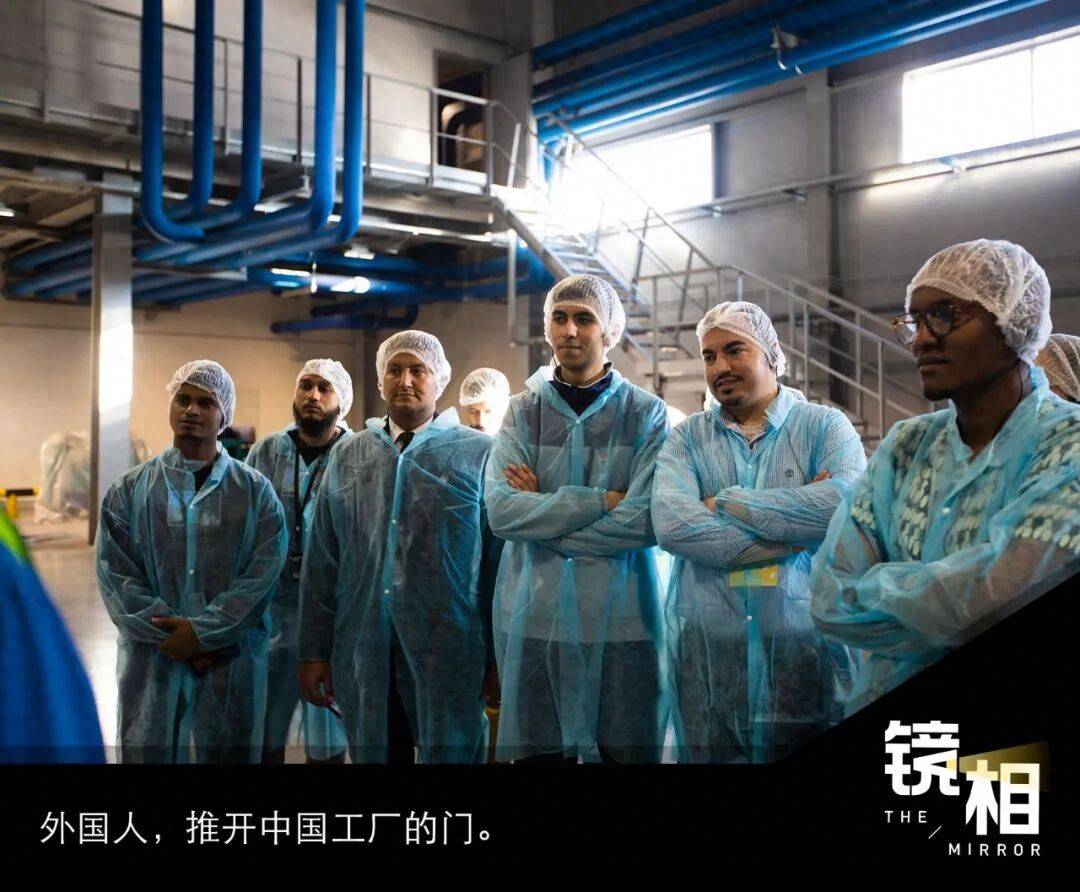
These videos bring more than just curiosity. In the past, when foreigners came to China, their destinations were the Great Wall, the Forbidden City, and Zhangjiajie. Now, the destinations of some people have become BYD’s factories, DJI stores, UBTECH showrooms, and Huawei’s campuses. What they want to see is not just the scenery, but how Chinese technology is made.
But factories and attractions are different.Many Chinese companies are facing this kind of demand for the first time, and they don’t know how to receive it, who should show it, and to what extent they should see it. Some refused directly, some took away their mobile phones, and some used PPT to read honorary titles.
Foreigners want to see it, but the company is not ready to be seen.
Foreigners who come specifically to see science and technology
Pang Yin, a part-time tour guide in Shenzhen, discovered that this incident started on social platforms.
Late one night in December 2025, she saw a post: A family of three from Stuttgart, Germany were looking for a local guide in Shenzhen. Their requirements were very specific – related to future technology, visiting Huaqiang North and modern architecture, which can reflect the development of Shenzhen.
Pang Yin once worked as a commentator in Shenzhen and also had experience as a tour guide. She contacted the other party and received a reply the next day.
After that, more and more people came looking for her. Today, taking foreigners to travel to Shenzhen has become Pang Yin’s side job. She has received more than 100 guests, mainly from Europe and the United States. Only one or two of them came on traditional tours, and the rest came specially to Shenzhen for “tech tours”.
According to a local tour guide in Shenzhen, it costs about 1,500 yuan a day to take one or two tourists on a technology tour from foreign tourists.
It’s not just Pang Yin. Zhao Shuibo has been engaged in the tourism industry for 30 years. He previously worked as a senior executive at the Shenzhen headquarters of Kanghui Travel and started a tourism company after the epidemic. In 2024, he sees that the visa-free policy for foreigners coming to China is being relaxed and will shift to inbound tourism.By 2025, his company received more than 1,000 tourists from more than 30 countries.
Zhao Shuibo initially felt that technology tourism was a niche segment of inbound tourism. But he didn’t expect that 20% of the orders he received this year were for technology tours and factory tours. The proportion of technology tours in his company’s business is still increasing. In September this year, orders for technology tours have been scheduled until November.
Not only are there many orders, these tourists are also willing to pay a high price. This spring, Huang Yuanpu posted a video about Chinese technology on Instagram. On that platform, he has 400,000 fans. Many people left messages in the comment area asking him if he could visit Chinese technology companies and factories.
He organized two events for foreigners to visit Chinese companies. He took some customers from Europe and the United States to visit many leading companies in the Pearl River Delta and Yangtze River Delta, such as DJI, Xiaopeng, WeRide, Zhiyuan Technology, Yushu Technology and the factories of some manufacturing companies. One guest charged US$4,000.
Data also confirms this trend. From January to August 2026, national border inspections inspected a total of 61.287 million foreigners entering and exiting the country, a year-on-year increase of 19.5%. Behind this, there is no shortage of growing demand for technological tourism. As of September 6, 2026, foreign tourists have visited the Xiaomi Automobile Factory a total of 479 times, with 9,469 people, and the number of visits increased by approximately 153% year-on-year.
Why do foreigners spend RMB 1,500 for a day tour of Chinese technology, or US$4,000 to visit Chinese companies and factories? To what extent are they curious about Chinese technology?
The answer first appeared on the streets.
Huang Qiu works as a full-time tour guide in Shenzhen. He joined the job in 2018 and later took over tours freely. She once led a Vietnamese short video blogger. When experiencing drones and autonomous driving, the blogger frequently raised his mobile phone to take pictures. Facing the camera, his expressions were adjusted to the maximum, and he excitedly introduced these technologies in Vietnamese.
Huang Qiu has seen similar videos on the Internet. She is familiar with those scenes, usually in Shenzhen. In the picture, a drone landed with takeaway food; in the self-driving taxi, there was no one in the driver’s seat, and the steering wheel rotated automatically. From time to time, some exclamations came from behind the screen. Such videos can sometimes receive tens of thousands of likes and retweets.
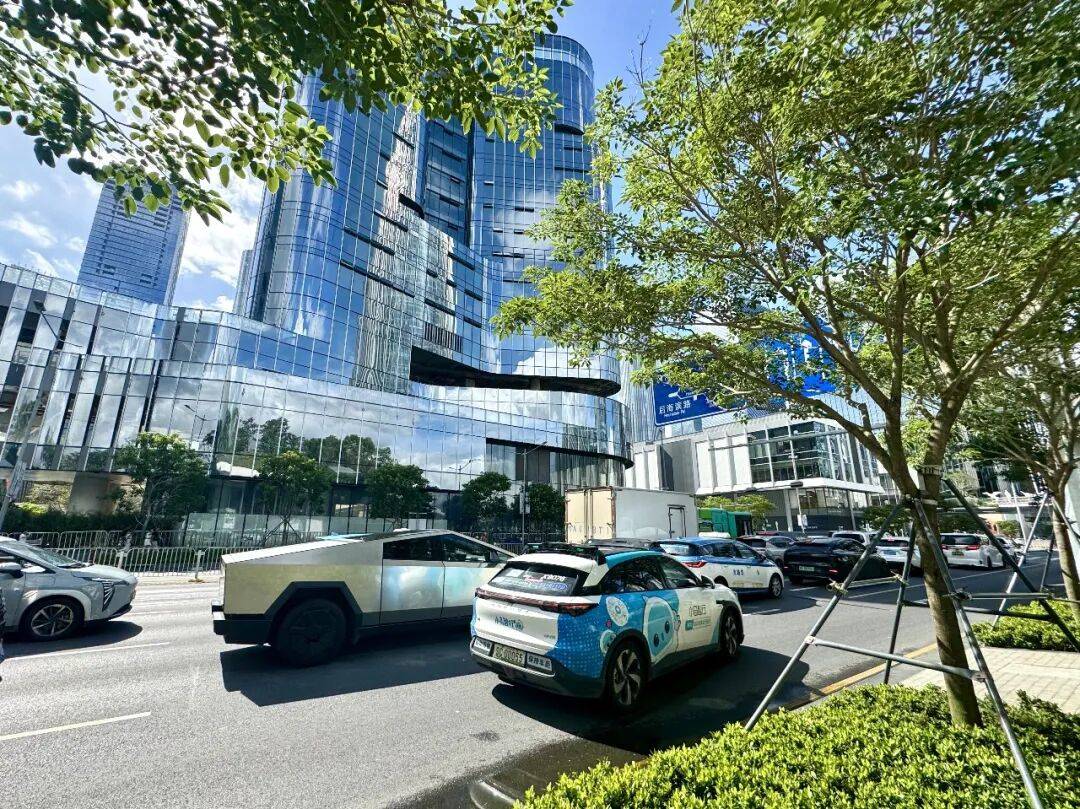 ● Driverless taxis on the streets of Shenzhen. Source: Interviewee
The guests Pang Yin receives have some fixed points in their itinerary. Drone takeout spots and self-driving taxis are almost unstoppable. These scenes are very popular on TikTok and Instagram, and many people are attracted by these videos before coming to China.They told Pang Yin that they came across Shenzhen’s high technology on social platforms and decided to come and see it in person.
But it’s not just the pictures that are new, many tourists want to know more about the uses of these technologies. Huang Qiu took a group to visit a Meituan unmanned food delivery site. The tourists asked her: In addition to food delivery, what will drones do next? Some people also raised several professional questions one after another – how high the drone can fly, how much weight it can bear, and how to solve aviation management. Huang Qiu was stunned when he encountered these questions for the first time.
Another time, a guest was sitting on Pony.ai and asked Huang Qiu abruptly:“What is the relationship between this company and Tencent?” It turned out that he saw that “pony” on the taxi app was the same as Ma Huateng’s English name, and he became curious.
The stores of some Chinese technology brands are the second answer to the motivation for visiting. Some foreigners who came here made requests to see representative companies and stores, such as Huawei, DJI, and BYD stores, factories, and history museums.
The changes in the robot 6S store (which refers to six services including robot sales, spare parts supply, after-sales service, information feedback, leasing and personalized customization) are the most intuitive. After April this year, the Robot 6S store where Pang Yin often took customers suddenly began to collect tickets and receive foreign tourists in groups. The fifty- to sixty-square-meter store is filled with people. Many foreigners look forward to seeing how robots are used in real life.
The DJI store is also very popular. This is the place that many of Zhao Shuibo’s customers want to see. Zhao Shuibo observed that every Saturday and Sunday, DJI stores would be crowded with people.
Tourists from different countries have different itinerary priorities. Many German guests want to visit car companies, especially BYD’s car factory. Pang Yin once received an employee from the German Porsche Company. In the showroom of a BYD car, the employee was surprised when he heard that the car could turn around and drive on water.
● Modern automobile manufacturing plants. Image source: pexels
Huang Qiu once received a Vietnamese immigrant in Australia. He came to China just to experience driverless vehicles. He is 60 or 70 years old. He said that in his own country, due to laws and implementation progress, he may never have the opportunity to experience it in his life.
Going one step further, foreign tourists want to go to factories and see how these high technologies are manufactured.
During the reception, Zhao Shuibo discovered that some guests came to China specifically to participate in industry exhibitions. Most of these people came from Latin America, Africa and other regions. After Zhao Shuibo’s team receives him, they will ask one more question: Can he connect with the industry chain and connect with top corporate executives? They want to visit and even establish partnerships.
When Huang Yuanpu led the team to visit factories and some technology companies, he often saw them holding up their mobile phones to take pictures, with expressions of surprise on their faces from time to time. He joked: “If Li Hongzhang went to New York at that time and could take a picture, his expression would probably be similar to theirs.”
Chinese companies are faced with new demands
In technology tours, factory visits are not as smooth as other tours.
Pang Yin often receives private messages asking her if she can visit the offices of some small giant companies in Shenzhen. She tried. Once, a customer wanted to visit Ubishop. She contacted her through the official account, Xiaohongshu, and the official website, but there was no reply.
Huang Qiu also encountered similar things. A foreign government official once asked her if she knew how to connect with a large factory in Shenzhen. She asked all her contacts but couldn’t find a way. Another time, when she was working as a receptionist for Huawei, someone in her team asked her if there was any way for other teams to visit, but she couldn’t get in touch with them.
A door blocked the foreigners who wanted to visit and the Chinese who wanted to provide services.
For many Chinese companies and factories, it is unfamiliar for foreign tourists to visit the factory. When Pang Yin took her guests to Huaqiangbei for the first time, she was looking forward to seeing some products made on-site by Huaqiangbei merchants, but neither she nor foreigners had access to visit and were “blocked” from the door.
● The streets of Huaqiangbei, Shenzhen. Photo by Ouyang Sifan
Currently, companies such as Huawei and UBTECH have not opened official reception services to the public. Some other companies will use exhibition halls instead of factory visits.
But some companies are also taking the initiative to open up. The Beijing Xiaomi Automobile Factory is open to foreigners and provides English-speaking guide services. Visitors can visit some workshops such as die-casting, battery, and bodywork. On September 20 this year, the Industrial Tourism Branch of the China Tourist Attractions Association (in preparation) went to Xiaomi’s factory to investigate the standard construction and sustainable operation of industrial tourism.
However, Xiaomi also has confidentiality requirements. Visitors must assume confidentiality obligations and are not allowed to disclose the business plans, strategies, samples and descriptions of new products they learned during the visit. For foreign tourists, they need to be assisted by someone holding a Chinese ID card to make an appointment, and they need to show their original passport when entering.
Not only Xiaomi, but many companies have clear boundaries. NIO’s base in Hefei is open for tours, but visitors are prohibited from taking photos and videos; BYD opens its exhibition hall instead of factory tours.
There are specific reasons for companies to be cautious, and there are specific difficulties.
In order to connect with factories and customers, Zhao Shuibo often needs to chat with the bosses and directors of some companies. During this process, Zhao Shuibo could feel the company’s unfamiliarity with this demand and the resulting caution.
Some companies refuse foreigners to visit directly because they are worried that there are spies among the visiting foreigners and they can steal business secrets. Others require Zhao Shuibo’s team to provide detailed customer information, including visas, companies they work for, identity information, etc. Others agreed to visit, but mentioned to him that the tour route involves leaks in production and processing, and tourists are required to prohibit taking photos and videos during the visit.
Zhao Shuibo himself was sometimes unsure.When taking an order, Zhao Shuibo will check the customer’s passport. Sometimes people who sign up are asked about their organizational background.
He himself would also remind some visited companies that if state secrets or corporate secrets are involved, measures should be taken to manage equipment and designate visiting areas in advance. He told some companies: “We can’t guarantee whether any of the people who come here are deeply hidden.”
The “door” of China’s industrial tourism has only recently been opened. In the late 1990s, Tsingtao Brewery and Baosteel took the lead in opening their production lines, but factory tours at that time were more like corporate promotional windows. It is only in recent years that industrial tourism has picked up speed.
In addition, relevant standards and policies for industrial tourism are still being formulated. In August 2026, the National Standards Plan is formulating the “Industrial Tourism Area Operation and Management Specifications” to solve several industrial tourism problems such as tourist reception, guided tours, and visitor access.
Another problem for foreign tourists is that even if the “door” is opened, introducing Chinese companies and technology to foreigners is still a problem.
When he led his team to visit Chinese companies, what struck Huang Yuanpu the most was that many senior executives would rigidly read from pre-prepared PPTs when introducing them to foreigners.The person in charge of one company introduced a series of honorary titles. For foreigners, it is understandable to pick out individual English words, but it is difficult to understand them when they are connected together. “They prefer to listen to stories.” Huang Yuanpu concluded.
What does a good introduction look like? Huang Yuanpu took his team to a drone manufacturing company in Guangzhou, and the company sent its head of international business to receive it. The person in charge had done diplomatic work. During the explanation process, he first greeted everyone and introduced the company’s business and implementation situation according to the team members’ respective countries. During that exchange, it was very interactive and the expressions on the faces of the team members were very relaxed.
But more companies are still unable to do this. Huang Yuanpu judged that the PPTs of 95% of the companies he visited in the Pearl River Delta and Yangtze River Delta with his team were unqualified. He lamented: “Many Chinese companies have become internationalized at the business level, but their storytelling capabilities have not yet been internationalized.”
Foreign tourists are beginning to regard Chinese technology companies as travel destinations, but the reception capabilities of the companies are actually still in the process of forming.
a bridge built
After receiving more than 100 tourists, Pang Yin has become proficient in reciting some introduction words. When he goes to some car 4S stores, he can directly introduce some parameters in English without introduction. Most of the tourists she receives now are looking at Chinese technology for the purpose of “appreciation”. There are also some customers who have new demands and want to go to factories and communicate with companies. Sometimes, Pang Yin feels happy when facing these new requirements.
She once went to a local robot manufacturing company in Shenzhen and met an employee. She stopped and asked, “Can people visit the company?” The other person pointed to the building in the distance and told her that there was an exhibition hall on a specific floor.It was a place that couldn’t be found on social platforms, but she opened the door. Although she still couldn’t visit the company, “it felt quite fulfilling.” She said.
● Chinese tour guides introduce technology to foreign tourists. Image source: AI generated
There is always a deeper need. Huang Yuanpu once helped introduce customers to a Brazilian unicorn food delivery company. The Brazilian company initially tried to contact the core executives of Hema through official channels. They tried emails and phone calls, but found that the effect was not good. They finally approached him and asked him to introduce it on their behalf. He happened to know someone from Hema, and after a brief introduction, he successfully signed the line for both parties.
Huang Yuanpu can feel that similar needs are increasing. Huang Yuanpu felt embarrassed when companies he had never heard of in China approached him and often declined these requests.
He won’t consider doing technology tourism in the near future. Those two visits were possible because he knew many business executives and could facilitate them through personal relationships. But now, the companies he once led to visit have seen an influx of more people, the processes are more standardized, and the experience may not be better.
The growing demand has penetrated the closed door of the original factory through many channels, causing more collisions between the two sides of science and technology tourism – foreign tourists and factories.
● In Shenzhen, a robot is playing the piano. Source: Interviewee
Among the tourists Zhao Shuibo received, some came with purchasing needs, and real orders were also generated while traveling. Once,His company took an African group to visit the Foshan ceramic tile factory. A customer wanted to introduce this brand to his country as an agent. Later, Zhao Shuibo introduced the factory owner to him, and the two parties really became partners.
Another time, Zhao Shuibo’s team brought a government and enterprise delegation from a certain country. After visiting a BYD 4S store, one of the guests placed an order on the spot for a BYD car that could turn around on the spot.
Similar things made him feel that doing inbound technology tourism is a profitable thing for many parties.
Despite this, Zhao Shuibo concluded: “Inbound tourism can be done, but not everyone can do it.”
About 90% of the technology travel customers he currently contacts are from developing countries. The needs of guests from different countries and industries vary greatly, and it is unrealistic to create a replicable route. Currently, most of the technology and factory tours he does can only be customized.
As a travel company, he can only take one step at a time to better meet more needs that were previously unavailable. He is already making business plans for next year, adjusting the quotation, implementation and execution of technology tours. Having been in this business for more than 30 years, Zhao Shuibo has seen that many travel companies are laying off employees and going bankrupt. Now, the demand for technology and factory tours has gradually stabilized in his company’s travel sector. We receive such orders every month, sometimes more than 100 people, sometimes as many as two to three hundred people. His company is still expanding.
He is still thinking about how to better knock on the “doors” of some factories. He has recently been sorting out the relationships with some enterprises, hoping to establish cooperation in advance and match the schedule. Next time, he can be better prepared for everything behind the “door” before foreign guests ask for it. He likes the relationships with people when doing tourism business, not to mention that doing technology tourism “can connect more things.”
When the American engineer left Shenzhen, Pang Yin told him that Shenzhen would be different next time he came. She also told many customers that buildings are still being built in Shenzhen. Maybe if you come back in five or three years, Shenzhen will be different again.
On both sides of the door, a new inbound tourism business centered on technological experience and commercial links is constantly forming and expanding. For the first time, Chinese companies have the need to be visited, and their next step is to decide how to open their doors and how to tell their stories well.
(At the request of the interviewees, Pang Yin and Huang Qiu are pseudonyms in the article.)
Related Reading
- Revelations of AI breaches add to safety fears as Trump meets with Anthropic’s CEO2026-09-28
- Original: What Luo Yonghao misses most is Yu Minhong2026-09-28
- The “young master and young lady” in the factory are being counterattacked by traffic2026-09-28
- Medical waste made into mobile phone cases? The poison exceeds the standard by 1,500 times and even causes cancer. Netizen: I still use it2026-09-28
- China is digging an “inexhaustible mine”2026-09-27