Under the huge pressure of an instant expansion of 75% of the circulating supply, Muxi, the leading domestic general-purpose GPU manufacturer, staged a comeback against the wind.
On September 17, Muxi’s 13.966 million offline allotment restricted shares were lifted. The holders include public offerings, social security, pensions, corporate annuities, bank financial management, insurance and other Class A and offline objects that meet regulations. After the lifting of the ban, the number of outstanding shares of Muxi without selling conditions increased from 18.5286 million shares to 32.4946 million shares. In the past two months, Muxi’s share price fell by about 50% from its high in mid-July. The market is generally pessimistic and predicts that Muxi’s share price may suffer another heavy blow.
At the opening of the day, Muxi shares fell 5.54%. However, a large number of buying orders suddenly poured in 1 minute after the transaction started, and the stock price rose rapidly. Finally, it closed up 14.44%, with a transaction volume of 7.175 billion yuan throughout the day, and a turnover rate of 44.97%.
In the following four trading days, Muxi shares continued to increase in volume, with a cumulative transaction volume of 14.4 billion yuan, and a cumulative turnover rate of 78.59%. Behind this is probably a very typical round of high-intensity exchange of chips of “agents cashing out on a large scale, hot money and leading securities firms taking over the market”.
01. Who is selling and who is taking over?
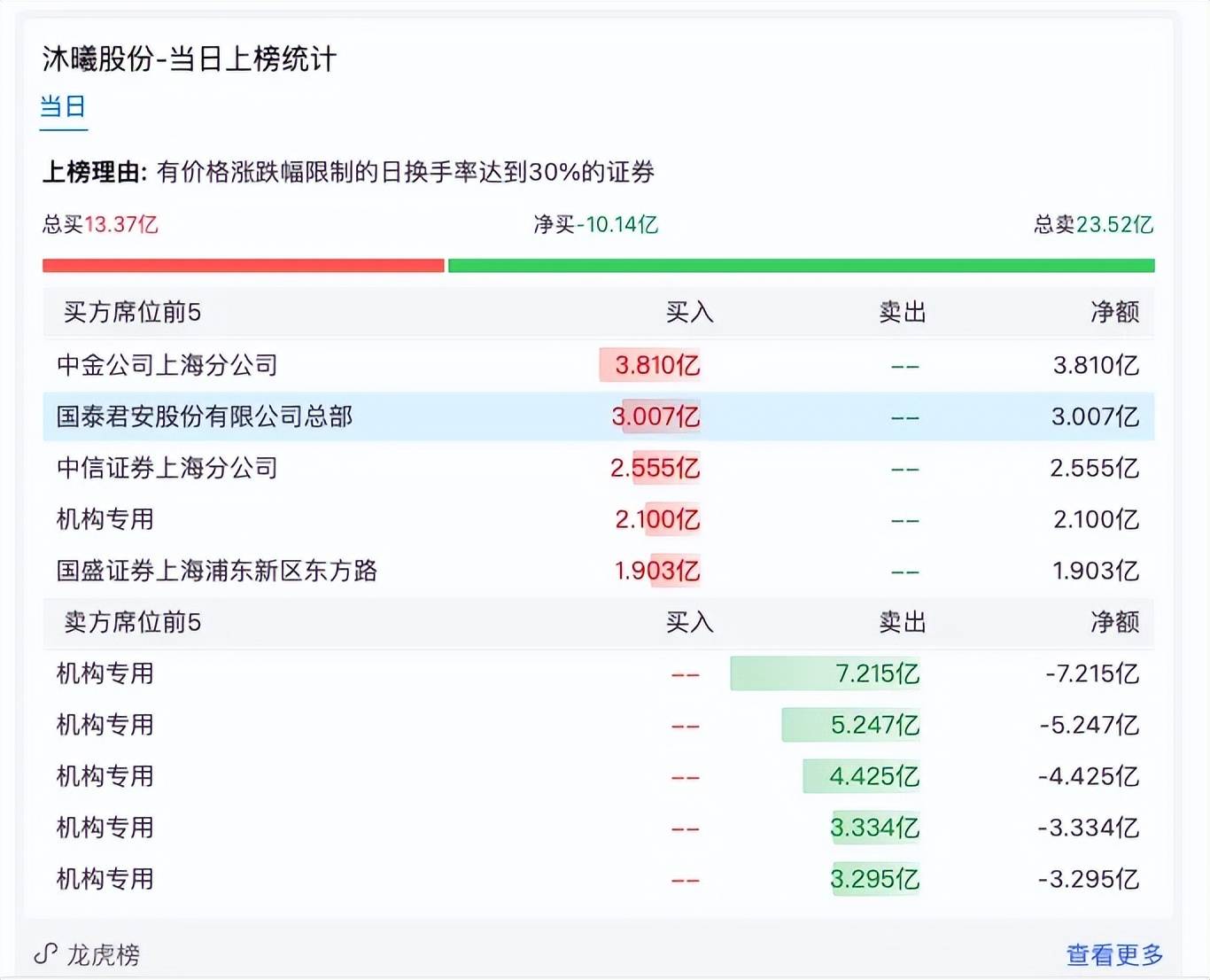
On September 17, Muxi Shares appeared on the Dragon and Tiger list with a high turnover rate, and the funds on both sides of the transaction showed a sharp contrast. As the transaction details of unusual stocks disclosed by the Shanghai and Shenzhen Stock Exchanges after the market opens, the core of the Dragon and Tiger List shows the top five trading positions and specific amounts of stocks with abnormal trading indicators on the day. It is an important window for observing the main capital trends and market games.
On that day, the top five buyers of Muxi shares bought a total of approximately 1.337 billion yuan, in order: CICC Shanghai Branch 381 million yuan, Cathay Haitong Securities Headquarters 301 million yuan, CITIC Securities Shanghai Branch 256 million yuan, institutional exclusive 210 million yuan, and Guosheng Securities Shanghai Pudong New Area Dongfang Road Sales Department 190 million yuan. These well-known brokerage business departments are the gathering places for active hot money, quantitative funds or large private investors in A-shares.
The top five sellers are all “institution-only”, with a total of about 2.352 billion yuan sold, which are 722 million yuan, 525 million yuan, 443 million yuan, 333 million yuan, and 330 million yuan respectively. The data difference between the top five seats sold shows that the net sales based on the Dragon and Tiger list were about 1.014 billion yuan.
It should be noted that the “institution-only” list of the Dragon and Tiger List does not disclose specific investor names, securities accounts and source of shares. Therefore, the top five sellers worth 2.352 billion yuan cannot be directly identified as the sales of all 13.966 million shares that have been released from the ban, and may also include the existing positions of other institutions.
What determines who will reduce their position first is the nature of the funds. Wang Zhaojiang, director of the Beishan Changcheng Fund Investment Research Institute, told Caijingtianxia: “Funds such as public offerings, annuities, and pensions are used to make new money. They are locked up for nine months and the floating profit is several times higher. When the target price is reached, it is easy to lose money; insurance, foreign investment, and long-term public offerings place more emphasis on the company’s continued profitability and may not necessarily sell on the first day after the ban is lifted.”
Enterprise annuities are a typical example of “strong cash-out motivation”. Wang Zhaojiang explained that enterprise annuities have annual income assessments. When the lock-in period expires and the floating profit is sufficient, the investment manager will evaluate whether to lose money; more than 40,000 shares in a single account will have limited impact on the market, but if a large number of similar accounts reduce positions at the same time according to similar disciplines, divergent behavior may form periodic selling pressure.
If someone sells, someone will buy. Wang Zhaojiang believes that from the perspective of motivation for taking over orders, they can be roughly divided into four categories: First, hot money and quantitative short-term, with large amplitudes on the day when the ban is lifted, they earn the fluctuation price difference; second, index funds passively buy, which index Muxi shares enters, the fund must be allocated according to weight, regardless of price The third is that industrial funds are optimistic about domestic GPUs and feel that the stock price of Muxi shares falling from more than 1,000 yuan to 400 to 500 yuan is an opportunity to build a position, but it can only be taken if the performance is realized; fourth, retail investors enter the market to buy at the bottom, and they are not sensitive to the floating profit of the issue price and the lifting of the ban structure. Among the four types of funds, the first two types focus more on transactions, and the latter two types focus more on fundamentals.
02. On the same board, some people are happy and some are sad.
The same group of people who lifted the ban, the same market, and different holding costs have different joys and sorrows.
For new accounts, based on the closing price of Muxi shares of 477.56 yuan on September 16, there is still a floating profit of approximately 356% compared to the issue price of 104.66 yuan. So on the eve of the lifting of the ban, what these institutions were thinking may be very simple: “The cost is there, the lock-in period is here, and you are still making so much, do you want to pocket it first?”
Some early investors whose costs are far lower than the issue price have a much calmer mentality, such as private equity tycoon Ge Weidong. The Muxi Shares prospectus and subsequent announcements show that Ge Weidong directly holds 14.3382 million shares and Chaos Investment holds 12.5997 million shares, totaling 26.9379 million shares, with a total shareholding of approximately 6.73%. Based on the dilution and conversion of its highest public share price, the shareholding cost does not exceed 60 yuan/share. Based on the price of 477.56 yuan per share on September 16, Ge Weidong’s floating profit from his shareholding was still as high as 11.248 billion yuan.

It should be noted that the shares of Ge Weidong and Huan Chaos are both subject to sales restrictions and are not within the scope of the lifting of the ban on September 17. The so-called floating profit is the floating profit on the book, not the cash-out income on the day. For early shareholders like Ge Weidong, they are like people sitting in the audience watching the game. They did not participate in the buying and selling on September 17, but their existence means: the same price means completely different things to different people.
Those who enter through the primary market also have some bosses who enter through order-making. An investor told Caijingtianxia that during the last round of financing for Muxi Shares in March 2025, a boss raised 300 million yuan, and the cost was “about 60 yuan.” He is either a professional investment institution, or his business has grown and he has money. He heard that domestic GPUs have prospects, so he joined the game.
Another primary market investor said that when raising funds at that time, LP repeatedly asked him a question: “CUDA (Nvidia’s software ecosystem) is so mature, why should Muxi share the cake with it?” His answer at the time was: This matter does not depend on technology, but on policy promotion, local governments building computing power centers, and the general trend of independent control of the industrial chain. In other words, what he bought was not the competitiveness of Muxi shares today, but the certainty of domestic alternatives to this track.
Low-cost holders can wait a few years with peace of mind, but high-cost holders cannot afford to wait. The most uncomfortable thing is the new retail investors who rush in at the high point. They do not have the safety cushion of 104.6 yuan/share to buy a new one, nor do they have the advantage of early shareholders’ cost of tens of yuan.
03. Returns from new buyers need to be realized by operations
What really determines how much Muxi’s shares will be worth in the future is whether the company can deliver an outstanding report card next. This is what new buyers value most.
Muxi’s revenue in the first half of 2026 was 1.324 billion yuan, and its net profit attributable to the parent company was 612 million yuan. As of the close of trading on September 18, the dynamic price-to-earnings ratio of Muxi shares was 181 times, which was higher than the average dynamic price-to-earnings ratio of Kechuang 50, which was 108 times.
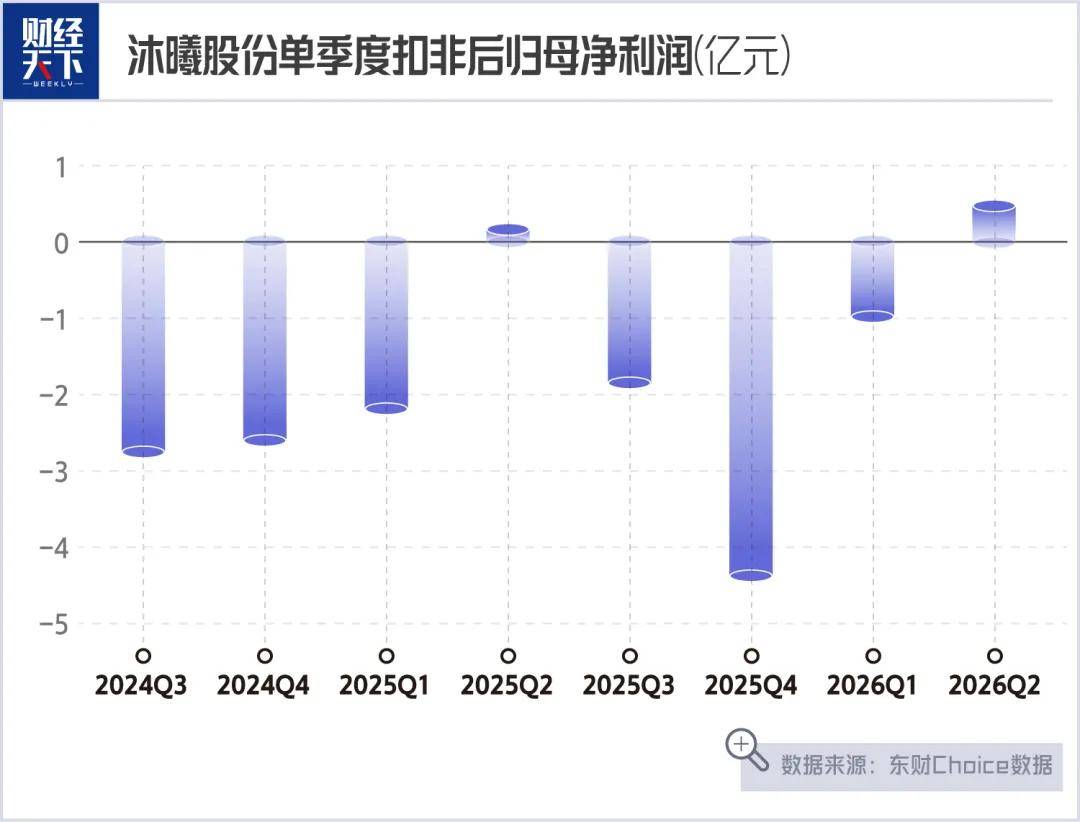
Wang Zhaojiang believes that “Muxi’s profit turning point has been reached, but the hematopoietic ability of its main business still needs to be verified, and the valuation has exceeded some expectations.” Judging from the 2026 semi-annual report, Muxi’s revenue is growing, and the deduction has just become positive in the second quarter, but operating cash flow has not yet returned to positive.
In the first half of 2026, Muxi’s operating cash flow was -1.297 billion yuan, which was more than 400 million yuan less than -883 million yuan in the same period last year. Where did the money go? The answer is that advances surged from 834 million yuan at the beginning of the year to about 2.2 billion yuan, inventory was 1.432 billion yuan, and accounts receivable were 969 million yuan, equivalent to more than 70% of revenue in the first half of the year.
The explanation of Wei Zhongwei, the financial director of Muxi Co., Ltd. confirms this logic: Chip manufacturing requires locking wafers, packaging and testing, and video memory in advance, and the money is paid to the supplier first; the product is sent to the intelligent computing center, and the customer has to wait for acceptance before receiving payment from the customer. The money went out but never came back, so the income statement seemed to be improving, but the cash flow was getting tighter.
When will the cash flow come back? It depends on whether the order can be delivered smoothly, whether the customer can accept it, and whether the money can be received on time. At the semi-annual performance briefing on September 7, Chen Weiliang, chairman and general manager of Muxi, said that whether the growth in AI computing power demand can ultimately be converted into company revenue depends on five aspects: whether the customer’s computing power budget is sufficient, how high the software cost of migrating the business to the domestic GPU platform is, whether the cluster operation is stable, whether the supply chain such as wafer packaging memory is available, and whether the project can be successfully accepted and paid back.
These five hurdles can be broken down into three steps: first sell the chips, which corresponds to “the customer’s budget is sufficient, and the migration cost is acceptable”; then make money based on scale, which corresponds to “the cluster is stable, and the supply chain can keep up”; finally, the cash is returned to the company’s account, which corresponds to “the acceptance is smooth and the payment is in place.” Only when the turnover of accounts receivable is accelerated, advances are made according to the pace of orders, and inventory is smoothly converted into income can cash flow shift from net outflow to balance.
The GPU chip Xiyun C600, which has been mass-produced in May this year, is accelerating to become the performance pillar of Muxi Co., Ltd., which is related to the current ability to deliver, but it is the new generation of Xiyun C700 that determines the company’s medium and long-term growth ceiling.
C700 is the next-generation flagship general-purpose GPU of Muxi’s “Xiyun C series”. The project was launched in April 2025. It adopts domestic advanced technology and is mainly targeted at AI training/inference and general computing. At the performance meeting, Chen Weiliang said that most of the core design and functional verification have been completed, and more in-depth performance tuning is being done. The follow-up process will include tape-out, software adaptation, customer testing and mass production introduction.
Compared with the C600 that has just been mass-produced, the C700 has been greatly improved in terms of computing power, storage capacity, communication capabilities and power consumption, and its overall performance is benchmarked against the NVIDIA H100. The mass production of this flagship product as scheduled will be a decisive step for Muxi to remove the “candidate” label and secure its position as a “flagship supplier”.
Related Reading
- More people are sending AI to fight their customer service battles2026-09-25
- Why “exclusive franchise” is the choice of the times2026-09-25
- Who will stop the cyber flood from flooding the world?2026-09-25
- Who needs a pair of AI glasses during Golden Week?2026-09-25
- Original AI short drama’s myth of getting rich, the fever subsided in half a year2026-09-24