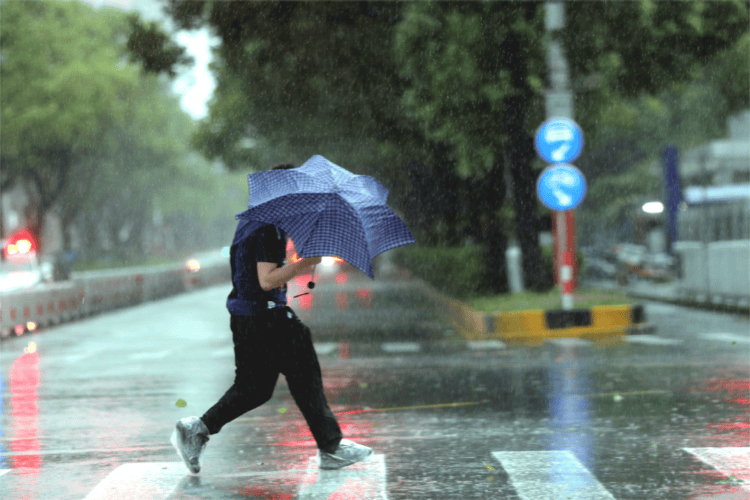
It is supposed to be a safety line to protect pedestrians, but why does it become a “road killer” on rainy days? A recent report by “Southern Weekend” revealed the answer: It turns out that the on-site measured anti-skid values of hot-melt reflective markings painted on domestic highways of all grades, including zebra crossings, guide arrows, lane dividing lines, stop lines, etc., are generally between 20 and 30 BPN (BPN is the anti-skid value, the higher the value, the better the anti-skid property), and the national standard requires no less than 45 BPN. In other words, the anti-skid performance of a large number of zebra crossings does not even reach half of the national standard.
And this problem has not gone unreported. The aforementioned reports found that of the 279 related complaints received by the Shanghai 12345 hotline in the past three years, 85 have resulted in actual damage such as slips and injuries; so far, at least 14 proposals from local people’s congress deputies and CPPCC members involve the issue of anti-skid road markings. As early as 2012, deputies to the Shanghai Municipal People’s Congress submitted written opinions. At that time, the public security department responded that new materials would be used at 100 intersections. Now it seems that more than ten years later, the problem remains the same.
In fact, the anti-skid problem of road markings is not unsolvable at the technical level. The two-component spin-coated zebra crossing piloted in Shenzhen has an anti-slip coefficient of 90 to 100 BPN, which is two to three times that of ordinary markings. Now that the technology can do it and the standards are written there, why are zebra crossings across the country still so slippery?
The crux of the problem lies mainly in the fact that “anti-slip is not a key item during the final acceptance of the project.” The current acceptance standards are based on the 2010 “Implementation Rules for the Acceptance Measures for Completion (Delivery) of Highway Projects”, and the anti-skid value has not been included in the actual measurement items of the markings. It means that even if the anti-skid value of a road marking is only 20BPN, which is far lower than the national standard, it will not affect the project being judged as “qualified”. The standards are written on paper, but they are bypassed during acceptance.
This leads to a series of questions that must be asked: Why can’t the anti-skid performance be integrated from the design and construction stages to the acceptance stage? Can the outdated as-built acceptance standards be updated soon? If a marking line fails to meet the slip resistance standard but still passes the acceptance inspection, what responsibilities do the acceptance unit and the construction unit need to bear?
Looking at a deeper level, this is not only an issue of technical standards, but also an issue of the weight of public safety in project acceptance. A road marking project involves the construction party, supervisor, construction unit and government departments. In the case of tight construction schedule and high cost pressure, the reflective effect and neat appearance are “visible” achievements, while the anti-skid performance is an “invisible” indicator. Therefore, anti-skid becomes the option that can be sacrificed.
Some people may say that the anti-skid performance of the markings will weaken after being used for a long time. This is due to the characteristics of the material. This just shows that the anti-skid performance of the marking must be dynamically monitored and cannot be limited to temporary acceptance.
To solve the problem of the marking line being too slippery, the key is to change the anti-slip value from a “soft indicator” to a “hard constraint”. Specifically, at least a few things need to be done: First, include the anti-skid value in the mandatory acceptance of marking projects. If the standard is not met, it will not be passed and a one-vote veto will be implemented; second, the anti-skid standards in key areas should be improved, and higher requirements should be implemented near schools, hospitals, intersections, and bus stations; third, a regular testing and maintenance system for the anti-skid performance of the markings should be established; fourth, the responsibilities of the acceptance unit and the construction unit should be clarified. Injuries caused by slipping on the markings must be traced back to the specific links and responsible persons.
In any case, a zebra crossing, from design, painting to acceptance, has gone through so many links and signed by so many people, and it should not be able to guarantee even the most basic anti-skid in the end. Only when the anti-skid function is no longer ignored in the acceptance process can the zebra crossing become a real safety line instead of the “culprit” that is criticized on rainy days.
Related Reading
- Four U.S. AI giants face antitrust lawsuits2026-09-21
- Behind the evaporation of 700 billion, the urban reshuffle has begun2026-09-21
- Undercover “matryoshka-like loan assistance”: a loan of 1.05 million yuan with a service fee of nearly 230,000 yuan. One company claims to be able to “let bank personnel control the lending time”丨Red Star Deep Dive2026-09-20
- Why is Xibei surrounded by rumors of bankruptcy? The “prepared dish crisis” is not a fatal factor, and the transformation effect does not meet expectations2026-09-20
- Video丨Focus on the care of the disabled elderly and medical treatment for people in mountainous areas. Financial funds are precisely used to “make up for shortcomings”2026-09-20