“Today I borrowed 20 pieces of rice from Dr. Duan Nianming’s name. I also received another 20 large yuan in silver dollars as a donation. This is true. It was received from the Red Army soldiers Li Weixiang and Liao Yuncai on November 12, 1934.”
In the home of Duan Yuanfa, a villager in Cailing Village, Liangtian Town, Suxian District, Chenzhou City, Hunan Province, there are still two written notes left by the Red Army, one of which is an IOU. “This is not an IOU, it is a testimony of the heart-to-heart connection between the Red Army and the people. We will never exchange it.” Duan Yuanfa said.
The doctor named Duan Nianming in the IOU was Duan Yuanfa’s great-grandfather, who was a doctor in the village at that time.
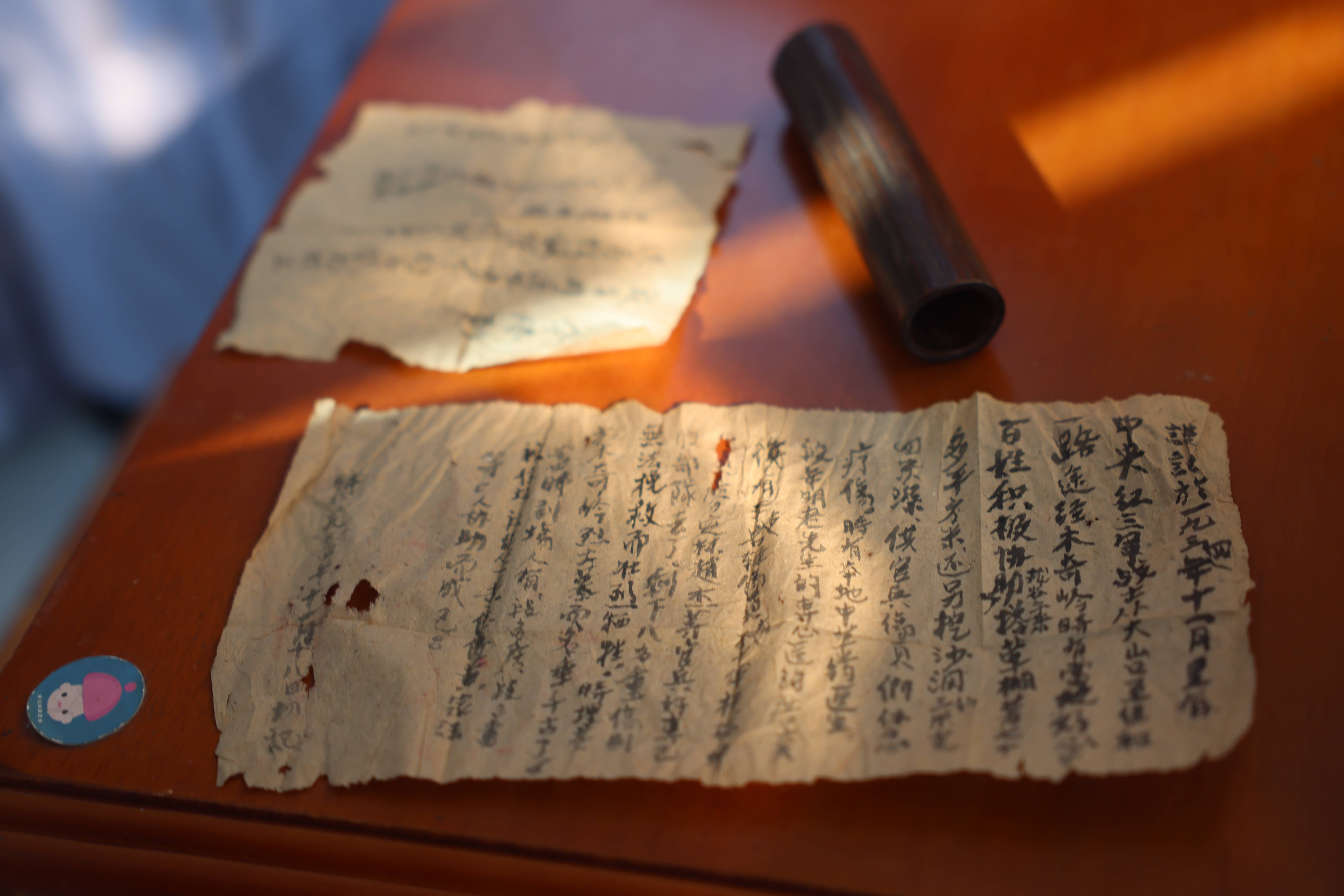
These are two Red Army documents taken at Duan Yuanfa’s home. Published by Xinhua News Agency (Photo by Lu Jingwei)
In November 1934, the Central Red Army’s Long March was breaking through the third blockade set up by the Kuomintang army between Liangtian and Yizhang in Chen County, Hunan (now Suxian District and Beihu District, Chenzhou City). Part of the Red Army Corps marched to Cailing Village and camped on the mountains to rest. It was already the beginning of winter, and the wind was biting on the mountain. Duan Nianming saw that the soldiers not only lacked food and clothing, but also had some sick and wounded, so he took medicine and other supplies back and forth between his home and the camp to diagnose, treat and change the dressings of many sick and wounded.
“My great-grandfather knew that the Red Army was fighting for the common people and could not let them starve or freeze.” Duan Yuanfa said that Duan Nianming emptied his own granary and went from house to house to raise food. He raised a total of 20 loads of rice and 20 silver yuan and donated them to the Red Army. Soldier Li Weixiang and others could not refuse, so they solemnly wrote down the IOU. Later, Duan Nianming took care of many wounded people, and together with the villagers, buried 8 Red Army soldiers who died of serious injuries. Before setting off, the Red Army soldier wrote another note, recording in detail the villagers’ support for the Red Army, and left it to Duan Nianming as a souvenir.
These two documents were carefully kept in a bamboo tube by Duan Nianming until his death in 1946. Before his death, he made family rules: firstly, the Red Army IOUs would never be redeemed, and secondly, he would sweep the graves of eight Red Army soldiers every Qingming Festival, just like worshiping his own family members.
In September 2025, staff from the Party History Research Office of the Suxian District Committee of Chenzhou City, Hunan Province investigated along the route of the Red Army’s Long March and found Duan Yuanfa’s home. For the first time, Duan Yuanfa took out two documents that his family had treasured for more than 90 years. It has been determined by authoritative departments at the district, city, and provincial levels that the two documents are in good preservation condition, with high integrity, and have certain historical and scientific research value.
For more than 90 years, four generations of the Duan family have never stopped guarding the tombs of Red Army soldiers. Every Tomb-Sweeping Day, the Duan family will clean the cemetery and lay flowers. In the memory of Duan Yuanfa’s son Duan Pengcheng, when he was a child, he followed his father and uncle to worship the Red Army soldiers.
“I have always listened to my elders telling stories about the Red Army since I was a child, and I hope that one day I can be a soldier.” Duan Pengcheng said that when he was a sophomore, he was drafted into the army. After two years of training in the army, he returned to school and successfully passed the postgraduate entrance examination. After graduation, he became a middle school Chinese teacher.
Duan Pengcheng often tells students classic stories from the Long March, and also incorporates some of his own experiences in the military to give students a more intuitive experience. But he rarely mentioned the story of his family, because “mutual assistance between the military and civilians comes from the heart, and everyone should help those who dare to sacrifice and contribute.”
This year, the first class of students he led graduated. Many students said that in the topic “Changes in Words” in the college entrance examination essay, they chose the word “Long March” to explain their understanding of the Long March.
Related Reading
- Who knows? My family’s Internet security consultant is a fifth-grade elementary school student2026-09-19
- [The “15th Five-Year Plan” has started well and started well] Vigorously implement urban renewal and promote high-quality urban development2026-09-19
- Video丨To deepen the feelings of family and country, various forms of national defense education activities are carried out in various places2026-09-19
- Super El Niño is coming. How will global agriculture respond?2026-09-19
- The largest lunar crater witnessed by scientists is here2026-09-19