When knowledge is at your fingertips, how can you win in the AI era? The “Fifteenth Five-Year Plan for Educational Development” (hereinafter referred to as the “Plan”) makes systematic arrangements for the cultivation of students’ health literacy, scientific literacy, artificial intelligence literacy, and language and cultural literacy. This is not a simple addition to the school curriculum, but a logical transformation of education that responds to the proposition of the times: the future of education does not lie in training children to become faster answering machines, but in helping them become new people of the era who are physically and mentally sound, advocate rationality, make good use of technology, and have deep roots.
Health literacy is the most solid foundation for all growth.
Health is not an add-on to higher education, but a prerequisite for growth and success. The “Plan” proposes to adhere to health first and improve students’ health literacy, including physical health, mental health, hygiene habits, reasonable diet, etc. In short, children must be able to run, jump, and withstand pressure, and be “resistant” both physically and mentally.
Currently, the overweight and obesity rate among children and adolescents aged 6 to 17 in my country is about 19%, and the overall myopia rate among children and adolescents is 50.3%. Anxiety, depression and other psychological problems tend to appear at a younger age. Some children get out of breath after running a few steps and collapse after a slight setback.
Putting health first is not a single task of the physical education discipline, but a basic requirement for cultivating moral character and cultivating people. It is not only related to physical fitness, but also to the cultivation of personality and tempering of will. To improve health literacy, it is necessary to shift from “controlling so that nothing happens” to guiding students to actively pursue health, strictly implement “no less than 2 hours of comprehensive physical activities every day”, and promote “15 minutes between classes”. Implement physical activities, adequate recess, sleep management, nutritional education, and myopia prevention and control into daily schedules and curriculum, use sports to strengthen the body, use aesthetic education to nourish the mind, and use labor to strengthen the will. Mental health work must not only establish early warning, consultation and referral mechanisms, but also protect privacy, improve teacher-student relationships, classmate relationships and campus ecology, and avoid pathologizing growing pains. To evaluate the quality of school running, we must also look at students’ physical fitness, exercise habits and campus vitality. Health requirements cannot be turned into “filling out a form and ranking.”
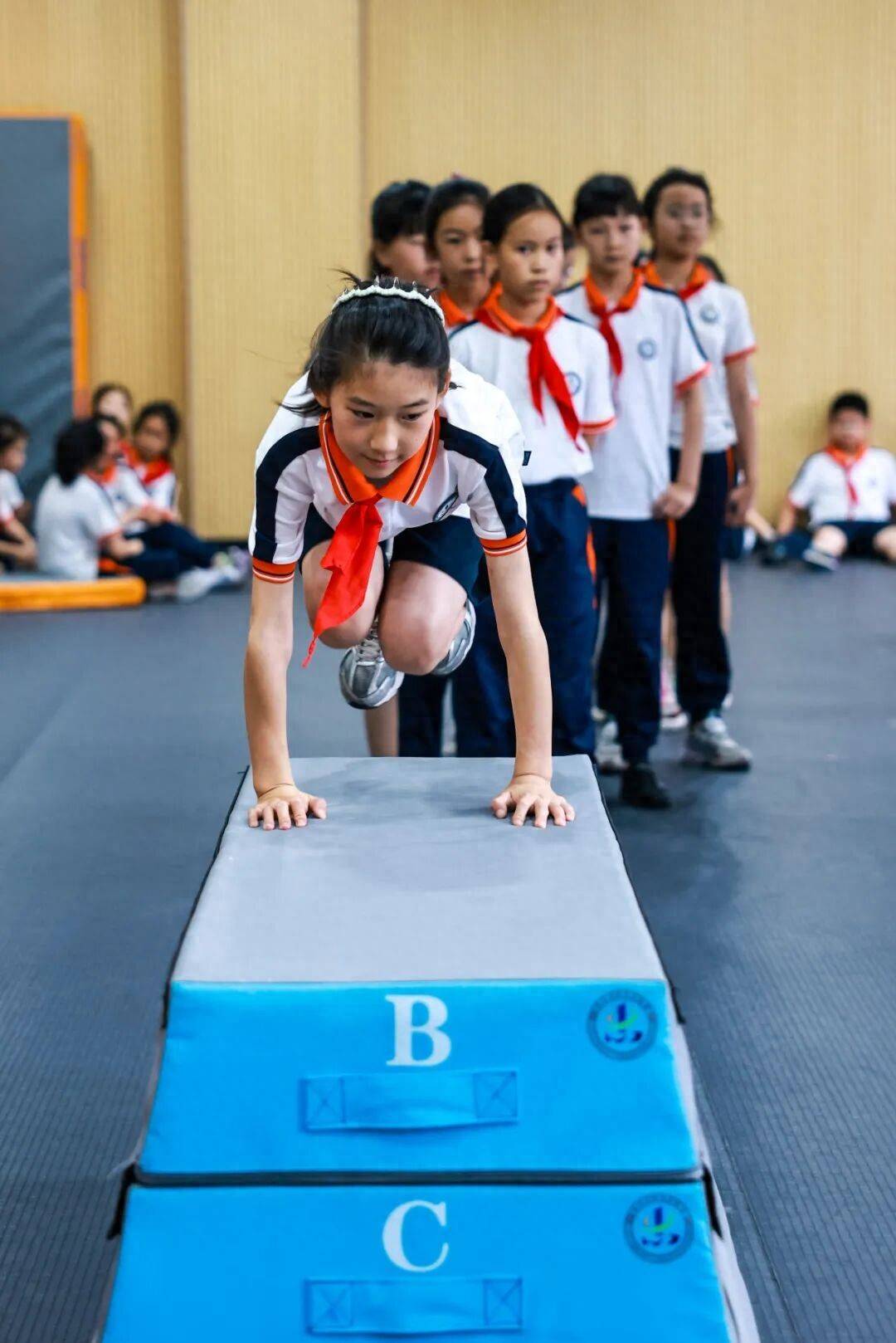
Students from Ningbo Jiangbei Central School are taking a parkour-specific physical education class
Scientific literacy must nurture innovative power in real problems.
Scientific literacy does not mean doing more test questions. It is an attitude and method of facing the unknown: asking questions, making arguments based on evidence, daring to question without dismissing it rashly, and revising understanding through repeated trials. Innovation is not a “fantastic idea” that appears out of thin air, but is the result of curiosity, knowledge reserve, evidence-based reasoning ability, practical ability and the courage not to be afraid of failure.
At present, a major pain point in science education is “knowing too much” and “doing too little”: experiments are completed on the blackboard, exploration is reproduced according to standard steps, and competitions are lively, but students lack opportunities to ask questions and solve problems. The “Guidelines for Piloting “Learning by Doing” in Science Education at the Compulsory Education Stage recently issued by the Ministry of Education proposed that students should be the main body, interests should be the guide, practice should be the path, and exploration should be conducted focusing on real issues. The “addition” of science education is not to add classes, questions, or competitions, but to increase opportunities to ask real questions, participate in hands-on practice, carry out evidence-based reasoning, and reflect on improvements.
Schools can coordinate science courses, comprehensive practices and school-based resources to allow each student to experience a more complete inquiry process; science and technology museums, universities, research institutes and corporate laboratories must transform from “visiting places” to “learning sites”. The evaluation system must also be innovated simultaneously, from looking only at conclusions to looking at problem awareness, inquiry process, cooperation and communication, and iterative improvement, so that performance evaluation can truly benefit students’ growth rather than creating another exam. In addition, cultivating scientific literacy must allow trial and error, encourage questioning and support restarting, and allow children to adapt to this “uneasy road” as early as possible, so that innovation will not remain just a slogan.
Artificial intelligence literacy requires teaching students to control tools instead of being coerced by them.
Incorporating artificial intelligence into whole-school education is an inevitable choice in response to the technological revolution. The next trend worth noting is that some places emphasize procurement over application, emphasis on display over education, or allow tools to replace students’ independent thinking and true expression.
Five departments including the Ministry of Education issued the “Artificial Intelligence + Education” Action Plan, which emphasizes integrity and innovation, quality first, application first, and intelligence for good. Artificial intelligence can be a learning companion, but it cannot be a substitute for ideas; it can assist experiments, but it cannot replace operations; it can provide expression solutions, but it cannot eliminate the value of originality. The cultivation of artificial intelligence literacy is not to let children be led by tools, but to let children still ask good questions after AI generates answers, and be better able to disassemble tasks, check evidence, judge right from wrong, and be responsible for the results of use.
For schools, they can establish usage specifications by academic section and scenario, clarify which tasks can be used, how to disclose the process, and which data cannot be uploaded, and integrate algorithm ethics, personal information protection and academic integrity into the construction of each discipline. Teachers should design tasks that require “human-computer collaboration but must use their brains” and evaluate the quality of questions, the verification process and independent contributions. High-quality resources must also be tilted towards weak areas to prevent new technologies from evolving into new educational gaps.
The faster technology iterates, the more it is necessary to enhance language and cultural literacy.
Language is not only a tool for thinking, but also the home of culture. Language poverty is not only a problem of language proficiency, but also limits cognitive depth, communication skills and cultural identity. Many teenagers talk about all kinds of “memes”, but they cannot explain or write clearly when faced with complex issues; they have read a lot of information, but they are losing the patience to read deeply and develop arguments.
To improve language and cultural literacy, it is necessary to promote the high-quality popularization of the national common spoken and written language, and to allow the excellent Chinese language and culture to enter the spiritual world of students. Chinese language teaching cannot be trapped in answer templates, and reading activities cannot stop at checking in. It is necessary to ensure students’ reading time and strengthen the inner connection between classic texts and real life, oral expression and written writing, cultural heritage and contemporary expression.
It should be noted that the “four major qualities” are interconnected and support each other. Without a healthy mind and body, innovation will be difficult to last; without a scientific spirit, artificial intelligence can easily become an “answering machine”; without a foundation of language and culture, technological creation may lose its value coordinates.
In practice, we must be especially wary of four impulses: adding classes when literacy is mentioned, competition when innovation is mentioned, equipment being piled up when artificial intelligence is mentioned, and activities being created when culture is mentioned. If the evaluation baton remains unchanged, literacy requirements may be misunderstood as “new test points and new tracks.”
To solve the problem, we need to seize three changes: In terms of curriculum, we shift from subject-based addition to theme integration, using real tasks to connect physical health, scientific inquiry, technology application and language expression; in teaching, we shift from teachers giving answers to teachers and students jointly studying problems, allowing students to learn by doing and create while learning; in terms of evaluation, we shift from setting a high level in one exam to multiple evaluations, which look at not only results, but also process, cooperation, responsibility and progress. At the same time, we should improve teachers’ scientific, digital and humanistic literacy, improve interdisciplinary teaching and research and resource sharing, eliminate invalid reports, repeated inspections and “material traces”, and return time to teachers and space to students.
Only by grasping the “four major qualities” as the fulcrum of education and adhering to the foundation of educating people with morality and cultivating people can we implement the blueprint of educational power into the real growth and change of every young person.
The author’s affiliation is with the Chinese Academy of Educational Sciences
Original title “”Four Competencies” Reshaping the Direction of Future Education”
Related Reading
- Someone has poisoned 28 Lake Tahoe trees. Now there’s a $147,000 reward.2026-09-19
- Why do mosquitoes bite people harder in autumn?2026-09-19
- After the “certificate of nomination” was returned by the United States: With trillions of minerals in hand, why is it still difficult for the Taliban to “break” through the economy?2026-09-19
- Photovoltaic giants collectively increase prices, but the window for large orders is closing2026-09-19
- As one data center bill stalls, more proposals to protect consumers from rising energy costs are brought forward in Congress2026-09-19