The conflict in the Arabian Peninsula has opened up a new front, with repercussions that will spill over to the European continent.
On September 18, Saudi Arabian National Oil Company (Saudi Aramco for short) has officially notified at least two long-term European oil refiners that it will suspend the allocation of crude oil supplies to them in October. Some cargo ships originally scheduled to be delivered in late September have also been cancelled, and some orders may be postponed to November shipment.
This news directly triggered a short-term rise in international oil prices. The price of Brent crude oil rose by $0.84/barrel to $99.13/barrel; WTI crude oil rose by $0.69/barrel to $96.16/barrel.
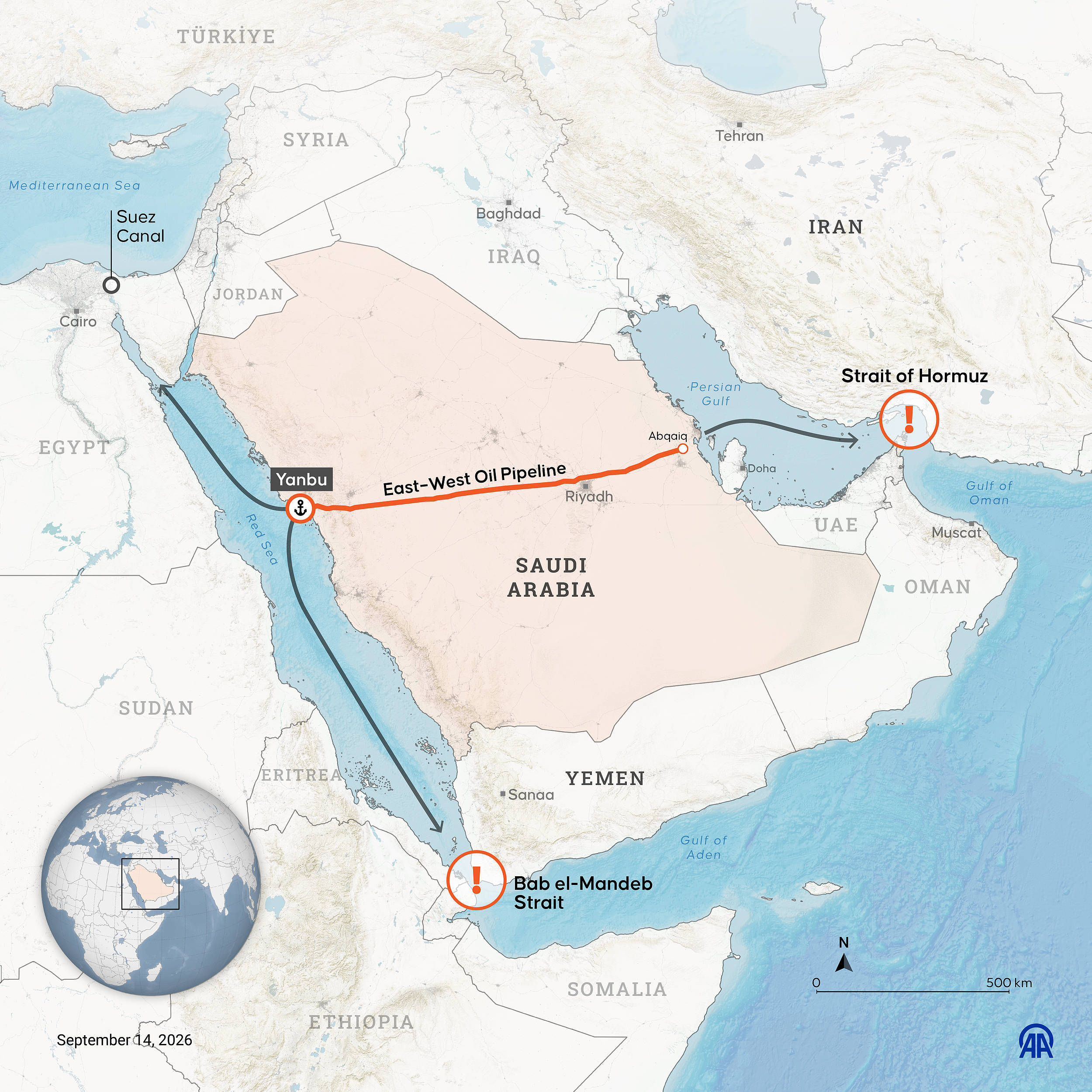
Since mid-September, Saudi Arabia has encounteredHouthi armed strongholds in Yemen, Iraq and other directionsThe core energy facilities and southern border cities have become key targets for joint attacks by drones and missiles. Saudi Arabia has temporarily shut down its east-west oil pipeline. The pipelineThe designed daily transportation capacity reaches 7 million barrels.Daily deliveries in recent months have been 4 million to 5 million barrels, accounting for about 4% to 5% of global supply.
Affected by this, the crude oil inventory group at the Yanbu Port on the Red Sea coast of Saudi Arabia can only maintain a day’s loading operation, and the originally convenient export channel to Europe through the port is completely paralyzed. At present, the market generally expects that some transportation capacity will be restored within a few days, but it will take about 6 weeks to fully resume transportation at full capacity.
As one of the world’s largest oil exporters, Saudi Arabia’s remaining recoverable oil reserves are 267.2 billion barrels, ranking second in the world, and its remaining recoverable natural gas reserves are 6 trillion cubic meters, accounting for approximately 3.2% of the world’s reserves.
On the other hand, although the EU’s crude oil imports from Saudi Arabia will only account for about 7% of total imports in 2025, some refiners have urgently sought alternative sources of crude oil from the United States, Kazakhstan, etc. North Sea crude oil prices have been pushed up to $136.75 per barrel. Superimposed on the simultaneous increase in Red Sea route war insurance premiums and detour freight rates, the crude oil procurement costs of European refineries have increased significantly.
by IranDirect guidance of the Islamic Revolutionary Guard CorpsThe Houthi armed forces have quickly seized the entire Red Sea coast of Yemen and claimed to have shot down at least one Saudi F15 fighter jet.
The Houthis are an armed organization born in Yemen and have been fighting against the Yemeni government since 2004.The International Organization for Migration said the latest conflict has displaced more than 100,000 Yemenis, with some fleeing in small boats across the Bab el-Mandeb Strait to Djibouti on the African coast of the Red Sea.
Due to the long-term accumulation of factors such as sectarian differences, geopolitical competition, and conflicts of core interests, the conflict between the Houthi armed forces and Saudi Arabia, which supports the Yemeni government, has continued since the large-scale war in 2015. The confrontation has recently escalated again.
Since the end of February this year, the Houthis have taken advantage of the window period of the US-Iran conflict to expand their power. The direct trigger for the escalation of this round of conflict occurred on July 13 this year. When an Iranian passenger plane carrying a Houthi delegation planned to land at Sana’a Airport, it was blocked by an airstrike on the runway by the Yemeni government forces. The Houthi armed forces blamed Saudi support for this incident and immediately launched retaliatory actions. This directly broke the four-year de facto ceasefire reached through UN mediation in 2022.
Yemeni government officials said that the Saudi and Yemeni air forces have recently stepped up air strikes against Houthi armed targets to prevent their advance. These include attacks in areas near the Red Sea port of Mocha, which was captured by the Houthis last week.
Chinese Foreign Ministry spokesperson Guo Jiakun said at a regular press conference on September 14 that the rising tensions in Yemen and the Red Sea have caused innocent civilian casualties and damage to energy and other civilian facilities. The regional situation has become more volatile and is not in the interest of all parties. The sovereignty and security of all countries should be respected. Resolving disputes through political and diplomatic channels is the only way out. China calls on relevant parties to exercise restraint, ease conflicts through communication and dialogue, and promote the situation to cool down as soon as possible.
On the other side of the Arabian Peninsula, the Strait of Hormuz guarded by Iran continues to be blocked and has曼德海峽Forming a “Twin Gorges Linkage” pattern.
Ship tracking information shows that the number of single-day ship traffic in the Strait of Hormuz in the past week was only single digits. This number does not include ships with automatic identification systems turned off.Iran’s Islamic Revolutionary Guard Corps said on September 18 that it had attacked a Togo-flagged oil tanker trying to pass through the Strait of Hormuz. The tanker caught fire and stopped sailing. However, all crew members are safe and the impact on the environment has yet to be confirmed.
The Strait of Hormuz is not only an important oil and gas transportation channel, but also an important channel for urea and other fertilizer products produced in the region to enter the global market. The United States and Israel launched a military attack on Iran on February 28. The war stalemate continued to block navigation in the Strait of Hormuz, and the fertilizer supply chains of many countries and regions were affected.