The 23rd China-ASEAN Expo:From “sharing opportunities” to “co-building an ecosystem”
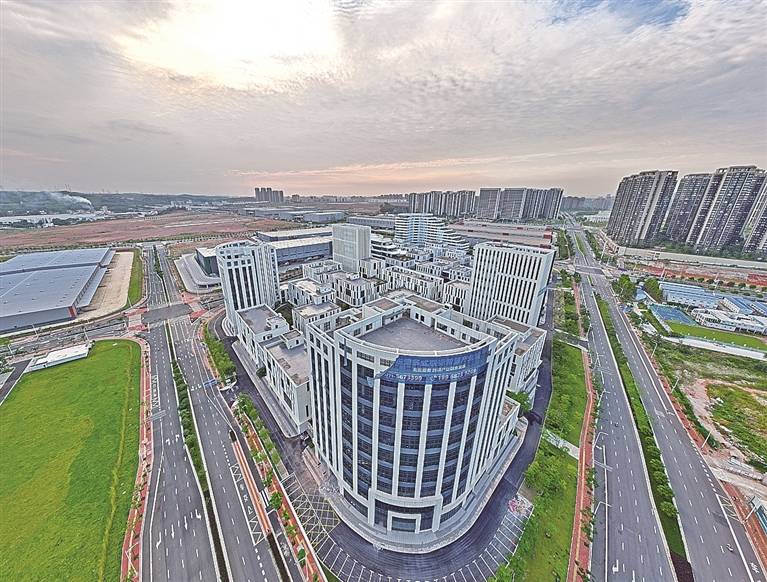
The ASEAN Multimodal Smart Industry City is located in Nanning City, Guangxi. Xinhua News Agency
From September 17th to 21st, the 23rd China-ASEAN Expo (hereinafter referred to as the “ASEAN Expo”) was held in Nanning, Guangxi. With the theme of “Sharing 3.0 Opportunities and Creating a Better Life Together,” this year’s China-ASEAN Expo has a total exhibition area of 170,000 square meters, an increase of about 6% over last year. More than 3,400 companies are participating in the exhibition. There are three exhibition areas: Nanning International Convention and Exhibition Center, Nan A Community, and Guilin International Convention and Exhibition Center. About 50 economic and trade activities are planned to be held during the expo.
Since the first CAEXPO was held in 2004, this grand event has gone through more than 20 years. From its initial platform for product exhibitions and sales to now a comprehensive event covering economic and trade cooperation, industrial docking, and people-to-people and cultural exchanges, the China-ASEAN Expo has witnessed the entire process of China-ASEAN relations moving from the “Golden Decade” to the “Diamond Decade”. This China-ASEAN Expo coincides with the fifth anniversary of the establishment of a comprehensive strategic partnership between China and ASEAN. The Free Trade Area 3.0 Upgrade Protocol was signed and will be implemented soon. It also marks the first appearance of Timor-Leste as a formal member of ASEAN and a co-organizer of the China-ASEAN Expo. The 11 member states gathered in Nanning for the first time after the expansion of ASEAN, achieving a historic “family portrait.”
System upgrade: Protocol 3.0 promotes regional economic and trade cooperation to enter a new stage
The core background of this China-ASEAN Expo is the signing and upcoming implementation of the Free Trade Zone 3.0 Upgrade Protocol. Different from previous versions that focused on tariff reductions, version 3.0 for the first time incorporates emerging fields such as digital economy, green economy, and interconnection of production and supply chains into an institutional framework, promoting regional economic and trade cooperation from “tariff concessions” to a new stage of institutional opening up of “rules coordination.”
This system upgrade is supported by solid trade data. In 2025, the bilateral trade volume between China and ASEAN exceeded the trillion-dollar mark for the first time, reaching 1.05 trillion US dollars. China has remained ASEAN’s largest trading partner for 17 consecutive years. From January to July 2026, the total bilateral trade volume reached US$744.41 billion, a year-on-year increase of 24.7%, and the growth rate outperformed China’s foreign trade market by 7.4 percentage points.
At present, China’s import and export of intermediate goods to ASEAN account for two-thirds of the total bilateral trade, and the economic and trade relations between the two sides have shifted from a simple sale of goods to a deeply embedded industrial chain. For this reason, this China-ASEAN Expo has set up an ASEAN countries demand exhibition area for the first time. Wang Jicai, Secretary-General of the China-ASEAN Expo Secretariat, explained: “This exhibition area has shifted from showing ‘what China can sell’ in the past to focusing on showing what ASEAN countries ‘want’ and what technologies and applications they need.”
Charming City: Humanistic ties and economic and trade windows for local cooperation
The “Charming City” exhibition area is the most humanistic presence at the China-ASEAN Expo. Since the establishment of the 2nd China-ASEAN Expo in 2005, this exhibition area has carried the memories of nearly 190 (sub-) cities. This year’s “Charming City” covers Changchun City in China, Bandar Seri Begawan City in Brunei, Kampong Speu Province in Cambodia, Sekong Province in Laos, Bago Province in Myanmar, Cebu Province in the Philippines, Singapore, Northeastern Thailand, Baucau City in East Timor, Anjiang Province in Vietnam, Indonesia and Malaysia for an overall display.
A closer look at the display content of each city reveals a clear logic: city image display is accurately aligned with industrial cooperation. Changchun City in China will focus on displaying its advantageous industries such as rail transit, optoelectronic information, and aerospace, and promote ice and snow cultural tourism resources, integrating the industrial strength and regional characteristics of the “Northern Spring City”. Kampong Speu Province in Cambodia is more pragmatic and will hold a special promotion and matchmaking meeting to directly promote project docking between Chinese companies and local governments and industrial parks. Sekong Province in Laos has set its sights on a green future, and clean energy projects such as wind power and solar energy have become highlights. Singapore focuses on the theme of “Inspiring new opportunities and connecting the world” to demonstrate the advantages of modern urban governance and scientific and technological innovation development. 20 provinces in the northeastern region of Thailand made a collective appearance to promote tourism resources and investment opportunities using geographically iconic products as a carrier. Baucau City in Timor-Leste made its debut on the stage of the China-ASEAN Expo, showcasing its local cultural tourism characteristics and emerging development potential.
From city business card to cooperation bridge, the functional iteration of the “Charming City” exhibition area reflects the deep logic of China-ASEAN local cooperation from encounter and mutual understanding to integration and win-win.
Leading the big with the small: Exhibition model of chain owners demonstrates the depth of industrial cooperation
If the “Charming City” reflects the breadth of local cooperation, then the “big and small” exhibition model for chain owners launched for the first time at this China-ASEAN Expo demonstrates the depth of industrial cooperation.
The innovation of this model is that industry leading companies take the lead in organizing a group, leading upstream and downstream companies in the industry chain to appear together, and panoramically display the technical achievements and system solutions of the entire chain.
In the field of smart energy, China Datang Group, based on its position as a chain owner, has linked up with enterprises such as Mingyang Intelligent and Century Internet to systematically demonstrate core green energy technologies and full-scenario zero-carbon solutions. China Datang has participated in the exhibition for 22 consecutive years. It has used the CAEXPO platform to launch hydropower and clean coal power projects in Cambodia, Myanmar, Indonesia and other countries, promoting the deep integration of domestic technical standards with local ASEAN industries. The State Power Investment Corporation took the lead in organizing 15 companies to focus on displaying the “Guohe No. 1” large-scale advanced pressurized water reactor nuclear power plant project with independent intellectual property rights, as well as hydrogen-based energy industry chain products and technologies. In the high-end equipment manufacturing sector, SINOMACH plays a leading role in the dual chain of agricultural machinery and metallurgical equipment, focusing on demonstrating its full industry chain integration capabilities covering the entire process of engineering design, equipment manufacturing, supporting supply and engineering services.
This iteration of the exhibition model is essentially an exhibition response to the “Industry and Supply Chain Collaboration” direction of the Free Trade Zone version 3.0. When bilateral economic and trade cooperation shifts from “selling single products” to “building an ecological chain,” exhibition platforms must also be upgraded from “displaying exhibits” to “building an ecosystem.”
In addition, this China-ASEAN Expo also set up an “AI Hypermarket” for the first time, with more than 70 companies and more than 500 products on display, promoting AI from technology display to practical application. Wang Jicai used a vivid metaphor: “Last year’s China-ASEAN Expo AI was a ‘show’, this year’s AI is a ‘mall’, turning AI from ‘visible’ to ‘taken away’.” For the first time, an exhibition area for future space and technological innovation enterprise growth empowerment will be set up, and more than 400 new products and more than 100 new technologies will be unveiled for the first time. These measures are complementary to the chain owner enterprise exhibition model – the former is oriented to the consumer side and small and medium-sized scientific and technological enterprises, and the latter is oriented to the industrial end and large chain owner enterprises, jointly building a multi-level cooperation ecosystem.
Another node worthy of attention is the completion and opening of the Century Project Pinglu Canal. Lu Xinning, member of the Standing Committee of the Party Committee and Vice Chairman of the Guangxi Zhuang Autonomous Region, said: “The Pinglu Canal connects the rivers and seas to the south, which greatly enhances the level of regional cooperation between China and ASEAN; it connects to Europe and Asia to the north, connecting China-ASEAN cooperation and the ‘One Belt, One Road’ initiative. It is difficult to find a place in the international exhibition area of the China-ASEAN Expo this year, and companies from more than 30 countries outside the region have actively signed up to participate in the exhibition. To a certain extent, they are also fancying this new cooperation opportunity.”
From system upgrading to local practice, from industrial collaboration to cultural integration, the 23rd China-ASEAN Expo is trying to answer a key proposition: when China-ASEAN cooperation enters the “deep water zone”, how can the exhibition platform move from “sharing opportunities” to “co-building an ecology”.