Japanese Prime Minister and Liberal Democratic Party President Takaichi Sanae reorganized the senior leadership and cabinet of the Liberal Democratic Party on the 16th and 17th respectively. Most of the important positions remained unchanged, and members of the Liberal Democratic Party’s ruling partner and the right-wing party Japan Reform Association entered the cabinet for the first time.
Analysts believe that Gao Shi’s personnel adjustment is to prepare for his re-election as president of the Liberal Democratic Party next year. In the future, she may accelerate her right-wing policies, but this personnel arrangement cannot solve old problems such as insufficient financial resources, and may also cause new troubles.
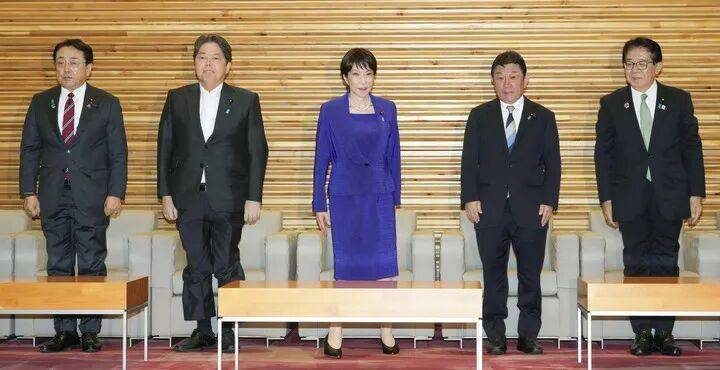
On September 17, in Tokyo, Japan, Japanese Prime Minister Takaichi Sanae (centre) attended a cabinet meeting with his cabinet ministers before reshuffling the cabinet. All cabinet ministers subsequently resigned. Xinhua News Agency/Kyodo News Agency
兩大特點
Japanese public opinion believes that Gao Shi’s personnel adjustment has the following two major characteristics.
The first is to maintain the “regime framework.” In terms of personnel within the party, important positions such as Vice President Taro Aso, Secretary-General Suzuki Shunichi, Political Affairs Investigation Chairman Kobayashi Takayuki, and Election Countermeasures Committee Chairman Nishimura Yasunari have not changed. The main adjustment is that Diet Countermeasures Committee Chairman Kajiyama Hiroshi replaces Arimura Hariko as the General Affairs Chairman, and the position of Chairman of the Diet Countermeasures Committee is taken by former Chief Cabinet Secretary Hideki Murai.
In terms of the cabinet, 8 of the 18 ministers except Takaichi remain in office, including Chief Cabinet Secretary Minoru Kihara, Foreign Minister Toshimitsu Motegi, Defense Minister Shinjiro Koizumi, and Finance Minister Katayama Satsuki. Masaya Inoue, a professor at Keio University in Japan, believes that the retention of these important cabinet ministers shows that there will be no major changes in the foreign and security policies of the Takako City Government and sends a signal that it will continue to adhere to a positive fiscal line.
The second is to shift from “cooperation outside the cabinet” to “cooperation within the cabinet” with the Japan Reform Society. The Restoration Council has not sent anyone to join the cabinet since it formed a ruling alliance with the Liberal Democratic Party in October last year. In this cabinet reshuffle, Nakaji Hong, the former Secretary-General of the Reform Council, became the minister in charge of regulatory reform.
Some analysts pointed out that the Japan Reform Association was only willing to engage in “cooperation outside the cabinet” in order to maintain its flexibility and avoid being too tightly tied to the Liberal Democratic Party, which was trapped in the “double minority” dilemma in both houses of Congress at the time. However, in the past year, Gaoshi has tried his best to win over the Restoration Council, promoted many policies in the coalition agreement reached with the Restoration Council, and led the Liberal Democratic Party to a resounding victory in the House of Representatives election in February this year, consolidating the foundation of the power. Therefore, the Reform Council changed its attitude to “cooperation within the cabinet.”
Koga Shigeaki, a former official of Japan’s Ministry of Economy, Trade and Industry, said that Japan’s Restoration Council has basically the same position as Takaichi on foreign and security policies, and is even more hawkish than Takaichi in some aspects. In the future, promoting hawkish policies towards Takaichi may further play a “step on the accelerator” role.
Just as Takaichi is undergoing this personnel adjustment, the new party “Middle Road Reform Alliance” formed in January this year by members of the House of Representatives from the important opposition parties the Cadet Party and the Komeito Party officially split on the 16th.
In view of the constant differences among the opposition parties, Hiroshi Shiratori, a professor at Japan’s Hosei University, believes that it is difficult for the opposition parties to effectively resist Takaichi’s moves to expand armaments and amend the constitution, and Takaichi will promote tougher security policies in the future.
爲謀連任
In Japanese politics, the prime minister often creates “surprises” through personnel changes in the cabinet and high-level parties to boost approval ratings. However, Hiroshi Ohnishi, an honorary professor at Keio University, pointed out that judging from past situations, only large-scale personnel adjustments can achieve such an effect. However, this personnel adjustment is small in scale and is not expected to cause much change in Takaichi’s support rate.
Japanese public opinion generally believes that Takaichi’s personnel adjustment is mainly focused on the Liberal Democratic Party presidential election next fall, with the intention of consolidating the foundation of the regime and seeking re-election.
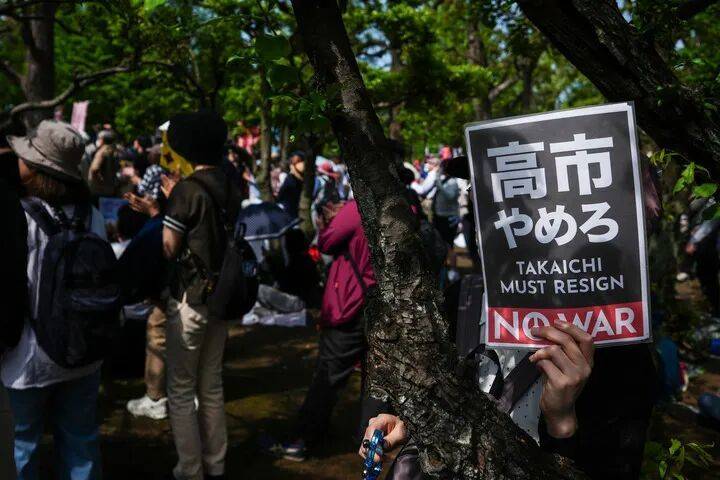
On April 19, people participated in protests around the National Diet Building in Tokyo, Japan, calling for the protection of the peaceful constitution. Photo by Xinhua News Agency reporter Jia Haocheng
Shinjiro Koizumi, Toshimitsu Motegi, and Takashi Kobayashi were all Takaichi’s competitors in last year’s Liberal Democratic Party presidential election. Generally speaking, if a Liberal Democratic Party politician holds a senior official position within the current regime, it means that he is a supporter of the current regime and has no reason to oppose the re-election of the prime minister and party president, who are leaders of the current regime.
Japan’s “Asahi Shimbun” reported that Takaashi tried to stifle the gathering of “anti-Takaashi forces” in the bud by allowing competitors to retain important positions in the regime. The report quoted a senior member of the Liberal Democratic Party as saying that the most important thing for Gao Shi is to ensure that he is re-elected in the presidential election, and this personnel arrangement is to lay the foundation for this.
Japan’s “Yomiuri Shimbun” analyzed that as the only existing faction within the Liberal Democratic Party, the “Aso Faction” led by Taro Aso has 60 members and is still one of the most organized political forces in the party. Aso’s support played a key role in Takaichi’s election as president last year. Takaichi’s retention of Aso and his brother-in-law, Shunichi Suzuki, clearly indicates an advance plan for next year’s presidential election.
新老問題
Japanese public opinion believes that Takaichi’s personnel adjustment may bring new problems to her future governance.
According to the “Asahi Shimbun” report, in this high-level personnel adjustment of the Liberal Democratic Party, although Takaichi took into account Aso, who is regarded as the “guardian of the regime” to a certain extent, he did not fully accept his intentions. Aso originally hoped that Hiroshi Kajiyama would remain as chairman of the Diet Countermeasures Committee, but Takaichi insisted on promoting Hideki Murai to the position. According to reports, for Gaoshi, who has a weak foundation within the party, the dissatisfaction surrounding this personnel arrangement may become a risk to his governance in the future.

On April 19, people participated in protests around the National Diet Building in Tokyo, Japan, calling for the protection of the peaceful constitution. Photo by Xinhua News Agency reporter Jia Haocheng
At the same time, the entry of members of the Japan Reform Association into the cabinet may deepen the conflict between Japan and the Liberal Democratic Party. Although the two parties have much in common on foreign and security policies, they also have differences on other policies. For example, the policy of reducing seats in the House of Representatives promoted by the Restoration Council has been widely opposed by the opposition parties in Congress because it has reduced the living space of small and medium-sized parties. There is also a lot of dissent within the Liberal Democratic Party. However, the Restoration Committee is very insistent on this and strives to pass a bill to reduce the number of seats in the House of Representatives in the interim Congress this fall.
Hiroshi Shiratori believes that the entry of members of the Reform Society into the cabinet may give the regime a stronger flavor of the Reform Society, which may trigger a backlash within the Liberal Democratic Party.
In addition, this personnel adjustment shows that Gaoshi will continue to expand its armaments and adhere to a proactive fiscal line. Whether it is purchasing weapons and equipment or cutting consumption taxes, a lot of financial support is needed. Currently, the Japanese government’s debt is high, the market’s confidence in Japanese government bonds has declined significantly, and government bond yields have risen rapidly. This means that the high market will continue to face the old problem of insufficient financial resources.