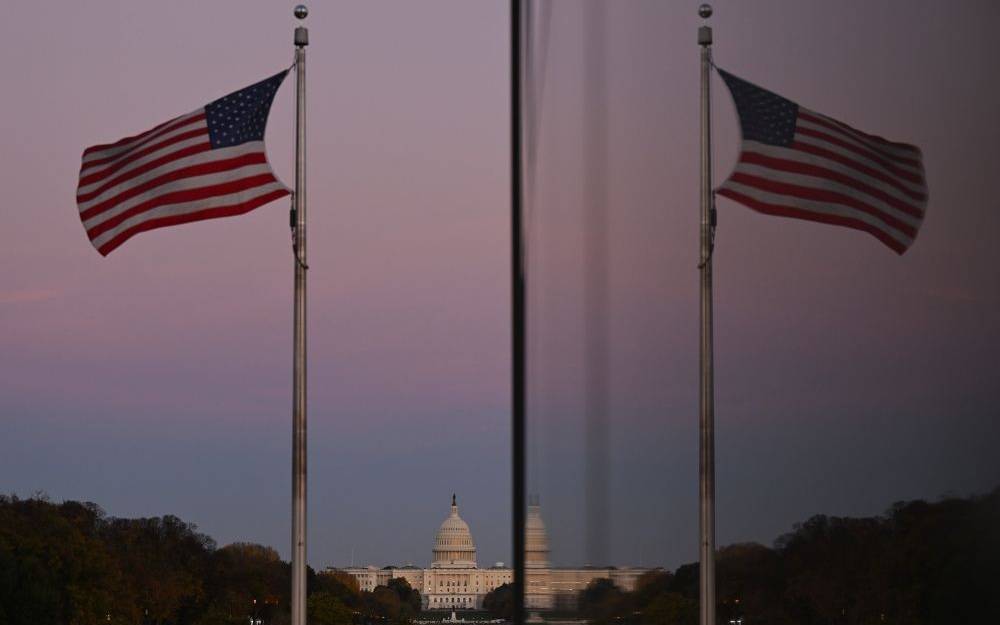
▲This is the Capitol Building taken in Washington, USA on November 3. Photo/Xinhua News Agency
In the 2026 U.S. midterm elections, it is predicted that the Democratic Party will gain control of both the House of Representatives and the Senate, and the Republican Party will suffer a historic defeat.
On November 4, China News Service quoted the latest report from CBS. In a telephone interview, US President Trump congratulated the Democratic Party on its victory in the midterm elections.
After the vote count became clear, Trump publicly congratulated the Democratic Party on their victory and expressed his willingness to cooperate. However, he also emphasized that he holds the presidential veto power and attributed the defeat to “not being on the ballot.” He did not admit that this was a veto of his personal ability to work.
According to Trump’s consistent style and personality, this statement is not about surrendering and compromising, but a political operation that combines posture, game, and self-protection.
The Republican base is loosening
Traditionally, midterm elections have been largely a “poll test” of the current president. Historically, the president’s party has a high probability of losing midterm elections in the House of Representatives. There has been a clear “pendulum-like” historical pattern in American politics for a long time. In the 20 midterm elections from 1946 to 2022, the president’s party had 18 “losses” in the House of Representatives, with an average loss of 25 seats; it had 13 “losses” in the Senate, with an average loss of 3.6 seats.
There are three core factors causing the above phenomenon: first, the structure of the electorate is naturally unfavorable to the ruling party – most of the people who helped the president come to power will not come out to vote two years later, and the ruling party’s natural vote pool shrinks directly; second, the support the ruling party receives in the election year is already “higher than normal”, and mid-term elections are a return to the mean; third, mid-term elections are positively correlated with the president’s support rate, and the president’s support rate declines, which naturally leads to poor mid-term elections.
Polls show that President Trump’s approval rating fell by nearly 30% on the eve of the midterm elections, a record low during his two terms. A considerable number of voters voted to express their dissatisfaction with the Trump administration: inflation, high cost of living, conflicts in the Middle East pushing up energy prices,Some governance disputes, is the core incentive; even traditional red states such as Texas have turned blue, indicating that the Republican base has loosened.
In particular, the Latino community, which once brought Trump to the presidency, has shifted to the Democratic Party on a large scale because of the violent enforcement by the U.S. Immigration and Customs Enforcement (ICE).
The pattern of “competition between government agencies and institutions” has taken shape
Although the Republican Party lost the midterm elections, Trump publicly “congratulated the Democrats” and generally maintained the most basic political dignity, avoiding the political disputes and potential violent conflicts that the outside world had previously worried about.
Trump has repeatedly questioned the election before. If we directly deny the results this time and incite supporters to question the votes, it will further tear apart society and trigger a constitutional crisis. It will also be labeled by mainstream public opinion as rejecting democratic rules. Taking the initiative to congratulate is to first maintain the superficial posture of “respecting the electoral process”, reduce the pressure of public opinion, reduce the intensity of conflicts, and avoid a judicial battle over the legitimacy of the election.
In addition, there is still a hidden mystery in Trump’s words, that is, he is trying to use the president’s “veto power” as a bargaining chip to bargain with the Democratic-controlled Congress in a “cooperative” posture.
The results of this midterm election indicate that the “house-chamber battle” pattern in the U.S. power structure has taken shape. That is, the Democratic Party controls both houses of Congress and can more efficiently exert power in areas such as legislation, appropriation, and investigations, and more effectively restrict and balance the power of the Republican president.
However, the president has veto power over bills passed by Congress. According to Article 1, Section 7 of the U.S. Constitution, if a bill passed by the House of Representatives and the Senate is vetoed by the President, it must be re-passed by both houses of Congress with a two-thirds majority in accordance with the rules and restrictions of the bill before it can take effect.
Therefore, even though the Democratic Party won the midterm elections, it is still not easy to pass a bill that was vetoed by the president with a two-thirds majority. Trump’s true intention is: I am willing to cooperate, but the bill must meet my bottom line, otherwise I will veto it directly. This is also a manifestation of Trump’s “art of dealing”. It is just a tactical adjustment, not a course change.
However, at present, there is very little room for consensus between the two parties, and there are huge differences between the two parties in many domestic and foreign affairs. Democratic lawmakers who are extremely dissatisfied with President Trump may launch rounds of attacks on many domestic and foreign affairs of the Republican administration.
Jeffries, the leader of the Democratic House of Representatives, has previously stated that the Democratic Party will prioritize four issues in the first 100 days after taking control of the House of Representatives: restoring the Affordable Care Act’s medical insurance premium tax credit; revoking the Medicaid spending cuts by the Republican Party in the 2025 bill; pushing for the revocation of Trump’s tariffs and restoring Congress’ power over tariffs; pushing for an end to the Iran war and launching an investigation into the Trump administration.
This also means that after the new Congress takes office in early 2027, Washington may not have the “transactional checks and balances” expected by President Trump, but will fall into “paralyzed checks and balances.”
Therefore, the main line of politics in Washington in the next two years is likely to be party struggle, supervision and mutual veto, making it difficult to implement major domestic and foreign reforms. The outside world may need to face the United States with two faces and two voices, the executive and the Congress.
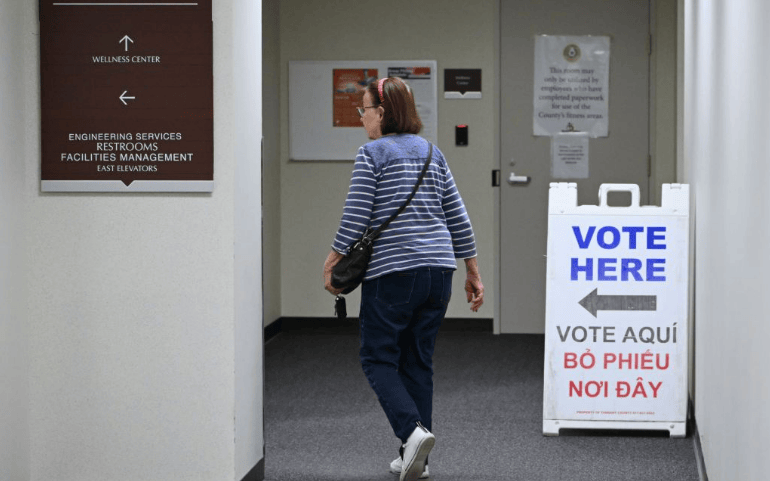
▲On October 23, in Fort Worth, Texas, the United States, voters went to the polling station to vote in advance. Photo/Xinhua News Agency
Will it affect the 2028 election?
Many people think that此次The mid-term elections are likely to have a significant and far-reaching impact on the 2028 U.S. election. In particular, the Senate seats in the deep red states of Texas and Kansas were won by the Democratic Party, indicating that the blue wave has swept across the country.
The last time the Democrats won the Senate seats in these two states through elections was 38 years ago and 94 years ago. Texas has 40 presidential electoral votes, second only to California’s 44. As long as the Democrats control Texas, it is almost impossible for the Republicans to win another election.
But this view is obviously too arbitrary. The important reason why Texas was flipped blue this time was that many people were extremely dissatisfied with Trump himself and the Republican candidates he endorsed, rather than the overall dissatisfaction with the Republican Party and its ideas.
This Senate election has greatly amplified the internal divisions in the Texas Republican Party. Republican candidate Ken Paxton challenged and unseated incumbent Republican Senator John Cornyn with long political credentials in the 2026 primary. As a core ally of the far right and the Trump camp, although he won the primary with his hard line, he also completely angered the traditional establishment.
The Bush family, which has been deeply involved in Texas for many years and has huge influence, publicly broke with the ultra-conservative Republican Party represented by Paxton in this election. Neil Bush, the younger brother of former President George W. Bush, has made an unprecedented public announcement that he is voting for Democrat Talarico.
The Bush family, as a symbol of the traditional Republican establishment in Texas, openly switched to the Democratic Party, essentially sending a clear signal to the state’s huge moderate voters and establishment Republicans that “split voting” is acceptable in specific seats. This loss of establishment voters has filled the most critical vote gap for Democrats to achieve a statewide breakthrough.
This also means that the 2028 general election does not necessarily belong to the Democratic Party. The key lies in the extent to which the Republican establishment can regroup and form an overwhelming advantage over the anti-establishment faction in the party.
Written by Liang Yabin (Professor of the Institute of International Strategic Studies, Party School of the Central Committee of the Communist Party of China)
Editor/Xu Qiuying
Related Reading
- The first in the country! How to learn “unpopular secret skills”? Who will teach? Dean’s interpretation2026-11-12
- The price of refined oil may drop for the sixth time this year. Filling up a tank will cost about 15 yuan less2026-11-12
- “Token hoarding” became a hot word in the “Double 11” circle, and after Li Jiaqi, Luo Yonghao also came to sell2026-11-12
- Does the United States really not want to fight Iran anymore?2026-11-11
- Fireballs are scattered around Shijiazhuang. How much is the value of “visitors from outside”?2026-11-11