On the last working day of October, the price of gold fell sharply again – as of the close of trading on October 30, international gold and silver prices closed sharply, with gold falling to a new low in a year. Spot gold fell below US$3,900 and was reported at US$3,875.19 per ounce, down 3.61%.
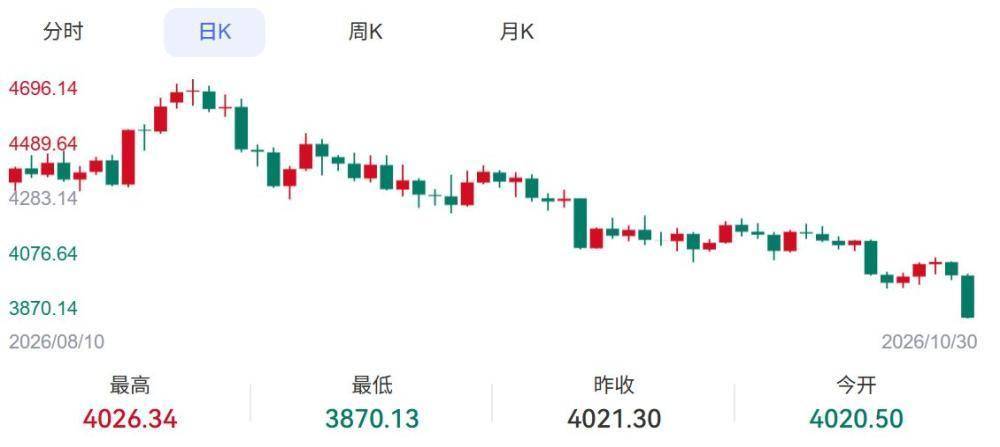
International spot gold daily K-line trend (unit: US dollars/ounce)
The domestic market is under pressure simultaneously. As of October 30, the main contract of Shanghai Gold Futures closed at 855.18 yuan/g, hitting an intraday low of 854.72 yuan/g, a new low for the year; Shanghai Gold Exchange Au99.99 closed at 854 .76 yuan/g, and plunged to 833.00 yuan/g in night trading, down 21.76 yuan, or 2.55%; Au (T+D) closed at 831.10 yuan/g in night trading, down 26.72 yuan.
Why is the gold market plummeting again? What is the future trend of gold? Is the consumer’s passion for purchasing still there? Is now the right time to buy or sell?
In order to find out, on the afternoon of October 31, a reporter from “Daily Economic News” (hereinafter referred to as a reporter from “Daily Economic News”) came to Shenzhen Shuibei Gold Market. The intuitive feeling was that there were more consumers in the market than usual. Every time the reporter communicated with many gold and silver store owners, they found that the listed prices of gold and silver in this market actually “failed”. Whether it was the sales price of gold, the recycling price, or the buying and selling price of silver, they all differed from the listed price of Shuibei.
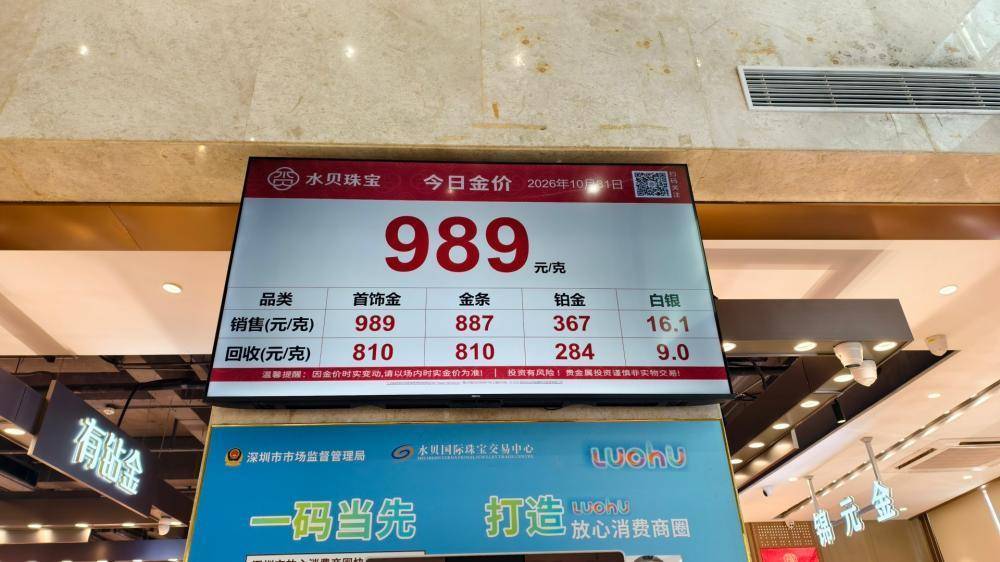
The gold transaction price displayed by Shuibei merchants. Photo by reporter Pan Ting.
Actual exploration of Shuibei: Quotations from many merchants deviate from the market price of Shuibei
On the afternoon of October 31, every reporter (as a consumer) came to Shenzhen Shuibei Gold Market and found that there were more consumers here than usual.
However, the gold buying and selling prices of many Shuibei merchants are somewhat different from the listed market prices, and the quoted price will differ by a few dollars.
A shop owner told reporters that the current recycling price in their shop is 815 yuan (per gram), and the purchase price of gold is 885 yuan. After learning that the gold jewelry that the reporter wanted to sell weighed about 20 to 30 grams, the shop owner punched another number “820” on the calculator, which means that he could add 5 yuan per gram to recycle the gold in the reporter’s hands. This price was 10 yuan higher than the market recycling price.
The reporter went to another gold store and expressed that he wanted to buy 200 grams of gold bars. “(This price) can be bought now, and I’ll give you a price of 875 yuan.” After seeing that the reporter still had some concerns, the store owner said that the lowest discount could be as low as 871 yuan. After the reporter mentioned that it was even cheaper to buy through the bank app, the store owner discounted the price again to 869 yuan.
In fact, the market price of Au99.99 on the Shanghai Gold Exchange is 833 yuan/gram. After asking whether he could buy gold bars at the market price, the store owner said “impossible” and said: “This price is mainly for futures, and it is deliberately lowered for you. You cannot buy physical gold. Although it is listed at 833, you definitely can’t buy it at this price, and we can’t get it.”
Some shop owners also said, “Today’s recycling price is 810 yuan, which is the market price. This is a fixed price and cannot be higher.”
Although there are differences in the buying and selling quotations of gold, the price difference of a few yuan is not that big compared to the price of gold of several hundred yuan per gram. In the silver market, the recycling price ranges from shops quoting 10.5 yuan (1.5 yuan higher than the market price of Shuibei) to shops quoting 6 yuan (3 yuan lower than the market price of Shuibei). The fluctuation range is much greater than that of gold.
Is it appropriate to sell the gold you hold now? Regarding this issue, many store owners said: “If you are not in a hurry to use money, you can not sell it yet. No one knows the price trend on Monday.” Many stores engaged in selling and recycling silver in Shuibei also expressed the same idea.
The fall in gold prices has led to a recovery in the consumer side
Looking over a longer period of time, data shows that in the first 10 months of this year, spot gold prices experienced an operating cycle of “peaking – collapse – repair – and then falling again”.
On January 29, spot gold peaked at US$5,598.75 per ounce; on June 30, it reached a low of US$3,942.43 per ounce, the lowest price in the first half of 2026; after rebounding in August, it came under pressure again. The decline has intensified since September, closing at around US$3,875 per ounce on October 30. Spot gold has now fallen to the level of early October 2025, a drop of more than 30% from the high of $5,598 per ounce set at the end of January 2026.
The fall in gold prices has led to a recovery in the consumer side. According to data from the China Gold Association, national gold consumption in the first half of the year was 511.412 tons, a year-on-year increase of 1.23%, including 339.336 tons of gold bars and gold coins, an increase of 28.42%, and 132.133 tons of gold jewelry, a decrease of 33.88%. The differentiation between investment gold and jewelry consumption continues to expand.
Purchases from official reserves have not stopped. On October 7, central bank data showed that my country’s gold reserves stood at 77.47 million ounces at the end of September, an increase of 740,000 ounces from the previous month. This is the 23rd consecutive month that the central bank has increased its gold holdings since it restarted its holdings in November 2024.
Industry: The long-term trend of gold prices will shift to “high consolidation and repricing”
So, what are the reasons for the fluctuations in gold prices? What is the industry’s view on the short-term and long-term trends of gold in the future?
Zeng Gang, president of the Tianfu Liyan Financial Research Institute, said in an interview with a reporter that “this year’s violent fluctuations in gold prices are essentially the result of multiple driving forces taking turns to dominate.” Zeng Gang further explained that at the beginning of the year, the combination of safe-haven demand, continued gold purchases by central banks, and market concerns about U.S. dollar credit and global debt risks, coupled with the influx of leveraged funds and momentum trading, pushed spot gold to quickly reach a historical high of $5,500 per ounce. But the faster it rises, the more profit margins and valuation bubbles accumulate.
“In the second half of the year, the situation reversed. Rising international oil prices pushed up inflation expectations, U.S. inflationary pressures resurfaced, and the market began to bet that the Federal Reserve might further raise interest rates. The strength of real interest rates and the U.S. dollar directly raised the opportunity cost of holding gold, a non-interest-bearing asset.” Regarding the sharp drop on October 30, Zeng Gang also further expressed his views: “On October 30, the high-level crowding of long positions and stop-loss orders were triggered intensively, which amplified the decline and formed a stampede.”
Zeng Gang believes that in the short term, gold prices are still dominated by monetary policy expectations and the trend of the US dollar. Until the inflation data does not cool down significantly and the expectations of the Federal Reserve raising interest rates do not subside, the rebound in gold prices may be limited, and the price is likely to fluctuate widely at low levels. However, after falling for two consecutive months and the short-term decline is too large, a rebound after technical oversold conditions may occur at any time. Investors should not blindly buy the bottom, let alone chase. It is safer to operate in batches and small positions. In the long term, several basic logics supporting gold have not completely disappeared. Global geopolitical uncertainty, high sovereign debt, diversification of central bank reserves and the trend of “de-dollarization” will still provide medium and long-term support.
“But this round of sharp rises and falls also reminds us that gold does not just rise but not fall. The previous stage overdrawn many expectations, and the price needs time to digest.” Zeng Gang believes that the long-term trend of gold prices will shift from “unilateral rush” to “high consolidation and re-pricing.” For ordinary investors, a more reasonable approach is to use gold as the ballast stone in asset allocation, control the proportion, avoid increasing leverage, and trade time for space.
Related Reading
- The first in the country! How to learn “unpopular secret skills”? Who will teach? Dean’s interpretation2026-11-12
- The price of refined oil may drop for the sixth time this year. Filling up a tank will cost about 15 yuan less2026-11-12
- “Token hoarding” became a hot word in the “Double 11” circle, and after Li Jiaqi, Luo Yonghao also came to sell2026-11-12
- Does the United States really not want to fight Iran anymore?2026-11-11
- Fireballs are scattered around Shijiazhuang. How much is the value of “visitors from outside”?2026-11-11