This article is reproduced from [CCTV News Client];
Recently, the topic of a two-year-old child having abnormal blood mercury levels after eating “children’s silver cod” for 8 months has been on the hot search, causing widespread concern among parents. The reporter learned that although the product involved has been removed from the shelves, this incident has also brought to the surface the risks of purchasing cod “different fish with the same name”. For a time, various opinions appeared on the Internet. Some said that cod should never be eaten again, while others said that it was recommended not to eat all sea fish, including cod. Can it be eaten?
What kind of fish is cod?
Does the word “cod” in the name mean cod?
Let’s first take a look at what kind of fish is cod and why does it contain mercury? Is it the same thing as the cod we are talking about? The reporter’s investigation found that the products on the market labeled with the word “cod” do not actually refer to a specific fish species.

Reporters recently visited offline supermarkets and fresh food stores and found that the outer packaging of many products in frozen aquatic product cabinets was marked with the word “cod”: there are real cod, black cod, silver cod and other products. The reporter found that although the product names were all called cod, the ingredient list showed that they were not the same fish species.

Zhu Yi, associate professor at the School of Food Science and Nutritional Engineering, China Agricultural University:The cod on the market now is a commercial general term. The real cod is biologically classified into the genus Codidae, so it is a true cod, such as Atlantic cod, Pacific cod, Greenland cod, and Alaska pollock. Silver cod and black cod are not real cod by biological definition, but are just a common commercial name formed by the industry. The scientific name of cod is Antarctic toothfish. It is the top giant predatory fish in the deep sea. It can reach more than 2 meters in length, weigh more than 100 kilograms, and can live for more than 50 years. The longer a fish lives and the higher it is in the food chain, the more heavy metals it will accumulate in its body for decades.
“Cod is better than real cod” is a cognitive bias
Silver cod is just a common commercial name, but because of the word “cod” in the name, many consumers confuse it with real cod. Some consumers are even influenced by the merchant’s propaganda and think that silver cod is better than real cod. Experts say that this is actually a cognitive bias caused by the high price.
On e-commerce and social platforms, reporters searched with the keyword “children’s cod” and many cod products popped up. Most of these products feature “rich in DHA” and are accompanied by slogans such as “supports brain development” and “meets nutritional needs for growth” to emphasize the product’s role in promoting children’s growth and development.
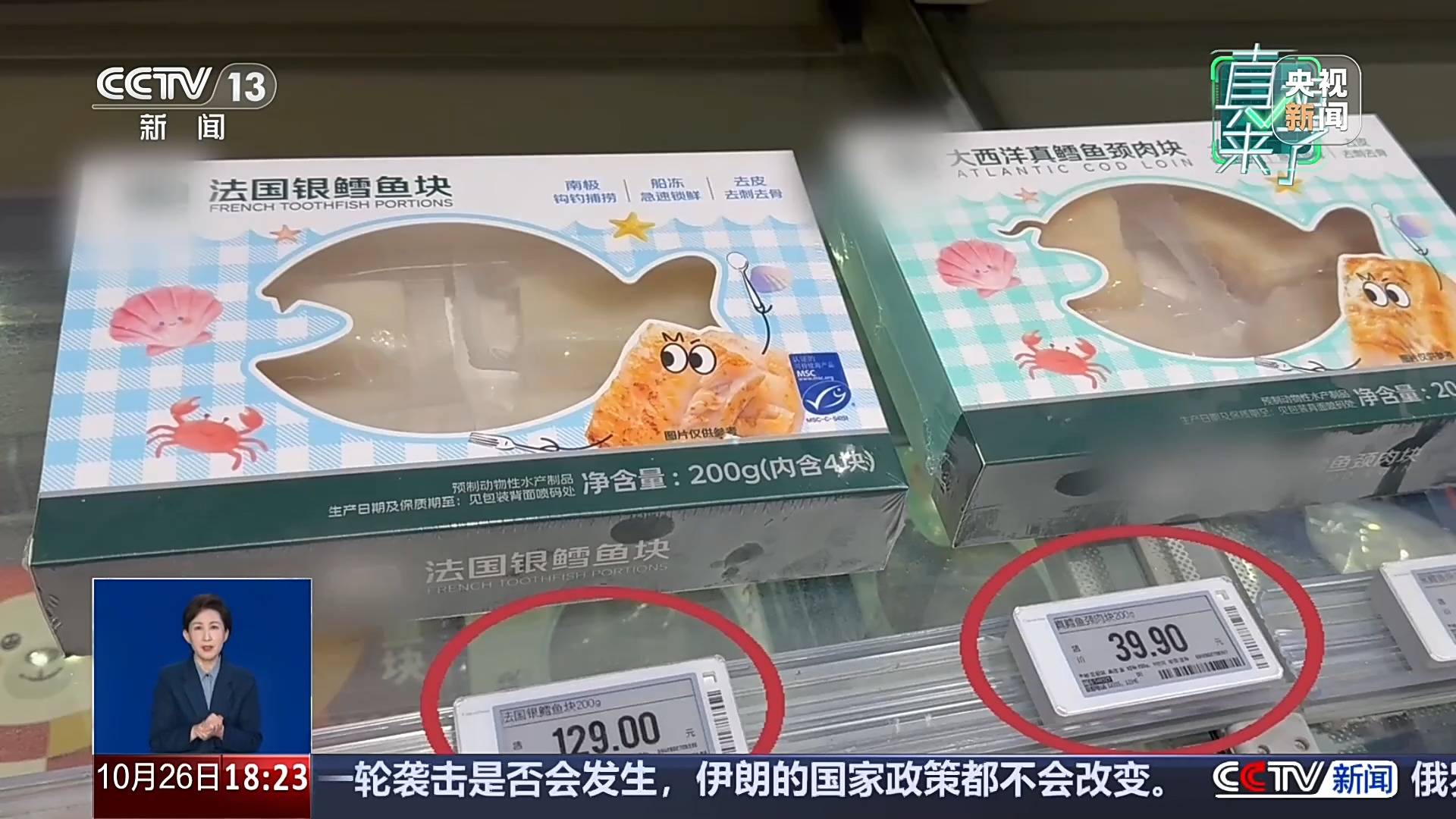
The reporter noticed that although silver cod and black cod are not real cod, the price is often much higher than that of real cod. Also 200 grams, this real cod is priced at less than 40 yuan, while the silver cod is priced at more than 120 yuan.

Zhu Yi, associate professor at the School of Food Science and Nutritional Engineering, China Agricultural University:The scientific name of cod is Antarctic toothfish. Toothfish is a large predatory fish in the deep sea. Deep-sea fishing quotas are limited and fishing costs are high. This indeed makes the price of cod high. The most important thing is that the marketing premium of domestic children’s complementary foods is superimposed, and the price gap is very obvious. The price difference between different categories can reach five to six times, or even more than ten times.
Misunderstanding of online communication system
Different cod fish have their own nutritional value
Let’s go back to the nutritional value itself. Compared with real cod, is silver cod actually nutritious? Can it be eaten? The Shanghai Consumer Protection Commission recently conducted testing and analysis on the nutritional content of cod on the market. Among 14 cod samples: the higher-priced silver cod and black cod have relatively higher DHA content; while the affordable real cod has the most prominent protein content among the three types of cod. This result shows that different types of cod have their own advantages in nutritional value. To put it bluntly, cod fish does have a higher DHA content and is edible, but this does not mean that it can be eaten in large amounts for a long time.
Shark, tuna, cod, etc.
Methylmercury levels are often high
The National Food Safety Risk Assessment Center recently issued a reminder showing that due to the accumulation effect in the food chain, deep-sea fish are more susceptible to mercury pollution in the environment. Large carnivorous fish such as shark, tuna, and cod usually have high levels of methylmercury.
It is understood that the “National Food Safety Standard – Limits of Pollutants in Food” (GB 2762-2025) sets graded limit requirements for heavy metal mercury in aquatic products. Among them, the mercury limit index for carnivorous fish such as cod is 1.0 mg/kg. For canned supplementary foods for infants and young children, the mercury limit is 0.02 mg/kg. Frozen cod fillets comply with the relevant standards for ordinary aquatic products and cannot meet the mercury limit requirements for canned complementary foods for infants and young children.
Zhu Yi, associate professor at the School of Food Science and Nutritional Engineering, China Agricultural University:Many children’s cod fish are qualified according to the national standard mercury limit for ordinary aquatic products, but they do not meet the strict limit of mercury limit for infant food supplements, and are not suitable for babies to eat frequently for a long time.
The National Food Safety Risk Assessment Center recommends that consumers can obtain nutritional benefits by eating moderate amounts of low-mercury fish, and should avoid long-term and high-frequency consumption of large carnivorous fish of a single species; pregnant and lactating women and infants should avoid eating fish with high mercury content.
Don’t just eat one kind of fish
Don’t just eat fish from one origin, either.
Related Reading
- The “Purple Train” with KTV boxes prefixed with Y is popular2026-10-27
- [Ring Time Depth] What a miserable fate the mercenaries had on the Russian-Ukrainian battlefield2026-10-27
- To balance bilateral relations and stabilize dialogue channels, the German President visited China again after 8 years.2026-10-27
- The election situation is urgent! While seeking help from Trump while exaggerating nuclear panic, Netanyahu faces a big political test2026-10-27
- Comment now2026-10-26