[Global Times Special Correspondent Wang Yi] Israel is scheduled to hold parliamentary elections on the 27th. Opinion polls show that the ruling coalition led by current Prime Minister Netanyahu is currently lagging behind in support ratings. U.S. sources told U.S. media on the 25th that Netanyahu, who is fighting for “political survival,” has recently been actively lobbying U.S. President Trump to provide campaign help, showing a “sign of desperation.” The British Broadcasting Corporation (BBC) stated that Israel, which is deeply divided, is ushering in one of the most important elections in its history. The vote on the 27th may end Netanyahu’s nearly 20 years of right-wing rule and replace it with a more left-wing government.
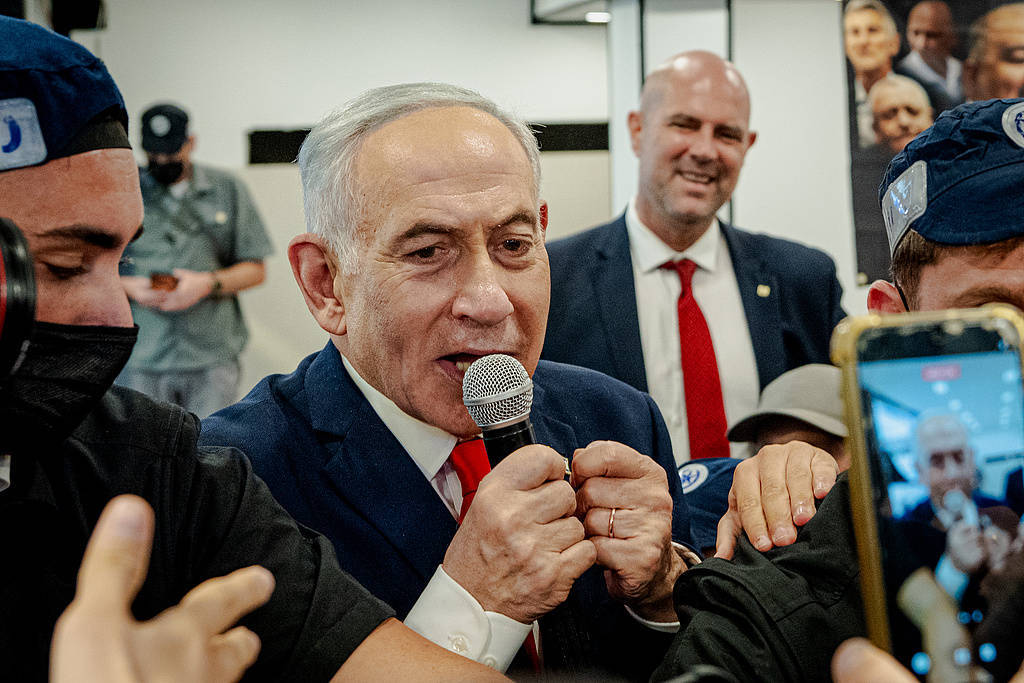
Seeking more public support from U.S. president
According to Israel’s “Jerusalem Post” report, on the eve of the parliamentary election, results from Israel’s major polling agencies showed that the opposition camp led by former Chief of Staff of the Defense Forces Eisenkot won an average of 54 seats, while the ruling coalition led by Netanyahu won an average of 49.5 seats. Neither political camp received enough seats (61) to secure a majority in the 120-seat parliament. This means that there is currently no clear path for either Netanyahu or his political opponents to form a government.
The BBC reported that this was the first general election in Israel since the outbreak of a new round of Palestinian-Israeli conflict. Support ratings for the ruling coalition and the main opposition camp are almost evenly matched. The “India Narrative” website stated on the 26th that the most important significance of this election is that it may be the most fiercely competitive political contest in recent years and will also be the most severe test for Netanyahu in his decades-long political career.
Sources revealed to the American Axios News Network that Netanyahu will fight for political survival in the election on the 27th and has recently sought more public support from US President Trump for his campaign. U.S. sources said that Netanyahu had two phone calls with Trump in the past three days and asked him to double down on his endorsement posts on the “Real Social” platform. On the evening of the 25th, Trump issued another statement supporting Netanyahu and calling on Israelis to vote for him, mainly because of his tough stance on the Iran issue.
The Times of Israel stated that as Trump publicly supported Netanyahu, Israeli President Herzog stated on the 26th that any external pressure would not affect his decision on who will form a coalition government. According to Haaretz, Trump’s support will not bring an overwhelming victory to Netanyahu’s camp.
Netanyahu’s post exaggerates “Second Holocaust”
Netanyahu released an AI-generated image of a nuclear explosion in Tel Aviv on the 25th, warning the public with just two days left before the election: voting for anyone other than him would put Israelis at risk of a “second Holocaust.” Recently, critics have accused Netanyahu of pushing to restart the war with Iran to influence or delay the Oct. 27 vote, which he denies.
Netanyahu’s post about “Second Holocaust” comes under fire from opposition. Eisenkot accused him on social media of spreading fear before the vote on the 25th. He wrote: “Netanyahu, you are hysterical. Just like every election campaign, it is the same lies and intimidation tactics.” Israeli Democratic Party leader Golan bluntly said: “Netanyahu and the people around him have lost their minds.”
In addition, Netanyahu had major differences with IDF Chief of Staff Zamir. According to a report from Israel’s Channel 12 on the 26th, a rare confrontation between Netanyahu and Zamir has reached a fever pitch, and the military is worried that someone is trying to use the Iran issue to gain political gains before the election. People familiar with the matter said the confrontation focused on an operation that could lead to a conflict with Iran. At a meeting on the 25th, the tension between Netanyahu and Zamir was very obvious, and the atmosphere at the meeting was extremely bad. Defense Minister Katz denied on the 26th that there was a conflict between Zamir and Netanyahu.
Israel’s international image is in sharp decline
The BBC said that as Netanyahu ramps up warnings about new threats from Iran, the opposition warns of potential interference in voting, and relevant figures warn that settler violence in the occupied West Bank may surge further, domestic political instability may expose Israelis to new tests of their democracy and new security threats.
Qatar’s Al Jazeera said on the 26th that Israelis are struggling to deal with a series of domestic and international crises during this election cycle. On the domestic front, there are growing demands for accountability for reported security lapses, including those leading to the October 2023 attacks, and concerns over Netanyahu’s repeated push for judicial reform. The election comes at a time when Israel’s international standing has deteriorated, with many countries condemning Israel’s continued attacks in the Gaza Strip and Lebanon.
Related Reading
- The “Purple Train” with KTV boxes prefixed with Y is popular2026-10-27
- [Ring Time Depth] What a miserable fate the mercenaries had on the Russian-Ukrainian battlefield2026-10-27
- Here comes the truth | Does the word “cod” in the name mean cod? How to eat healthier? Explain clearly in one article2026-10-27
- To balance bilateral relations and stabilize dialogue channels, the German President visited China again after 8 years.2026-10-27
- Comment now2026-10-26