At around 18:15 on October 23, Chang Liujia ignited from the Taiyuan Satellite Launch Center and flew southwest. Across 500 kilometers, the top of Mount Tai ushered in the twilight moment. An arrow shot through the air, and its wake created a huge spiral halo in the dark blue night sky, like an “eye of the sky” opening in the universe. Under your feet is the towering Mount Tai, and above your head is the ultimate romance. At this moment, the shock of China’s aerospace industry was perfectly intertwined with the majesty of Mount Tai.
Soon, social platforms in many places in Shandong were flooded with the same picture: a huge luminous spiral slowly spreading in the sky, like an eye hanging in the twilight.
Photographers at Daiding in Mount Tai captured it, as did citizens on Langmao Mountain in Jinan. The driver driving on the highway pulled over and the dash cam recorded the co-pilot’s exclamation. Witnesses in Yantai, Qingdao and other places also recorded this scene which lasted about two minutes.
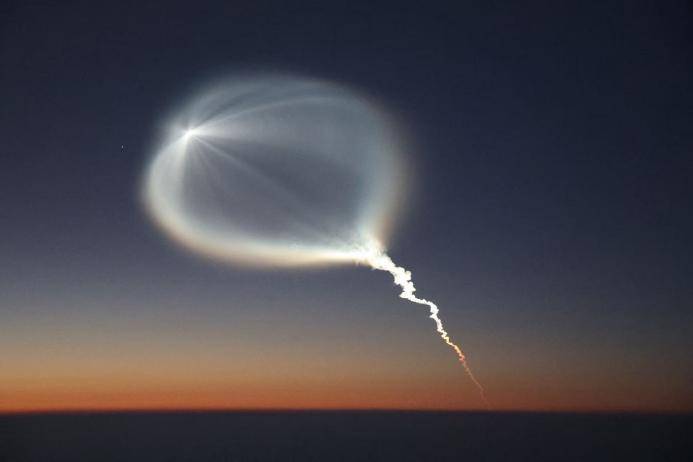
Around 18:17 on October 23, rocket cloud. Photography: Fu Jiazhi
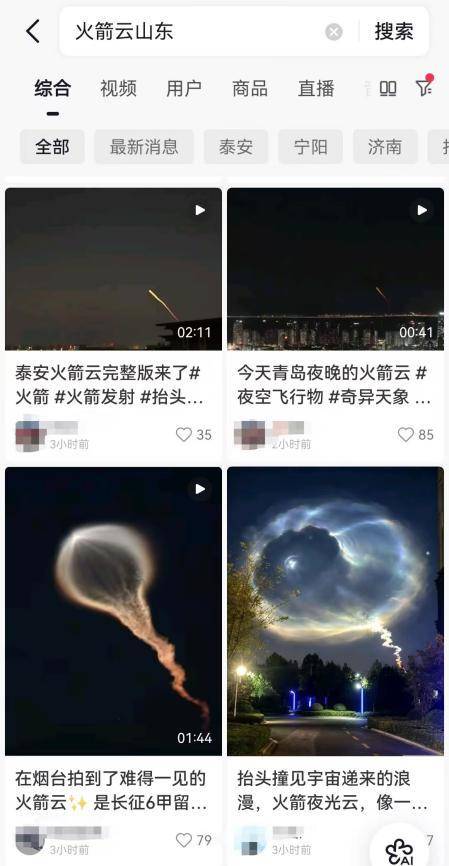
Photos from the Internet
A question naturally arises: the straight-line distance from Taiyuan to Shandong is at least four to five hundred kilometers. Mount Tai has a high altitude and a good view, so it’s not surprising to take photos. But why can even ordinary people on urban streets and highways see it so clearly?
It’s not Taishan’s “privilege”: everyone stands in the same “viewing window”
Taishan’s advantages do exist. The altitude of Daiding is more than 1,500 meters, the air is transparent, there is little obstruction, and the photographer has the blessing of a telephoto lens. But this time the rocket cloud was widely witnessed in many places in Shandong. The fundamental reason is not the altitude of the observation point, but the The rocket flies high enough,而 The ground happens to darken early enough。
This phenomenon (rocket cloud) is called the “twilight effect” in aerospace meteorology. According to a previous introduction from the Shanghai Institute of Aerospace Technology, the best time to witness rocket clouds is often in the early morning or dusk. When a rocket launches shortly after sunset, it gradually leaves the Earth’s shadow as it rises. At this time, the ground is already in darkness, but the contrail of the high-altitude rocket can capture sunlight and be lit “from top to bottom.”
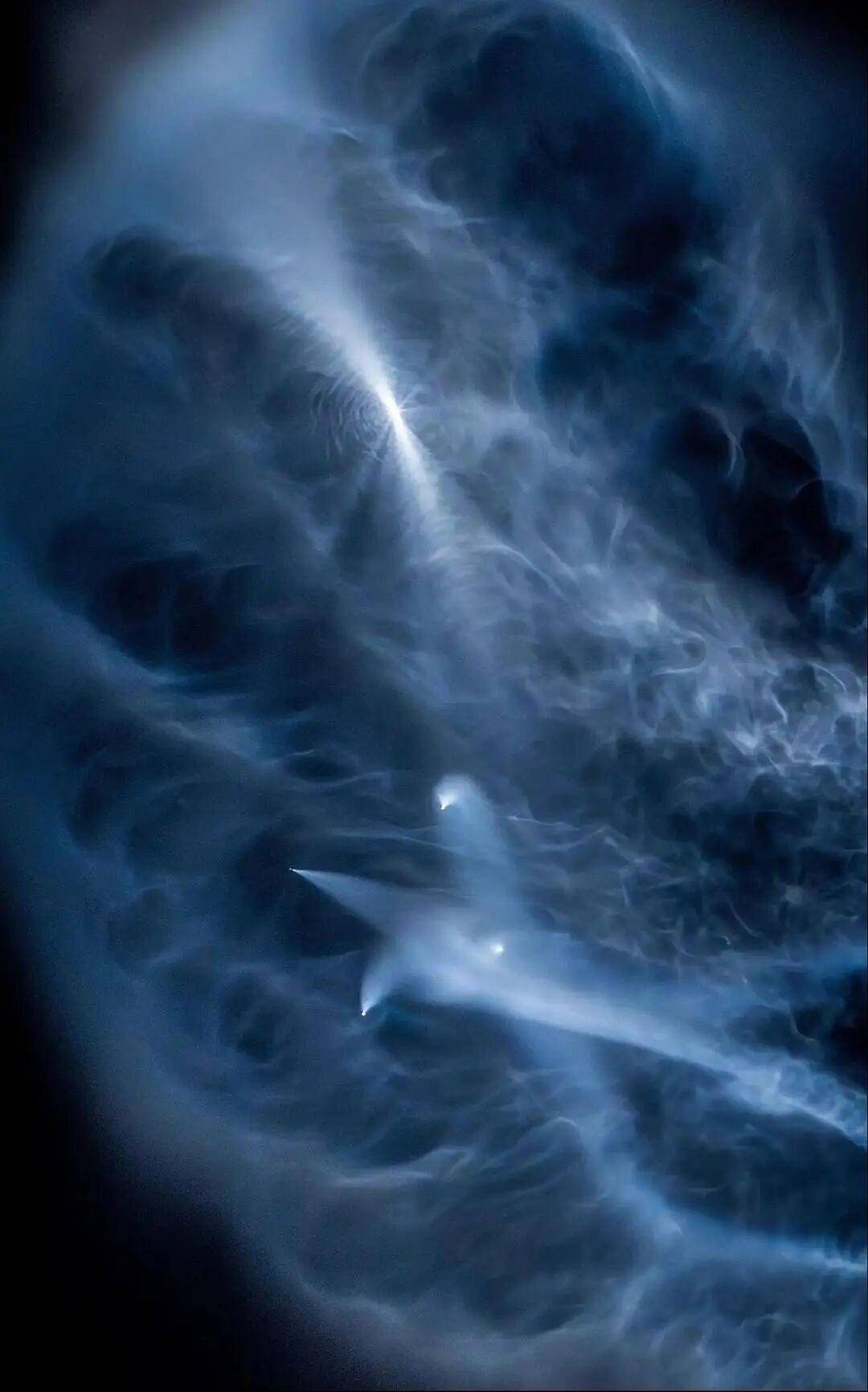
The time point of 18:15 on October 23 happened to be on this window. The ground enters twilight and the sky becomes darker; the rocket flies to an altitude of dozens of kilometers and is still illuminated by the setting sun. Water vapor and particulate matter in the wake condense and spread, forming extremely high-contrast luminous objects on the dark sky. Anywhere in Shandong with a wide view and no obstruction by tall buildings or mountains, you can look up and see the same picture – people parking on the highway, people stopping on the street, people with telephoto lenses on the top of the mountain, essentially sharing the same illuminated sky. This is also confirmed by the records of netizens.
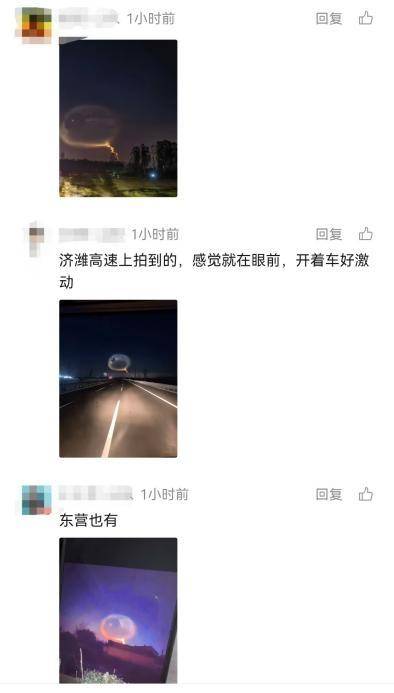
Photos from the Internet
The reason why many cities in Shandong can “collectively watch” is because the visible range of the rocket contrail after spreading at high altitudes far exceeds the “hundreds of kilometers” that ordinary people intuitively understand.
From the “launch site” to “looking up”: the “era of national observation” has quietly arrived
What is really noteworthy about this incident is not how shocking a particular photo is, but a trend that is becoming clear: to see rockets, you no longer need to buy a ticket to go to the launch site. In the past, watching a rocket launch was something with a threshold: checking the launch time and standing in a designated observation area, it was called a “professional event” at the launch site. But what happened in many places in Shandong on the evening of October 23 presented a different picture. It breaks away from the inherent understanding of time and place in rocket observation. Let everyone be unprepared to “unexpectedly encounter” the Long March 6A hundreds of kilometers away.
At around 18:17 on October 23, tourists took photos of rocket clouds. Photography: Fu Jiazhi
Related Reading
- Autumn is deep and the leaves are red! The most beautiful autumn colors in these places are online2026-10-24
- Young people have become popular about “drinking a lot of water”. How can drinking be healthier behind the minimalist health regimen?2026-10-24
- Cross-provincial mutual aid of personal account funds has been fully implemented. How to use the medical insurance wallet version 2.0?2026-10-24
- Typhoon “Qiangpi” is approaching. Experts explain why autumn typhoons are “more powerful than tigers”2026-10-24
- Hero dad describes taking down Oregon school shooter: “I see faces, I hear voices, I hear screams”2026-10-24