
On weekend mornings, a number of large and small release groups had already gathered along the Huadi River. When the vehicles transporting aquatic products arrived at the scene, release groups threw lotus carp, dace, loach, field snail and other aquatic animals into the river. In the eyes of the participants, this is a good deed; but behind this lively scene, there are hidden concerns about ecological security.
Release activities have always existed in our country. When the released species change from native fish and shrimp to exotic species with complex origins, traditional activities are in fierce collision with modern ecological protection requirements.
The Ecological and Environmental Code of the People’s Republic of China, which has been in effect for nearly two months, stipulates that “no unit or individual may introduce, release or discard alien species without authorization” and “it is prohibited to release aquatic alien species, hybrids and other aquatic organisms that do not meet ecological requirements into open waters.” The Ministry of Agriculture’s “Regulations on the Management of Aquatic Life Proliferation and Release” also requires that units and individuals that carry out large-scale aquatic life promotion and release activities on their own must report to the competent authorities at or above the county level 15 days in advance and accept supervision and inspection.
However, Nandu N Video reporters have repeatedly investigated and found that even at officially designated sites, unreported releases are still the norm, and released species are mixed with foreign species that are prohibited from release; release activities in non-designated areas are also active, and there are also fake releases on social media. Why is it so difficult to fully implement supervision in accordance with the law in reality?
The advance filing system is “hanging”
The process threshold is easy to get stuck in the elderly
“We are doing good deeds, why do we need to report?” an old man who was releasing loaches on Haiou Island in Panyu District, Guangzhou asked a reporter when he was asked whether he should report. At the Liuxi River in Baiyun District, a middle-aged couple released a bucket of snakehead fish and said that it was their habit to release the fish during the Ghost Festival. “Since there is a special release point in the district, just go to the right place and release it directly.”
2023年11月1日开始实施的国内首部专门规范野生动物放生的地方性法规《广州市野生动物放生管理规定》要求,任何组织和个人不得随意放生野生动物,放生须提前三个工作日将物种图片、种类、数量、来源等信息上传至野生动物放生信息管理平台,由区林业或农业农村部门反馈是否适合放生,并给予科学指引。 Release activities must also be carried out in designated release areas.
Reporters from Nandu N Video recently made unannounced visits to aquatic wildlife release sites in Liwan, Baiyun, and Panyu districts and found that most on-site release groups and individuals did not comply with the requirements for advance reporting, and many small release groups and individuals were completely unaware of the regulations. Even though Guangzhou has optimized the reporting requirements to only three working days in advance, the system of prior reporting for release still fails to have a sufficient normative effect.
The group that Xiaoxi (pseudonym) belongs to is a frequent visitor to the aquatic wildlife release site in Liwan District. He bluntly said that they planned to release about 20,000 dace fish that day, but because “the official reporting requirements were too strict and it was difficult to get approval,” they chose to release them directly.
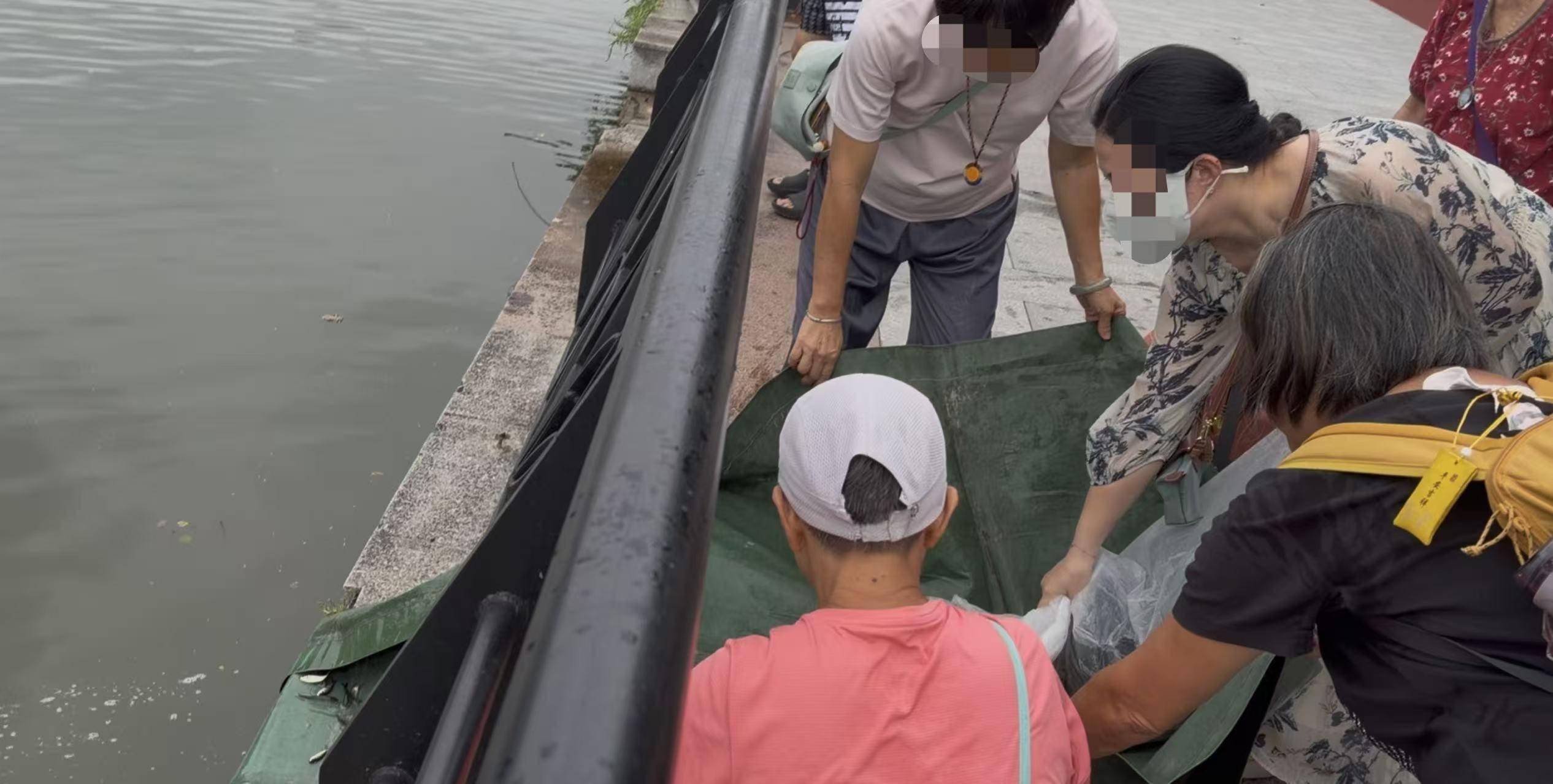
People releasing dace fish at the aquatic wildlife release site in Liwan District.
Another group organizer, Xiao Liang (pseudonym), gave inconsistent statements. When reporters first asked him as a participant, he vaguely stated that “it has been reported,” so that reporters don’t have to worry. But when the reporter made an unannounced visit for the second time, Xiaoliang changed his mind: “No one cares about this kind of thing, so how can anyone investigate it.”
In addition, a small number of groups choose to move to other places in order to circumvent Guangzhou’s release supervision. A Ping (pseudonym), who organizes release activities at Yunlu Wetland Park in Shunde District, Foshan City, claimed that the local management of release activities is looser, as long as no exotic species are released.
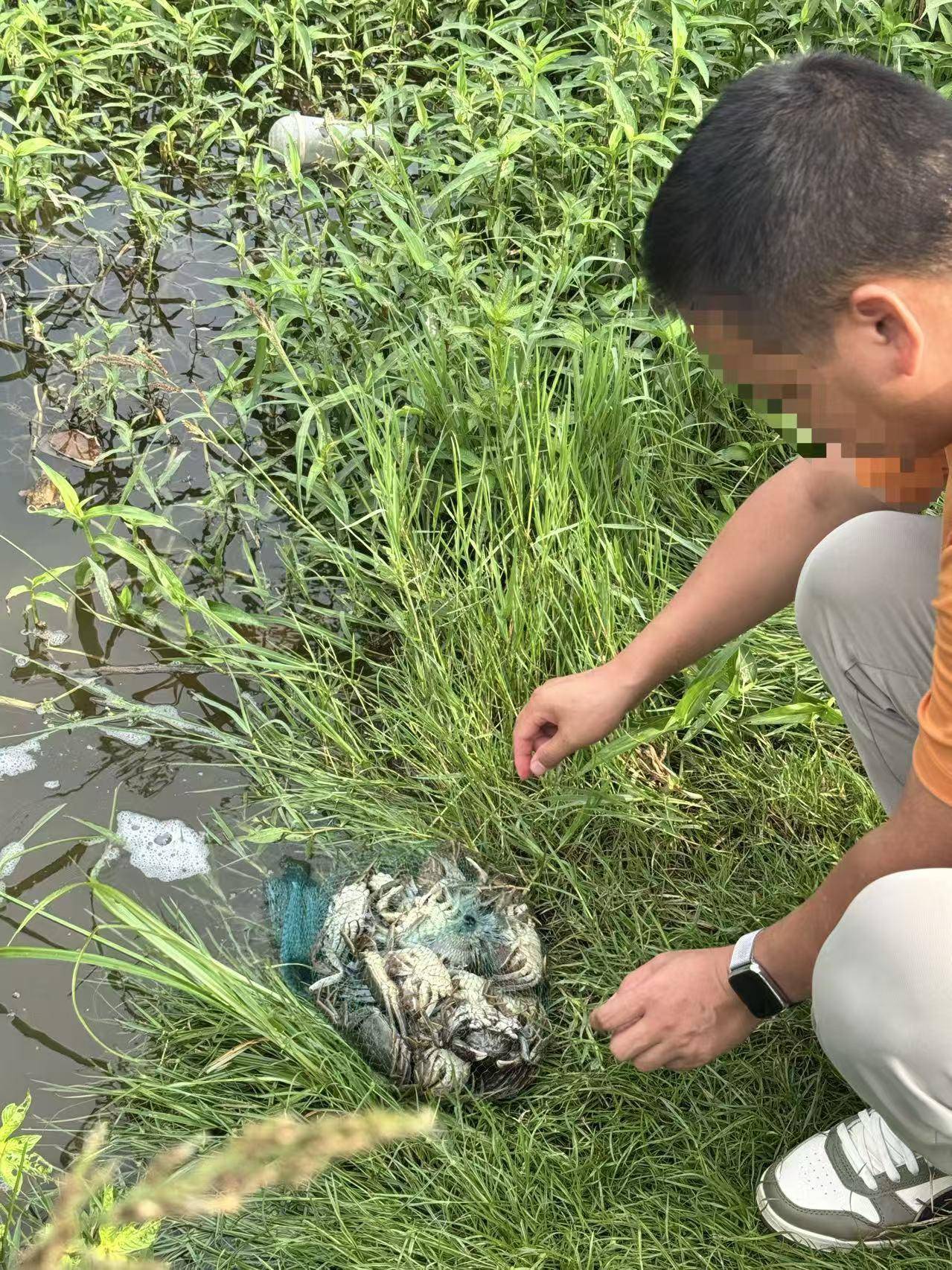
Someone released hairy crabs at Yunlu Wetland Park in Shunde District, Foshan City.
The deeper obstruction lies in the process threshold. The reporter’s actual measurement found that to report, you need to log in to the Guangdong Government Service Network or the “Suihaoban” App to inquire about the “Aquatic Wildlife Release Consultation”, download and print the application form and sign it by hand before you can enter the consultation and registration process. For the middle-aged and elderly people who participate in life release, this digital threshold is not low.
Song Ruliang, director of the Guangdong Research Center for the Rule of Law, believes that the reporting process is too cumbersome, and most of the participants in the release are middle-aged and elderly people with limited use of digital tools. “Many people who release animals do not know where to report and through which channels to report. This also shows that law enforcement agencies have not done a good job in popularizing the law.” He suggested that the reporting process should be further simplified. “If you only need to simply fill out a form on a small program and sign online, citizens will not find this a troublesome matter.”
The reporter combed through and found that there was no reporting and designated system, and the actual lack of control over the release of animals was not unique to Guangzhou. In 2025, some media revealed that “guerrilla” release of animals was repeatedly banned in Beijing. The releasers claimed that they change release locations every week, “almost searching all the rivers in Beijing, like fighting ‘guerrilla warfare.’ The rivers in the suburbs are wide and open, and they can avoid inspections by law enforcement officers.” When asked if they knew that the government had announced a targeted release platform, they all said they had never heard of it.
Exotic species were released as native dace
Abandoned animals become “blind boxes”
Releasing animals without following the reporting procedures is not just “disobeying the rules”. In the absence of scientific guidance, release groups can easily release alien species by mistake, further causing ecological problems.
Take Xiao hope’s group as an example, although the group claims to choose dace fry to avoid releasing alien species. However, after the fry arrived at the site, the reporter found that the appearance of these fry was very different from the native species of the mud carp in the Pearl River Basin, especially the lack of the blue stripes unique to the carp behind the gill cover.
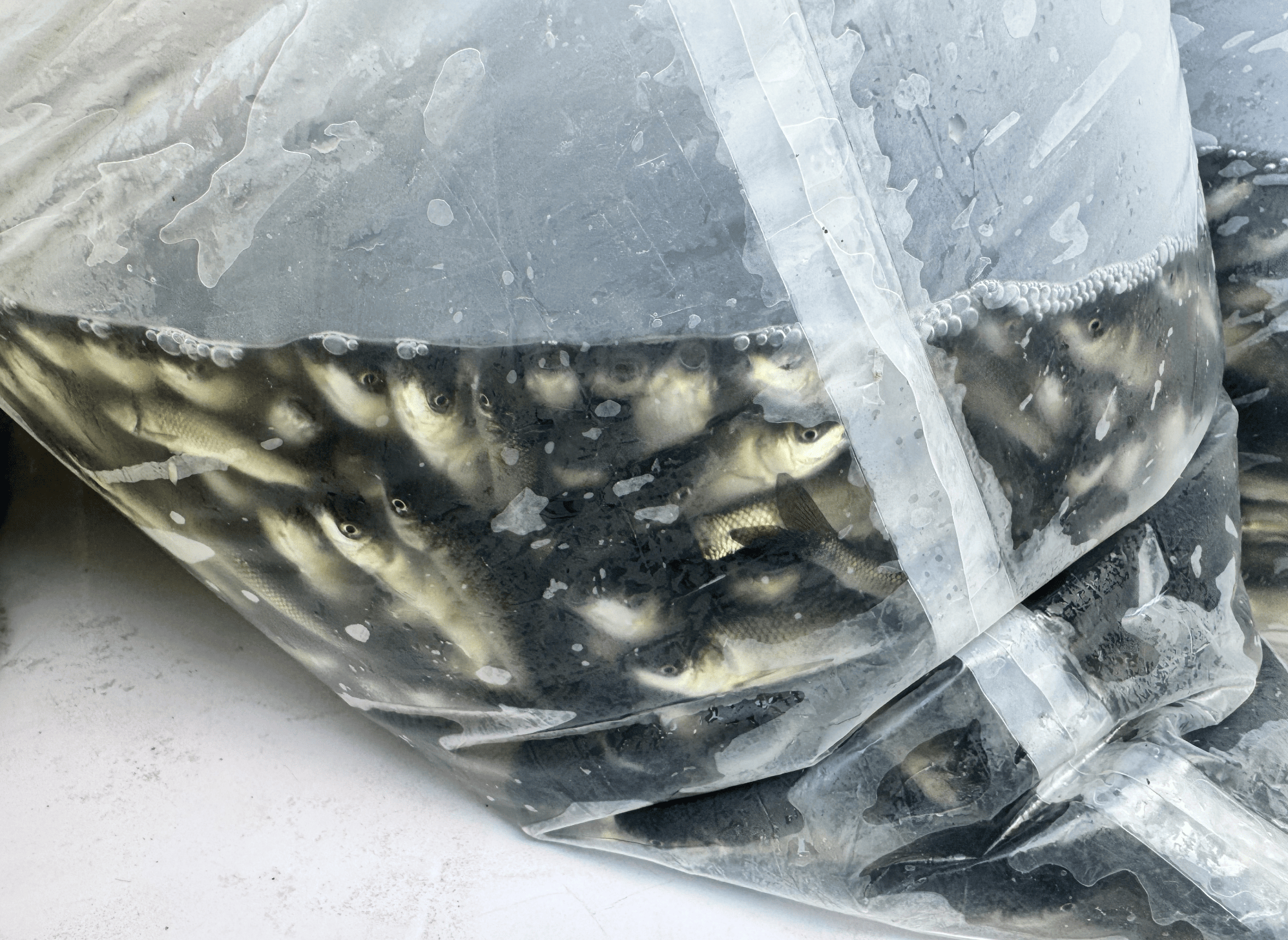
A bag of roost fry ready for release.
Zhou Zhuocheng, deputy director of the Native Aquatic Biology and Water Ecology Professional Committee of the China Fisheries Association, said after identifying the fish through on-site pictures that what Xiao hope and others actually released was South Asian rohu, also known as Lusta rohu. According to the “Guangzhou Aquatic Wild Animal Release Guidelines (Trial)”, the Lusta wild dace is an exotic aquatic wild animal that is prohibited from being released.
There are also problems with common released species such as carp, crucian carp, eel, and loach. Zhou Zhuocheng explained that most of the carp and crucian carp purchased in the market are artificially improved populations, which can easily cause genetic pollution to wild populations; the loaches released are basically artificially cultured large-scale loaches, which not only bring genetic pollution, but also forcefully crowd out the living space of the native species true loach in the same ecological niche.
He specifically mentioned that the eels currently on the market may be mountain eels introduced from Southeast Asia, not native eels, which may pose an invasion risk.
Some groups have released a large number of artificially bred carp and crucian carp in Liwan District.
In order to further understand the situation, the reporter, as a citizen, submitted a release consultation to the agricultural and rural departments of Liwan, Baiyun and Panyu districts through the Guangdong Provincial Government Service Network, and filled in “carp” as the species to be released.
Among them, the staff of the Baiyun District Agriculture and Rural Affairs Bureau called back and clearly informed that artificially selected carp species such as koi carp and lotus carp must not be released into the wild. “Even if it is an ordinary carp, it is difficult to guarantee that it can be purchased in the market that has not been genetically improved.” The staff suggested that the reporter could change the species to be released to herring, grass carp, silver carp, anchovy or Guangdong bream belonging to the same order of Cypriniformes. They also reminded that if the fry are released, the breeding farm must provide valid animal quarantine certification materials.
It can be seen from this that the system design of consultation and reporting before release can theoretically prevent the release of alien species, hybrids and other individuals that do not meet ecological requirements. But as long as the releasers do not go through the consultation process, the “defense line” of this system can be easily bypassed.
Lack of supervision and accountability
A pair of carp released online for NT$69
Due to the dense river network and numerous wetlands in Guangzhou, in addition to officially designated points, there are also many releases in non-designated areas, and these areas are basically in a regulatory vacuum.
On the bank of the Dongjiang River near Dadun Police Station in Xintang Town, Zengcheng District, organizer A Xiang (pseudonym) and more than a dozen participants released a batch of eels, brown catfish, tiger frogs and field snails. He said that this section of the river bank is also a frequent activity point for release groups. “This area is relatively remote, and the management is not as strict as in the urban area, and we are not afraid of fish being released and caught again.”
Along the Dongjiang River in Xintang Town, Zengcheng District, some releasers released frogs into the water for breeding.
On social platforms, in the past six months, people have privately recorded the release of aquatic animals in places such as Haizhu Daganwei, Panyu Chencun Waterway, Baiyun Mountain Nengren Temple, Fangcun Huadi River, and Nansha Jiaomen River. Among them, there are many species that are not suitable for release such as tilapia, koi, and shrimp.
Posts on social platforms about local release records in Guangzhou.
The reporter’s investigation found that social platforms have no obvious restrictions on videos or graphic content of aquatic animals such as loaches, koi, turtles, and tilapia being released into natural waters. The publisher’s IP address covers many provinces in China, and some content is even accompanied by labels such as “Do a good deed a day.” Some publishers also use this to attract traffic and promote the business of releasing raw materials on behalf of others. The business positioning of releasing raw materials on behalf of others includes Liwan and Zengcheng in Guangzhou, as well as Foshan, Zhaoqing, Chaozhou and other cities in the province.
The reporter contacted a blogger who runs a business of releasing animals on behalf of others. The blogger claims that in Chaozhou City, he can release crucian carp, carp, eel, snail, etc. on his behalf. According to the price list provided, the charge for releasing a pair of carp is 69 yuan or 99 yuan depending on the size, and 50 yuan can be used to release 5 to 10 eels. The blogger’s WeChat Moments show that he has release records almost every day, including many species that are not suitable for release such as koi.
A person claiming to be engaged in the business of releasing koi in Chaozhou, Guangdong posted a video of releasing koi in WeChat Moments.
It is worth noting that live broadcasts once became part of the live broadcast. In April this year, some media revealed that some platform live broadcast rooms clearly marked the price for releasing animals – giving sunglasses to release 2 soft-shell turtles, hot air balloons to release 10 turtles, sports cars to release 24 turtles, and helicopters to release 60 turtles. Within minutes, hundreds of turtles were thrown into the Yangtze River tributaries.
In the face of the “exuberance” online and offline, the problems of insufficient regulatory power and lack of accountability have been further amplified. A grassroots staff member of the agricultural department told reporters that it is difficult to control private release of wild animals because there are many activities and a wide jurisdiction, but the regulatory department has limited manpower.
In 2024, relevant staff of the Baiyun District Agriculture and Rural Affairs Bureau responded to the media regarding clues about an illegal release of wild animals, saying that law enforcement officers “basically focus on criticism and education, and will punish those who persist in admonishment or are of a bad nature.” At present, Guangzhou City has not announced any cases of punishment based on the “Guangzhou City Wildlife Release Management Regulations”.
In the same year, media reported that a large number of dead fish appeared in the Suzhou River in Shanghai due to citizens blindly releasing them, and even a ton of dead fish was fished out in one day. The report also pointed out that several departments in Shanghai jointly issued a document last year to regulate release activities in public waters, but with little effect. Some citizens said, “If you think of it, you can put it here.”
Song Ruliang believes that in reality, law enforcement officers lack the ability to distinguish species. “The prerequisite for law enforcement is to understand the laws and regulations and know what the objects of law enforcement are. Now that there are more and more new species that have never been seen on the market, law enforcement officers must first learn to distinguish them.”
At present, a few prefectures and cities have precedents for holding people accountable. In 2022, a certain Luo Moumou of Baise, Guangxi was fined 28,000 yuan for releasing scavengers and ordered to capture them within a time limit; in 2024, several elderly people released barrels of loaches in the waters near West Lake in Hangzhou, Zhejiang , management personnel rushed to the scene to dissuade them, and after investigation and evidence collection, they punished the tourists who released the animals; in April 2026, Chen Moumou of Xiamen, Fujian Province was fined 10,000 yuan for releasing alien aquatic species without authorization.
Expert advice:
Focus on controlling organizers, and the list of rules and regulations needs to continue to be improved
How to use refined and humane management methods to prevent “good deeds” from becoming an ecological burden?
Zhou Zhuocheng analyzed it from the perspective of the development differences between traditional culture and modern species resources. He believes that unlike in ancient times when people basically could only choose to release local native species, in modern society due to the abundance of introduced species and the development of aquaculture, people are more likely to come into contact with genetically modified individuals of exotic species and native species, so there is a situation where “good intentions lead to bad things”.
He also specifically mentioned that although people will pay attention to exotic species such as the alligator gar and clean them up once discovered, not enough attention has been paid to species such as tilapia (mainly including Nile mouth-brooding non-crucian carp, Qi’s cut non-crucian carp, Galileo’s broom-toothed non-crucian carp) and Merigala dace that are actually invasive in South China waters.
In response to the reality of limited law enforcement resources, Zhou Zhuocheng suggested that regulatory authorities should focus on organizers. “Those who promote and organize crowdfunding on social platforms, as well as those who do not understand science and plan large-scale releases, are the focus of law enforcement. The official control of the ‘leader’ will naturally have a certain deterrent effect on the following participants.”
Song Ruliang said that illegal release of animals will cause biosecurity problems, which are difficult to control simply by relying on post-event punishment. Social organizations, volunteers, societies, and associations can be relied upon, and elderly volunteers can be involved in guidance. “If we can provide science popularization guidance to some elderly people, and then let them serve as guides to promote scientific release to their relatives and friends, this will not only allow them to release animals in compliance with the regulations, but also achieve popular science propaganda.”
A slogan hanging at the aquatic wildlife release site in Liwan District.
He suggested that in key waters with frequent release activities, monitoring equipment should be improved for normal supervision. If any illegal release behavior is found, they should be punished and the cases should be disclosed in a timely manner. At some time points when release activities are frequent, regulatory authorities should strengthen control.
Song Ruliang also called on Guangzhou to formulate more complete guidelines and regulations for releasing wild animals on the basis of existing local legislation, and to continue to update the list of prohibited species.
Managing the ecological ledger of this bucket of “released fish” is not only a test question faced by law enforcement agencies, but also a major test of urban governance wisdom.
Produced by Narada Guangzhou News Department
Related Reading
- The “touchstone” battle: Zheng Qinwen hits the semi-finals of China Open2026-10-09
- Three years after the Palestinian-Israeli conflict: The ceasefire has not stopped the fighting and reconstruction has no timetable2026-10-09
- Why was the Nobel Prize for Literature awarded to Anne?2026-10-09
- Venezuela’s Maduro, wife Flores tortured opponents to stay in power, US prosecutors say2026-10-09
- (Photos from China) As evidenced by mountains and seas, “destination wedding” has become a new trend in marriage and love among Chinese young people2026-10-09