On the evening of the 4th local time, the results of the first round of voting in the Brazilian presidential election were released. Brazil’s High Electoral Court announced that since no candidate received more than half of the votes, the two candidates with the most votes – Flavio Bolsonaro, the son of former President Bolsonaro and candidate of the Liberal Party, and Lula, the current president and candidate of the Labor Party, will compete in the second round on October 25.
What’s the reason for the stalemate in this election? In the second round of competition, what is the focus of the competition between the two sides? What impact does the “American factor” have on the election?
Why is the election so close?
According to preliminary statistics from Brazil’s High Electoral Court, Flavio Bolsonaro led the first round of voting with about 47% of the vote, and Lula came in second with about 45% of the vote. Both of them had a significant lead over other candidates. According to Brazil’s presidential election rules, if a candidate receives more than half of the votes in the first round of voting, he will be directly elected. Otherwise, the two candidates with the most votes will decide the winner in the second round of voting.
Brazil’s Folha de São Paulo and other media quoted political analysts as reporting that a prominent feature of this election is that both Lula and Flavio Bolsonaro have a relatively solid base, and they also face a certain size of opposition groups.
Voters’ lack of willingness to vote also adds uncertainty to this election. According to preliminary statistics, the abstention rate in the first round of the election was as high as 21.08%, and the proportion of blank votes and invalid votes was about 5%. According to Brazilian presidential election rules, voters can express their political will by casting a blank or invalid vote without choosing any candidate.
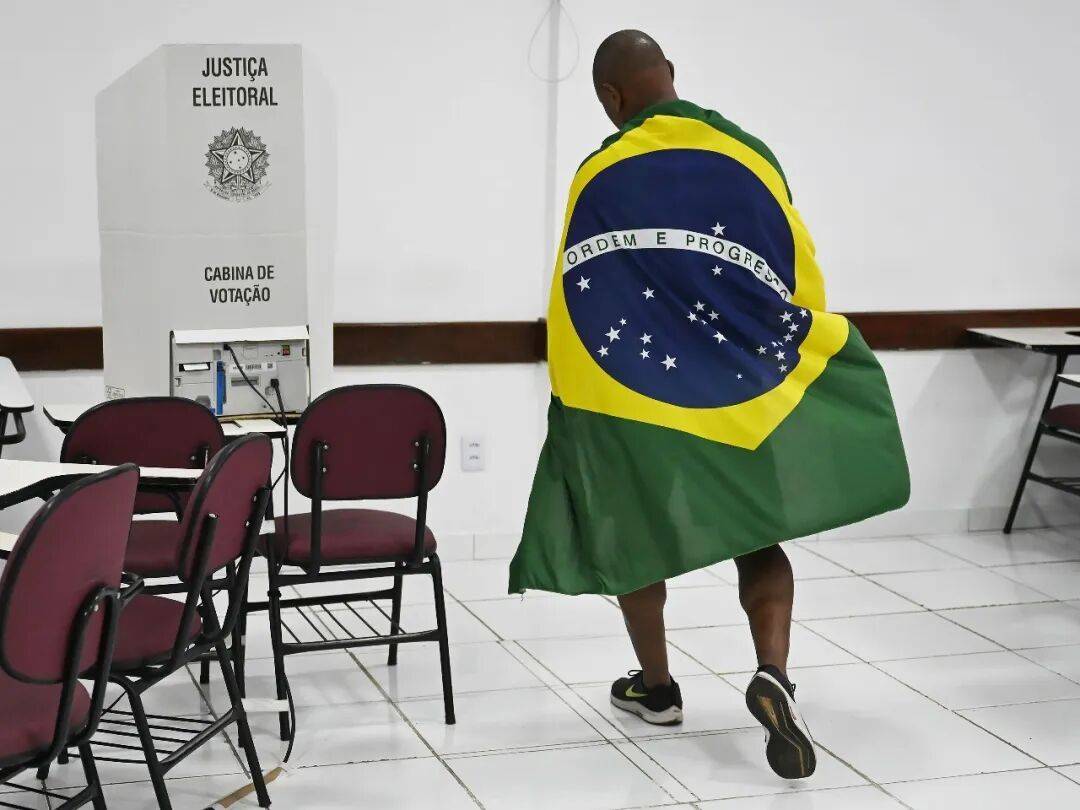
On October 4, voters wore Brazilian flags to vote at a polling station in Brasilia, the capital of Brazil. Xinhua News Agency
A pre-election poll by the Brazilian consulting agency Foria Poll showed that 47% of Brazilians surveyed said they were less concerned about this election than the last time. A poll by Cuaeste, another Brazilian consulting agency, showed that 23% of the respondents were “not interested at all” in this election, and another 10% of the respondents said they might choose to abstain, cast a blank vote or an invalid vote.
Where are the points of contention in the second round?
After the results of the first round of voting were announced, Lula said that his campaign team will win the support of voters with a policy plan that focuses on economic development and social inclusion, and called on voters who abstained from voting in the first round to actively participate in the second round of voting. Flavio Bolsonaro said that if successfully elected, he would start solving the “real problems” facing Brazil.
According to multiple rounds of pre-election polls, the two will still face a “technical tie” in the second round of voting. A poll by the Foria Poll Company showed that more than 90% of voters in both support camps said they would make the same choice in the second round of voting.
Analysts believe that with the camps of both parties relatively stable, supporters of the candidates who lost the first round of voting, middle voters and voters with low voting intention will become the focus of both parties in the second round of voting.
In addition, how to mobilize voters with low voting intention in their own camps to enter the polling stations will also become the focus of the second round of competition between the two parties. Data from the Brazilian High Electoral Court show that the abstention rate in Brazilian elections has generally been at a high level in recent years, and the abstention rate in both rounds of voting in the 2022 presidential election exceeded 20%. “Folha de São Paulo” reported that in the case of tight candidate competition, the abstention rate may become a key variable affecting the election results.
What is the impact of the “American factor”?
U.S. President Trump has close ties with former Brazilian President Jair Bolsonaro, who was convicted of plotting a coup. Trump said on October 1 that he would pay “close attention” to the Brazilian presidential election. Flavio Bolsonaro has said that if he is elected, he will promote Brazil to become a “close ally” of the United States. Lula’s campaign accused the Trump administration of trying to interfere in Brazil’s election.
In recent years, Brazil and the United States have frequently had frictions over issues such as tariffs, justice, and visas.
On the one hand, the Trump administration has repeatedly put pressure on the Brazilian government, including imposing high tariffs on Brazil and calling for the suspension of Bolsonaro’s judicial trial. On the other hand, it has continued to show goodwill to Bolsonaro’s camp. In addition to supporting Bolsonaro, it also provided a high-level reception to Flavio Bolsonaro when he visited the United States in May this year.

On October 4, voters lined up outside a polling station in Brasilia, the capital of Brazil, to vote. Photo by Xinhua News Agency reporter Wu Hao
The Brazilian government has repeatedly accused the United States of trying to interfere in Brazil’s elections. In March this year, Brazil revoked the visa of Darren Beatty, Trump’s adviser on Brazil affairs, to visit Brazil. Beattie had originally planned to visit Bolsonaro, who was serving his sentence. In July, Brazil refused to issue visas to two US officials on the grounds that they suspected that the latter were trying to interfere in Brazil’s elections. In addition, Brazilian intelligence agencies have warned many times recently that the United States may interfere in Brazil’s internal affairs in many ways.
Related Reading
- Former Prince Andrew takes legal action over warrants used in Epstein2026-10-05
- Cornell student who gave police leads in alleged rape says she feels ‘betrayed’ over its handling2026-10-05
- Coast Guard suspends search for 6 missing medical plane passengers off Nantucket2026-10-05
- Cornell rape accuser faces threats demanding she drop her lawsuit, attorney says2026-10-05
- Original “Roosevelt” aircraft carrier goes to the Middle East, the strategic deadlock between the United States and Iran is difficult to break, and regional risks rise2026-10-05