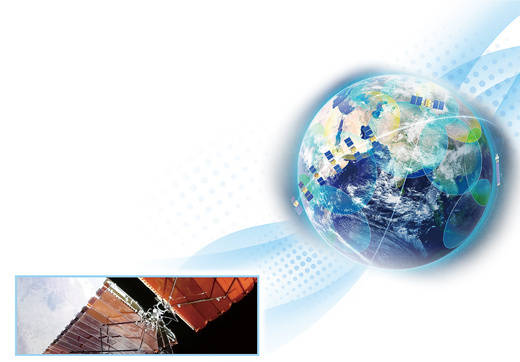
Above: Schematic diagram of the Galaxy Space Satellite Internet “Little Spider Web” test constellation. Picture provided by Galaxy Aerospace: The large-size flexible solar wing of the “Xiong’an-1” satellite developed for satellite Internet networking is deployed normally in space and is operating in good condition. Photo courtesy of Hongqing Technology
Not long ago, my country successfully completed six consecutive rocket launches within a week, and more than 30 satellites were sent into predetermined orbits to support industry needs such as low-orbit networking and cutting-edge technology verification.
From “launches every few years” to “launches every week” and even “updates every day”, the development of my country’s satellite Internet industry is accelerating across the board, injecting surging momentum into economic and social development.
One of the major deployments in the first year of the “15th Five-Year Plan” is the planning and construction of “six networks”. In the “new generation communication network”, satellite Internet plays an important role, helping to effectively achieve full-area coverage of integrated air, space and ground networks.
What are the development characteristics of my country’s satellite Internet? Why is space computing power attracting so much attention? How to promote the healthy development of industry?
As a space-ground integrated information infrastructure, satellite Internet extends the network to the open sea, deserts, mountains and air
Click on the mobile phone software to connect to the satellite Internet hundreds of kilometers away: when going to sea, the network signal is always full, and crew members and relatives can make video calls; in remote overseas nursing homes, the elderly have real-time video consultations with domestic doctors through stable satellite signals… Satellite Internet is entering real life.
As networking is accelerated and commercial operations are promoted, intelligent space infrastructure represented by satellite Internet will become the most basic public resource like water and electricity, providing the public with intelligent services such as communication, perception, and computing.
Our country has a vast territory and complex topography. In remote mountainous areas, oceans, deserts and other areas, the construction cost of traditional terrestrial communication networks is high and the coverage capacity is limited. “Satellite Internet can break through the constraints of geographical environment, complement the advantages of terrestrial communication networks, provide more extensive and stable information services, and bridge the ‘digital divide’.” said Shi Shengqing, co-founder of Beijing Guanyu Core Computing Technology Co., Ltd.
The value of satellite Internet is not only to expand the coverage of communication networks, but also to provide information infrastructure support for industries such as intelligent transportation, smart oceans, and energy exploration, and to promote the deep integration of digital technology and the real economy. Cao Meng, executive deputy general manager of Shenzhen Magic Satellite Technology Co., Ltd., said: “The integrated communication network between space and ground is an important development direction. Promoting the construction of satellite Internet can drive the development of high-end industries such as the aerospace industry, communications industry, and chip industry.”
Experts point out that in the face of damage to terrestrial communication networks caused by natural disasters, satellite Internet can also quickly restore communications and ensure emergency disaster relief and rescue. Space-based communication infrastructure gets rid of the geographical constraints of terrestrial communication networks and strengthens national security capabilities.
“In the future, these groups may be the first to try satellite Internet. One type is users in remote areas who want stable network coverage. The other type is users who work and live overseas. If they encounter unstable overseas ground networks, they will be willing to give priority to satellite networks.” Yan Xu, vice president of Hongqing Technology, speculated.
As an important track for emerging pillar industries, the satellite Internet industry chain covers multiple links such as satellite development, rocket launch, ground equipment manufacturing, terminal applications and operation services. The top priority for development is that satellites have low-cost, high-efficiency mass production capabilities.
Yan Xu introduced that most of my country’s satellite development currently adopts the single-satellite customization model. The design, production, and testing processes of different satellites are quite different, the manufacturing cycle is long, the cost is high, and the gap with foreign countries is large.
In order to achieve affordability, rapid development, and effective use, domestic commercial satellites are working hard to catch up and accelerate their evolution toward standardization, scale, and industrialization.
With the help of cutting-edge technologies such as assembly robots and intelligent equipment, the Galaxy Aerospace production line has the characteristics of flexible production, automated assembly, programmed testing, digital development, etc., and the development cycle is significantly shortened compared with the traditional model;
Introducing the assembly line concept of the automobile industry into satellite manufacturing, Hongqing Technology built an intelligent satellite batch production line in Xiongan New District, Hebei, shortening satellite production time to about 30 hours;
Micro-Nano Star Wuxi commercial satellite intelligent production line focuses on the batch development of satellites ranging from 200 kg to 500 kg, and can achieve an annual production capacity of more than 150 satellites…
To transform satellites from single-piece customized “handicrafts” to standardized, assembly-line-produced “industrial products”, more attention must be paid to breakthroughs in key core technologies. Zhou Xin, deputy general manager of MicroStar, said that it is necessary to strengthen independent innovation and standardization of key core products, overcome core component problems such as phased array antennas and on-board computing power, and adopt modular design, innovative universal platforms and other means to achieve rapid delivery of satellites and ensure consistent performance and controllable quality.
As the “ladder” for sending satellites into space, rocket capacity building cannot be ignored.
Thanks to the efforts of all parties, my country’s rocket manufacturing supply chain capabilities have been greatly improved, and more suppliers have participated in the industry-wide cost reduction and efficiency improvement. As my country has achieved major breakthroughs in both maritime and land recovery technologies, rocket reuse technology has made steady progress.
“The domestic rocket industry’s chasing each other and healthy competition have led to a significant year-on-year decrease in satellite launch expenditures, and the proportion of freight costs in satellite networking costs has been reduced accordingly.” said Peng Haomin, co-founder of Oriental Space.
Satellite Internet not only enables communication, but also superimposes multiple functions such as navigation and remote sensing, and integrates space computing power and artificial intelligence
The key satellite Internet business, “satellite direct connection to mobile phones”, has become the focus of global competition. According to predictions by foreign institutions, global direct monthly active users will reach 411 million in 2030. my country’s “mobile phone direct connection to satellite” application exploration is active and progress is obvious.
Tiantong business launched a “mobile phone direct connection to satellite” package, with a monthly lease of 10 yuan, and call charges are gradually reduced;
Huawei, Honor, Xiaomi, OPPO and other mobile phone manufacturers have supported satellite calls. Users do not need to change cards or numbers. When there is no ground signal, they can make satellite calls and send text messages directly through their mobile phones;
The “Qianfan” and “State Grid” constellation network construction progress has been accelerated, and the mobile phone direct connection test satellite has carried out key technology verification work…
However, communication is only the core function of traditional satellite Internet. Experts agree that in the future, satellite Internet will inevitably be superimposed with navigation, remote sensing and other functions to achieve multi-purpose and functional integration on one satellite.
Ren Jiadong, deputy director of the Galaxy Space Satellite General Technology Department, gave an example. The deep integration of satellite communications and intelligent remote sensing detection can achieve integrated collaborative operations of remote sensing imaging and on-board intelligent processing. “If there is a fire on the ground, in the traditional mode, the satellite needs to download the remote sensing data and generate the image before conducting analysis. Now, the satellite can directly analyze the data in orbit, output the fire determination result, calculate the fire range and then send it quickly, without the need to send back the original image, which greatly reduces the satellite data transmission bandwidth occupation and data transmission time.”
Yan Xu gave an example: satellite communications and satellite navigation can also be integrated organically. “Originally, the positioning accuracy of navigation satellites is 3 to 5 meters. Once integrated with low-orbit satellite-related functions, the positioning accuracy is expected to be improved to centimeter level, which is very important for the improvement of intelligent industries such as autonomous driving.”
Satellite Internet can better realize communication, navigation, remote sensing and other capabilities, and it is increasingly inseparable from the empowerment of space computing power and AI (artificial intelligence).
Li Fenghui, founder of Yunyao Aerospace, said that the essence of traditional satellites is data collection and forwarding nodes, which rely more on the ground for calculations, slow response and high pressure on transmission links. Empowered by space computing power and AI, satellites can move from “seeing” to “understanding”, from “transmitting data” to “giving answers”, and evolve into on-orbit intelligent entities with the capabilities of perception, calculation and decision-making.
Cao Meng made an analogy: building a satellite Internet is like “building a road.” When the “highway” for data transmission is completed and data can flow freely between satellites and between satellites and the ground, the next step that needs to be solved is the problem of data storage and computing.
Ren Jiadong took the Pengcheng first satellite recently launched by Galaxy Space as an example. “Pengcheng’s first satellite is the first technology verification satellite in China to jointly move 5G non-terrestrial network base stations, core networks, satellite-borne AI computing, satellite-to-ground lasers and microwave communications into the sky.” Ren Jiadong said that this satellite can move the “brain” core network of the 5G network originally deployed in the ground computer room directly to work in space. Ground users only need to access the satellite network to directly view various information calculated and analyzed by the satellite in real time, just like browsing the web.
Shi Shengqing introduced that space intelligence uses large models to process data collected in space to realize space-native large models and agents; global intelligence empowers computing power to the entire world through cloud-edge-device collaboration through the satellite Internet; the sky-and-earth collaborative computing power network builds distributed computing and computing collaboration across the world to achieve efficient complementarity of heaven and earth resources. “Moving computing power into space has unique development advantages. The solar energy acquisition efficiency is 6 to 8 times that on the ground, and the vast space also provides unlimited space for large-scale computing infrastructure.”
Centering on the satellite Internet, businesses such as space 4S stores, which specialize in satellite refilling and maintenance services, and the orbital transfer vehicle “space bus,” together constitute the “logistics support system” of the on-orbit economy, which determines whether the constellation can be deployed efficiently, survive for a long time, and continue to create value. It is the key infrastructure for the satellite Internet to move from “usable” to “easy to use and durable.”
The ultimate goal of satellite Internet construction is not to launch more satellites, but to transform space-based communications into the ability to truly serve the national economy and people’s livelihood.
From a global perspective, satellite Internet has formed a complete ecosystem of “construction-networking application-operation”. How to accelerate the formation of a commercial closed loop for my country’s satellite Internet is currently a difficult development problem.
“The ultimate goal of satellite Internet construction is not to launch more satellites, but to transform space-based communications into the ability to actually serve the national economy and people’s livelihood.” In Cao Meng’s view, in order to make the dream come true, in addition to achieving large-scale production and deployment of satellites, we must also break through bottlenecks in multiple aspects such as ground network and support system construction, space and ground network integration, space traffic management, and data security capabilities.
Zhou Xin believes that satellite Internet is related to both the manufacturing industry and the service industry, and in the final analysis, profitability must be achieved. It is necessary to start from the user end to form a virtuous cycle in which the real needs of consumers drive the development of the industry.
“Promoting construction through use” is becoming the common aspiration of practitioners.
“Perhaps we can quickly build a basically usable satellite Internet to form practical services and revenue streams in scenarios where ground networks cannot cover ocean shipping, aviation Internet, emergency communications, etc. At the same time, we can promote consumer-level applications such as ‘mobile phone direct connection to satellite’ to reduce terminal costs and tariff thresholds and cultivate the mass market.” Yan Xu suggested.
Experts call for the need to accelerate the on-orbit verification and coordinated development of new satellite materials, new devices, and new technologies. For commercial aerospace companies, on-orbit test opportunities are limited and costs are high, which restricts the maturity of new technologies. Li Fenghui said that it is necessary to encourage in-depth collaboration between industry, academia and research, to accommodate trial and error innovation in commercial aerospace, and to carry out business verification based on a large number of domestic industry scenarios. Last year, Hongqing Technology, Zhijiang Laboratory and Xiongan Science Park jointly launched the “Olive Leaf Project”, proposing to launch 1 to 2 public welfare scientific test satellites every year, providing open loading and verification services, and committed to continuously lowering the threshold for space scientific research and promoting cooperation and sharing.
“It is necessary to promote the construction of coastal launch sites and launch stations as soon as possible, plan relatively safe, controllable and economical launch directions and trajectories in the navigation area, optimize frequency and launch license application and approval processes, allow more rockets and satellites to fly and be tested as they should, and improve the industrialization level of my country’s aerospace products.” Cao Meng said.
“We must also fully face internationalization, aim at new vast overseas market opportunities, combine satellite Internet construction with emerging needs such as domestic industry overseas and ground computing power overseas, and find a unique development route of our own.” Shi Shengqing said.
Related Reading
- Trump announces plans for largest steel plant in U.S. history to be built in Iowa2026-09-29
- Daily watch2026-09-29
- Lin Shidong, Triple Crown Champion! Defeated Wang Chuqin 4-0 and won the Asian Games men’s singles championship2026-09-29
- “8·28” Full Moon Observation on New Deals in the Real Estate Market|The proportion of existing sales of new houses in Shenzhen has increased significantly, and the bargaining space for second-hand houses continues to narrow.2026-09-29
- SpaceX “Starship” successfully entered Earth orbit for the first time and deployed 26 Starlink V3 satellites2026-09-29