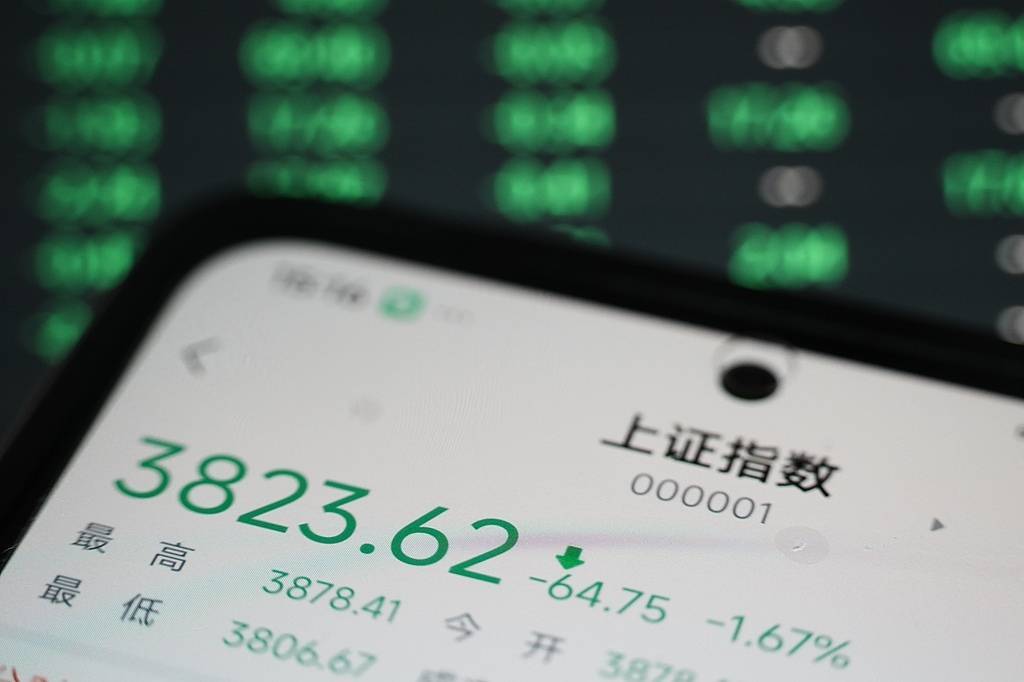
The A-share market showed a volatile and declining trend on Monday.
Among them, the midstream component varieties and precious metal varieties of the AI industry chain represented by CPO led the decline, causing major stock indexes such as the ChiNext Index and the Shanghai Composite Index to accelerate their bottoming. However, dividend asset stocks such as banking stocks and coal stocks, as well as chemical sectors that benefit from expectations of rising industrial prices, have become active, showing that short-term bulls are still unwilling to be left alone and are still looking for long opportunities.
High U.S. bond yields suppress non-U.S. assets
From a market perspective, A-shares and even many equity assets other than U.S. dollar assets, and even gold and other varieties that have been used as safe-haven assets in the past, have shown a continuous decline in the near future. Among them, the international gold price has recently continued to break down through integer marks such as US$4,400/ounce, US$4,300/ounce, and US$4,200/ounce, which illustrates the extreme anxiety and nervousness of global capital, so that safe-haven assets have also become the target of selling and become a tool to obtain more liquid assets.
The reason for this is mainly because the yields on U.S. Treasury bonds have continued to rise recently. Not only the yields on medium and long-term Treasury bonds such as 10-year and 30-year bonds have comprehensively exceeded the highs in 2007, but the yields on short-term Treasury bonds such as 2-year U.S. Treasury bonds have also continued to rise, reaching new highs in many years. Such high yields quickly attracted the attention of global capital, which not only focused on the influx of more international liquidity into U.S. dollar assets behind the high yields, but also on the duration of such high yields. Against this background, more international capital is returning to U.S. dollar assets, causing non-U.S. assets, even former safe-haven assets such as gold, to face the pressure of “liquidity bleeding.” Therefore, on Monday, Asia-Pacific stock markets struggled, and RMB assets represented by A-shares and Hong Kong stocks were also under pressure.
Two types of stocks bucked the trend and gained popularity
It is worth pointing out that there is another piece of information that has intensified the short-term risk aversion of A-share participants recently, that is, the direction of the midstream components of the AI hardware industry chain represented by CPO is once again affected by the increasingly clear information about overseas control measures. This actually shows from one side that the logic of the AI hardware industry chain with only US dollar assets is the strongest at present, and other components may be suppressed by the US dollar, including the direction of Korean storage components. Therefore, not only the main line of A-share AI hardware performed weakly on Monday, but South Korea’s KOSPI index also led the decline. This will undoubtedly further intensify the clearing of A-share technology-oriented asset chips. This may also be one of the incentives for the larger decline in A-shares on Monday.
Related Reading
- Lin Shidong, Triple Crown Champion! Defeated Wang Chuqin 4-0 and won the Asian Games men’s singles championship2026-09-29
- “8·28” Full Moon Observation on New Deals in the Real Estate Market|The proportion of existing sales of new houses in Shenzhen has increased significantly, and the bargaining space for second-hand houses continues to narrow.2026-09-29
- SpaceX “Starship” successfully entered Earth orbit for the first time and deployed 26 Starlink V3 satellites2026-09-29
- Republicans join Democrats in questioning Trump’s taxpayer2026-09-29