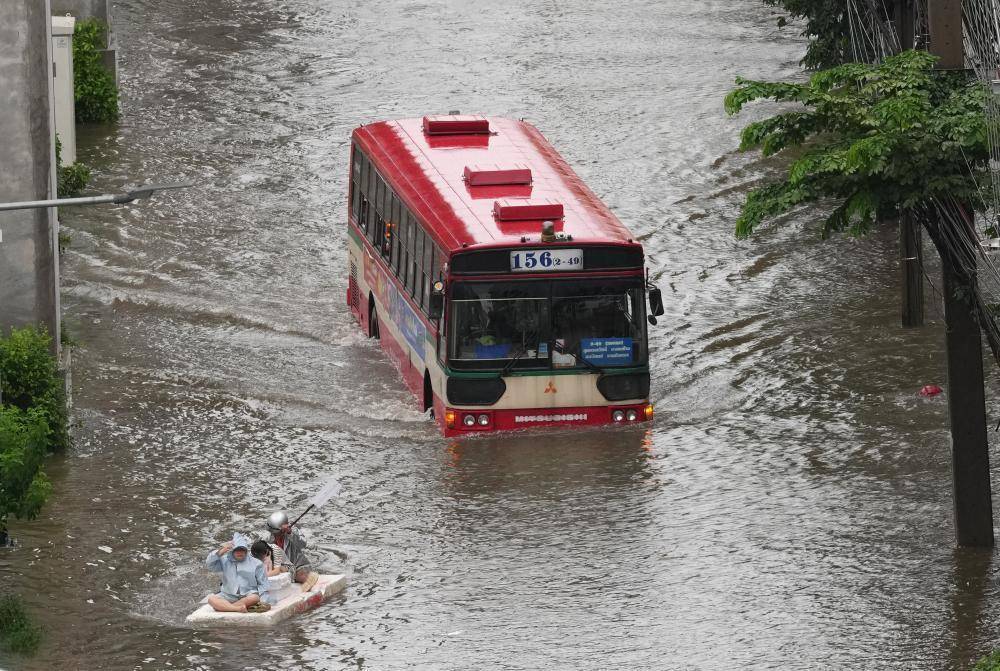
This is a flooded street taken in Bangkok, Thailand, on September 27. The Mayor of Bangkok, Thailand, Chacha Sidivan issued a statement from the Municipal Disaster Prevention and Reduction Headquarters on September 26, declaring the city a flood disaster area. Xinhua News Agency/AP
From September 24th to 27th, Bangkok, the capital of Thailand, suffered continuous heavy rainfall and caused widespread flooding. According to data released by the Thailand Disaster Prevention and Reduction Department on the 27th, as of 6:00 that day, a total of about 545,000 people in 25 provinces in Thailand were affected by floods, and about 52,000 households in 50 districts of the capital Bangkok were affected.
The Thai Meteorological Department stated that this round of rainfall is mainly affected by the active low pressure area and the enhanced southwest monsoon. In less than 48 hours since the afternoon of the 24th, the cumulative rainfall in some areas of Bangkok has approached 300 millimeters. The continuous rainfall has caused the water levels of many major canals to rise rapidly, putting the city’s drainage system under tremendous pressure. As the water situation intensified, the Bangkok City Government declared that all 50 districts in the city were flood disaster areas and activated corresponding disaster relief mechanisms. The city government subsequently stepped up efforts to activate pumping stations, clear drainage channels, and open schools and other places as temporary resettlement sites.
The impact of heavy rainfall on residents’ daily lives is very intuitive. According to observations by a “Global Times” reporter on the morning of the 26th, most sections of Phetchaburi Road, an important traffic route with dense traffic on weekdays, were temporarily closed due to water accumulation, and vehicles could only detour. Taxi-hailing has become one of the most realistic problems. Online taxi-hailing has no one to take orders for a long time; the number of take-out riders has decreased, delivery fees have increased four to five times, and many restaurants have simply suspended take-out.
At the same time, more residents are turning to offline purchases. The reporter saw near the residence that the shelves of many convenience stores had been emptied, and there were long queues in front of the checkout counters of large supermarkets. However, according to the reporter’s actual observation, the basic daily necessities in supermarkets are generally sufficient, and there is no obvious shortage. Local media reported on the 27th that as residents concentrated on purchasing food and daily necessities, some convenience store shelves in Bangkok were empty for a time, and merchants were replenishing supplies.
Faced with the water situation, Thai Prime Minister Anutin, who was visiting the UK, listened to the situation through a video conference on the 26th and requested unified coordination from the Thai central government, the Bangkok Municipal Government, disaster prevention and reduction, water conservancy, transportation and other departments. He stressed that flood prevention and disaster relief cannot be regarded as the unilateral responsibility of the Bangkok City Government, and that all departments must work “as a team”. Anutin also asked relevant government departments to consider flexible home working arrangements if travel is hampered. Anutin then decided to end his trip to the UK ahead of schedule and immediately began flood response work after returning to Thailand on the morning of the 27th.
From the early morning of the 27th, the rain in Bangkok began to weaken, but the water has not completely subsided.
Related Reading
- Mexico’s Baja California braces for major Hurricane Polo as Hurricane Nolo still threatens Hawaii2026-09-28
- No detection2026-09-28
- Why do we have to wait until the problem of washing pots and mops is solved before it is exposed?2026-09-28
- High-speed rail is focused on new projects, with four new lines opening today2026-09-28
- The courier boy “made a lot of money” in Africa2026-09-28