Cover News Reporter Liu Kexin
The excavation work of the Sanxingdui-Jinsha ruins continues, and the research results of the two ruins have been released one after another in the past two years. Previously, the traceability results of the carnelian beads unearthed from the Sanxingdui site and the research results on the casting place of bronze vessels have attracted public attention and have been trending on many platforms.
On September 23, at the Beijing Cultural Forum’s “Sanxingdui-Jinsha and Surrounding Cultural Exchange” themed salon, Liu Zhiyan, Secretary of the Party Committee and President of the Sichuan Provincial Institute of Cultural Relics and Archeology, announced a series of new breakthroughs in multidisciplinary archaeological research, covering the four major dimensions of sacrificial remains research, bronze craft analysis, cultural relic protection technology, and civilization value interpretation.
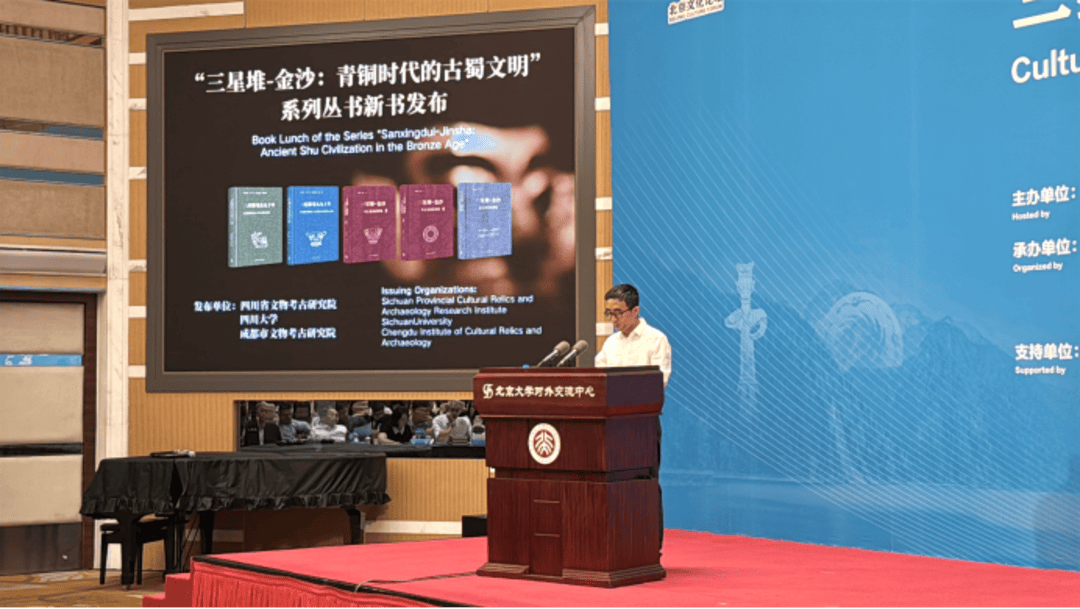
Liu Zhiyan announces series of new breakthroughs in multidisciplinary archaeological research
The Yellow River and the Yangtze River are both the cradle of Chinese civilization
Huo Wei: Attention should be paid to the study of Yangtze River Civilization and Bashu Civilization
Huo Wei, a first-level professor of liberal arts at Sichuan University and a distinguished professor at Sichuan University, mentioned in the article “On the Contribution of Bashu Civilization in the Origin of Chinese Civilization” that the Bashu civilization made outstanding contributions to the formation of the “diversity and unity” pattern of Chinese civilization.
From the Paleolithic Age Piro Site, the Neolithic Age Baodun Culture, to the Bronze Age Sanxingdui and Jinsha Sites, the ancestors of Bashu have always participated in the construction of Chinese civilization. Sanxingdui has unearthed not only bronze sacred trees, masks, altars and other artistic creations that show extremely imaginative artistic creations, but also artifacts influenced by the rituals of the Central Plains such as Zun and Lei. It is a model of the diversity and integration of Chinese civilization. Secondly, the Bashu civilization is an outstanding representative of the Yangtze River civilization. There are many ethnic groups and diverse cultures here, and it also has the distinctive characteristics of emphasizing shamanism and worship and immortality. After the Qin and Han Dynasties, Bashu civilization gradually integrated into the unified multi-ethnic country and became the hub of the “Southern Silk Road”. Finally, the Bashu civilization also embodies the wisdom of the unity of nature and man, and the wisdom of following the trend, especially the Dujiangyan water conservancy project as a typical example.
“It is more realistic to emphasize that both the Yellow River and the Yangtze River are the cradle of the great Chinese civilization.” Professor Huo Wei proposed that attention should be paid to the study of the Yangtze River Civilization and the Bashu Civilization. This has important academic value and practical significance for forging a stronger sense of the Chinese nation’s community, strengthening the study of the history of contacts, exchanges and integration among the various ethnic groups in China, and understanding the grand narrative formed by the pluralistic integration of Chinese civilization.
Restore the sacrificial process of ancient Shu
The sacrificial pits are planned in a unified manner
The announcement of two results on the formation and process of the sacrificial pits at the Sanxingdui site has once again raised public awareness of the eight sacrificial pits at Sanxingdui.
Liu Zhiyan introduced that the multidisciplinary team completely restored its three-stage burial process: orderly burial of artifacts, external ashes, soil backfilling, and later compaction, restoring the ancient Shu ritual process.
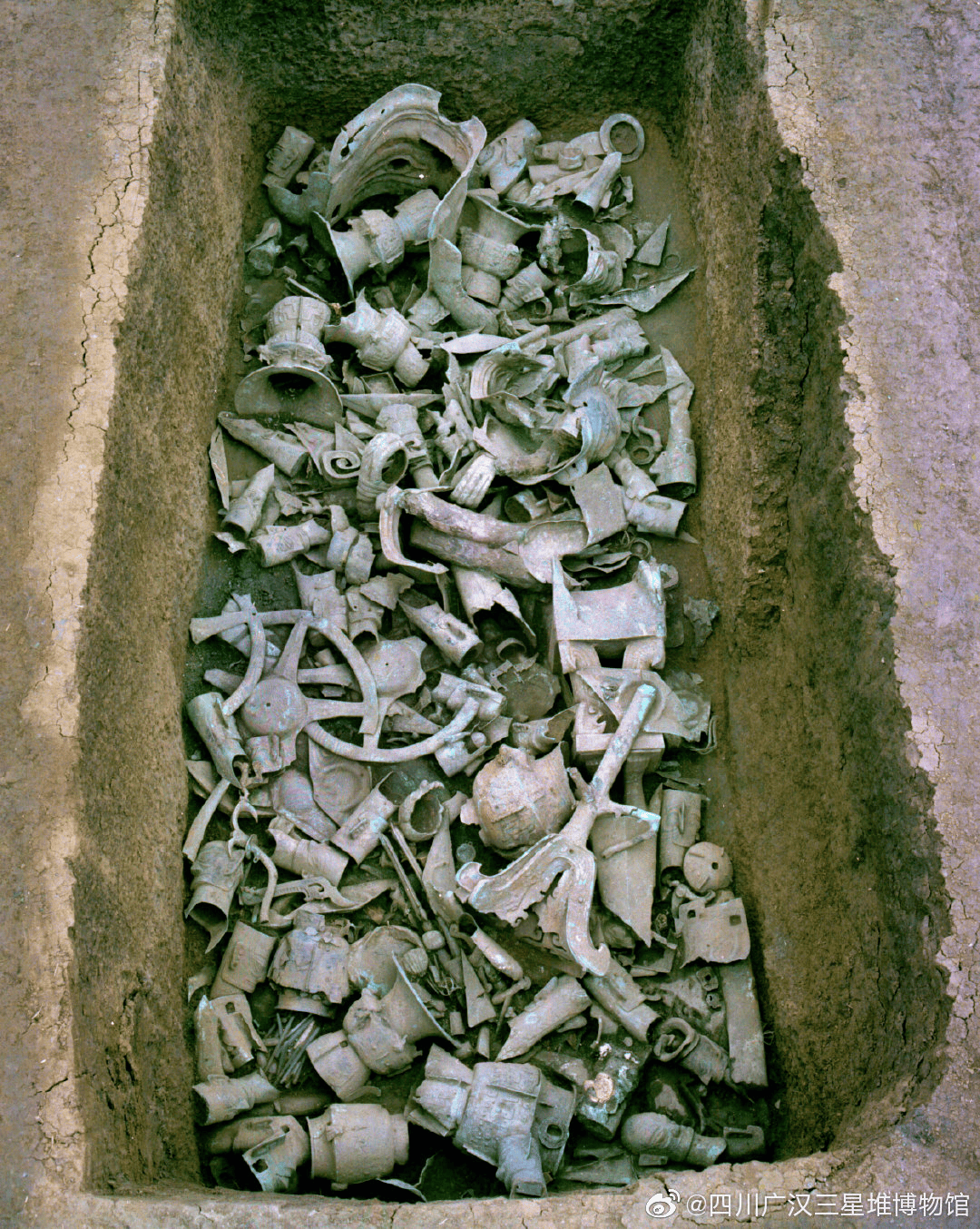
Sanxingdui Pit No. 2. According to Sanxingdui Museum
Zhao Hao, associate professor at the School of Archeology and Museology at Peking University, has made new breakthroughs in his research on the orientation system of eight sacrificial pits. Based on the axial direction, position, spacing and shape structure of the artifact pits, Zhao Hao believes that the ancient Shu people chose a more regular plan. Research results show that the north-south axes of these eight pits are basically the same, and they all adopt an orientation system of 30 degrees to 35 degrees north to east. This directional system is not only common to the eight pits, but also the same direction as the largest single building in Sanxingdui, the Qingguan Mountain No. 1 Building, and the Sanxingdui City Wall. “This shows that the diggers of these eight pits followed the basic orientation habits of Sanxingdui society.”
During the two excavations in 1986 and 2020, archaeologists have already mastered the burial rules of the sacrificial pits. The ancient Shu people first put in relatively complete utensils, then filled them with ivory, burned ashes, and finally sealed the pit with earth. Zhao Hao’s recent research results show that the ancient Shu people not only buried these artifacts in an orderly manner, but also consciously classified and stored small objects such as seashells, jade beads, and copper rhombus eye-shaped objects.
As for what the Sanxingdui artifacts experienced before they were “entered into the pit”, the research on the sedimentation process of Pit 4 by Capital Normal University, Sichuan Provincial Institute of Cultural Relics and Archeology, and the University of Science and Technology Beijing may provide a glimpse. Zhang Junna, associate professor and doctoral supervisor at the School of History at Capital Normal University, who presided over this experiment, said that the experimental results showed that the sedimentation process in Pit 4 can be “clearly divided into three stages.” First, the ancient Shu people placed a large number of artifacts in an orderly manner at the bottom of the pit, including precious items such as bronze, gold, jade, and ivory. Then, they poured a mixture of external ashes, charcoal, and sediment into the pit from the southeast corner of K4, forming a layer of black burning residue with an average thickness of about 20 centimeters.
The research team also found that the combustion residues in Pit No. 4 were not burned in the pit, but the burned residues were collected and dumped into Pit No. 4. Finally, the pit was filled with yellow sediment. This is also consistent with what Zhao Hao mentioned in his research. In pits 1 to 4 and pit 8, no red-burning or hardening of the pit walls was observed.
Round bronze foil unearthed from sacrificial pit at Sanxingdui site
Latest research results on copper foil decoration
Early forms of metal engraving technology
In the two archaeological excavations of the Sanxingdui sacrificial pit, in addition to a large number of bronze casting artifacts, a large number of bronze foils were also discovered, such as fish-shaped copper foil decorations, leaf-vein pattern copper foil decorations, fish-scale copper foil decorations, animal-face-shaped copper foil decorations, bird-shaped copper foil decorations, etc. There are different textures on these copper foil decorations. Recently, the Sichuan Provincial Institute of Cultural Relics and Archaeology and other units have carried out classification and research on these copper foil decorations.
Copper foil ornaments unearthed from Sanxingdui
Guo Jianbo, an associate researcher at the Sichuan Provincial Institute of Cultural Relics and Archeology, said that the material of Sanxingdui bronze foil can be divided into copper-tin-lead ternary alloy and copper-tin binary alloy, both of which are formed by forging. It has been observed that most of these copper foil decorations have unique techniques, including scratching, stamping, embossing and painting. This is not only a reflection of the superb skills of the craftsmen, but also a manifestation of the society’s pursuit of both decoration and practicality at that time.
Particularly worth mentioning are scratches. This is a kind of pattern formed by carving on one side. It can be divided into two categories: deep and shallow carving according to the depth of the lines. Among them, the depth of the shallower longitudinal cross-section is even less than 10 microns. Scratching technology, as the main decorative processing form on Sanxingdui copper foil sheets, is closely related to the evolution of later engraving technology. It is an early form of metal engraving technology in ancient my country.
Ivory layer and artifact layer in K8 pit of Sanxingdui site
Breaking through the problem of protecting water-saturated ivory
It is expected to be directly displayed in the museum
Strolling through the Sanxingdui Museum and the Chengdu Jinsha Site Museum, the public can see a dazzling array of bronzes and gleaming goldware, but rarely can they see ivory on display. This is because most of the ivory that has been buried deep in the ground for thousands of years is in a water-saturated state. Its structure is very loose and fragile, and it will break when touched. Therefore, the protection of water-logged ivory has always been a difficult point in ivory conservation.
K8 ivory from the Sanxingdui site. According to the Sichuan Provincial Institute of Cultural Relics and Archeology
Xiao Wei, director and researcher of the Cultural Preservation Center of the Chengdu Institute of Cultural Relics and Archeology, is part of a team that has built a full-chain integrated protection technology system to address the problem of protecting fragile, water-logged ivory unearthed from the Sanxingdui-Jinsha site. This system runs through the entire process of ivory protection and includes two core technologies: innovative research and development of chemical material reinforcement and microbial in-situ reinforcement. It improves the standardized process of moisturizing, mildew prevention, and non-destructive extraction at the excavation site.
Ivory tusks unearthed from Jinsha site. According to Chengdu Jinsha Site Museum
Related Reading
- Iran’s president backs diplomacy but rules out surrender after Trump’s threat2026-09-24
- Fifty thousand cards and three thousand football games: American teacher Chi Ou’s twelve years in Luoyang2026-09-24
- Iran, US still far apart in peace talks, Iranian official says; Pezeshkian vows no surrender2026-09-24
- Seven thousand persimmon trees bear fruit, and Xixi fire persimmons in Hangzhou attract tourists in autumn2026-09-24