Several media outlets released investigative reports on September 21, revealing the inside story of the U.S. government’s “third-country repatriation” plan, pointing out that it is causing serious disputes over procedural justice and human rights.
The “Third Country Repatriation” program is a new initiative launched by the “Trump 2.0” administration and a core component of its hard-line immigration policy: the U.S. government secretly reaches agreements with dozens of countries to exchange economic assistance for these countries to accept immigrants repatriated from the United States. Since 2025, the Trump administration has deported more than 25,000 immigrants, refugees and asylum seekers to third countries that are not their countries of origin.
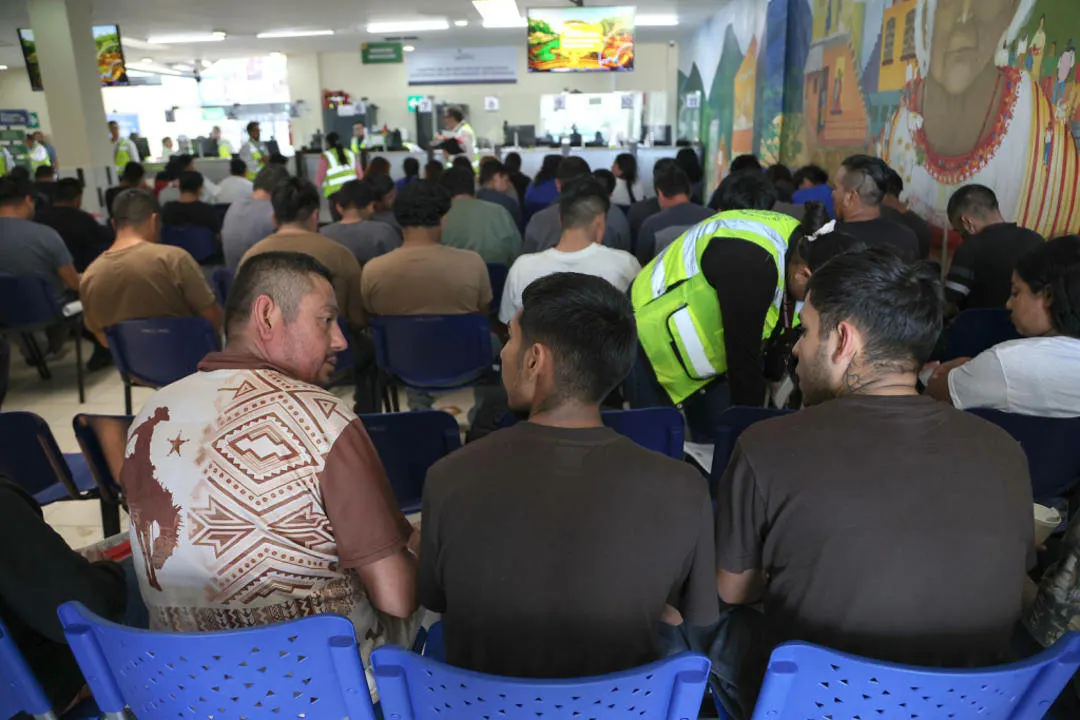
On September 8, 2026 local time, in Guatemala City, Guatemala, Mexican citizens who were repatriated from the United States were waiting at the return immigration reception center. According to data from the Guatemalan Immigration Service, the country has received 2,848 Mexican citizens repatriated from the United States this year, including 72 on September 8. Visual China Map
Just last month, Xinhua News Agency quoted U.S. media reports that over the past few months, the U.S. government had secretly deported large numbers of Mexican immigrants to Guatemala and Honduras, and then sent the immigrants back to Mexico through the two countries. Mexico’s Ministry of Foreign Affairs opposed this move by the United States.
The latest investigative report lists a number of human rights concerns: some receiving countries are listed by the U.S. State Department’s own human rights report as having problems with torture, arbitrary detention, or abuse of power by security forces; deportees and their lawyers allege that some are beaten, deprived of food, and have limited contact with lawyers and family members.
On the 18th local time, the First Circuit Court of Appeals for the Federal Circuit in Boston ruled that the Trump administration’s practice of deporting people to third countries was illegal and that if sufficient time was not given to challenge the decision, the due process rights of the deportees may have been violated. Human rights lawyers argued that the ruling should immediately halt all repatriation flights to third countries. James Percival, general counsel for the U.S. Department of Homeland Security, responded that the ruling “is not yet effective” and that the policy will continue to advance and the Trump administration is expected to seek review from the Supreme Court.
US$410 million was used to “buy a road” and 25,000 people were sent to a third country
Under U.S. law, it is illegal to return immigrants to their countries of origin where they may face persecution. To avoid the associated legal risks, the Trump administration has instead deported immigrants and asylum seekers to third countries.
To fully expose this policy that operates largely behind the scenes, the Guardian and 23 other media organizations launched the Deportation Project, a joint investigation coordinated by the Paris-based Forbidden Stories organization. The coalition interviewed more than 100 people affected by or involved in the U.S. crackdown on illegal immigration and reviewed documents outlining the details of agreements U.S. officials have reached with governments around the world.
The investigation tracked more than 100 flights carrying migrants and asylum seekers to 28 different countries. Because the alliance’s data set only includes flights it can independently verify, the actual number is likely much higher.
The Guardian reported on the 21st that the Trump administration has so far reached agreements with 35 countries to send immigrants and asylum seekers to countries that are not their countries of origin and often have no connection with them. In many cases, the receiving country then returns these individuals to the country from which they fled.
“This policy is a means by which the Trump administration attempts to dismantle the concept of asylum and refugee protection.” Immigration lawyer Alma David, who has long paid attention to the policy, pointed out that the Trump administration knew that it could not legally return some immigrants to their countries of origin, so it chose to take a roundabout way and send them to third countries that the White House regarded as “transit hubs.”
Internal U.S. government records show that as of the end of June, the Trump administration had approved or committed to invest at least US$410 million to promote relevant agreements with 31 African and Latin American countries.
According to statistics from the International Refugee Organization and Human Rights First, about 20,000 people were sent by bus to Mexico by the U.S. government, and at least 5,000 others were put on planes to countries in Latin America, Africa, Central Asia, and the Caribbean that had no connection with them.
The report pointed out that the security situation in repatriation destinations is sometimes poor, and there is also a lack of language, job opportunities and social networks that the parties are familiar with. One case uncovered by the investigation is that the Iranian woman “Nika” had previously been granted a “withhold of deportation” by a judge and was released on May 28. However, she was re-detained by the U.S. Immigration and Customs Enforcement (ICE) on June 8. She boarded a plane in shackles on June 11 and was sent to Bangui, the capital of the Central African Republic. She was not clearly informed of her destination in advance, arrived without a passport or legal identity document, contracted malaria, and had severe restrictions on her life and movement.
In addition, the United States reportedly made a $7.5 million deal with Equatorial Guinea to arrange to receive up to 250 people. More than 50 third-country nationals have been sent to the country, and lawyers said some were being held in a defunct hotel in Malabo and subjected to harsh treatment. The country’s government denies the abuse allegations.
Countries that agree to accept repatriates can receive varying amounts of financial assistance from the Trump administration. Internal documents show that related financial commitments include direct payments of $81 million to 13 countries.
The funds involved in this plan are not large compared with the overall budget of the U.S. government. But for some countries that have received less U.S. assistance in the past, the money could mean a significant increase in U.S. funding. According to people familiar with the matter, the relevant agreement was signed in the form of a contract, thus bypassing many legal requirements that U.S. foreign aid usually needs to comply with, including human rights protection clauses.
The Trump administration has also committed a total of $179 million to the International Organization for Migration and $124 million to the United Nations Refugee Agency for projects related to refugee resettlement and infrastructure in third countries. The funds largely replace past voluntary contributions from the U.S. government to global aid agencies and are used as a “sweetener” to get foreign governments to accept repatriated people, according to people familiar with the matter. Both the International Organization for Migration and the United Nations High Commissioner for Refugees have publicly denied that they are parties to the bilateral agreement.
The acceptance conditions proposed by various governments are different. For example, Uganda only accepts citizens of African countries, while the Democratic Republic of Congo refuses to accept any Africans. Several countries, including the Central African Republic and Swaziland, have agreed to accept people with violent criminal records, while countries such as Ghana and Sierra Leone only accept non-violent offenders.
The Trump administration claims the deportation campaign is focused on removing “criminal elements” from the United States. However, many of the deportees interviewed by the Guardian had no criminal records. Reports indicate that the deportees include people who have lived in the United States for most of their lives, parents who were detained on their way to take their children to school, or adult children who need to care for elderly relatives.
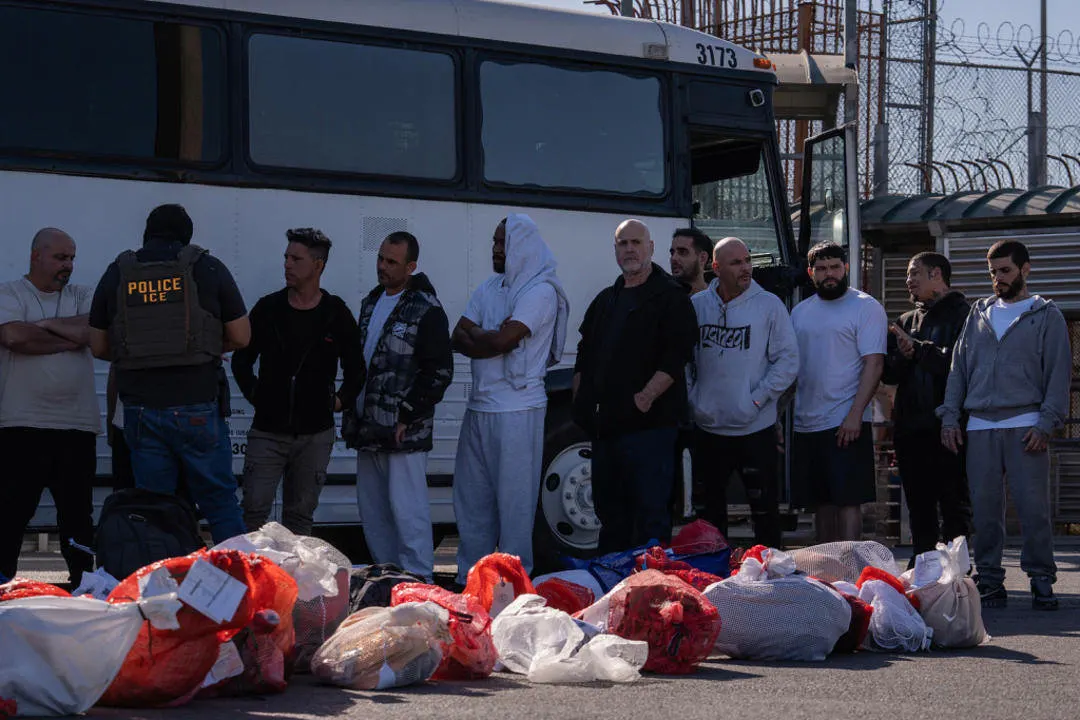
On March 13, 2026, local time, in McAllen, Texas, the United States, a group of undocumented immigrants were processed by U.S. Immigration and Customs Enforcement officers next to the McAllen-Hidalgo-Reynosa International Bridge and would then be deported. Dozens of migrants from countries including Cuba, Venezuela, Haiti, Guatemala and El Salvador were handed over to Mexican authorities. Visual China Map
Who is behind the immigration “outsourcing” operation?
Although the U.S. Department of Homeland Security has been the main executive department of the Trump administration’s large-scale deportation policy, the State Department also plays a low-key “core role” in this process.
Within the State Department, the person leading negotiations on the third-country repatriation agreement is Deputy Secretary of State Chris Landau. Landau served as an associate to conservative Supreme Court Justice Antonin Scalia and served as the U.S. ambassador to Mexico from 2019 to 2021.
The newly established “Office of Remigration” (Office of Remigration) is responsible for carrying out specific work. The 15-person agency is part of the State Department’s Bureau of Population, Refugee and Immigration Affairs and is led by Deputy Assistant Secretary Christian Earhart.
To the outside world, Earhart was not a typical career diplomat. For the past 20 years, he has been working in the Security Department of the State Council, mainly responsible for the protection of embassies and consulates. In 2025, Earhart was transferred back to Washington and appointed head of the “Office of Re-Immigration.”
An investigative report published by the “Washington Post” analyzed that the establishment of the “Office of Re-Immigration” marks a major shift in U.S. foreign policy: a system that has long been committed to resettling refugees has now shifted its focus to the large-scale deportation of immigrants in the United States.
At the same time, the name of the agency has also caused controversy. Some Trump administration officials have expressed concern, noting that the term “re-immigration” has deep roots in white supremacist and far-right movements in Europe and North America.
Behind the scenes, White House Deputy Chief of Staff Stephen Miller and Assistant Secretary of State for Population, Refugee, and Immigration Affairs Andrew Weprek are key figures in promoting the third-country repatriation program.
Multiple current and former officials said Miller is known for his strong anti-immigration stance. He prioritized mass deportations of immigrants over other foreign policy goals by pushing for key appointments at the State Department.
In contrast, Veprek’s role in this policy is less well known. He worked closely with Miller on the White House Domestic Policy Council during Trump’s first term. During his time in the White House, Verpreek developed a reputation as a master of using bureaucratic procedures rather than heated political debates to help Miller implement his immigration policy ideas. A former colleague of the two said that although Weprek was 10 years older than Miller, he was “more like Miller’s protégé.”
Many staff in the State Department’s Bureau of Population, Refugee, and Migration (PRM) believe that even though Veprek does not officially lead the Bureau, he controls its operations behind the scenes. Multiple former officials recalled that Deputy Assistant Secretary of State Spencer Chretien, who co-led the Office of Re-Immigration, would go to his seventh-floor office at the State Department every day to confer with Verprek and receive verbal instructions.
Chrétien has no diplomatic experience and worked in the White House Office of Presidential Personnel during Trump’s first term. Since then, he has participated in the “2025 Plan”, a conservative initiative closely related to the Trump camp. Long before Trump was re-elected, the plan laid out a policy platform for his potential second term, which included limiting the number of refugee admissions and shifting the focus of the Office of Population, Refugees and Immigration to curbing the so-called “immigration crisis.”
The U.S. State Department said in a statement that relevant media reports “misrepresented the work of Veprek, Earhart, and Chrétien” and called the three “conscientious public servants who worked tirelessly to promote the prosperity and security of the American people.”
The third-country repatriation agreement sets a dangerous precedent and marks a complete abdication of the United States’ responsibilities to refugees and the commitments it made after the end of World War II.
When the refugee resettlement system becomes a “re-immigration” machine
The U.S. State Department officially assumes responsibility for refugee management, which can be traced back to the Refugee Act of 1980 passed nearly half a century ago, which is regarded as the foundation of the modern refugee resettlement system in the United States. At the time, the United States was grappling with the massive influx of Southeast Asian refugees following the end of the Vietnam War. This law not only provides an institutional basis for the resettlement of these refugees, but also promotes the integration of the U.S. refugee system with relevant international conventions.
Trump has fundamentally reshaped America’s commitment to the system. Days after the new administration took office, the State Department imposed a blanket freeze on foreign aid and began reviewing thousands of humanitarian grants to determine whether they violated an executive order signed by Trump banning federal programs based on diversity, equity, and inclusion (DEI) concepts.
At the same time, the Department of Government Effectiveness, led by tech giant Elon Musk, cut 92% of spending projects under the US Agency for International Development, and the agency was subsequently shut down completely.
Months later, the Trump administration notified Congress that it was embarking on a massive reorganization of the State Department and submitted a 136-page memorandum to lawmakers that included plans to establish an “Office of Re-Immigration.”
This means that some American career diplomats who have long been engaged in humanitarian work are now being asked to help the government use carrot and stick to persuade other countries to accept immigrants repatriated by the United States. As for how these immigrants will be treated after leaving the United States, relevant policy arrangements have hardly given sufficient consideration.
Within the Office of Re-Immigration, reports of mistreatment of deportees have caused significant mental stress among staff. Some sought transfers to other departments, while others chose to leave the State Department entirely. The positions they leave behind are gradually being filled by new employees who are more supportive of the government’s repatriation policy, according to people familiar with the matter.
One staff member who has since left said that some of his former colleagues struggled to stay positive about their jobs. They would comfort each other on encrypted communication platforms, sharing links to news about the situation of deportees in third countries, along with warnings that reading the content would “make you feel bad.”
The staff member told the media: “Everyone feels very conflicted. Morale is low, the work is heavy, and everyone is unwilling to do what they are doing. This is a very painful thing.”
Another official who left the State Department over his opposition to the third-country repatriation program said the Trump administration wanted “money that comes quickly and with no strings attached.” “Their fundamental purpose is to avoid reporting to Congress,” the former official said, “because these funds are being sent to governments that are known for corruption.”
Meredith Yoon, director of litigation at Asian Americans Advancing Justice, said in an interview that the Trump administration’s treatment of immigrants is undermining the global refugee protection system.
Related Reading
- The first in the country! How to learn “unpopular secret skills”? Who will teach? Dean’s interpretation2026-11-12
- The price of refined oil may drop for the sixth time this year. Filling up a tank will cost about 15 yuan less2026-11-12
- “Token hoarding” became a hot word in the “Double 11” circle, and after Li Jiaqi, Luo Yonghao also came to sell2026-11-12
- Does the United States really not want to fight Iran anymore?2026-11-11
- Fireballs are scattered around Shijiazhuang. How much is the value of “visitors from outside”?2026-11-11