Original first release | Golden Horn Finance (ID: F-Jinjiao)
Author | Mai Maiying
Blueglass, the “Hermès of yogurt”, is experiencing a wave of store closures.
At the end of October, Blueglass in Nanning Vientiane City posted a closure notice, announcing that it would officially close the store on October 31 due to the expiration of the contract. Previously, Blueglass stores in shopping malls such as Taikoo Li Qiantan and Longfor Baoshan Tianjie in Shanghai have also been withdrawn one after another.
Extend the time and the situation becomes even less optimistic.
According to data from Narrow Door Restaurant, from November 2025 to October 2026, the number of Blueglass stores in operation nationwide dropped from 214 to 148, a net decrease of 66 stores in less than a year, a decrease of more than 30%.
At first glance, this might seem like no surprise.
After all, a cup of yogurt dares to sell for 49 yuan, and Starbucks dare not set this price rashly; the ingredient list looks like a chemistry experiment report, with more than a dozen nutrients, probiotics, and dietary fiber added to it.
What’s even more embarrassing is that some people had diarrhea after drinking it and were even sent to the doctor. Netizens laughed at it and called it “diarrhea yogurt” and “Blueglass’s flower language is that it’s afraid you don’t have enough paper.”
But looking at it from another perspective, Blueglass’s failure is somewhat surprising.
What Blueglass really sells is the healthy, self-disciplined and refined lifestyle that is highly sought after by the middle class. From imported fruits and superfoods to the exquisite lighting, tables, chairs and flower arrangements in the store, Blueglass has almost everything the middle class likes.
In recent years, from coconut water to kale, from yoga to outdoor wear, there are many brands that have built businesses based on similar logic.
Why did Blueglass fail to continue this style of play?
“Drink Starbucks, wear lululemon, consume Blueglass”
“A cup of periodic table ingredients that outlasts my life.”
Many people first learned about Blueglass through the ingredient list that was turned into memes.
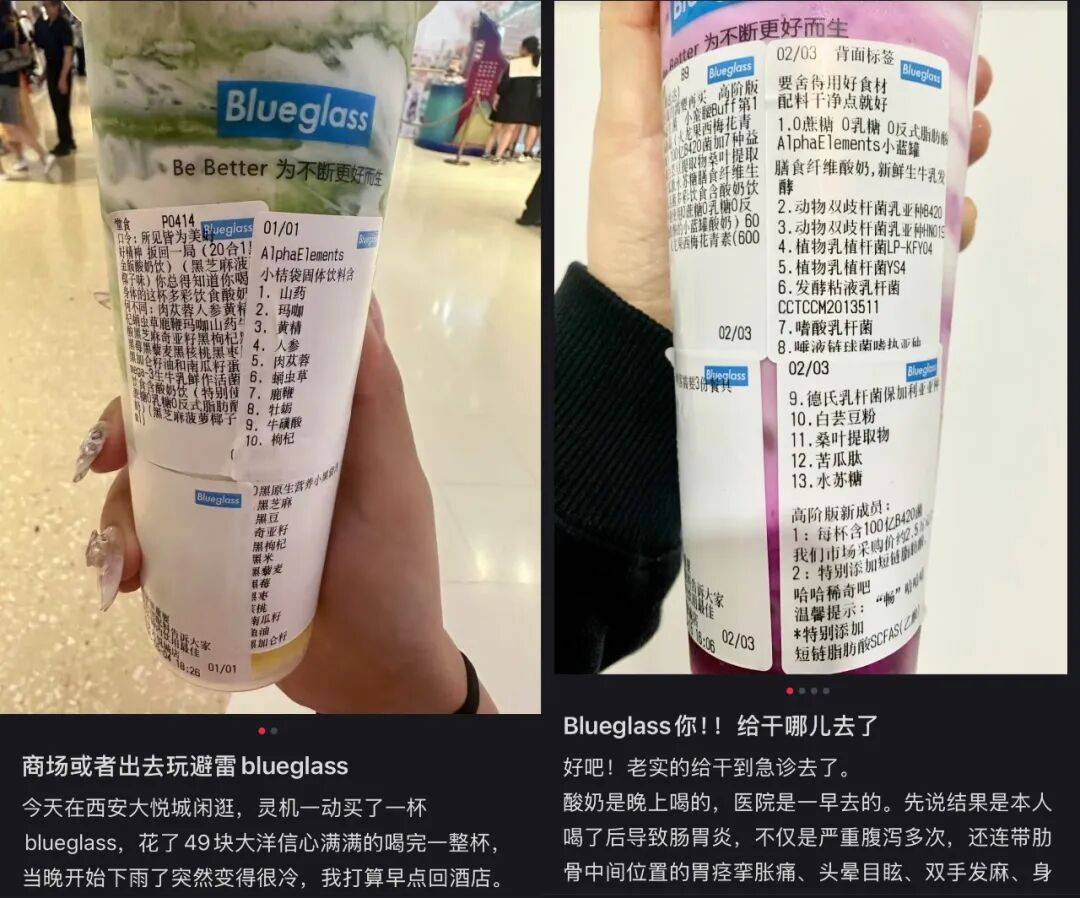
In the photo posted by a netizen, there are four pieces of paper attached to a cup of yogurt, densely filled with vitamin A, B vitamins, calcium, iron, zinc, magnesium, and various nutrients that ordinary people find difficult to pronounce. At first glance, those who didn’t know better thought that the hospital’s infusion slip was attached to the yogurt cup.
But all joking aside, the seemingly exaggerated ingredient list is the key to Blueglass’s brand recognition.
French Rosellot collagen peptides, acai berries, Huaxi Biotech’s hyaluronic acid… have all appeared in its products. Expensive ingredients are superimposed with nutritional ingredients, and paired with product names such as “short-chain fatty acid yogurt” and “16+8 nutritional meal replacement yogurt” that are all professional terms. This cup of yogurt has been given more expectations for body management, nutritional supplements and more.
“Although I don’t know if it can save my life, it sounds very powerful.”
Blueglass understands this psychology very well. For many urban migrant workers, staying up late, sitting for long periods of time, and eating too much takeout may cause some health anxiety. It’s not easy to completely adjust your daily routine, but adding some extra nutrition will always make you feel like you’ve done something for your health.
There are bottles of health care products on the office desk, and spending 49 yuan to buy a cup of yogurt with various nutritional ingredients has a somewhat similar mentality behind it.
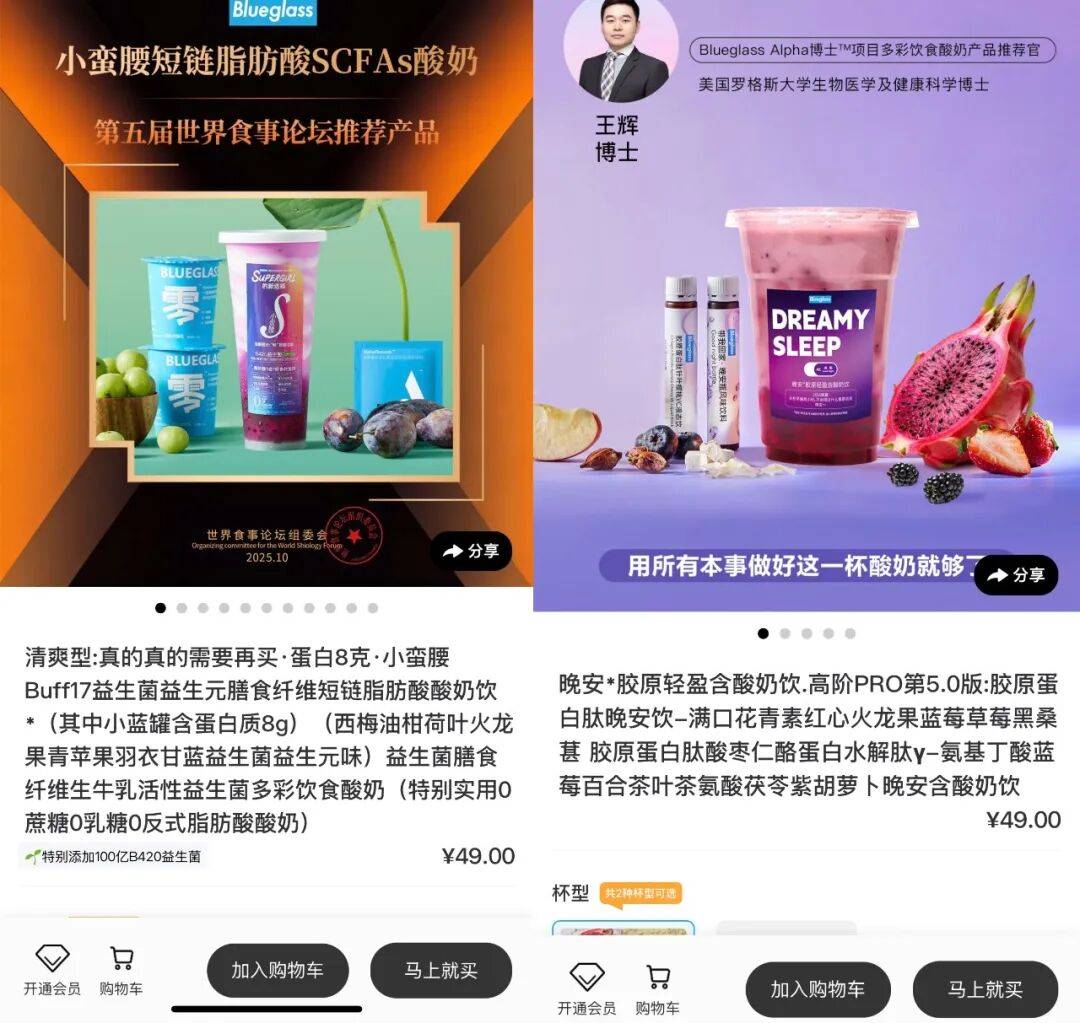
| Blueglass applet
Over time, although some consumers reported that the concentration of active probiotics, dietary fiber and other ingredients in yogurt was too high, causing diarrhea after drinking it. Many doctors also publicly warned that frequent diarrhea may lead to the risk of disease, but everyone’s curiosity has not been dispelled, and “detoxification memes” have been derived.
Blueglass will also actively pursue popular ingredients.
In 2021, an employee of the Blueglass brand department revealed in an interview that the company will pay attention to popular ingredients and creative drinking methods on Instagram and Xiaohongshu, and maintain the frequency of monthly product updates. For example, after avocado became popular on social platforms, the R&D team added it to yogurt.
Blueglass is also very particular about the price of ingredients. “The grape series products use Sunshine Rose. This variety sells for 500 yuan per bunch at SKP.” said the above-mentioned employee.
However, the pile of ingredients alone may not be enough to convince consumers to pay 49 yuan in the long term.
What’s even better about Blueglass is that it sells yogurt into another consumption scenario.
When Blueglass first became popular, industry insiders pointed out that consumers were usually unwilling to spend more than 10 yuan on breakfast yogurt, but were willing to spend more than 20 yuan on a cup of afternoon tea. In short, the scene reference of this cup of yogurt determines everyone’s expected value to it.
Blueglass clearly understands this. Its predecessor, “Aqiulaga Tibetan Yoghurt”, was established in Beijing in 2012 and was renamed Blueglass in 2018. Since then, the brand has gradually opened stores in high-end business districts in cities such as Beijing and Shanghai.
There has been a saying on social media over the years: “Wherever lululemon and Starbucks are open, Blueglass will be opened.” This is not entirely the imagination of netizens. Blueglass once revealed to the media that it will indeed consider whether there is a Starbucks nearby when selecting a location, and has also opened a cooperative themed store with lululemon.
Blueglass’s user operation strategy is also partially similar to lululemon.
According to the Blueglass applet, the brand has ordinary membership gift packages of up to 199 yuan/45 days, and SVIP membership gift packages of up to 2,400 yuan/365 days. SVIP members cover private high-end medical and health support and other services, and will also be invited to participate in a variety of offline activities. According to data disclosed in 2021, Blueglass already had 500,000 members at that time.
What consumers buy with their money, in addition to the yogurt itself, is also a ticket into a certain life circle.
This method of play was once very popular with capital.
In August 2021, Blueglass announced the completion of Series B financing of more than 200 million yuan, jointly led by Eight Roads Capital and Youshan Capital, setting a financing record in the field of freshly made yogurt. At that time, Blueglass only had more than 40 stores across the country, but it had already announced that it would open “more than 1,000 new stores within three years.”
With high-end business districts, imported ingredients, nutrition concepts, membership communities, and capital infusion, Blueglass seems to have found its own expansion path.
Now that the time has arrived in 2026, the reason for the shrinkage of Blueglass must be related to the cliché “consumption downgrade”. After all, lululemon’s performance has been slowing down for a long time.
However, there are still many brands targeting middle-class consumers, and they are surviving well in this trend. Mr. Savage is a typical example. The situation of Blueglass cannot be simply attributed to “the middle class no longer drinks yogurt and eats ice cream instead.”
Apart from the factors of the times, what else happened to Blueglass?
From anti-aging to aphrodisiac
The most obvious signal will already appear in November 2025.
According to media reports at the time, some yogurts from Blueglass priced at 49 yuan were only 19.9 yuan after the discount, which was almost a 40% discount.
In this regard, Blueglass customer service explained that the discount is related to membership cards and third-party platform subsidies, and the brand has not directly lowered product prices.
However, a resigned employee interviewed by Ifeng.com Technology gave another explanation: The price reduction has actually been going on for some time, and it is becoming increasingly difficult to sell at high prices.
Look a year later and the offers are still going on. Taking the Meituan page of Guangzhou Tianhuan Plaza store as an example, a variety of “Xiaomanyao Series” and “16+8 Nutritional Meal Replacement Series” products with original prices of 49 yuan are priced at 36.9-38.9 yuan after coupons. “Xiaomanyao-Jelly Orange Peach Flavored Yogurt” also appears in special group purchases, priced at 32.4 yuan. Even if the discount comes partly from platform subsidies, Blueglass’s price anchor of 49 yuan is clearly unsustainable.
One of the main reasons Blueglass’s brand appeal has waned is that it blew the health-anxiety bubble bigger and bigger, eventually blowing it too far.
In 2021, Beijing Yuehuo Catering Management Co., Ltd., the operating entity of Blueglass, used expressions such as “beautifying and nourishing the skin”, “delaying aging” and “enhancing immunity” when promoting “natural phycocyanin yogurt”. Due to the inability to provide corresponding supporting materials, these promotions were determined by the regulatory authorities to constitute false advertising, and the company was fined 60,000 yuan.
Since then, Blueglass is still keen on adding various functional concepts to yogurt.
The “Chang” series, launched in 2023, focuses on high-content probiotics and dietary fiber. Because some consumers reported diarrhea and other discomforts after drinking it, it triggered a lot of discussions on social platforms.
Jokes such as “new laxative” and “you have to find the toilet after drinking” have even become the traffic password for brands to get out of the circle. But when a cup of yogurt starts to attract attention with diarrhea jokes, consumers’ impression of it will inevitably become subtle.
An even more outrageous controversy occurred in 2024.
In May of that year, Blueglass launched the “Superboy Boyfriend to Win Back” series of yogurt, with suggestive copywriting such as “I dare not sell it to those over 60 years old” and “I will not sell it to those under 18 years old” in the promotion.

| The Blueglass advertisement involved
Some products also add maca, deer penis, polygonatum, ginseng and other raw materials, and netizens ridiculed that yogurt has begun to sell the concept of “aphrodisiac”.
In October of the same year, the Beijing Chaoyang District Market Supervision Bureau determined that the content of the relevant advertisement was vulgar and violated public order and good customs, and fined Beijing Yuehuo Catering 400,000 yuan.
From beauty and beauty, to body management, to the so-called “boyfriend power”, Blueglass is becoming more and more adept at finding consumers’ health needs. But as more and more concepts pile up, consumers will begin to wonder: How many problems can a cup of yogurt solve?
Thousands of discussions surrounding Blueglass ended with a sentence of soul torture: “Just go and eat an apple.”
In addition to the loss of consumers, the cost account behind the high-end image is also weighing on Blueglass.
In 2021, the media “Future Brand” visited the Blueglass Beijing Financial Street store and made an estimate of its operating conditions: This store of about 250 square meters sells about 500 cups per day. Calculated at 40 yuan per cup, the monthly turnover is about 600,000 yuan.
Corresponding to this income is a monthly rent of about 100,000 yuan, labor expenses of about 70,000 yuan, water and electricity bills of about 10,000 yuan, plus raw material costs accounting for about 25% of the turnover. The four fixed expenses total about 54.6% of the turnover. Based on these data, Blueglass’s gross profit margin is estimated to be 45.4%.
Looking at the market for freshly made tea drinks or freshly made yogurt at that time, the gross profit level was actually not high. According to Guosen Securities, around 2021, Heytea’s gross profit margin will be in the 65%-70% range; Moyo Yoghurt disclosed to the media in 2023 that its interest rate is about 60%.
What’s more, judging from Blueglass’s marketing efforts, it will cost a lot more in this regard.
When passenger traffic declines, cost pressure will be further amplified. The continuous promotions and store closings seem to indicate that Blueglass needs to find a new way out.
However, the next stop was a bit unexpected.
When a yogurt merchant starts talking about AI
In September 2025, Blueglass launched “Dr. AI customized yogurt”.
According to the brand’s design, before placing an order, consumers can fill out a health questionnaire, complete relevant information collection, and then select a virtual expert image to get personalized yogurt recommendations.
The actual operation process is quite ritualistic. According to feedback from netizens who have opened AI membership, before placing an order, you need to fill in a questionnaire, follow the prompts to use your mobile phone camera to take pictures of your face, eyes and tongue, and then choose one of the eight avatars of doctors/professors to get customized yogurt recommendations.
| Yogurt can only be customized after passing the iris and tongue test
Buying a cup of yogurt suddenly feels like taking a health assessment.
However, this is just the beginning.
In 2026, Blueglass launched the AI smart ring Alpha Ring. According to the product introduction, the ring can record health data such as heart rate, blood oxygen, and sleep, and can be used in conjunction with the brand’s AI health management service.
Currently, smart rings are also included in membership packages. The Blueglass applet shows that multiple SVIP membership packages ranging from 299 to 2,400 yuan include the ring rights.
| Alpha Ring related promotion page
Blueglass’ ambitions are obviously no longer limited to selling drinks.
In August this year, it officially released the “AI Active Health Strategy” and proposed a rather ambitious goal: to create the world’s largest personal active health world model.
At the same time, the brand launched 7 health AI Agents, covering breathing exercises, breakfast, sleep, emotions, sports and other scenarios. From yogurt to smart rings to AI health assistants, Blueglass is trying to expand its business into a broader field of health management.
According to its vision, smart devices can record some of the user’s health data, and AI will provide diet, exercise and lifestyle suggestions based on this information, and then connect it to yogurt, nutritious food and other health services.
From a business model perspective, this is not entirely illogical. Consumers may only buy a cup of yogurt every few days; if they become health management members, brands have the opportunity to establish a longer-term paying relationship with users. In March this year, Blueglass also announced the completion of US$20 million in overseas financing and proposed to develop into the field of AI precision nutrition and health management.
But the problem is that making yogurt and doing AI health management are two different businesses after all.
The former tests taste, raw materials, stores, supply chain and repurchase; the latter also requires intelligent hardware, data processing, algorithm capabilities, and long-term health service operations.
More importantly, why should consumers trust a yogurt company to understand their bodies better than professional health technology companies? At least for now, Blueglass has not publicly disclosed sufficiently detailed new business revenue and paying user data to prove that this model has worked.
But consumer confusion began to appear first. Now when you open the Blueglass applet, the first thing you see is AI health management services, nutritional recipes, smart hardware introductions, and healthy living posters. The order entry is placed in the side sub-column, juxtaposed with the mini-game entry.
After entering the order page, you still have to face a long description of ingredients and the title of the recommending officer – the content seems to account for more than that of yogurt.
“In the mini program, I feel what is called the uncanny valley of text, where the entire screen is densely packed with professional terminology.” Some netizens complained. Another sentence is more direct: “I was stunned for 5 minutes because I didn’t know which product name was. I only saw the doctor’s name. Can the doctor eat it?”
Even former fans began to lament: “Now it seems that the entire brand is serving AI. Can this really make people believe that yogurt is delicious?”
| “I watched it for 5 minutes, and there were so many technical terms, but I didn’t know which one was the product name.”
Blueglass does not lack the ability to package products. At that time, it could associate a cup of yogurt with imported ingredients, nutritional formulas, and fashion sports, making consumers willing to pay much higher prices than ordinary drinks. Now, it puts AI, smart hardware and health management into the same story.
However, there is no answer yet as to how much real income these new concepts can bring and whether they can retain the original yogurt consumers. And store shrinkage continues.
When it launched its plan to build thousands of stores in three years, Blueglass only had more than 40 stores. Five years later, its number of stores reached 214, but dropped to 148 in less than a year. Dozens of stores are disappearing far faster than new business can prove itself.
Maybe Blueglass does have a chance to become a health technology company, but until then, it has one question to answer:
When a consumer is willing to spend 49 yuan on a cup of yogurt, is it because of the complicated nutritional ingredients, expert titles and health concepts, or because he really thinks the cup of yogurt tastes delicious and is worth the price?
Back then, with its dense ingredient list, Blueglass made many people think that 49 yuan was well spent. Now, it wants to use AI to explain how healthy this cup of yogurt is.
I just don’t know if consumers have the patience to read this increasingly long instruction manual.
References:
Jiemian News “Blueglass completed over 200 million yuan in Series B financing, “Hermès in the yogurt industry” will open 1,000 stores in three years”
Jiemian News “”Hermès in Yogurt World” has closed 30% of its stores”
Ifeng.com Technology “”Hermès in the Yogurt World” Quietly Cuts Prices”
Vista Hydrogen Business “Blueglass’s 50-yuan cup of yogurt looks like an infusion bottle. Are workers trying so hard to prevent sudden death?” 》
Related Reading
- World, line up to sell goods to China!2026-11-12
- Ni Runfeng, the “King of Color TV”, passed away. From a workshop technician to the head of a state-owned enterprise, his ups and downs in half a life defined an era of home appliances.2026-11-12
- Original “Fearless” Wang Jianlin regains control of Wanda Business Management, and his net worth has evaporated by 200 billion in ten years2026-11-12
- Original: The middle-class people are crazy about grabbing Archaeopteryx in Sam2026-11-12
- There is no more double 11 in the world, leaving businesses miserable2026-11-11