In Li Jiaqi’s live broadcast room, big-name beauty products are discounted at most by 30 to 30%, while tour groups are directly cut in half.
“Cosmetics are Li Jiaqi’s basic base, and now travel product discounts are even more severe than cosmetics.” Sun Rui, a senior tourism practitioner, found that the 7-day tour of the Qinghai-Gansu Ring Road has dropped from the regular price of 5,000 yuan to the lowest of 1,980 yuan, and the travel agency is almost losing money.
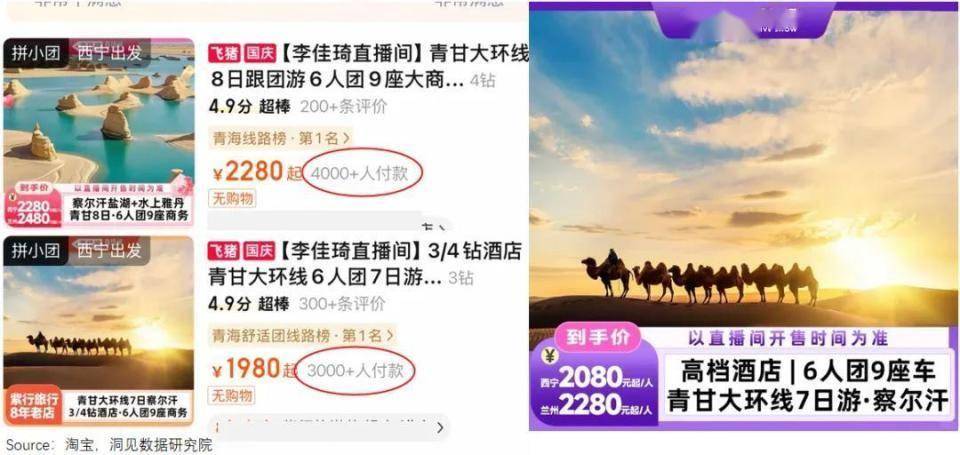
But don’t interpret this scene as “miserable”. Sun Rui changed the subject and said, “The travel agency in the live broadcast room may be the smartest.”
“Price is the brand” of big-name cosmetics. The price reduction for Li Jiaqi is not to sell off, but to “make faces”. When travel agencies link up, they are also interested in the golden sign of “Li Jiaqi Recommendation” – use it to advertise on major platforms and channels, increase the “occupancy rate” of hotels and buses, and slowly make money back.
This approach is just the tip of the iceberg of the accelerated changes in the tourism industry.
As independent travel becomes the norm, social media and even AI rewrite consumption habits, a number of new travel agencies have accelerated their rise, and“Laodeng” travel agencies, which stick to traditional group tours and rely on poor information to make profits, are gradually being ruthlessly shuffled out of business.. In the first half of this year, 2,400 hotels have closed down.
Nowadays, the tourism market is still booming – during the National Day holiday, the topic “The whole world knows that Chinese people have a holiday” has reached the top of the hot search, and tickets for top domestic scenic spots are also hard to find. According to data from the Ministry of Transportation, more than 300 million people traveled every day during the holidays.
只可惜,When time abandons you, you won’t even say goodbye。
1. Young people want to be photographed by “handsome guys”, so hotels issue “local-flavored big-character posters”
Nowadays, young people account for less than 10% of traditional tour groups.
When Sun Rui first entered the industry more than ten years ago, half of the group were tourists under the age of 35. At that time, the “tourism craze” was heating up, and travel agencies that controlled transportation, hotels, ground transportation and other resources were praised as pigs in the spotlight. “The store is open in a shopping mall, and people who sign up take their money and line up from the information desk to the door.”
The first turning point occurred around 2018. “Platforms such as Ctrip, Qunar, and Tuniu came out.” Sun Rui recalled that the prices of air tickets, hotels, and tickets were all standardized and made public, and the information gap was eliminated. Young people began to abandon travel agencies and embrace independent travel.
Another turning point happens now. To use the words of cultural tourism founder An Pang:“As the main tourist group, the younger generation no longer wants routes, but experiences and services.”
A restaurant he runs is located in the Gobi desert 20 kilometers away from the city. It takes an hour to get back and forth. The key staff in the restaurant are not chefs, but photographers. The location and decoration have become the biggest purpose before “delicious food”.
According to traditional concepts, it is impossible for this place to be included in the tourist itinerary, but the reality is that many young people who do not want to queue up to ride camels flock to this “Dragon Gate Inn” to check in.
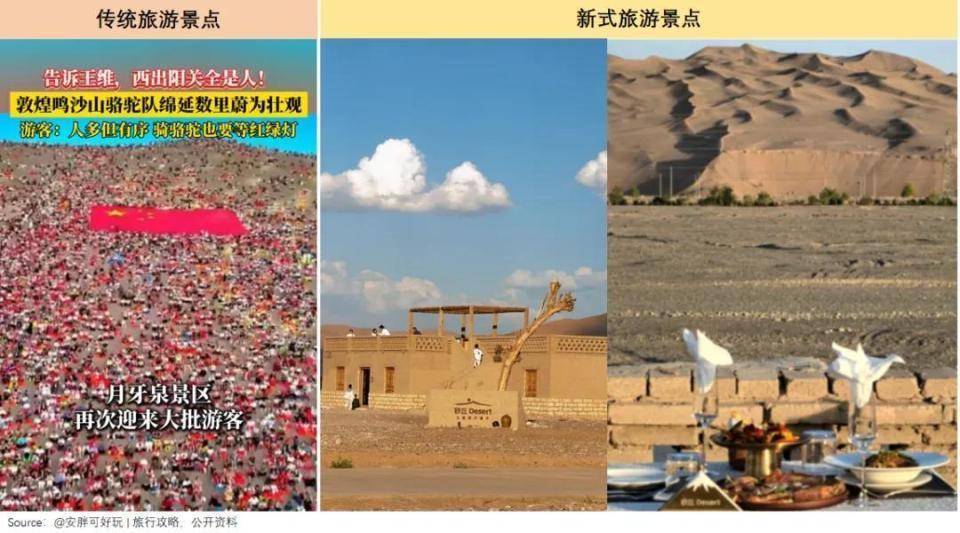
The logic of tourism has changed. In the past, just saying “Come here” could make tourists walk away, and the fuller the itinerary, the more worth the price; nowYoung people regard travel as a way to “maintain themselves”, they don’t go to crowded scenic spots, or rush to “collect stamps” to check in, they just want to lie down in the hotel or find a cafe to relax.
After completing a questionnaire survey among white-collar elites in 100 cities, Tan Balang decided to name the route “Wild Xinjiang”: the more money everyone earns, the more pressure and responsibility they have to bear, and they are all eager to escape from the heavy work and go “wild”.
“Trafficking in ‘escape’ and ‘cure’ became the hotel’s survival codes.” He said bluntly.The old way of “packaging itineraries” is gradually not working, and a large number of orders come from customized tours and theme tours., tourists want to “immerse themselves in a place”.
Service requirements have also shifted. Take local tour guides as an example. In the past, tour guides were valued for their familiarity with routes, professional explanations, and ability to lead tours. Nowadays, the popular “handsome tour guides” are valued for their good looks, ability to take photos, and ability to provide emotional feedback.
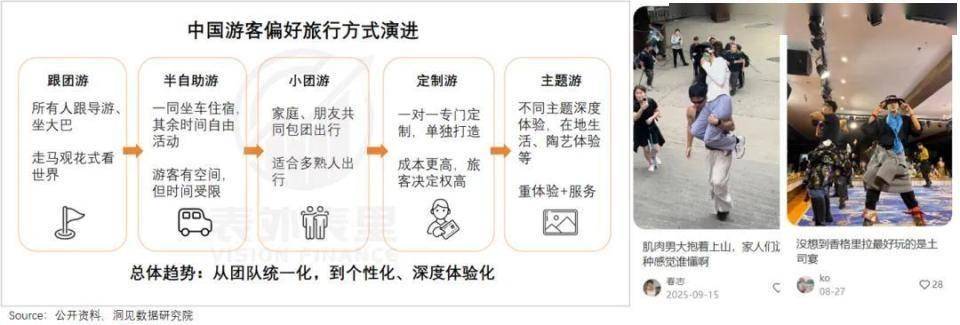
This seems simple, but in fact the threshold has been raised:It needs to be niche, it needs to be unique, and it needs to be a moment that “poke the center”.
In order to satisfy customers, Xiao Tan Balang will make a “background” for each person – whether it is an i person or an e person, whether you want drone photography or snapshots, whether you like natural scenery or folk customs… After understanding clearly, we will arrange a suitable team leader to do the delivery. In the information sent to guests, it is also necessary to specify the tour leader’s resume, camera model, and even the hotel floor and WiFi password in advance.
“Wild Xinjiang” has been running for nearly 800 times, and its popularity remains unabated. It is he who truly builds products around “user experience”. Hongdou, who has been in the industry for more than ten years, also feels the same way: “In the past, this industry was only divided into simple positions such as tour guides and planners. Now, veteran ground handlers, travel photography customizers, in-service butlers, in-depth experience guides, campground housekeepers, etc. are emerging one after another, and the division of labor is becoming more and more refined.”
The industry is rushing forward, but many traditional hotels have almost stood still.
“I gave my boss suggestions to use refined posters, cut-out videos with BGM to attract young people, but in the end, the big-character posters that were sent out were still earthy.” Hongdou said helplessly,Most of the traditional hotel owners are “old” and they will reach retirement age after a few more years. There is insufficient motivation for change.。
Those who want to transform don’t know where to turn. Travel agency Ji Tiao Sisi attended a morning meeting. The boss in his fifties kept banging on the table and talking about PUA: “We didn’t close the deal. Did you guys not work hard enough?” “That project last time was obviously profitable…”
She was already used to sitting opposite her, nodding her head like a chicken pecking at rice, but she knew in her heart that it was impossible for the company to restart growth. In the past two years, the boss has followed the trend and created tours for seniors, wellness tours, parent-child tours and study tours, all of which are popular sectors at the moment. However, if you look at it separately, it’s just that the bus tour group has changed its name.
She said frankly that a true “wellness tour” should be designed around hot springs, slow travel and other needs. Food taboos should also be taken into consideration, and accommodation should be barrier-free. It is a systematic project rather than a patchwork of itineraries. There are only a handful of professional benchmark cases in the industry, and each of them is still in the exploratory stage. However, low-price shopping tours under the banner of “wellness tourism” have become popular and continue to consume the remaining trust of tourists.
As a result, the hotel’s income has continued to decline. In order to survive, the hotel operators either “cheat a little more” on the price difference, or “a little more rudimentary” on the service, and eventually fall into a vicious circle.
The bad bear who started his business in 2016 chose to do real high-end customization because he couldn’t stand the fact that the so-called “high-end tours” on the market were still promoting shopping, self-payment, poor accommodation, and poor experience. In the first year, the turnover reached 30 million.
But as time went by, he discovered that the successive closures of hotels could not entirely be blamed on unscrupulous practitioners.
2. The most profitable “information gap” for travel agencies was censored by the platform
“If you say a word to a client, you will have to spend hundreds of dollars in opening fees.”, this is the current concern of tourism practitioners.
If you want netizens to search for you in the search bar of popular keywords such as “Western Sichuan Tourism” and “Xinjiang Tourism”, each click will start at 6 yuan. The cost doubles in peak season, and the cost of 500 yuan can be burned in 3-6 hours. And the quality of incoming leads varies, so the cost of getting a sales lead can easily exceed one or two hundred.
There is still a huge gap between depositing capital and closing the deal. “Chinese people don’t like to pay for services, and prostitution is the mainstream.” Bad Bear said helplessly, especially with the popularization of AI, they have begun to become “tool people to test whether the AI itinerary is reliable.” Consumers will disappear after achieving their goals, but hotel manpower cannot be reduced, but must be more professional and meticulous.
To make matters worse, traffic platforms are updated every three to five years. Once the bonus period is over, advertising fees will skyrocket. Data shows that the customer acquisition cost of Xiaohongshu and Douyin in the tourism industry has increased by as much as 289% in two years. “The gross profit of a single line is less than 400 yuan, and it is difficult to withstand the cost of investment in search keywords during peak seasons.”
Author’s statement: This image was generated by AI
Bad Bear targets the high-end customization crowd who pursue quality services and can absorb expensive operating expenses. It even attracts a lot of natural traffic because of its rave reviews. But there are still pain points that cannot be escaped:Some customers will deliberately leave bad reviews for money, and will “expose you” on the platform without paying them.。
“The number of views on a positive post may only be a few dozen, but the exposure of scolding you can exceed 10,000 in an instant.” Bad Bear said frankly that it is not easier for merchants to protect their rights than for consumers, and they often have to suffer the consequences.
More hotels have not yet reached this stage. Sun Rui estimates, “The success rate of traditional travel agencies doing self-media is no more than 10%.”
“When the entire process is completed and the tourist season is over, very few hotels will issue official accounts because they will not be operational.”
Creating a personal IP can bypass the cumbersome compliance process, but nowadays, becoming an Internet celebrity requires thousands of troops to cross a single-plank bridge. “And once an individual becomes popular, he will go off and work alone. The hotel will ultimately make wedding dresses for others.”
After going full circle, hotels have returned to the “hypermarket” of OTA platforms, but these players are not vegetarians either.
On any OTA platform, travel products are always “lowest price first” whether overtly or covertly.. “This one is 20,000, that one is 17,000, and another one is 15,000. The service is still very different. Customers are definitely willing to choose the cheaper one.” Sun Rui said that merchants can only become more involved, and honest quotations mean losing exposure opportunities.
In addition, the platform also has “routines” such as surcharges, OEM, account terms, etc. They control the traffic entrance and monopolize pricing power, allowing hotels to work for the platform.
According to Hongdou, there are almost only “two ways to survive” in hotels:Either we can be infinitely close to resources such as platforms and act as route agents, scenic spot agents, and hotel agents, and infinitely reduce costs in terms of price; or we can be infinitely close to customer sources and completely embrace C-end consumers.
But no matter which one, it seems destined to be difficult.
I still remember that half a month ago, she arranged a trip to Yunnan for several guests. Three or four days before departure, the local travel agency suddenly called and informed me: “Sister, we can’t make the tour for this day again.”
That was the bad news for the Nth time this year. Tourists from Jiangsu, Zhejiang, Hubei and other major provinces gathered together at a local pick-up agency in Yunnan, but they couldn’t even get the minimum group size of 15 people, so they had to cancel.
According to news reports, tourism revenue and number of visitors are still reaching new highs. Relatives around her asked Hongdou, “Aren’t you busy? It’s very prosperous now.” She couldn’t explain it——Per capita tourism expenditure is still weak, and tourists are traveling in reverse directions by self-driving, staying in tents, eating at roadside stalls, and not leaving travel agencies.
Sun Rui shared a set of more intuitive data: the wholesale revenue of the general agent of travel routes on an OTA platform in Hubei has dropped by 50% compared with previous years, which shows the severe situation faced by hotels.
“Tourism is very environmentally friendly.” Bad Bear said with a smile that tourism practitioners are “the people who most hope for world peace and development.” After the war broke out in the Middle East and it was not suitable for flying, the European market was greatly affected; Japan’s outbound tourism market also went cold due to wrong remarks.
Even the tourism industry is very “lucky”. Extreme weather, disasters, diseases… any uncontrollable factors may crush the hotel’s fragile cash flow. after all,Hotels are in the business of “advance money first and collect money later”. Corporate customers, OTA and other channels often have to wait 30 or 60 days after the trip is completed before settlement.
Ten years ago, when consumers were “buying in”, the risks of hotels were not yet prominent. Now that the information gap advantage has been wiped out, reputation has collapsed again, and cash flow pressure has been fully increased. Well-known players such as Yingke Tourism collapsed in this way.
However, Bad Bear is still optimistic about the industry:“The need for pleasure and relaxation is not going away, it’s just about who can satisfy it better.”There is no industry that is not easy to get involved in, and there is no industry that is easy to do. All he can do is practice diamond drills well and keep this bowl of rice steady.
And An Pang is planning a longer-term thing – to let more people enter the industry to really do tourism well. “There are many people who want to travel, but few can do it well.” He believes,Only by making the people who come in more and more professional will the entire industry get better and better.
Related Reading
- Everyone is waiting for Luo Yonghao to overturn2026-10-08
- Colleges are slashing tuition prices as students balk at soaring costs2026-10-08
- Baby formula is in trouble, dairy companies are eyeing cats and dogs2026-10-08
- “Gold bracelets are out of stock”! The gold market is sold out2026-10-08
- Michael Dell defends Trump Accounts’ shift to individual company stocks2026-10-08