Under the superposition of multiple factors such as new assessment regulations, salary constraints and platform competition, the public offering industry is undergoing a round of talent reallocation.
Text | “Finance” reporter Huang Huiling, intern Feng Zhouyue
Editor|Guo Nan
The eve of the long holiday has always been a time window for public funds to announce important personnel changes. Since mid-September, well-known fund managers have successively announced their resignations, including Han Chuang, the tens-billion equity fund manager of Dacheng Fund, and Shao Jie, a core member of the China-Europe Fund Technology Team.
In recent years, the number of public fund managers leaving has increased year by year. Wind data shows that as of September 29, 350 public fund managers have resigned during the year. Among them, there are 34 retired fund managers with a management scale of more than 10 billion yuan, involving a public offering product scale of 1.4 trillion yuan.
The above-mentioned statistical caliber refers to complete resignation or liquidation of products under management, excluding fund managers who only resigned from some products and continue to stay on the front line of investment research. In fact, in recent years, it is not uncommon to resign in the form of “burden reduction”.
On September 30, well-known fund manager Zhang Kun once again “reduced his burden.” According to the announcement of E Fund, due to work needs, Zhang Kun resigned from the E Fund High Quality Enterprise Three-Year Holding Period Fund, and the product will be managed by Zhang Qi alone. Previously, many of Zhang Kun’s products have successively hired fund managers to jointly manage them. However, Zhang Kun did not leave E Fund and continued to serve as the fund manager of other products.
From the perspective of where to go, several current paths have been strengthened at the same time: more and more veterans are choosing to take a break or quit, the siphon effect of leading institutions on talents is accelerating, the list of people joining the private equity camp continues to lengthen, and cases of executives resigning, returning to the front line of investment research, and shrinking scale are also constantly appearing.
Behind the shrinkage and migration of fund managers is the re-pricing of talent, a core production factor, as the industry shifts from scale expansion to high-quality development. What drives this repricing are multiple forces coming from different directions. New assessment regulations reshape performance standards, salary constraints adjust the incentive structure, and platform competition affects the flow of talent. The three act on evaluation, incentives, and competition respectively.
At the same time, the rule that “you cannot leave your post until you have managed a fund for one year” has further lengthened this migration cycle in terms of handover procedures. If a fund manager wants to resign smoothly, he needs to wait for each product under his management to be completed for one year. Fund companies also prefer to hire co-managers and team takeovers to smooth the transition.
Which public funds have serious brain drain?
Judging from annual changes, the number of resignations of public fund managers has gradually increased in recent years.
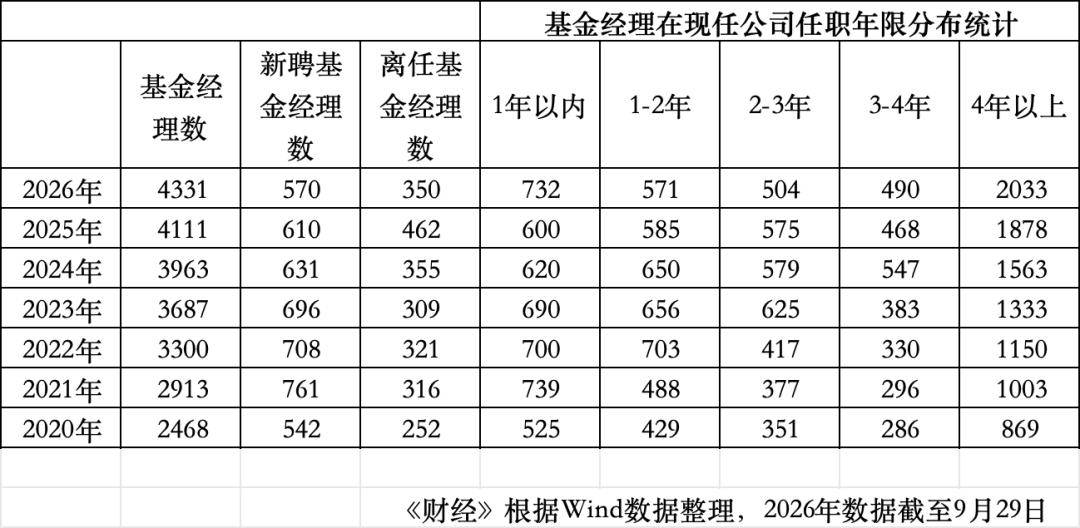
As can be seen from the table above, the number of fund managers resigning in 2025 will reach 462, which is the peak level since 2020. In the first nine months of 2026, the number of fund managers resigning has also reached 350, which is close to the level for the whole of 2024.
In contrast to departures, the number of new hires has not increased simultaneously over the same period. There will be a phased peak of 761 new hires in 2021, and there has been a downward trend year by year since then.
On the other hand, the industry is more mature. The proportion of fund managers who have worked for the same company for more than four years has increased year by year, from 35% in 2020 to 47% in 2026.
Focusing on 2026, what are the new trends in the departure of fund managers? According to statistics from Wind, “Caijing” shows that among the fund managers who will resign within 2026, there are 34 fund managers with a management scale of more than 10 billion yuan, involving an asset scale of 1.46 trillion yuan. Among them, money market and bond products accounted for more than 60% of the turnover.
In the active equity camp, there are six departing fund managers with management scale exceeding 10 billion yuan. Taking the data at the end of 2025 as a reference, the management scale of Wu Yuanyi of GF Fund, Han Chuang of Dacheng Fund, Lei Tao of Debang Fund, Zhong Shuai of China Asset Management, Shi Bo of Southern Fund, and Fu Youxing of GF Fund before their departure were 19.747 billion yuan, 17.403 billion yuan, 16.149 billion yuan, 11.914 billion yuan, 10.691 billion yuan, and 10.276 billion yuan respectively.
In addition to tens of billions of managers, many outstanding fund managers have resigned during the year, including Jiang Qiu of Huaan Fund, Ren Xiangdong of Industrial Securities Global, Bao Wen of Caitong Asset Management, Yu Guang of Invesco Fund, Wang Bin of Huaan Fund, Jin Xiaofei of Penghua Fund, Xiao Ruijin of Boshi Fund, Yu Liping of Bank of Communications Schroders, Huang Ding, Zhou Shanshan, Shao Jie of China Europe Fund, Xia Qin of Caitong Fund, Chen Ping of HSBC Jinxin.
In this round of changes, there has been a significant loss of bank-based public fund managers.
Taking ICBC Credit Suisse as an example, 10 fund managers have resigned or canceled their qualifications during the year, including equity, fixed income, and quantitative lines, involving Yan Yao, deputy general manager of the equity investment department, Li Di, deputy investment director of the equity investment department, He Xiuhong, chief fixed income investment director of the fixed income department, and many other senior fund managers.
The personnel changes at Bank of Communications Schroders are also concentrated. In terms of equity, Yu Liping joined Wells Fargo Fund after resigning in February; Huang Ding resigned from all products in August. “Finance” learned that the next stop is likely to be Wells Fargo Fund; Zhou Shanshan left BoCom Qiming Mixed and BoCom Preferred Return Flexible Allocation Mixed in September. In addition, Liu Bing of the FOF (fund of funds) line and Wang Lijing of the fixed income line also resigned during the year.
It is worth noting that some resigned fund managers also manage institutional entrusted assets such as special accounts, social security, and annuities, and their volume may far exceed their public offering scale. The departure of a core investment manager affects not only the handover of public offerings, but also the reallocation of institutional funds. It requires higher style stability and team continuity, and the handover is more difficult. Take ICBC Credit Suisse Li Di as an example. Before leaving his job, he only managed one public fund with a scale of 300 million yuan. However, he managed the special account for a long time, and the size of the special account reached 26.7 billion yuan before leaving the company.
Caijing has learned that Cheng Kun, senior fund manager of GF Fund, will leave his post in the near future. He has been in the securities industry for more than 20 years and has been a fund manager for nearly 14 years. He manages nearly 20 billion yuan in assets including public offerings and social security portfolios. According to mid-term report data, Cheng Kun manages 7 public offerings with a total scale of 2.417 billion yuan; he also serves as the investment manager of 1 private equity asset management plan with a scale of 898 million yuan; there are also 3 “other portfolios” with a total scale of 16.595 billion yuan; all assets under management total 19.890 billion yuan, with the non-public offering accounting for nearly 90%.
Signals and constraints of leaving office
Actions such as the resignation of fund managers and the hiring of co-management are often the first step.
On September 10, the three products of GF Reverse Strategy Mix, GF Excellent Enterprise Select Mix, and GF Core Select Mix managed by Cheng Kun simultaneously hired Feng Hanjie as co-management manager. Previously, on August 15, GF Value Growth Mixing also hired Wu Chenggen and Cheng Kun to co-manage.
The case of Dacheng Fund Han Chuang is more typical. From September 16th to 17th, Dacheng Industrial Trends, Dacheng Chuangyou Xinxuan, Dacheng New Industry, Dacheng Prosperity Selection Six-month Holding, and Dacheng Juyou Growth will recruit Xu Xionghui, Bai Yang, Qi Weizhong, Du Cong, and Dai Jun as co-management managers. At this point, all seven products managed by Hanchuang have been transferred to the co-management model, and there are no longer independently managed products. On the eve of the Mid-Autumn Festival on September 24, Han Chuang resigned from all the products he was managing due to personal reasons. From the centralized recruitment to the formal resignation, there were only 6 days apart.
Product-intensive recruitment is a signal of personnel changes. More importantly, fund managers still need to comply with relevant rules when leaving.
According to the “Registration Rules for Investment Managers of Securities and Futures Institutions” revised and released by the Asset Management Association in November 2023, when applying for registration, fund managers must promise that “without special circumstances, they will not voluntarily leave their jobs within one year of the public fund product offering period or closed period (excluding publicly raised infrastructure securities investment funds) and manage public fund products.” If the existing public fund products have been managed for less than one year and are still in the raising period or closed period, the change procedures will not be processed.
This constraint changes the pace of turnover. If fund managers want to resign smoothly, they have to wait for one year for each product under their management, which lengthens the personnel handover cycle. Fund companies also tend to smooth the transition by hiring additional co-managers and team takeovers.
Rumors of Han Chuang’s resignation had circulated in the industry as early as July, but the official announcement of his departure was not made until September 24. The reason was the newly implemented rule constraints. Hanchuang will manage Dachengchuang Youxinxuan from August 25, 2025, and it will only be one year on August 25, 2026. Therefore, the change procedures can only be completed after the product has been completed for one year.
Recently, the signs of resignation of Xing Junliang, the main fund manager of ABC-CAI Fund, are also obvious. On September 28, all its funds have hired additional fund managers. However, the ABC Industrial 4.0 under his management took over at the beginning of this year, and his current term is less than one year. This also means that even if Xing Junliang intends to leave, the relevant change procedures will not be completed until the product is one year old.
According to the requirements of the rules, those who have managed public fund products and voluntarily resigned after less than 1 year, and the time of resignation is less than 18 months, are not allowed to register as a fund manager. This means that if a fund manager leaves the company within less than a year of managing the product, an additional year will be added to the regular six-month quiet period. If you voluntarily leave your job during the product fundraising period and closed period, it will take 24 months to register as a fund manager again.
Under the constraints of the above rules, fund managers have to plan their resignations in advance. An industry insider told Caijing: “If you want to leave but don’t leave as early as possible, you may be forced to take over new products due to the resignation of others, and you will have to leave after a year.”
In addition to resignation restrictions, assessment standards and salary restrictions are also being strengthened simultaneously. The China Securities Regulatory Commission’s 2025 “Action Plan for Promoting the High-Quality Development of Public Funds” requires that the weight of mid- and long-term performance assessments be no less than 80%, and scale and short-term rankings should be weakened. The follow-up “Performance Appraisal Management Guidelines for Fund Management Companies” further clarified that if an active equity fund manager underperforms the performance comparison benchmark by more than 10 percentage points and the fund profit is negative, the performance compensation reduction shall not be less than 30%. At the same time, no less than 40% of the performance remuneration must be invested in your own products, with a holding period of no less than one year. The superposition of these rules and resignation constraints lengthens the decision-making cycle of fund managers and increases the cost of short-term games.
Where do public recruitment talents go?
“Finance” learned from the industry that the destinations of the aforementioned fund managers have been clarified one after another. Ren Xiangdong has joined Yuanxin Investment, a tens-billion private equity firm, and the next stop for Jin Xiaofei, Xiao Ruijin, Han Chuang and others may also be private equity funds.
The flow among public offering peers is also active. In recent years, E Fund has significantly increased its efforts to bring in funds from the outside, attracting many fund managers such as Yang Siliang from Baoying Fund, Xiong Xiaoya from Southern Fund, Zheng Ning from Bank of China Fund, Jiang Xiaoli from Tianhong Fund, Pei Xiaohui from China Minsheng Fund, Lu Congfan from China China International Fund, and Wan Zhiwen from Bosera Fund. GF Fund continues to introduce mature players from its peers, including Li Yin from Investment Fund, Wu Chenggen from Zhonggeng Fund, and Zhou Zhishuo from CCBIT Fund.
Wells Fargo Fund is a major siphon investor in the Shanghai area. Xia Qin, Yu Liping, and Huang Ding have joined in succession, and Caitong Asset Management Xu Jingze is also in place. Yongying Fund, which has grown rapidly in recent years, has successively attracted Caitong Asset Management Bao Wen, Wells Fargo Fund Xu Zhixiang, etc. In August, it also introduced Guo Beibei, deputy director of the Index and Quantitative Investment Department of China Universal. China Europe Fund has attracted former HSBC Jinxin Chen Ping, former Huaan Fund Portfolio Investment Department Director Lu Jingchang and others.
Taking into account the many changes during the year, in addition to veterans such as Yu Guang, Cheng Kun, and Fu Youxing who chose to take a break or temporarily leave the front line, more fund managers showed the following three major characteristics in their career choices.
First, industry talents are accelerating to concentrate in leading institutions with more flexible mechanisms.
Wind data shows that as of September 29, E Fund hired 22 new fund managers during the year, China Southern Fund hired 21 new managers, Guangfa Fund and Wells Fargo Fund introduced 19 and 17 respectively, and China Universal hired 15 new managers. Judging from the stock structure, 14 of the current fund managers of E Fund are from Huabao, Huaxia, Wells Fargo, Tianhong, Southern and other institutions, while 24 of the current fund managers of Wells Fargo Fund are from companies such as Bank of China and Bank of Communications Schroders.
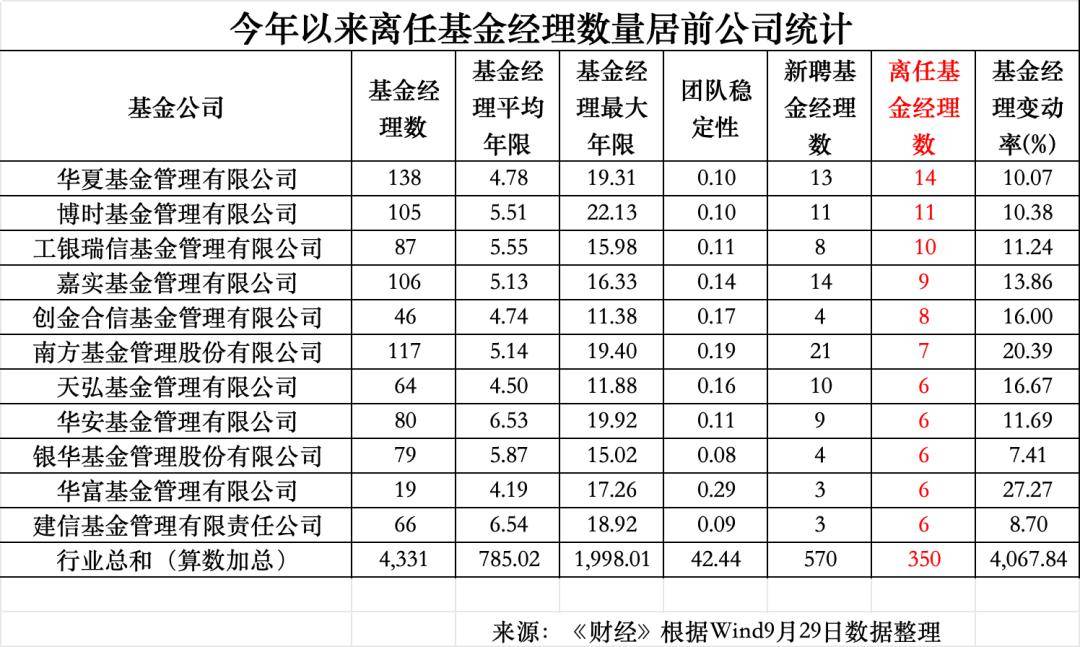
At the same time, some public fundraisers had a large number of resignations: 14 people resigned from China Asset Management, 11 people from Boshi Fund, 10 people from ICBC Credit Suisse, 9 people from Harvest Fund, and 8 people from Chuangjin Hexin.
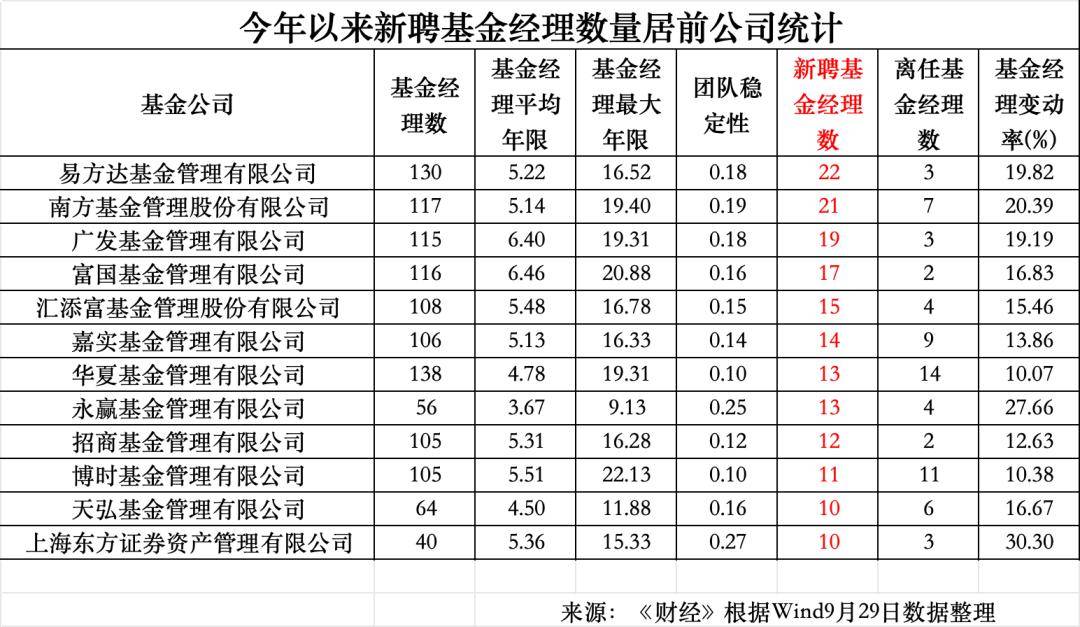
Many industry insiders told Caijing that this differentiation is related to the intensity of implementation of salary constraints under different shareholder backgrounds. Fund companies dominated by state-owned assets are usually subject to stricter management and institutional mechanisms, and fund managers’ compensation restrictions are more obvious; the shareholder structure is market-oriented and the head organization without a single actual controller retains more flexibility in salary incentives.
Second, the trend of “public and private” is still continuing.
During the year, many well-known public fund managers began their private equity careers. These include: Ren Xiangdong of Industrial Securities Global Fund joined Yuanxin Investment, Invesco Great Wall Bao Wu, and Investment Fund Zhai Xiangdong joined Hillhouse’s Lingren Investment, China Europe Fund Cao Mingchang founded Shanghai Puxiao, Yongying Fund Yu Hang, Huashang Fund Liang Hao, and Manulife Fund Wang Peng also completed private equity registration.
The latest information shows that Zhou Haidong, the former equity investment director of Huashang Fund, has also decided on his personal path. The “Shangquan Yue (Zhejiang) Private Equity Fund Management Co., Ltd.” he founded completed the industrial and commercial changes in September, and Zhou Haidong is the legal representative and 100% controlling shareholder.
Third, in parallel with “resigning and running away”, there are also a number of star fund managers who have stepped down from their senior management positions, returned to the front line of investment research, and reduced their management scale.
On September 18, Liu Yanchun, deputy general manager of Invesco Great Wall, resigned as a senior executive due to work adjustments and continued to serve as a fund manager. Its management scale exceeded 100 billion yuan in 2021, and the scale at the end of the second quarter of 2026 was 24.049 billion yuan. Earlier, Xiao Nan, Chen Hao, Zhang Kun, Zhang Qinghua and Hu Jian of E Fund Fund had resigned as vice presidents one after another to focus on investment.
On September 30, according to an announcement from E Fund, due to work needs, Zhang Kun will no longer manage the E Fund High-Quality Enterprise Three-Year Holding Period Fund, and the product will be managed by Zhang Qi alone.
The fund was established in June 2020, with a return of -27% since its establishment, and the latest net value is 0.73 yuan. The scale of this product has dropped from over 10 billion yuan at its peak to about 1.5 billion yuan, making it the smallest fund under Zhang Kun. In June this year, the fund hired Zhang Qi. Currently, Zhang Qi has been managing for 95 days, with a tenure return of -2.25%.
“Investors should focus on the consistency of investment strategies and the continuity of positions after the addition of co-management, and make rational decisions based on the long-term performance of the product and their own allocation needs.” A fund observer said.
However, some people in the industry believe that this wave of migration may not last long. “Those who are going out now are either going to private equity or to those large public equity platforms. Their salary ceilings are higher, they give money and resources, and they are more tolerant, but such opportunities are very few.” This person believes, “According to the 28-year-old rule, only 20% of the fund managers have the right to choose, and most people still have to stay where they are.”
In addition to switching between asset management institutions, some fund managers also choose to leave institutions and invest independently. It is understood that some people have made huge profits in the AI (artificial intelligence) market, but there are also people who have suffered considerable losses after entering the market at a high level.
Editor | Chen Xiang
Related Reading
- Treasury says over 60 million children have been auto-enrolled in Trump Accounts2026-10-02
- Layoffs are down, but employers aren’t rushing to hire for the holidays2026-10-02
- Original milk tea shop “rebellion”? Selling coffee in the morning and beer in the evening, what do you want to do to grab jobs in convenience stores?2026-10-01
- Trump to begin sending $500 ACA refund checks to 1 million Americans2026-10-01
- Original After losing more than 70 billion in 5 years, the “big brother of Huanjing Real Estate” is waiting for the “white knight”2026-10-01