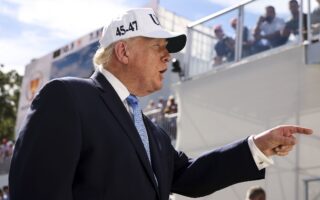
At the invitation of President Trump of the United States of America, Chinese leaders paid a state visit to the United States from September 23 to 25.
The courtesy given by the US was extraordinary from the moment the plane landed – Trump and his wife came to the tarmac to greet him in person, which is extremely rare in the history of modern US diplomacy: the last time a US president personally went to Joint Base Andrews to greet a foreign head of state, it dates back to 1962, when then-President Kennedy greeted British Prime Minister Macmillan on the tarmac.
The welcome scene was full of ceremony. A red carpet about 30 meters long was rolled out, with honor guards on both sides, a military band played the national anthems of the two countries, a 21-gun salute was fired, and two B-1 bombers roared over the base.
“High-standard”, “extremely special”, “grand”… At the same time, major foreign media wrote with emotion.
David Sachs, Asia researcher at the Council on Foreign Relations, described the U.S. arrangements as “unprecedented” and “amazing”: “From meeting with Chinese leaders at Andrews Air Force Base to arranging air shows for them, it is difficult for even U.S. allies to enjoy this kind of treatment.”
The itinerary previously released by the Office of the First Lady of the White House shows that this visit was arranged in a very elaborate manner:
On the 24th, a formal welcome ceremony was held on the South Lawn, State Dining Room and Rose Garden of the White House, attended by 479 military personnel, and a B-2 “Phantom” stealth bomber and four F-22 “Raptor” fighter jets performed a flight performance;
After the ceremony, the two first ladies visited the Smithsonian’s National Museum of Asian Art;
That evening, a formal state dinner was held in the East Room of the White House;
On the 25th, we had tea in the Red Hall and then went to the National Archives together to formally say goodbye at the archives.
In the words of the US media, this state visit was “extremely luxurious even by the standards of the White House.” First lady Melania recently told Fox News: “When the Chinese leader comes to our land, we need to welcome him with the highest courtesy.” Trump himself said that people from all walks of life in the United States want to come to the welcome banquet. “The only regret is that there are not enough seats.”
The Rose Garden and East Room of the White House are all “familiar faces” during state visits. In addition, the United States has also arranged several less “familiar” locations: the Smithsonian National Museum of Asian Art, the Red Room of the White House, and the U.S. National Archives.
“Cultural exchange” at the museum
On the 24th local time, after the welcome ceremony, the two first ladies visited the Smithsonian National Museum of Asian Art.
Public information shows that this is the first art museum under the Smithsonian Institution, with a collection of more than 45,000 works covering thousands of years of Asian cultural heritage. Among them, Chinese art occupies a very important position.
From ancient China to Japan, Korea, India and the Islamic world, this museum is regarded as an important window for American society to understand Asian culture. The Smithsonian also positions it as “an important platform for understanding Asian art, culture and society, especially the connection between Asia and the United States.”
A White House press release read: “The two ladies will appreciate art masterpieces spanning centuries, as well as precious collections of cultural exchanges between China and the United States.”
Tea Selection in the “Living Room” of the President’s Home
On the morning of the 25th, Trump and his wife welcomed the Chinese leader and his wife at the South Portico of the White House, and then moved to the Red Room for tea.
The Red Room, the Blue Room, the Green Room, and the State Banquet Room are also known as the four major reception rooms for state guests in the White House, but compared to the other ones, its temperament is more like a “living room at home.”
The history of the Red Room is almost as old as the White House. According to the White House Historical Association, on the White House floor plan drawn by the architect in 1803, this room was marked as the “Presidential Antechamber” – it is adjacent to the President’s Office and is where visitors wait to be summoned.
During Madison’s presidential term, First Lady Dolley Madison turned it into a salon for Washington celebrities to gather.
It wasn’t until the 1840s that this room truly became “red”: President Polk and his wife rearranged the curtains, furniture and carpets with red fabrics, hence the name of the Red Room, which is still in use today.
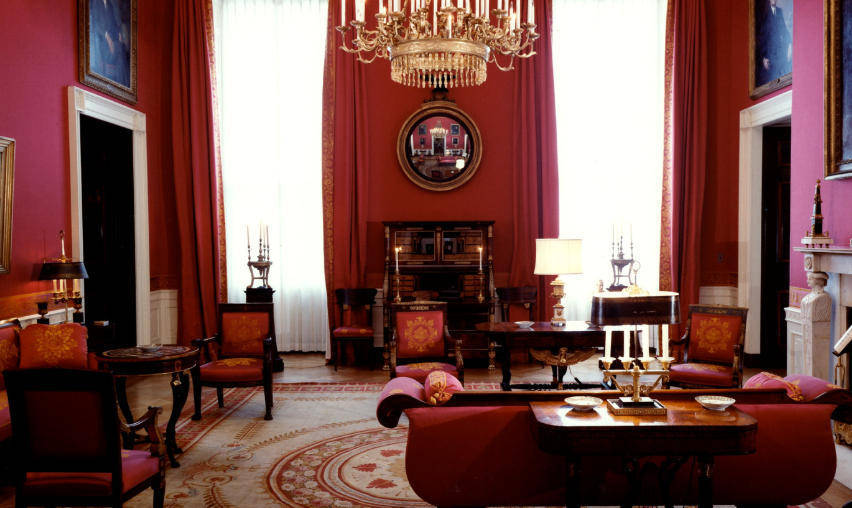
Today, the walls of the Red Hall are covered with gold-painted red silk, and the furniture is covered with silk of the same color. The small room is traditionally used for small receptions and small dinners and has been a favorite place for successive first ladies.
During Trump’s first term, in 2019, Melania used her expertise as an interior designer to renovate the White House. According to US media reports at the time, the wall fabric of the Red Room of the White House was renovated. The red fabric of the wall had faded and turned pink under the sunlight. After the renovation, it returned to an atmospheric red.
This time, the United States arranged the tea ceremony in the Red Room of the White House, which was quite thoughtful.
Compared with the formality of the White House State Dining Room and the ceremonial feel of the Rose Garden, the Red Room is more private and homely.
Look back at history and move on
After tea, the two couples went to the U.S. National Archives.
The National Archives of the United States holds a very important place in the hearts of Americans.
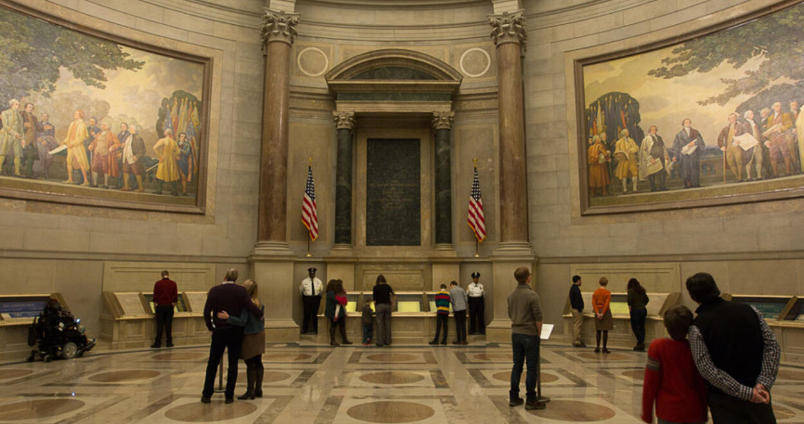
According to the official website, the core space of the building is the rotunda: the dome is about 23 meters high, and the originals of the Declaration of Independence, the U.S. Constitution and the Bill of Rights are permanently displayed in the center. These three parchment documents are collectively called the “Charter of Freedom” and are regarded as the entity of the founding spirit of the United States. In December 1952, then President Truman personally opened the Rotunda.
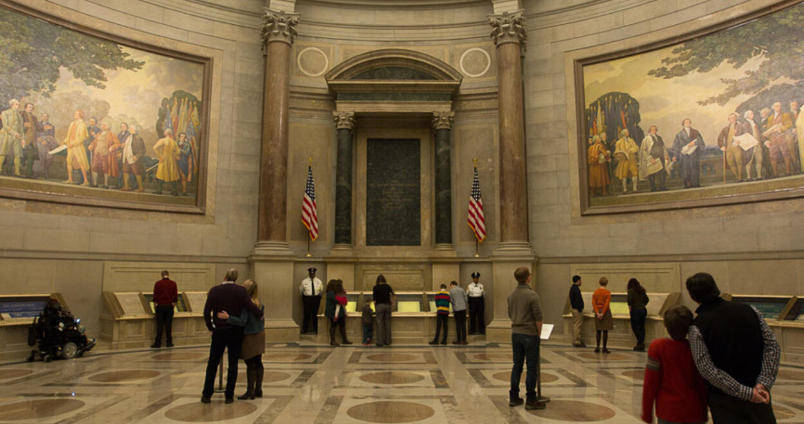
For ordinary tourists, the Rotunda is one of the most popular “check-in” places in Washington – people line up in long lines just to see the original appearance of the three yellowed documents in front of the display cabinets with constant temperature and humidity. The symbolic meaning of choosing this as the last stop of a state visit is self-evident.
At the same time, the White House also emphasized the historical importance of the National Archives to Sino-US relations. The White House stated that there, the two couples “visited various important records and documents that are of great significance to the history of Sino-US relations.”
The National Archives of the United States is also the most important official U.S. historical database for the study of the history of Sino-U.S. relations. The Embassy preserves official documents, original treaties, presidential decision-making documents and other materials between the U.S. State Department and the embassy and consulates in China. From early exchanges, to before and after the establishment of diplomatic relations, to the 21st century, federal records involving Sino-U.S. relations are archived here.
This means that the National Archives of the United States is the basic evidence for understanding the structure and transition of Sino-US interactions in modern times.
“Finally, the president and the first lady bid farewell to the Chinese leaders here, bringing a successful conclusion to this historic state visit.” the White House wrote.
“Stabilizing Sino-US relations is in Trump’s great interest”
According to CCTV news, on the afternoon of September 26, Chinese leaders successfully concluded their state visit to the United States and returned to Beijing.
From the personal pick-up at the airport to the grand welcome ceremony to the carefully arranged state banquet at the White House, the United States received the Chinese leaders with high standards of courtesy. Why does Trump take this visit so seriously? In less than half a year, the heads of state of China and the United States exchanged visits from Beijing to Washington. What stabilizing factors have been added to the relations between the two countries?
Focusing on these issues, Observer.com spoke with Professor Wu Xinbo, Dean of the Institute of International Studies at Fudan University and Director of the Center for American Studies.
Wu Xinbo said that from a personal level, this reflects the respect and admiration Trump has always said for Chinese leaders, and also reflects the personal friendship established between the two leaders; from a political needs perspective, I think Trump hopes to create a successful diplomatic narrative towards China to advance his domestic and foreign policy goals.
In his view, the U.S. midterm elections are approaching and many foreign agendas are facing difficulties. Stabilizing Sino-U.S. relations is Trump’s “great benefit.”
Wu Xinbo believes that through continuous heads of state diplomacy, the two countries have enhanced political mutual trust, promoted strategic understanding, made progress on some specific issues, further improved the atmosphere of Sino-US relations, and increased the motivation for the stability and development of Sino-US relations.
Among them, the positive progress in the fields of economy, trade and artificial intelligence has expanded the space for cooperation between the two countries; the initiative of “inviting 100,000 American teenagers to China for exchange and study in five years” is investing in the future of Sino-US relations.
Related Reading
- “Sky-high divorce” raids Shennong Group2026-09-28
- The courier boy made a lot of money in Africa2026-09-28
- Trump says he’s ‘very seriously’ looking at a diesel export ban2026-09-28
- New energy vehicles are still there, but “father” is gone2026-09-28
- Two accounts of Chinese and foreign car companies2026-09-27