
Source|Shenzhen Krypton New Consumption Donald
On the occasion of the Mid-Autumn Festival and National Day, will the Golden Nine and Silver Ten of the home appliance industry come this year? It’s difficult. It is said that liquor is in bleak condition, but the home appliance industry has been suffering for a long time.
Recently, the 2026 Home Appliance Service Industry Development Conference was held. Relevant data shows that the domestic domestic service industry market size has reached 1.2 trillion yuan, with 3.5 million employees, and more than 1 million temporary workers in peak seasons. The growth rate of the stock service track consisting of maintenance, recycling, and trade-in has already outperformed the manufacturing and sales business of home appliance products.
But frankly speaking, in addition to the inventory, the chill in the home appliance manufacturing end has quietly spread to the entire industry chain.
One detail is that both traditional giants and other mid-level echelon players are mostly filled with the inability to grow.
Huge policy dividends such as national subsidies for home appliances and trade-in of old ones have not been transmitted to the profit statements of manufacturing companies. As the old growth engine gradually stalls, the second curve that each company has bet on will still be difficult to realize scale returns in the short term, and new forces are closing in on the segmented tracks.
Looking back, the entire home appliance industry is standing at the intersection of old and new, and the fundamentals that once supported the glory of the industry are loosening. The thinking in the industry is, who can take over the future of the industry?
01
The giant stalls and the younger brother suffers
Nowadays, the fundamentals of the entire industry have entered a cycle of stock pressure. The white appliance giants at the top and kitchen appliances and small home appliance companies at the waist have almost collectively encountered a growth ceiling, but the degree of impact of each company is different.
Looking over time, as far as the three giants are concerned, the overall situation is obviously divided.
Haier Smart Home’s revenue in the first half of the year was 152.115 billion yuan, down 2.8% year-on-year, and net profit attributable to the parent company was 10.316 billion yuan, down 14.27% year-on-year. Exchange rate fluctuations caused exchange losses of 704 million yuan to further erode profit margins. Haier Smart Home’s financial report shows that the company’s revenue will increase by 7.33% year-on-year in 2023, and net profit attributable to the parent company will increase by 12.8%; in 2024, revenue growth will narrow to 4.29%, and net profit growth will remain at 12.92%.
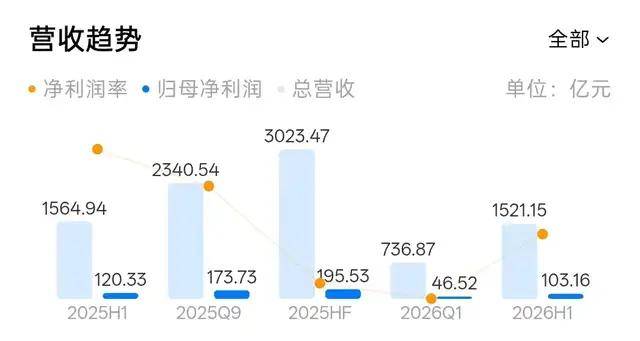
By 2025, the revenue growth rate will be only 5.71%, and the growth rate of net profit attributable to the parent company will plummet to 4.39%. The trend of growth rate decline is very clear. Entering the first quarter of 2026, under the overall pressure of the industry, Haier Smart Home has experienced a double decline in revenue and profits. Revenue fell by 6.86% year-on-year, and net profit attributable to the parent company fell by 15.22% year-on-year.
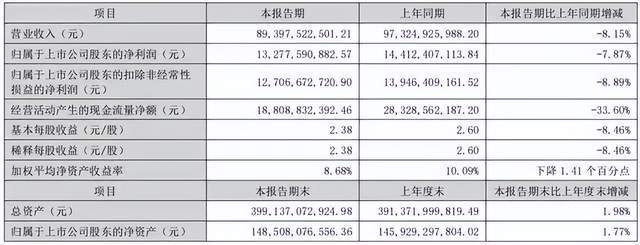
Data show that Gree achieved operating income of 89.398 billion yuan in the first half of the year, down 8.15% year-on-year; net profit attributable to the parent company was 13.278 billion yuan, down 7.87% year-on-year, with both revenue and net profit falling. This was not an accidental stall.
In recent years, after Gree’s operating income reached a high of 203.979 billion yuan in 2023, it dropped to 189.164 billion yuan in 2024, and then dropped to 170.447 billion yuan in 2025. It has shrunk for two consecutive years, with a cumulative loss of 33.5 billion yuan. The profit side is also under pressure. The net profit attributable to the parent company in 2025 is 29.003 billion yuan, a year-on-year decrease of 9.89%. It is a rare double decline in revenue and net profit. Entering 2026, the downward curve has not turned around.
Midea’s overall performance is better. According to the 2026 semi-annual report released by Midea Group, its total operating income in the first half of the year was 261.05 billion yuan, a year-on-year increase of 3.5%; the net profit attributable to shareholders of listed companies was 264. 500 million yuan, a year-on-year increase of 1.7%. However, the most eye-catching figure in this financial report is the 19.595 billion yuan in net profit deducted from non-ownership, a year-on-year drop of 25.31%, including a sharp decline of 35.98% in the second quarter.
In the past two years, Midea’s total operating income in 2024 increased by 9.47% year-on-year, and net profit attributable to the parent company increased by 14.29% year-on-year. In 2025, the company’s total operating income will increase by 12.1% year-on-year and 14.0% year-on-year, which will be relatively stable in the two years.
Looking back, it is not difficult to find that the overall performance pressure of the three white goods giants is still there. The background to the pressure on each company’s performance is that Aowei Cloud monitoring data shows that domestic all-channel retail sales of home appliances in the first half of 2026 were 425 billion yuan, a year-on-year decline of 9.9%. The decline in the second quarter was further expanded compared to the first quarter. Factors such as the transmission of the real estate chain and the lower willingness of residents to renew have jointly suppressed the industry. The market has bid farewell to the era of general rise, and it is difficult for even leading companies to survive alone.
The pressure is transmitted down the industrial chain, and life for kitchen appliances and small household appliances companies is also difficult. For example, due to the shrinking demand for new home decoration, Robam Electric’s revenue and profit both declined in the first half of the year, and the growth of the traditional stove category fell into a pressure cycle. Robam Electric’s revenue was 3.972 billion yuan, a year-on-year decrease of 13.78%; net profit attributable to the parent company was 578 million yuan, a year-on-year decrease of 18.75%. The revenue of Youshang Vantage Co., Ltd. was 2.461 billion yuan, a year-on-year decrease of 12.11%; the net profit attributable to the parent company was 173 million yuan, a year-on-year decrease of 36.35%.

Among them, Supor’s domestic cooking utensils and small household appliances business has seen sluggish growth, and its gross profit margin continues to be under pressure due to cost squeeze. Take Bear Electric as an example. In the first half of 2026, Bear Electric’s operating income was 2.349 billion yuan, a year-on-year decrease of 7.34%; the net profit attributable to shareholders of listed companies was 120 million yuan, a year-on-year decrease of 41.3%.
From giants to low-end companies, this semi-annual report jointly reflects the reality that relying solely on the old method of selling hardware can no longer support the company’s past growth expectations.
However, under the competition in the existing market, prices have involuted and raw materials have fluctuated at high levels, which has continuously compressed the profit margins of manufacturing companies. The pressure on the industry has been fully reflected in the financial report figures, and the proposition before all companies is to find new growth pivots.
Another phenomenon is that in the face of the reality of shrinking stock market, almost all home appliance companies have pinned their hopes on the second curve. However, the reality is that most new businesses are still in the bottom-out stage and are still far away from contributing to revenue and profits on a large scale.
02
Home appliance companies are collectively dreaming of the second curve, but they have yet to usher in a period of large-scale redemption.
At present, the giants have already jumped out of the boundaries of the traditional home appliance business to lay out new tracks. However, whether it is B-end industrial business, high-end package ecology, or channel innovation, any second curve does not have enough strength to support the company’s basic market.
The commercial and industrial solutions segment, which has high hopes, achieved revenue of 66.666 billion yuan in the first half of the year, a year-on-year increase of 3.30%. Although revenue has increased, segmented businesses face different challenges.
Among the specific key sectors, building technology revenue was 21.625 billion yuan, a year-on-year increase of 10.84%, and the gross profit margin was 29.61%. Robots and automation (i.e. KUKA) revenue was 16.621 billion yuan, a year-on-year increase of 10.27%. However, the gross profit margin dropped 1.86 percentage points year-on-year to 20.9%. Revenue increased but profitability did not increase with it, presenting a typical situation of “increasing revenue without increasing profits”. The revenue of the industrial technology segment was 13.138 billion yuan, a year-on-year decrease of 12.72%, and the gross profit margin decreased simultaneously by 2.13%.
The conclusion is obvious. Although the revenue of the building technology business and the robotics and automation business both increased by more than 10% year-on-year, their revenue proportions were less than 10%, and the gross profit margins of some sectors are still facing downward challenges. Therefore, the volume of many new businesses is still small, and the cyclical fluctuations in capital expenditures downstream of the industry will also directly affect the stability of business profitability. It is still unable to replace the main home appliance business as the ballast stone.
Gree is highly dependent on its main businesses such as air conditioners. In the first half of the year, consumer electrical appliances revenue was 74.074 billion yuan, accounting for 82.86%. It is still the absolute main force, with only a year-on-year decrease of 2.89%, and its performance is relatively resilient; industrial products and green energy revenue is 86 .52 billion, accounting for 9.68%, but dropped by 9.79%; smart equipment revenue was 374 million yuan, a year-on-year increase of 19.02%, but the volume only accounted for 0.42%, which is far from being able to support the “second growth curve” story.
In fact, Gree Electric’s road to diversification is even more bumpy.
Although Gree has tried to deploy mobile phones, new energy, and smart equipment for many years, most sectors have always been difficult to achieve scale. Air conditioning still firmly occupies an important proportion, and the business structure is highly dependent on the traditional main business. Although some new businesses maintain a growth rate, they have a low base and are difficult to offset the growth pressure faced by the main air-conditioning business. The new businesses are more of a point-like breakthrough and fail to form industrial synergy.
Haier has also experienced internal differentiation. In the first half of the year, revenue from smart HVAC solutions was 44.75 billion yuan, a year-on-year increase of 5.7%. However, revenue from smart living appliances was approximately 88.95 billion yuan, a year-on-year decrease of 6%, which dragged down the overall performance. In recent years, Haier Smart Home has chosen to bet on high-end and a full-scenario ecosystem for people, cars, and homes.
However, the concept of smart people and cars is still in the exploratory stage. Even the instant retail of home appliances, which is hotly discussed in the industry, and the innovation of channel models will change the efficiency of goods circulation. It can only optimize the existing business, but cannot create new demand out of thin air.
As for the kitchen appliances and small household appliances camp, they are also trying to make mistakes across borders.
Robam Electric has increased its integration into kitchens, Supor has expanded its home furnishing categories beyond cooking utensils, and Xiaoxiong Electric has continued to expand its new category matrix. Most of these attempts stayed within the original circle of competence and it was difficult to break away from the logic of hardware manufacturing. The new track failed to produce disruptive results.
The reason for this situation is not just a matter of track selection. In the past, the home appliance giant grew up in an era of incremental growth driven by real estate dividends, and its organization, research and development, and resource investment were all built around hardware sales.
As industry dividends fade, the pace of corporate transformation is slower than market changes. Many second-curve businesses accelerate their expansion after the main business encounters pressure, and do not complete enough technology and user accumulation during the industry boom cycle. When the market goes down, the profits of the main business are under pressure, and new businesses need to continue to burn money. It will be difficult for companies to fully invest in incubation, and it will naturally be difficult for new businesses to reap large-scale gains.
It is still early for the second curve to be realized, and competition in traditional main businesses will only become more fierce. Old players are still trying their best to hold on to the basics of the existing market, while a group of new forces have entered the home appliance track with new playing methods, adding another layer of variables to industry competition.
03
The old forces are keeping face, while the new forces are still attacking
Traditional home appliance giants are struggling to adjust while guarding their fundamentals. New forces represented by Xiaomi and Zhumi are using different product logic and marketing narratives to continue to disrupt the home appliance market structure and create new competitive pressures for established companies.
Chuimi has established a firm foothold in the cleaning appliances track. In the first half of 2026, the global sales share of Chuimi sweepers was 21.7%, and the sales share was 25.8%; the global sales share of MOVA sweepers was 4.4%, and the sales share was 5.4%. Combining its two brands, the global sales share of Chuimi sweeper business (Chuimi + MOVA) reached 26.1%, and the sales share reached 31.2%. Accordingly, Zhuimi announced that its sweeper business ranks first in the world in terms of sales volume and sales volume.
Interestingly, Chuimi has started from a single category of sweeping robots. It has gradually expanded into floor washing machines and personal care appliances, using AI intelligent narrative to redefine the home appliance product experience. Online traffic operation and rapid product iteration are its significant advantages that distinguish it from traditional home appliance companies.
Xiaomi is also a new player in the home appliance industry. In 2025, Xiaomi’s revenue from smart home appliances hit a record high, with a year-on-year increase of 23.1%. In the first half of 2026, its revenue from smart home appliances increased by 66.2% year-on-year, achieving both volume and price increases. Xiaomi also threatened to enter the top of China’s air-conditioning industry in the future.
Xiaomi’s advantage is that it continues to penetrate all categories of home appliances with the ecological chain model, from large appliances to small home appliances, relying on mobile phone traffic and AIoT ecology, using cost-effectiveness and smart interconnection stories to create a continuous impact on the mid-range product lines of traditional home appliance companies. It can indeed have a sustained impact on the mid-range product lines of traditional home appliance companies.
Of course, conversely, these new forces are not without their shortcomings. The domestic sweeping robot market is also facing shrinking pressure, and domestic market growth has shown signs of weakness. Under the Xiaomi ecological chain model, the product depth and offline channel accumulation of some product categories are not as good as those of established manufacturers. But they all have one characteristic in common: they dare to break away from the inertial thinking of traditional home appliance companies, and their product definitions and marketing communications are more in line with the new generation of consumers.
In other words, new forces are good at seizing the gaps in subdivided categories and telling product stories that are more in line with the current market. This just pokes at the weakness of traditional home appliance giants. Established companies are accustomed to relying on the supply chain for hardware iterations, and lag behind in product narrative and user demand capture.
The existing cake will not get bigger. Every time a new force wins a piece of the market, it means that traditional manufacturers need to give up part of their share. To hold on to their existing market positions, the old forces must not only solve their own second-curve landing problems, but also deal with the continued impact from new opponents.
For traditional home appliances and some small and medium-sized players, it is difficult to rely on a single factor to achieve a breakthrough in the industry today. In the past few years, the home appliance industry has caught up with the era of real estate boom. As long as hardware products are produced, considerable market returns can be obtained.
Nowadays, real estate dividends have receded, the renewal cycle has lengthened, and the industry has bid farewell to its barbaric growth. Whether they are traditional giants or new players entering the game from across the border, they have to face the same reality. The era of relying solely on hardware to sell goods has come to an end.
Related Reading
- Trump floats banning U.S. diesel exports as prices hit a record $6.522026-09-23
- Original: Yushu’s listing is over one month old, Wang Xingxing’s expression is more interesting than the financial report2026-09-23
- Mr. Savage running wild, and the “Gui” who can’t escape2026-09-23
- Original Heilan House shared nearly 90% of its profits but failed to boost the stock price2026-09-22
- Mid-Autumn Festival Wine Market Observation: Wine merchants reported that “sales volume fell by half year-on-year”, and the gift price was concentrated at 2002026-09-22