Investors will speculate whether Wang Xingxing is worried about overvaluation and whether he sees undisclosed risks. This is somewhat misleading, but it also reveals the true situation of the star founder: before going public, Wang Xingxing only had to build the robot; after going public, he himself became part of Yushu’s valuation.
Text丨Financial Gossip Female Contributing Author: Qiu You
· · ·
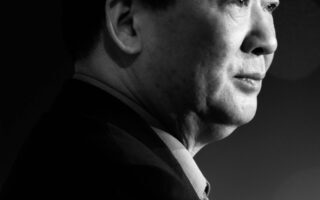
Netizens noticed that Wang Xingxing always had an expressionless face when he appeared on some occasions.
Not long ago, Lei Jun showed up at Yushu Technology to watch a robot performance accompanied by founder Wang Xingxing. The humanoid robot performed traditional Chinese New Year arts such as boxing and calligraphy. After being kicked hard by Lei Jun, it only took a few steps back to regain its balance, showing its excellent qualities far beyond those of its relatives. In contrast, Wang Xingxing seems less relaxed. In the news photo distributed by the media, Lei Jun looks high-spirited, and next to him is a frosty Wang Xingxing.
This is not the first time a similar scene has occurred. On August 19, when Yushu was listed on the Science and Technology Innovation Board, Wang Xingxing’s expression at the scene of ringing the bell was also described as “indifferent”.
Tianyushu opened at 1,100 yuan, a surge of 629.44% from the issue price. The intraday market value once exceeded 440 billion yuan, and Wang Xingxing also became the “richest man born in the 1990s” overnight. However, by the close of trading, the stock price had fallen back to 845 yuan. It continued to fall in the next two trading days, closing at 672 yuan on August 21. Within three trading days, Yushu’s market value evaporated by more than 170 billion yuan from the intraday high on the first day.
Of course, facial expressions cannot influence stock prices, but in the technology industry where founders are deeply bound to the company, facial expressions themselves can also become market-focused information.
Investors will speculate whether he is worried about overvaluation and sees risks that have not yet been disclosed. This is somewhat misleading, but it also reveals the true situation of the star founder: before going public, Wang Xingxing only had to build the robot; after going public, he himself became part of Yushu’s valuation.
1./ RMB 170 billion evaporated in three days after listing. Can Yushu return to its peak? /
Judging from the issuance results, Yushu’s listing can be called a capital carnival.
The company’s issue price was 150.8 yuan, with a market value of approximately 61 billion yuan. The online issuance was subscribed more than 8,000 times; the opening price on the first day of listing reached 1,100 yuan, and the highest floating profit for the first lottery exceeded 470,000 yuan. As of the close of the day, Yushu was quoted at 845 yuan, still 460.34% higher than the issue price, with a total market value of 341.772 billion yuan.
Wang Xingxing directly holds 86.715 million shares of the company, accounting for 21.44% of the total share capital after the issuance. The book wealth corresponding to this part of the shares alone reached 73.27 billion yuan. If the shares held indirectly through the employee stock ownership platform are included, his net worth once exceeded 100 billion yuan.
The same set of data may look different from another perspective.
Investors who bought it at 1,100 yuan had already lost about 23% at the close of the day; by the third trading day, the stock price of 672 yuan fell nearly 40% from the opening price. Some people have achieved a wealth jump by hitting new stocks, while others have just taken a risk education class as soon as they caught up with the “first stock of humanoid robots”.
It’s not hard to understand why market sentiment has cooled. Yushu has product visibility that is rare among domestic robotics companies. The Spring Festival robot performances, robot dogs, humanoid robot boxing matches, and Wang Xingxing’s image as a young technical genius have all given the company its own traffic. The list of luxurious shareholders such as Tencent, Alibaba, Meituan, and Shunwei Capital has further strengthened the market’s confidence in Yushu.But once you return to the financial report from the hot search, the question becomes: Is this company’s current profit equivalent to a market value of hundreds of billions of yuan?
In 2025, Yushu achieved revenue of approximately 1.7 billion yuan, more than four times that of the previous year, of which revenue from humanoid robots reached 868 million yuan, surpassing quadruped robots for the first time and becoming the largest business segment. By the first quarter of 2026, the company’s revenue reached 423 million yuan, a year-on-year increase of 68.49%. The growth rate has dropped significantly from the 332.64% in 2025; the non-net profit during the same period was 40.2536 million yuan, a year-on-year decrease of 52.55%.
Judging from last year’s full year, Yushu’s R&D expenses and sales expenses accounted for 8.53% and 8.31% of revenue respectively, which was lower than peers such as Youbixuan and Yuejiang Technology. The decline in profits at least shows one thing: it is difficult for Yushu to continue to rely on the strategy of “making high-performance products at low costs” to grow easily. Production expansion, R&D, channels and brands have all begun to become expensive.
Some media calculated a more direct calculation: According to the issuance valuation, Yushu’s corresponding annualized price-to-earnings ratio is approximately 118 times. After the stock price rose further on the first day, investors clearly paid not just for the company’s current performance, but for the growth expectations of humanoid robots for many years to come.
This may be the fundamental reason why Yushu’s stock price fluctuates easily. Its robots have learned to run, fight, dance and write calligraphy, but commercialization is still in the stage of moving from exhibits to products. In 2025, the U.S. market will account for approximately 13.3% of Yushu’s operating revenue. Tariffs, procurement restrictions, and product access may all affect overseas expansion; in the domestic market, vehicle companies such as Tesla and Xpeng, as well as a large number of robotics startups, continue to enter the market, squeezing Yushu’s original leading advantages in capital, manufacturing, and channels.
The combination of high valuation, low circulation, declining profits and intensifying industry competition means that the fluctuations of Yushu after its listing are not unexpected. Even if a robot takes a kick, it can rely on algorithms to regain its footing. After a valuation falls, it can usually only rely on the next financial report to help it.
2./ With a net worth of hundreds of billions, you can only collect your salary honestly? /
Many people have a misunderstanding about the wealth of listed company owners. If a person’s stock market value reaches 100 billion yuan, it does not mean that he has 100 billion yuan in his bank card. More precisely,This wealth is a string of numbers temporarily written in his name in the capital market based on the stock price of the day.
Wang Xingxing directly and indirectly holds about 33.36% of Yushu’s shares. For every percentage point increase in the stock price, his book value may increase by one billion yuan; however, according to the share locking and reduction rules of the Science and Technology Innovation Board, pre-IPO shares held by controlling shareholders and actual controllers cannot be sold at will. Even if the ban is lifted in the future, the shareholding reduction ratio, announcement requirements and market impact will also limit its operating space.
So to put the situation more crudely, although Wang Xingxing has a net worth of hundreds of billions, what he can really freely spend in the short term may still be mainly salary, bonuses, dividends and the cash accumulated before going public. When stocks rise, he only gets richer on paper; when stocks fall, the outside world will immediately ask him to respond, increase holdings, repurchase, or find ways to stabilize market confidence.
Ordinary shareholders find that the company does not meet expectations, they can click to sell, close the software, and look for another opportunity; if Wang Xingxing reduces his holdings, the signal the market will get is likely that “even the boss is not optimistic about it.” The more a company relies on the founder’s technical ability and personal credibility, the harder it is for the founder’s wealth to truly be pocketed. Stocks look like assets, but in fact they are more like a deposit placed by the company on the market.
This is especially true for Yu Shu. Wang Xingxing is not only the chairman and general manager, but also the chief technology officer. The company’s technical route, product definition and external image from quadruped robots to humanoid robots are deeply bound to him.In a sense, he is Yushu’s most important engineer, and he is the company’s most valuable and most unsellable “product.”
Lei Jun’s visit therefore provides more room for interpretation. Shunwei Capital is an early investor in Yushu, and Lei Jun is one of the entrepreneurs best at generating traffic in the Chinese business community. When he went to station B, he could review “Are You OK” with Chen Rui, and when he went to Yushu, he personally tested the stability of the robot. Just showing up can bring hot searches and spread. For Yushu, which has just been listed and has seen sharp fluctuations in its stock price, this is certainly a low-cost attention asset.
It must be emphasized that Lei Jun can prove that Yushu’s circle of friends is luxurious enough, but he cannot prove that its profit statement is equally impressive. Yushu needs to continue to invest in research and development, expand production capacity, open up overseas markets, and also deal with more well-funded competitors such as Tesla. Non-net profits will be cut in half in the first quarter of 2026, which already shows the cost pressure at this stage.
The capital market can tolerate short-term profit declines for technology companies, but only if future revenue, orders and market share can be realized.
When valuations run out many years in advance, founders can no longer just tell stories, but also turn stories into performance on a quarterly basis. A net worth of 100 billion sounds like a reward. From another perspective, it can also be understood as a gambling book with a scale of 100 billion handed to Wang Xingxing by the market.
3./ They have already landed, but Wang Xingxing cannot get off the car yet /
Not all owners of listed companies are as difficult to leave as the founders of technology companies.
The value of traditional consumer companies is more concentrated in stores, supply chains, channels and cash flow, and the company’s reliance on the individual founder is relatively limited.After the boss reduces his holdings or withdraws, the factory will continue to produce as usual and the franchisees will continue to purchase goods. Consumers will not even notice the change in the company’s shareholder list.
Haidilao founder Zhang Yong is such a case. Haidilao was listed on the Hong Kong Stock Exchange in 2018, and in the same year, Zhang Yong and his wife became Singapore citizens; the rise in stock prices after the listing propelled Zhang Yong to become the richest man in Singapore in 2019 with a net worth of US$13.8 billion.
The outside world often splices “listing, cashing out, and moving to Singapore” into a complete wealth transfer route. The specific time and transaction details may not be so simple. However, Haidilao has a stable cash flow for a long time. The founders can gradually convert corporate value into family wealth through dividends, equity arrangements, and global asset allocation. As long as there are still people queuing up in the store, whether Zhang Yong lives in Sichuan or Singapore does not affect consumers using a colander to scoop out the hair.
Nayuki’s tea shows another version.
In 2021, Naixue was listed on the Hong Kong Stock Exchange with an issue price of HK$19.8, becoming the “first new tea drink stock in the world”; by July 2026, the stock price had fallen to around HK$0.65, a drop of more than 96% from the issue price. From 2018 to 2025, Naixue suffered a cumulative loss of approximately 2 billion yuan. When it was listed, its imagination about high-end tea drinks, third space and young consumption eventually turned into huge floating losses for investors.
The Internet is accustomed to summarizing this kind of story as “the company goes public, the boss cashes out, and the investors take over.” However, at the 2026 shareholders’ meeting, faced with questions from investors asking Chairman Zhao Lin to receive an annual salary of one yuan, Peng Xin responded that they had not reduced their holdings after listing, and Zhao Lin also had to live on his salary. In 2025, the two people received a total salary of approximately 3.1 million yuan from Naixue; at the same time, the book losses of some shareholders on site have exceeded one million yuan.
Going public turns entrepreneurial equity that was originally difficult to price into liquid assets, and also transfers some operating risks to the secondary market. The boss still has control and receives salary, while ordinary investors bear more than 90% of the stock price drop. This is the emotional basis for the “cash out” narrative that continues to emerge.
Wang Xingxing currently has limited room for even this kind of operation. Yushu’s valuation is highly dependent on his technical image and market confidence. Once he publicly reduces his holdings, investors will not understand it as an ordinary family asset allocation, and will only wonder whether the founder is preparing to abandon ship in advance. Therefore, the higher the market value of Yushu, the harder it is for Wang Xingxing to get out of the car;The more wealth he has on paper, the less freedom he truly has.
This is probably the most embarrassing thing for technology star founders. Before going public, they faced investment institutions; after going public, they faced thousands of investors. In the past, if the robot did not jump well, you could go back to the laboratory and continue to adjust parameters; now that the profit has not reached expectations, people will vote with their feet when the market opens the next day.
Therefore, investors focus on the fundamentals of Wang Xingxing’s expression, and may not really be worried about how many points Yushu rose or fell that day. What should be even more worrying is that the capital market has already bought up Yushu’s story for the next few years in advance, and in each subsequent financial reporting season, Wang Xingxing will be responsible for turning the story into revenue, and then turning the revenue into profit.
Related Reading
- World, line up to sell goods to China!2026-11-12
- Ni Runfeng, the “King of Color TV”, passed away. From a workshop technician to the head of a state-owned enterprise, his ups and downs in half a life defined an era of home appliances.2026-11-12
- Original “Fearless” Wang Jianlin regains control of Wanda Business Management, and his net worth has evaporated by 200 billion in ten years2026-11-12
- Original: The middle-class people are crazy about grabbing Archaeopteryx in Sam2026-11-12
- There is no more double 11 in the world, leaving businesses miserable2026-11-11