“Core Tips”
Is Ning Wang dying, or do car companies no longer want to work for it?
作者 | 陳法善
編輯 | 劉楊
In four months, the price fell by more than 760 billion yuan, which is equivalent to losing 1 BYD, 1.3 Xiaomi, and 8 Li Auto.
The one whose value has shrunk significantly is not a company with explosive performance, but CATL, which has an “exploding” earning power. In the first half of the year, Ningde Times’ revenue was 276.9 billion yuan, a year-on-year increase of 54.8%; net profit was 43.3 billion yuan, a year-on-year increase of 42%, which is equivalent to a daily net profit of 240 million yuan.
However, since the end of August, Ningde Times has begun a continuous decline. On September 21, the stock price once fell to 295.5 yuan, down about 36% from the May high of 467 yuan, and the market value fell below 1.4 trillion, hitting a one-year low.
Performance is at the top of the mountain, and stock price is at the bottom. What is the market trading behind an abnormal K-line?
1. Car companies no longer want to work for “Ningwang”
On the evening of September 16, Ideal released the new pure electric model i9 Home. At the press conference, Li Xiang announced that the first batch of delivered vehicles will be equipped with CATL’s 5C ternary lithium batteries. As the mass production of Ideal’s self-developed batteries advances, all the vehicles will be switched to Ideal’s self-developed batteries in the future.
Since batteries account for about 40% of the cost of a vehicle, many consumers are accustomed to looking at the battery brand before buying a car. CATL is one of the brands that many people trust most. Therefore, it is quite subtle to dismantle Li Xiang’s words. When there is an urgent need to increase sales of new products in the early stages of launch, they will first use batteries from CATL for endorsement; when subsequent supply and demand stabilize, they will then use self-developed batteries with better cost performance to reduce costs.
As early as the second quarter financial report communication meeting at the end of August, Li Xiang revealed that starting from the second half of the year, all Lixiang models will be equipped with self-developed batteries. Behind this is Ideal’s layout in the industrial chain. On September 4, Sunwanda announced that Lideal planned to invest 2.65 billion yuan in Sunwanda Power and subscribe for 8.79% of its shares. After the transaction is completed, Lili related entities will indirectly hold a total of 11.17% of the shares, becoming Sunwanda’s second largest shareholder.
This is not the first car company that is unwilling to work for CATL. For Xiaomi’s “Dragon A Battery”, the cells were handed over to China Innovation Airlines and Sunwanda; Wenjie’s new battery suppliers added China Innovation Aviation and Guoxuan Hi-Tech; Xpeng simply promoted China Innovation Aviation to be the largest supplier. A few years ago, car companies that were queuing up for supply in the CATL era almost invariably began to provide double insurance for batteries.
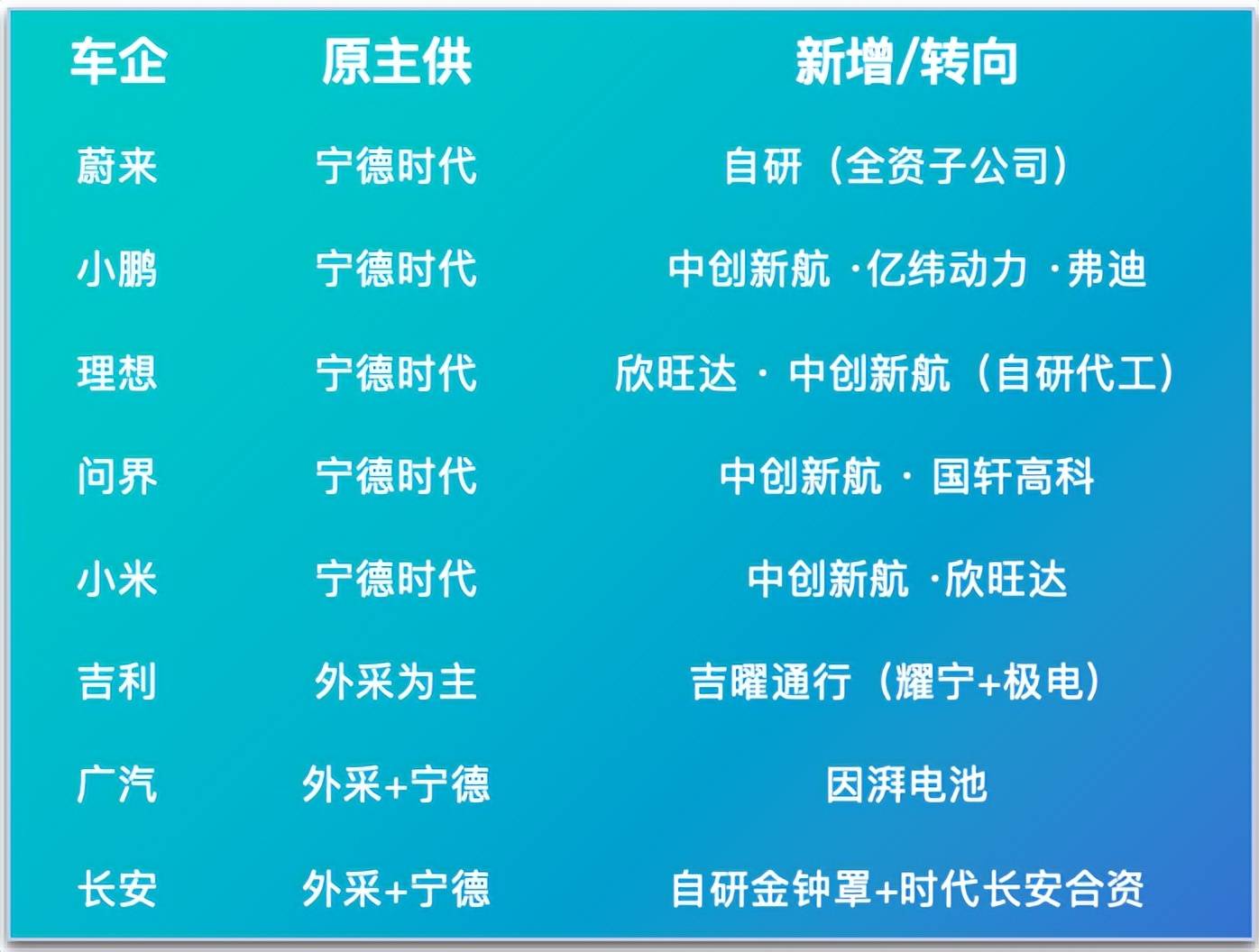
It’s not that the CATL era is bad, but that under the pressure of survival, car companies must prepare an escape route for themselves. Take Ideal as an example. Although it holds more than 87 billion in cash reserves, due to the previous decline in sales and the increase in the sales volume of low-priced models, the gross profit margin of the vehicle fell to 9.4% in the second quarter. Statistics from the Passenger Car Association are even more disturbing. From January to July, the automobile industry’s profit margin dropped to 3.6%, which is lower than the average level of 6.5% for downstream industrial enterprises. Cost reduction has become a must for car companies.
In contrast, in the first half of the year, CATL’s domestic power battery installation share reached 46.7%, with a gross profit margin of approximately 24%. Statistics from “21st Century Business Herald” show that in the first half of the year, the total net profit attributable to parent companies of 22 listed vehicle companies was approximately 17.8 billion yuan, less than half of that of CATL.
On September 16, veteran media person Hu Xijin posted a post on Weibo, claiming that he did not hold CATL shares, but publicly suggested that it proactively consider its relationship with domestic electric car companies to prevent the car companies from feeling that they are all working for CATL. He also mentioned that the words of his predecessor Zeping three years ago, “The world has been suffering for a long time,” are now fermenting in the industry.
“Battery batteries are just suppliers. End-use car companies don’t make money. Why do suppliers make so much money?” said a salesperson from a “new force” in car manufacturing.
Price is only one aspect. Car companies also need “more obedient” suppliers. As competition in the industry deepens and vehicle model iterations accelerate, it is difficult for homogeneous battery packs to highlight their selling points. Car companies have put forward higher requirements for customized battery packs. However, the sales volume of some “crash cars” is limited, and it is difficult to persuade CATL to open a separate production line for them. Coupled with the misalignment of production schedules between the two parties, there have been cases where the supply of “Ningwang” battery packs was not timely, resulting in the slowdown in the delivery of new cars by car companies.
For second- and third-tier battery manufacturers, they are obviously more motivated to receive orders from the leading “new forces”, and car companies naturally begin to turn to more obedient suppliers.
Although the current profitability of CATL is still exploding, as the “de-CATL” fermentation has affected the capital market’s expectations of its future profitability, it is not difficult to understand the abnormal K-line.
2. Can it be successful?
When car companies collectively clamor to develop their own batteries and “de-Ningde”, can they really make good batteries?
In the recently held CATL “Quality Global Open Month” event, Ni Jun, chief manufacturing officer of CATL, bluntly pointed out that auto companies develop self-developed batteries. Those who know how to build cars may not necessarily be able to manufacture batteries. Professional people are still required to do professional things.
In fact, consumer batteries and power batteries have huge differences in consistency requirements. Power batteries are usually composed of many small cells, and there is an obvious “barrel effect”. If there is a problem with one of the cells, it may affect the entire battery pack. For battery manufacturers, it is not difficult to make a good battery. What is difficult is to make every one of them equally good during large-scale mass production.
The financial report shows that Ningde Times will invest 22.147 billion yuan in R&D in 2025, and the cumulative R&D investment in the past ten years has exceeded 90 billion yuan. Public information shows that when CATL developed power batteries for Mercedes-Benz, it conducted more than 1,700 days of testing, which exceeded the iteration time of many “new force” models. This kind of barrier of capital, technology and time cannot be overcome by just saying “self-research”.
Wang Wei, who has worked for a joint venture car company, told “Leopard Change” that the CATL era started early and could use patents to block the way of competing products. For example, CATL’s Kirin batteries have liquid-cooling plates on the sides of all cells. The expansion area is several times the industry average, making them less prone to thermal runaway. However, competing products are restricted by patents and can only arrange liquid-cooling plates above and below the cells, which results in less effective results.
“The battery still has a calendar life, which requires time and actual vehicle verification. This cannot be simulated in the laboratory. Brands that start early and have large sales have more advantages in this regard.” Wang Wei said.
In order to avoid shortcomings, car companies have adopted more clever methods. They purchase cells from battery factories, and modules and battery packs are assembled by themselves or joint ventures. Although the battery cells account for the majority of the cost of power batteries, car companies can not only lock in part of the profits but also highlight the “self-developed” technological attributes of batteries by doing the remaining steps.
But the question is, is the quality of the “self-developed” instant battery acceptable? A car blogger once dismantled the same car of the same brand but with different battery packs. One of the cars had traveled hundreds of thousands of kilometers. After the battery pack was disassembled, it developed a serious bulge. It fell off from the bottom of the battery case and curled into a banana-like shape. On another car equipped with CATL batteries, there were no bulges, leaks, rust, etc. after the battery pack was disassembled, and the battery health was 91%.
This case comes from the disassembly of a single blogger. The sample size is only two vehicles and cannot represent all vehicles of the same batch. But it at least shows that the difference in the status of different battery packs after long-term use of the same car and the same batch is real.
In recent years, after a leading “new force” changed its battery supplier, a new car caught fire and exploded while driving. In July this year, GAC Aion S launched recalls due to batch failures of Sino-Sino aviation batteries, and Volvo EX30 due to the risk of thermal runaway of Sunwanda batteries. For car companies, replacing CATL can save a lot of money, but in the face of a batch failure, the cost savings may be wiped out in an instant.
But why do car companies still want to “de-Ningde”? A battery industry practitioner told “Leopard Change” that this is related to the mature development of battery technology. A few years ago, battery packs of the same size could last up to 600 to 700 kilometers in CATL, and fast charging only took 10 minutes. However, second- and third-tier batteries had a battery life of more than 100 kilometers less, and fast charging was ten minutes slower. The experience gap made the market willing to pay a premium. But now, the experience gap between the two in terms of battery life and fast charging is no longer obvious, and car companies are naturally more inclined to replace batteries and cut costs.
Although the self-developed batteries of car companies are more like changing from “buying the whole package” to “buying batteries + packing them yourself”, the essence of “de-Ningdeization” is to compete for the right to speak in the supply chain. Once started, it will be difficult to go back.
3. Who can challenge CATL?
If the “De-Ningdeization” of car companies is a loosening of the demand side, then BYD and other battery manufacturers represent an even more severe tightening on the supply side.
In August, Zhang Hongjun, executive deputy general manager of FAW Fudi, publicly confirmed that BYD’s second-generation blade battery has participated in the core project of FAW Hong’s first-generation pure electric platform, and that megawatt flash charging technology will be installed on a car model for the first time. FAW Hongqi is one of the core customers of CATL for many years.
What is even more intriguing is that FAW Fudi itself is a joint venture between BYD and FAW, with BYD holding 51% and FAW holding 49%. When Hongqi used BYD batteries, it was not so much that it took away Ningde’s customers, but rather that the customers were already in the same boat as its rivals. Similar equity bindings also appeared between Leapout and China New Airlines, and between Ideal and Sunwanda.
What is more threatening than a single customer being exploited is the generation gap in cost structure. BYD controls all the core links from lithium mines, battery cells to vehicle manufacturing. In addition, BYD supplies external vehicle parts and components, which gives it a cost advantage over a pure battery factory. When rivals use cheaper methods to create batteries that also meet demand, the technology premium of “Ningwang” will be re-priced by the market.
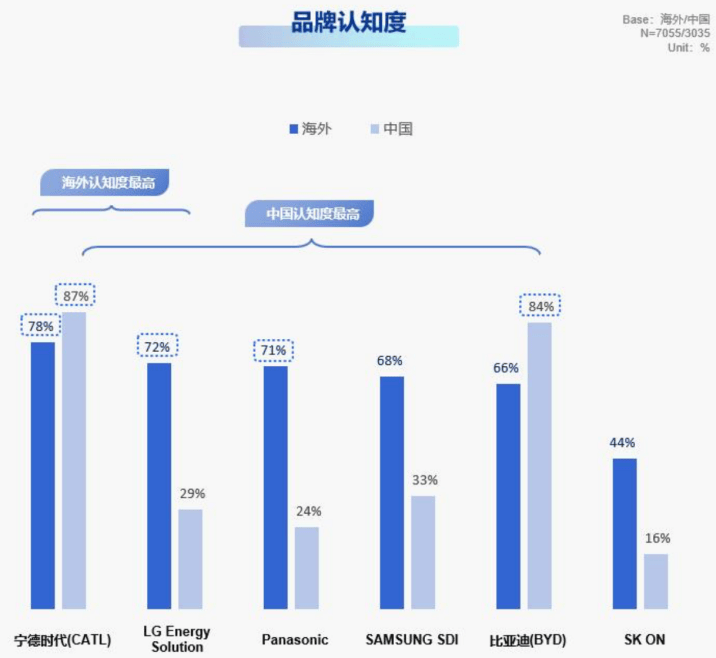
In terms of consumer perception, the gap between BYD and CATL is closer. Source: Nielsen IQ
In addition, the position of the technical line is also being tied up little by little. In March, BYD released its second-generation blade battery, claiming that it only takes 5 minutes to charge from 10% to 70%. On September 17, Sunwanda announced at a press conference that by the end of 2027, 10,000 megawatt flash charging stations will be built across the country, which can recharge more than 100 kilometers of energy in one minute at room temperature, and can charge from 10% to 97% in 9 minutes. At the same time, the next generation of solid-state batteries, for which high hopes are placed, is still far from mass production, and the entire industry can be said to be on the same starting line. When new technologies have not yet broken through the bottleneck, mature technology fields will inevitably fall into more intense market competition.
Spring River Plumbing duck prophet, “Ning Wang” is already changing. The 2026 semi-annual report shows that CATL, which focuses on the B-side, is increasing its marketing investment. In the first half of the year, marketing expenses increased by 33.44% year-on-year to 2.164 billion yuan. On the consumer side, in May, CATL launched a battery query function on official channels. After entering the car model, users can check whether the CATL batteries installed in the vehicle are exclusively supplied or mixed, thus forcing car companies to adopt CATL batteries.
Nielsen IQ recently released the “Global New Energy Vehicle Consumer Research Report 2026”, which shows that from the perspective of consumer perceptions, in the international market, the power battery market has formed a three-power structure of CATL, LG, and Panasonic; in the domestic market, CATL and BYD are competing for hegemony. Among them, 37.1% of Chinese consumers may give up purchasing because their favorite model is not equipped with CATL batteries. It can be seen that it is not easy for new players to shake “Ning Wang”.
In fact, CATL, which has a dominant position, also has the “price” card. In June, Zeng Yuqun, the founder of CATL, said in an exclusive interview with Caijing that CATL is supporting this price. If CATL also joins the price war, the situation of the entire industry will be worse than that of photovoltaics. At the World Power Battery Conference in early September, he publicly criticized the industry’s quick success trend of “compare speed, compare parameters, and compare price.”
But the problem is that even if the Ningde era cuts prices, it will not change the situation of involution and car companies losing money. According to a person in the battery industry, the price space given up by battery factories will cause car companies to turn around and enter the next round of price wars. Involvement in the industry cannot be settled with one profit concession or one price cut.
Related Reading
- Original BYD’s world has changed2026-09-22
- Wisdom spectrum, I was taught a lesson2026-09-22
- From Google to bit tuples, every big company will eventually have a pharmaceutical factory2026-09-22
- The tax paid in five years is about 53.6 billion! Jen-Hsun Huang: I’m not afraid of paying taxes, I’m just afraid of being poor2026-09-22
- AI is creating an era of app glut2026-09-22