
Overseas holds up half the sky.
Under the dual disturbances of domestic price wars and international exchange rate fluctuations, BYD handed over a semi-annual report that was “short-term pressured and structurally upward.”
In the first half of this year, BYD’s sales, revenue, and profits all fell year-on-year. As soon as the news came out, BYD’s Hong Kong stocks and A-shares fell 5.17% and 4.46% respectively on its first trading day.
However, brokerage institutions are almost unanimously optimistic: overseas revenue exceeds domestic revenue for the first time, high-end brands accelerate their sales, and flash charging technology opens a new product cycle…
What does this financial report of “book pressure and structural upgrade” say?
01
According to the financial report, in the first half of this year, BYD sold 1.8085 million vehicles, with operating income of 344.815 billion yuan and net profit attributable to the parent company of 12.325 billion yuan.
Regardless of revenue or profit, BYD is one of the best.
It is worth mentioning thatBYD is the only listed car company with revenue exceeding 300 billion yuan, and it is also the only listed car company with net profit attributable to its parent company exceeding 10 billion yuan.
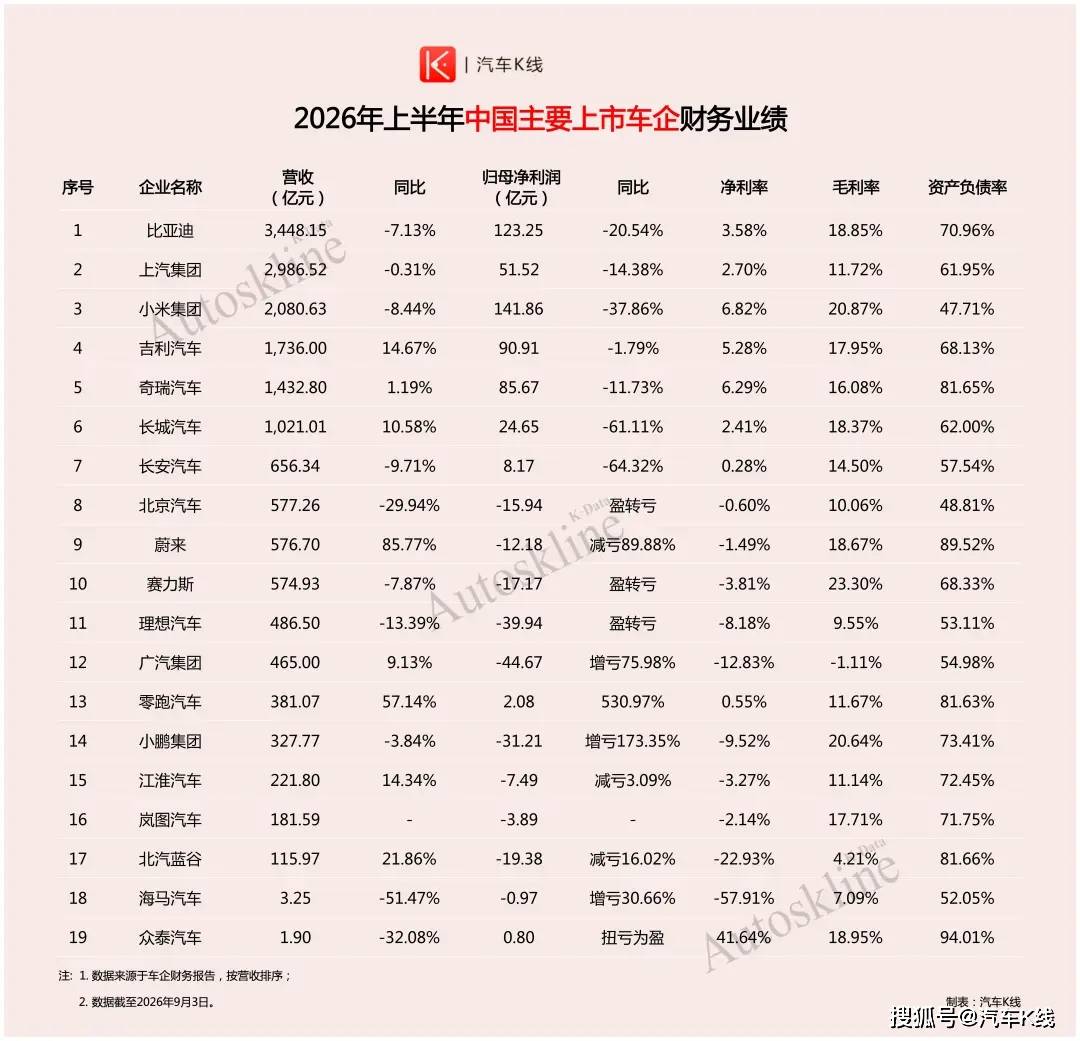
不過,In terms of sales volume, BYD lost to SAIC with a gap of 237,000 units, losing the title of sales champion among Chinese listed car companies.。
However, with the release of flash charging technology, BYD has regained the title of monthly sales champion among listed car companies since May, and the cumulative gap between the two is quickly disappearing.
In addition, BYD’s R&D investment is far ahead among the listed car companies. In the first half of this year, although its R&D investment fell 6.54% year-on-year to 28.861 billion yuan, it was still 3.6 times that of SAIC Group (8.111 billion yuan).
As of the first half of this year, BYD’s cumulative R&D investment exceeded 270 billion yuan.
02
The most outstanding performance is undoubtedly the overseas market.
In the first half of this year, BYD sold 792,000 vehicles overseas, a year-on-year increase of 67.8%, accounting for 43.8% of total sales. In August, overseas sales reached 189,500 units, a year-on-year surge of 134.4%, setting another record high.
In the UK, Brazil, Thailand and other places, BYD has topped the sales list of new energy brands. The business territory covers more than 120 countries and regions around the world.
More importantly,Overseas business not only contributed to sales, but also reshaped the profit structure。
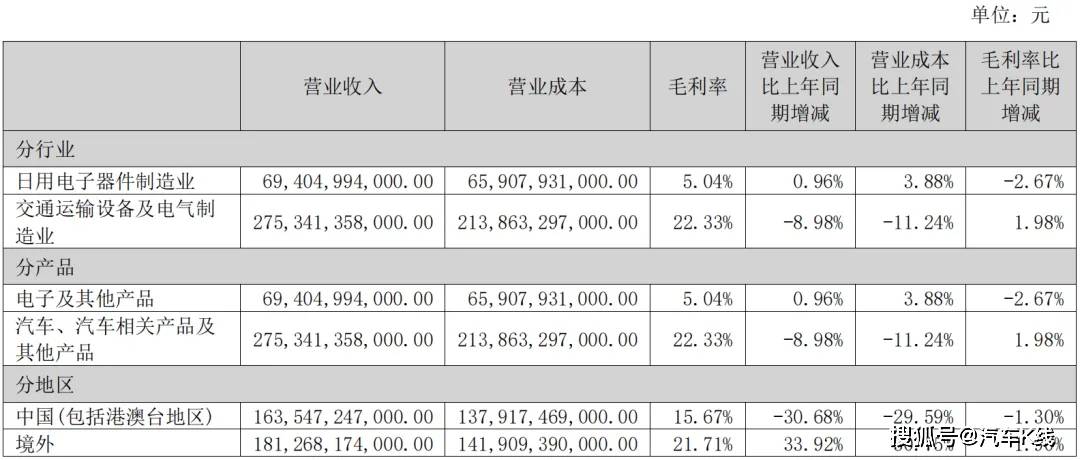
In the first half of this year, BYD’s overseas revenue was 181.268 billion yuan, a year-on-year increase of 33.92%, and its proportion of total revenue exceeded 50% for the first time, reaching 52.57%.
At the same time, the gross profit margin of overseas business reached 21.71%, which was significantly higher than the domestic rate of 15.67%. This means that overseas contributed about 60% of BYD’s gross profit with 43.8% of sales volume and 52.57% of revenue.
In other words, BYD’s profit engine is shifting from domestic to overseas. This is also the most iconic change in this semi-annual report. “Auto K-Line” believes that this will also strengthen the overseas strategies of other Chinese listed car companies.
—Extended reading—
Why doesn’t capital give face to Lingpao Auto?
Changan Automobile makes so much less money
03
Premiumization is BYD’s second upward curve.
The three major brands, Fangbao, Denza and Yangwang, sold a total of 228,000 vehicles in the first half of the year, a year-on-year increase of 61.03%, and their proportion in total sales rose to 12.61%.
Among them, Fangwangbao contributed the most, with sales in the first half of the year reaching 159,500 units, a year-on-year increase of 162.53%. However, Denza and Yangwang are under pressure. The former sold 66,500 units in the first half of the year, a year-on-year decrease of 16.65%. Although the latter increased by 96.61% year-on-year, its sales volume was only 1,972 units.
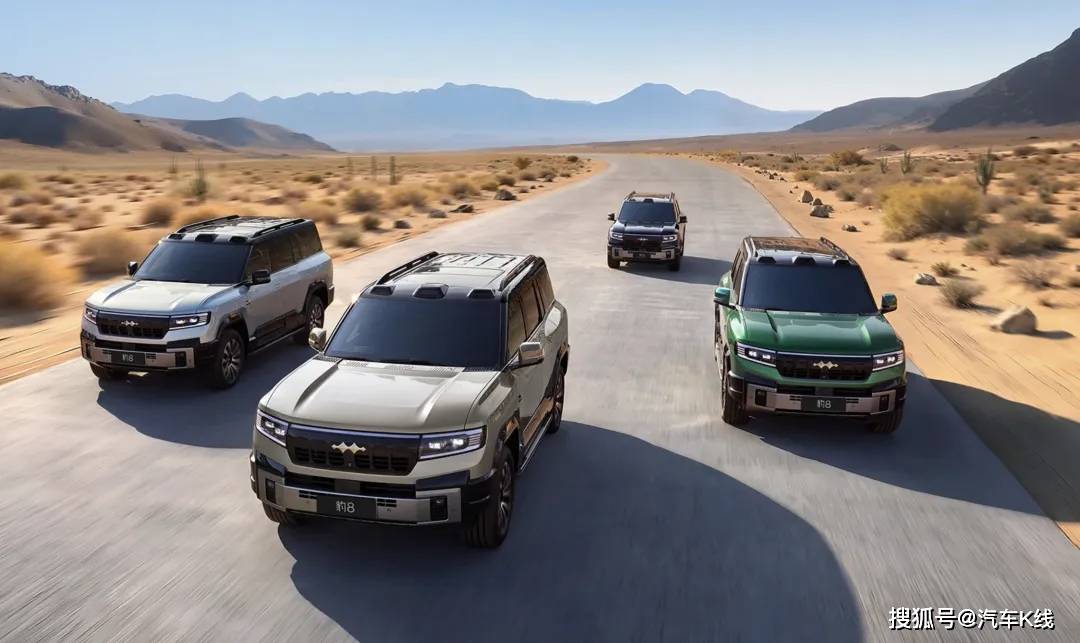
As high-end models increase in volume, BYD’s profit structure is being reshaped.High-end brands not only bring higher unit prices, but are also expected to improve gross profit margins and reduce reliance on low-priced, high-volume models.
However, it should be noted that high-end brands currently account for only 12.6% of total sales. Although they are growing rapidly, their volume is not enough to completely offset the stalling of the domestic mass market.
It can be said that high-endization is only the starting point of the second curve.
04
Although BYD’s performance is far ahead, hidden concerns cannot be ignored.
The most eye-catching thing is that the net profit attributed to the parent company has evaporated significantly. In the first half of last year, BYD’s net profit attributed to the parent company was 15.511 billion yuan. This year, it is only 12.325 billion yuan. It has evaporated nearly 3.2 billion yuan, a year-on-year decrease of 20.54%.。
At the same time, the average daily profit fell below the small target, about 68.09 million yuan.
There are two direct reasons.
First, the RMB appreciated against the U.S. dollar in the first half of the year. BYD recorded an exchange loss of 4.703 billion yuan, compared with a profit of 3.16 billion yuan in the same period last year, with a difference of 7.863 billion yuan between one in and one out.
BYD attributed the decline in net profit to this, but it just exposed the risks in the current international environment. The faster BYD expands overseas, the greater the impact of exchange rate fluctuations on the income statement.
The second is the stalling of the domestic market. In the first half of this year, BYD’s domestic revenue was 163.547 billion yuan, a sharp drop of 30.68% year-on-year. Automobile business revenue was 275.341 billion yuan, a year-on-year decrease of 8.98%, which almost explained the 7.13% decline in BYD’s revenue in the first half of the year.
Domestic sales are under pressure, with BYD’s sales falling by 15.72% in the first half of the year. Wang Chuanfu admitted that the lower-than-expected sales volume was directly related to the insufficient production capacity of the second-generation blade battery.
The deeper concern lies in the continued erosion of profits by the automobile price war.
In the first half of this year, the automobile industry’s profit margin was only 3.76%, and the profit margin of vehicle manufacturing was as low as 1.5%. The price of BYD bicycles dropped from approximately 160,000 yuan in Q1 to 136,000 yuan in Q2.
In this bloody competition across the industry, even the leading companies cannot survive alone.
05
Different from short-term market sentiment, mainstream securities firms are almost unanimously optimistic about BYD’s mid- to long-term development. The reason is that after excluding exchange disturbances, the profit quality of its main business has actually improved significantly.
Guojin Securities estimates that after restoring the impact of exchange tax and excluding BYD’s electronic equity contribution, the actual profit in Q2 was approximately 10.3 billion yuan, a year-on-year increase of 182%. The profit from a bicycle under this caliber reached 9,300 yuan.
Huatai Securities believes that the strong rebound in Q2 profits is due to the opening of the new product cycle of flash charging technology and the continued high growth of overseas business, and maintains a “buy” rating.
Kaiyuan Securities pointed out that Q2 gross profit margin has recovered significantly year-on-year, and overseas markets continue to increase volume, maintaining a “buy” rating.
Orient Securities emphasized that overseas sales in August reached a new high of 189,500 vehicles. Overseas is expected to become the core growth pole, with a target price of 125.28 yuan.
BOCOM International is optimistic about BYD’s export performance in the second half of the year and maintains its target price of HK$138.53.
Cathay Haitong Securities pointed out that overseas revenue exceeded domestic revenue for the first time, and the flash charging ecosystem has accelerated, maintaining the “overweight” rating.
On the whole, exchange losses are paper losses, overseas business is the core growth engine, and flash charging technology + high-end reshaping competitiveness are the consensus of institutions that are optimistic about BYD.
06
As the main automobile business enters a period of deep adjustment, BYD’s layout in other fields is also worthy of attention.
The energy storage business has become a real implementation project of BYD.In the first half of 2026, BYD’s energy storage system shipments ranked first in the world, with its products entering more than 110 countries and regions, covering scenarios such as source-grid side energy storage, industrial and commercial energy storage, household energy storage, and AIDC computing power storage.
At present, BYD is seizing the dual strategic opportunities arising from the global new energy transformation and the release of AI computing power demand. However, price competition in the energy storage industry is also fierce, and it is still uncertain whether the scale advantage can be transformed into a profit advantage.
In terms of semiconductors, BYD’s self-developed 4nm process smart driving chip “Xuanji A3” released in May has been mass-produced. In September, a new generation of 4D millimeter-wave radar chip with Xuanji A3 as the computing center was launched, fully covering L2-L4 smart driving applications. Cumulative shipments of BMS AFE chips exceeded 100 million.
In terms of electronics and AI computing power, the AI computing power infrastructure business continues to advance, and overseas customer liquid cooling cold plate projects have entered the mass production ramp-up stage. BYD Electronics’ revenue in the first half of the year was 82.234 billion yuan, a year-on-year increase of 2.02%; net profit attributable to the parent company was 426 million yuan, a year-on-year decrease of 75.35%.
07
Robots are longer term options.
Nowadays, more and more car companies are starting to “create people”, and BYD is no exception.
In August 2026, BYD’s first humanoid robot “Xiao Di” made its global debut at the World Robot Conference, and announced that it would be directly transferred to regular factory services. The first batch of implementation scenarios were parts handling and quality inspection of internal production lines.
It is reported that the project will be initiated by the 15th Business Department in 2022, with a research and development cycle of approximately 4 years.
Li Ke, executive vice president of BYD, publicly confirmed that the company is developing humanoid robots and pointed out that “BYD’s current focus is on industrial robots, because BYD is already the largest user.”
In addition, BYD has invested in Zhiyuan Robot and signed a strategic cooperation agreement with the tactile sensing company Passini. In the future, it is planned to install robots in each dealer store to undertake tasks such as greeting guests and explaining vehicle models.
Of course, the robotics business has little contribution to the current financial report, and is more of a layout for the next decade.
Its value lies in that BYD itself is one of the largest users of industrial robots and can use internal scenarios to feed back iterations. However, the pace of commercialization, cost reduction curve and external customer expansion still need time to be verified.
08
Judging from BYD’s semi-annual report, it is in a period of structural shift.
The old engine of the domestic mass market is slowing down under the dual squeeze of price wars and production capacity bottlenecks. As new engines for overseas markets and high-end brands are accelerating, they are not yet enough to completely offset the stalling of the old engines.
Overseas income exceeded domestic revenue for the first time, which was a landmark node in this shift; the risk of exchange loss exposure was a necessary price in the process of shifting gears.
The key is, can overseas and high-end structural improvements be able to offset the pressure of domestic price wars in a short enough time?
The answer is uncertain, but the direction is clear.BYD is evolving from a hit-driven car company that relies on the domestic market to a diversified technology group with a global presence and technology drive.
The layout of energy storage, semiconductors, robotics and other businesses is paving the way for the next decade of this manufacturing giant. This process is bound to not be smooth.
Views of Autoskline:
The direction has been clear and the answers are still on the way. What BYD has to do is not to prove that it will not decline, but to prove that it can complete evolution despite the decline.
Related Reading
- Wisdom spectrum, I was taught a lesson2026-09-22
- From Google to bit tuples, every big company will eventually have a pharmaceutical factory2026-09-22
- The tax paid in five years is about 53.6 billion! Jen-Hsun Huang: I’m not afraid of paying taxes, I’m just afraid of being poor2026-09-22
- AI is creating an era of app glut2026-09-22
- Ultraman failed! OpenAI CEO ranks among the top 50 richest people in the United States with $25.5 billion2026-09-21