Lenovo Group’s Hong Kong stock price hit a record high. On September 18, Lenovo Group continued to rise after the opening of the market, and its stock price once reached a new high of HK$37.88 during the session. At the close of the day, Lenovo Group’s share price was reported at HK$37.58, with a market value of HK$466.5 billion.
Prior to this, Lenovo Group’s stock price had been strengthening since September 16. On September 15, Lenovo Group closed at HK$31.20, with a market value of approximately HK$387.3 billion. In the next three trading days, Lenovo Group’s market value soared by approximately HK$79.2 billion. If calculated based on Lenovo Group’s share price of less than HK$10 in early January this year, its stock price has soared 311% during the year, and its market value has increased by more than HK$350 billion.
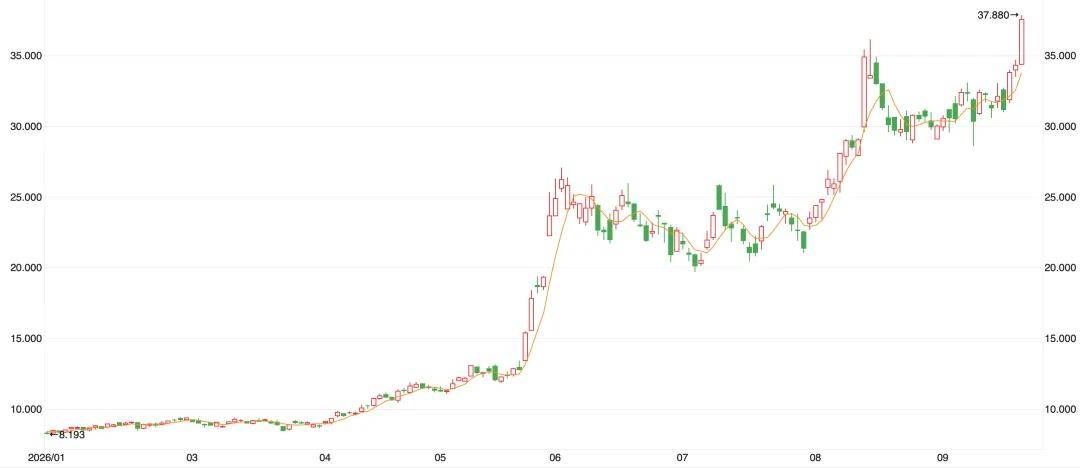
▲Lenovo Group’s stock price trend chart since 2026
There was also a wave of excitement among investors, with voices saying “It’s too fierce” one after another. One investor even excitedly predicted: “Next year will be the year of AI infrastructure super-node, and we will catch up with Dell!”
01. CFO’s message: Lenovo is underestimated by the market
In terms of news, Morgan Stanley recently released a research report stating that Lenovo’s ISG revenue will continue to accelerate and maintained an “overweight” rating for it. It pointed out that Lenovo’s general-purpose servers and AI servers are in strong demand, and cloud customers account for about 70% of revenue. If the demand for AI is faster than expected, the company’s revenue growth will be stronger in the future.
In addition, at the AI Investment Summit on September 16, Lenovo Group Senior Vice President and CFO Zheng Xiaoming publicly stated that Lenovo Group’s value was “seriously underestimated.” He believes that Lenovo Group’s current valuation is only about one-seventh of Dell’s, but the revenue and net profit of the two companies are not 7 times different.
Dell was once a company famous around the world for “selling computers,” but since 2000, enterprise servers and storage have become its new growth poles. Now, it has completed an astonishing transformation: in the fourth quarter of fiscal year 2026 (November 2025 to January 2026), AI optimization server revenue reached US$9 billion in a single quarter. The company also predicts that its AI server business will reach US$50 billion in fiscal 2027, becoming the largest source of revenue. Dell’s stock price has also been on a strong trend this year, with a cumulative increase of more than 370% and a total market value of US$374.1 billion.
When Lenovo’s management takes the initiative to compare Dell with Dell, it also shows that Lenovo hopes that the capital market will re-understand itself – it is transforming into a global AI infrastructure leader.
Lenovo is confident in thinking this way: according to IDC data, in the second quarter of 2026, Lenovo’s x86 server shipments surpassed Dell for the first time, ranking first in the world, with a market share of 7.4%. 13 years ago, Lenovo reached the top of the global PC market for the first time, and now it has once again occupied this position in the server market.
Zheng Xiaoming also said that compared with Dell, Lenovo has its own advantages in technology, channels and supply chain, and “should have the opportunity to achieve its profit level.” He also emphasized that the growth opportunities Lenovo is currently seeing are supported by real orders, and there are still a large number of customer projects under negotiation.
Judging from the overall market situation, with the rapid development of AI technology, global technology giants have launched a wave of AI infrastructure construction, which is still in a period of upsurge so far. McKinsey has predicted that global data center-related investment may reach approximately US$7 trillion by 2030.
Lenovo’s chips are not just servers. There is another huge industry opportunity that the market is optimistic about in the future, and that is the super node, which is gradually becoming an important form of AI infrastructure. Chen Zhenkuan, vice president of Lenovo Group and general manager of China Infrastructure Business Group, said, “Today, a pure server manufacturer cannot build a super node.” Enterprises are paying more and more attention to the implementation capabilities of hardware and service providers. What server manufacturers deliver may no longer be limited to servers or cabinets, but a complete set of delivery solutions covering computing power, storage, liquid cooling, network, operation and maintenance, etc.
This is precisely Lenovo’s advantage: Lenovo does not have core chips or large models, but its business covers terminals, hardware and software. It has a mature supply chain, strong local delivery capabilities, a global manufacturing system and government and enterprise customer channels, and can quickly transform it into implementable and deployable delivery solutions.
02. Lenovo AI server, US$54 billion in backlog orders in hand
Is Lenovo underestimated? From a performance perspective, Lenovo Group Chairman and CEO Yang Yuanqing has been betting on AI since 2017, splitting the group’s business into three major segments: IDG smart device business group, ISG infrastructure business group, and SSG solution service business group. Among them, the server-based ISG business has grown significantly in fiscal year 2026 and achieved profitability.
Lenovo Group’s financial report for the first quarter of fiscal year 2027 shows that as of June 30 this year, the company achieved revenue of US$26.943 billion, a year-on-year increase of 43%; the adjusted net profit attributable to the parent company was US$1.075 billion, a year-on-year increase of 176%, and the adjusted net profit rate reached 4.0%.
In terms of business, the ISG business performed well, achieving revenue of US$8.510 billion, a year-on-year increase of 98.4%; operating profit was US$777 million, and the operating profit margin jumped from -2% in the same period last year to 9.1%.
At the same time, AI-related business revenue increased by 60% year-on-year in the quarter, accounting for 35% of the group’s total revenue; AI server backlog orders reached 54 billion US dollars, a month-on-month increase of 157%. This has also become the main reason why the market has high expectations for Lenovo.
Lenovo does not want to be seen by the outside world as simply “stepping on the trend.” At the performance meeting after the end of the first quarter of the new fiscal year, Yang Yuanqing further concluded that the growth of the group’s performance in recent years is attributed to Lenovo’s long-term investment. For example, the server business originated from IBM’s x86 server hardware business acquired by Lenovo in 2014, but more than ten years later, it became the ballast for Lenovo to gain a foothold in the global AI wave.
But Lenovo still has to answer a question: Is it already an AI-driven company? Can the huge demand brought about by AI infrastructure construction be converted into company profits? At the first fiscal quarter performance meeting, Yang Yuanqing admitted frankly that the current proportion of AI in ISG’s business is still small, and the real main force of growth in the last quarter is still the traditional computing business. The demand for AI in the external market is indeed very strong, as evidenced by the AI server order data. “But the key is whether we can effectively transform these demands into actual delivery through our supply chain capabilities.”
Another major focus of the market is Lenovo’s valuation. Yang Yuanqing said at the performance meeting that the outside world should pay more attention to Lenovo’s long-term strategic direction, operational capabilities, execution and innovation capabilities. But Lenovo also said that it is expected to achieve its sales revenue target of US$100 billion within this year.
Related Reading
- Customized screens for domestic mobile phones have begun to roll back to Samsung. . .2026-09-19
- Why are there so many Chaoshan bosses in China’s technology industry?2026-09-19
- The humanoid robot is still dancing, and the chip seller has already counted the money.2026-09-19
- Beanbao mobile phone stepped on the brakes first2026-09-19
- AI isn’t coming to destroy humanity, but experts say the real security threats are here2026-09-18