Produced by Dharma Finance
News of limited access to computing power has fermented, and the stock price of Hong Kong AI large model company Zhipu (2513.HK) has further plummeted.
On November 17, Zhipu’s stock price opened low and closed down 5.26% to HK$335 per share. The company’s total market value also fell to HK$163.5 billion. During the session, the company’s stock price once fell to HK$328 per share, a new low since March this year.
Behind the bottom of Zhipu’s stock price, the threshold for domestic AI companies to obtain computing power has risen again. On November 16, the U.S. Department of Commerce’s Bureau of Industry and Security issued an interim final rule (IFR) aimed at restricting data centers in third-party countries from circumventing existing access restrictions through remote computing power arrangements.
The market is worried that this rule may have an impact on domestic AI companies renting overseas computing power, which will in turn affect the company’s large model training and business development.
This decline also continues Zhipu’s previous downward trend. As a well-known large-scale AI model company in China, Zhipu was listed in Hong Kong in January this year. After its listing, Zhipu’s stock price rose all the way, reaching a maximum of HK$2,980 per share in June this year. This price increased more than 25 times from the issue price, and its total market value hit HK$1.33 trillion.
Since then, Zhipu’s stock price has begun to correct. Compared with the high point in June, the company’s latest stock price has fallen by nearly 90%, and its total market value has also dropped by nearly HK$1.1 trillion.
As Zhipu’s stock price has declined, the values of the company’s two founders, Liu Debing and Tang Jie, have also shrunk. Currently, Liu Debing directly holds shares through Beijing Lianpai and holds a total of approximately 1.54% of Zhipu shares, while Tang Jie directly holds 6.02% of Zhipu shares. When the stock price reached its peak in June this year, the value of Liu Debing and Tang Jie’s shareholdings were HK$20 billion and HK$80 billion respectively. Today, the value of Liu Debing’s stock holdings has dropped to HK$2.3 billion, and the value of Tang Jie’s stock holdings has also dropped to HK$9 billion.
In recent months, the share price of MiniMax (0100.HK), another large model company in the Hong Kong stock market, has also declined. On November 17, MiniMax’s share price fell 7.13% to HK$116 per share, with a total market value of approximately HK$40.8 billion. Since hitting a high of HK$1,330 per share in March this year, the company’s stock price has continued to decline, with the latest stock price falling by more than 90% from its high point. In October this year, MiniMax’s stock price broke, and now its stock price has fallen 30% from the issue price.
Overall reassessment of the AI track
Behind the sharp declines of Zhipu and MiniMax for several months, the AI track is undergoing a re-evaluation.
In the first half of this year, the AI track was at the forefront. As the only two large AI model companies in the Hong Kong stock market, Zhipu and MiniMax were popular in the market, and their stock prices rose sharply as a result. But this enthusiasm has significantly deviated from the fundamentals of the track. When MiniMax’s stock price reached its peak in March this year, the company’s price-to-sales ratio (TTM) exceeded 600 times. When Zhipu’s stock price reached its peak in June, its price-to-sales ratio (TTM) even exceeded 1,000 times.
Since then, the popularity of the track has cooled down significantly, and the stock prices of AI industry chain companies have begun to correct. The commercialization progress of Zhipu and MiniMax has begun to become the focus of market attention. The two companies lived up to expectations and delivered high-growth financial reports during the mid-term reporting season.
In the first half of this year, MiniMax’s business structure has undergone tremendous changes, with B-end business replacing C-end products as the main source of income. During the same period, the company’s total revenue increased by 283.1% year-on-year to US$117 million (approximately RMB 778 million), and its adjusted net loss expanded by 52.7% year-on-year to US$293 million (approximately RMB 1.96 billion).
Zhipu’s performance has also achieved substantial growth. In the first half of the year, the company’s revenue was 954 million yuan, a year-on-year increase of 399.74%; its adjusted net loss was 1.964 billion yuan, a year-on-year increase of 12.11%.
However, while business structure adjustments have driven high performance growth, the gross profit margins of both companies have declined, which has also become one of the factors affecting the market’s concerns about their competitiveness.
More importantly, as market competition intensifies, whether domestic large model leaders can continue to maintain rapid growth has also been questioned.
A recent research report released by HSBC shows that in the face of price wars launched by international giants such as Anthropic and OpenAI, as well as high R&D expenditures and other factors, the development cycle of Zhipu’s new generation of large models will be lengthened, and stock price fluctuations will continue in the short term.
Therefore, HSBC lowered its mid-term profit forecast for Zhipu, adjusting its annualized recurring revenue (ARR) and total revenue forecasts for fiscal year 2027 to 2028 to 7% to 27%, while also significantly lowering its adjusted operating profit margin forecast by 15 to 19 percentage points. It will also postpone the company’s adjusted break-even point by two years from 2027 to 2029.
HSBC also significantly lowered the target price of Zhipu, a 64% reduction from HK$1,375 to HK$500.
In addition to the above influencing factors, the capabilities of flagship large models are also a key factor affecting the market’s perception of AI companies.
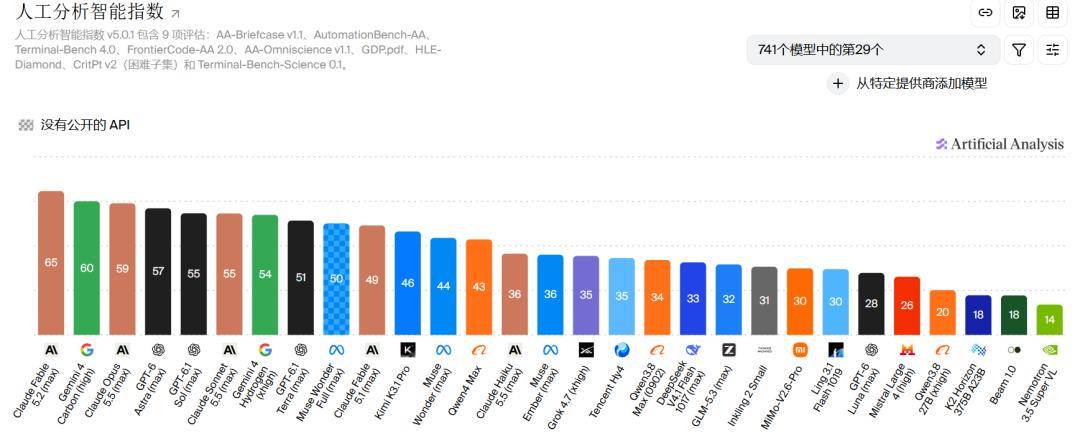
Since the second half of this year, the launch of flagship large models of domestic AI companies has slowed down. In April, June and August this year, Zhipu launched the GLM-5.1/5.2/5.3 three-generation flagship model. In March and June this year, MiniMax also launched the M2.7 and M3 two-generation flagship models.
But so far, the latest generation flagship models of the two companies are still under development. In the Artificial Analysis list, Zhipu’s flagship model GLM-5.3 (MAX) has fallen to 20th place, while the MiniMax flagship model has fallen off the list.
Related Reading
- Anthropic engineer’s warning about Claude Code explains why tech outages could get much worse2026-11-22
- Original Unexpectedly, just one day after the APEC summit, China became famous around the world because of its three “specialties”2026-11-21
- Original Anthropic goes public and creates wealth: 96% of employees became millionaires overnight2026-11-20
- The beauties and handsome guys from UB.com want to enter your home and wait until they arrive.2026-11-20
- Original: Tencent’s shareholders will suffer again2026-11-20