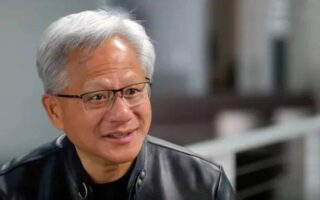
Huang Renxun, who single-handedly created the global AI chip empire, also stumbled in the “Tender Country”.
On November 8, local time, Nvidia founder and CEO Huang Jensen publicly admitted extramarital affairs on the company’s official website, saying, “I was unfaithful to my wife. My actions hurt her and our children. There is no excuse for what I did.” He apologized to his wife, children, employees, board of directors, and shareholders. Almost at the same time, Nvidia’s board of directors announced the launch of an independent investigation.
The turmoil quickly spread from private life to the capital market. On November 9, local time, Nvidia’s stock price fell by more than 5% in pre-market trading on U.S. stocks. According to Nvidia’s latest financial report, Huang Renxun’s current shareholding ratio is only 3.58%. When personal “love news” rises to the company level, can Huang Renxun still maintain his position as Nvidia CEO?
Huang Renxun data map/Visual China
Is the position of CEO still stable?
At the end of October this year, media reported that Huang Renxun had an intimate relationship with a business woman named Alice Huang. The woman previously worked for Singapore-based cloud computing company Megaspeed, which is a chip customer of Nvidia.
As Huang Renxun personally admitted the extramarital affair and apologized, the controversy quickly aroused public opinion. People are not only paying attention to the private love life of this technology tycoon, but are also curious about whether Nvidia’s future direction will be affected.
Huang Renxun has served as CEO since the company was founded and has been at the helm of Nvidia for 33 years. Although Huang Renxun is the “soul figure” of the company, Nvidia’s own equity is quite dispersed. The 2026 financial report shows that as of March 23, Huang Renxun actually held approximately 871 million shares of Nvidia, accounting for 3.58% of the company’s common shares. This part of the shares mainly involves arrangements such as trusts in which he and his wife jointly serve as trustees. It also includes foundation shares in which the two can jointly influence voting and investment decisions but do not enjoy financial benefits.
Now that there is a “fire in the backyard,” NVIDIA’s board of directors announced the launch of an independent investigation, which will be overseen by an independent board committee and hire outside lawyers to review relevant information. The board of directors emphasized that there is currently no reason to believe that U.S. national security or Nvidia’s trade secrets have been compromised, and expressed continued trust in Huang and his leadership team. Huang Renxun also promised to fully cooperate with the investigation. On November 8, Nvidia’s board of directors also stated that it “has confidence in Huang Renxun and his leadership team” and stated that Huang Renxun will continue to serve as CEO during the investigation.
Despite this, judging from Nvidia’s ownership structure, Huang Renxun does not have absolute say. If the investigation results are unfavorable, will Huang Renxun lose his position as CEO?
Lawyer Yang Zhaoquan, a partner at Weinuo Law Firm, analyzed that NVIDIA is registered in Delaware. In terms of the authority of the board of directors, the board of directors has the right to directly remove the CEO without a vote at the shareholders’ meeting. But removing a director requires a shareholder vote. Huang Renxun only holds about 3.58% of the shares, there is no dual-class shareholding structure, and there is no equity protection barrier. It is indeed easier to be challenged from the shareholding level.
Hao Junbo, chief lawyer of Beijing Haohan Law Firm, told China News Weekly that whether a company executive can be removed from his position, and under what circumstances, mainly depends on the specific provisions of the company’s articles of association. “The company’s articles of association are similar to the company’s ‘constitution’, stipulating major matters such as the appointment and removal of senior executives. Not all of these matters are mandated by law. The company can make agreements on its own in accordance with the principle of autonomy of will as long as it does not violate the law.”
Hao Junbo further pointed out that there are differences in the articles of association of different companies. The founders of some companies may set up a rights protection mechanism that is more beneficial to themselves through the articles of association, making it difficult for them to be dismissed from their positions; while the situation of other companies may be different. “A company’s internal management system has a certain degree of autonomy, similar to a contract agreement between civil entities. As long as there are no obvious violations of the relevant provisions, the law will generally not interfere too much, and the specifics still need to be judged in conjunction with the company’s articles of association.”
According to the company’s public documents, Nvidia’s board of directors will expand to 11 people in July 2026. The company has previously disclosed that, except for Huang Renxun, the other directors are independent directors. Nvidia does not have a chairman position in the traditional sense. Instead, it sets up an independent lead director, who is responsible for coordinating the supervision of independent directors, communicating with management and major governance matters. NVIDIA’s articles of association stipulate that the board of directors can remove senior managers with or without reason through approval by more than half of the current directors.
In other words, from a institutional perspective, even if Huang Renxun is the founder, the board of directors still has the right to remove him as CEO.
However, Yang Zhaoquan told China News Weekly that the responsibility of independent directors is to safeguard the interests of the company and all shareholders, rather than simply making moral judgments. Even if the independent directors make up the majority, whether to remove them or not will still depend on the conclusion of the independent investigation: whether there is any evidence of interest transfer, leakage, violation of regulations, etc. that damages the interests of the company. Huang Renxun is Nvidia’s core asset and has strong leadership and appeal. If Huang Renxun has not committed any substantive illegal behavior or seriously harmed the company’s interests, a hasty removal by the board of directors will impact the market value and raise questions from institutional shareholders. Therefore, business is usually not easy to take action.
How expensive is an extramarital affair for an entrepreneur?
“Unless a suspected illegal act is indeed suspected, personal ethics have no direct connection with company operations. Personal emotional infidelity is a moral issue, but if it involves the division of property in divorce, it may have a certain impact on equity stability, but personal ethics does not affect its operation or business capabilities, and has nothing to do with its trust in customers or investors. Having a personal relationship with customers may affect its business judgment, but it does not mean that it will inevitably lead to negative results. In addition, whether there are other deeper conflicts of interest behind the incident involving Huang Renxun requires further investigation.” Shen Meng, director of Chanson Capital, believes.
Jen-Hsun Huang is not the first technology entrepreneur to find himself embroiled in controversy over personal relationships. In the past few years, from Microsoft to Intel and McDonald’s to Chinese A-share listed companies, the personal relationships of corporate executives have repeatedly become the focus of the capital market.
The consequences of a boss’s cheating are also different. Bill Gates, who also founded a global technology giant like Jen-Hsun Huang, is a typical case.
In May 2021, shortly after Bill Gates and Melinda announced their divorce, the Microsoft board of directors’ previous investigation into Gates’ relationship with female employees was disclosed by the media. A spokesman for Bill Gates later admitted that Bill Gates had an extramarital affair with a Microsoft employee about 20 years ago, but said that the relationship had ended. It is worth noting that Bill Gates announced his withdrawal from the Microsoft board of directors as early as March 2020. At the time, he said he hoped to devote more energy to charity.
A-shares also had an attention-grabbing “love incident” not long ago. In June 2026, Chen Tao, chairman and actual controller of A-share PCB leader Shenghong Technology, was involved in an emotional dispute known as “elevator door”. As related videos and online revelations fermented, Shenghong Technology’s stock price fell 7.11% on June 8, and its market value shrank by approximately 23.7 billion yuan in a single day. Faced with the pressure of public opinion, Shenghong Technology responded that the relevant disputes were personal matters and had nothing to do with the company’s production, operation and governance, and the company had reported the matter to the police. Chen Tao was not announced to be removed from his position as chairman.
Two months later, Shenghong Technology announced that Chen Tao had transferred part of the equity of two upper-level shareholding platforms to his wife Liu Chunlan, involving indirect interests in listed companies worth approximately 27 billion yuan. However, both parties signed a concerted action agreement at the same time, Liu Chunlan exercised relevant voting rights in accordance with Chen Tao’s opinions, and the actual controller of the company did not change.
But some people have lost their CEO positions because of this. For example, in June 2018, Intel’s then CEO Krzanich eventually resigned as CEO and director because he had a close relationship with the company’s employees and violated the company’s internal regulations for managers. At that time, he had been in charge of Intel for five years.
In November 2019, McDonald’s then-CEO Easterbrook was dismissed by the board of directors for having an intimate relationship with an employee that violated company regulations. McDonald’s later found that he had concealed inappropriate relationships with other employees and took him to court. In the end, McDonald’s recovered cash and equity awards worth approximately $105 million at the time.
As for Jen-Hsun Huang, Internet analyst Ding Daoshi pointed out to China News Weekly that unlike a purely personal emotional dispute, Huang Jen-Hsun’s incident has also been linked to potential related transactions, insider trading and U.S. political struggles.
Ding Daoshi believes that the impact of this incident on Huang Renxun and Nvidia depends critically on how the incident is ultimately characterized. If it only involves private life matters, the impact may be relatively limited. However, if the investigation involves insider trading, the nature of the incident will fundamentally change. Huang may face pressure to resign, and he does not rule out the possibility of being dismissed from his position due to political pressure or corporate governance mechanisms. After all, NVIDIA is a listed public company, not Huang Renxun’s personal company. Even as the founder and core manager, he cannot completely decide whether to stay or leave.
In Ding Daoshi’s view, the more entrepreneurs are at the core of key global industries, the more they need to strictly restrain their personal behavior. This constraint involves not only personal relationships, but also interactions with other stakeholders. In particular, the high-end chip industry in which NVIDIA operates has been deeply involved in global technology competition. The transactions of related products are not ordinary commodity sales, but are strictly restricted by the laws, regulations and export control policies of various countries. In such a sensitive industry environment, entrepreneurs should carefully handle the boundaries between personal relationships and commercial interests to avoid potential risks to the company caused by personal behaviors.
Author: Yu Xin
Related Reading
- Nvidia live updates: Jensen Huang ousted, CFO Colette Kress to serve as interim CEO2026-11-13
- Are mangoes not afraid of red fruits?2026-11-12
- Original: After Huang Renxun, who is most likely to take over Nvidia?2026-11-12
- Samsung’s roll-screen mobile phone is exposed, creating a new form ahead of Huawei and Apple, and folding screens are expected to be eliminated2026-11-12
- Musk’s favorite car is going to be discontinued.2026-11-12